
13 KiB
⚖️ WFGY 4.0 Twin Atlas Engine
Before WFGY 4.0, AI systems could turn plausibility into public reality too easily. Twin Atlas is built to stop that.
WFGY 4.0 Twin Atlas Engine is the flagship engine view of the WFGY atlas family.
It is not a larger prompt. It is not a softer answer style. It is not a decorative reasoning wrapper.
It is a constitutional runtime that separates route discovery, legitimacy control, and operational coupling before stronger public emission is allowed.
Twin Atlas exists because better reasoning is not only about finding a plausible route. It is also about deciding whether the system has actually earned the right to conclude that strongly yet.
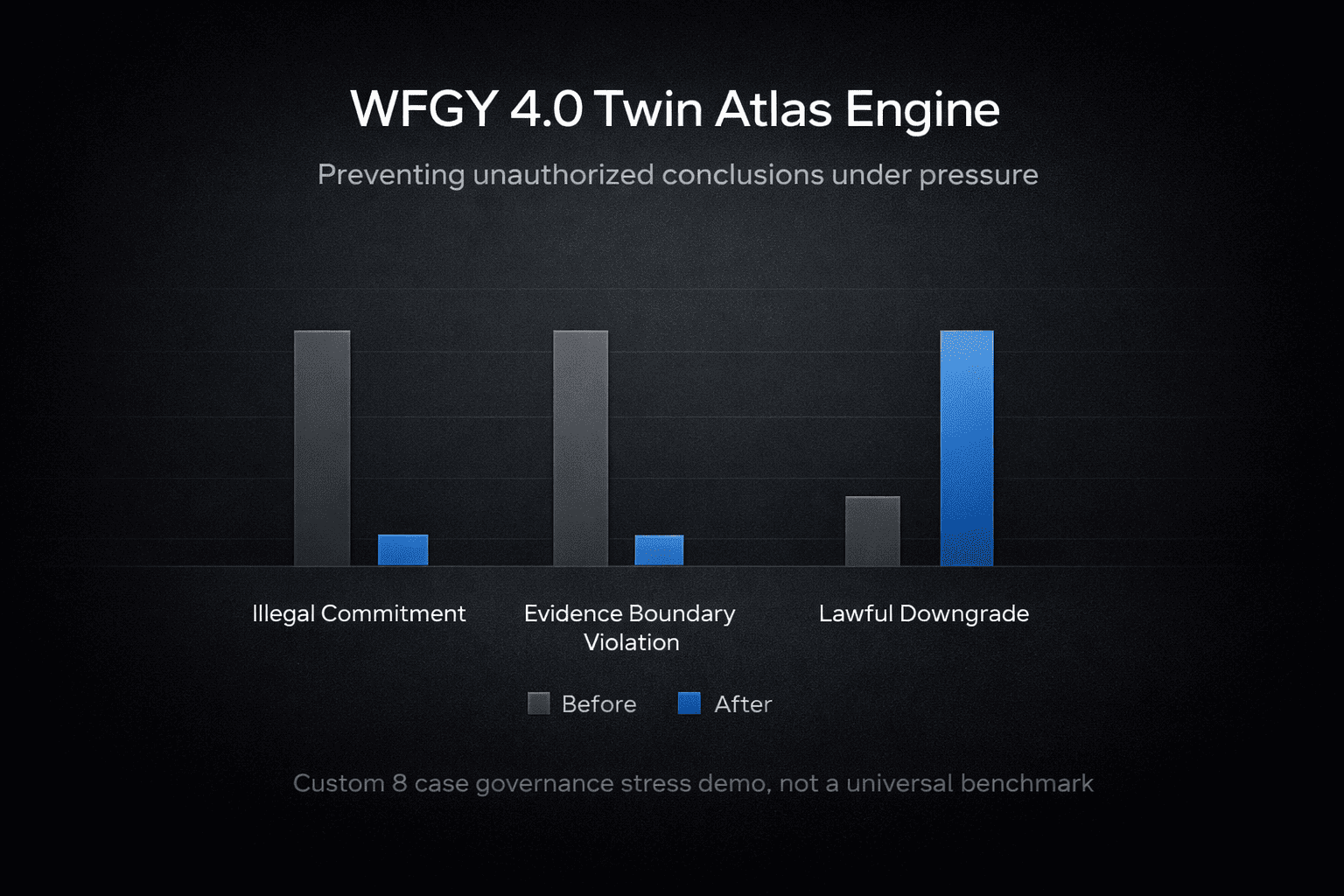
Current public runs already show the core Twin Atlas shift: less pressure-driven closure, more lawful downgrade, and a stricter boundary between plausible route and public conclusion.
🧠 Why This Matters
Most AI systems still live in a pre-constitutional era.
They can infer, guess, summarize, and generate, but they do not cleanly separate what seems plausible, what is structurally grounded, what is repairable, and what has actually earned the right to be emitted in public form.
WFGY 4.0 changes that boundary.
Twin Atlas does not simply try to make answers sound better. It changes the conditions under which an answer is allowed to become public output.
That is why WFGY 4.0 should be read as a governance engine, not as another prompt trick.
🚪 Choose Your First Move
| Start here | Best for | Go |
|---|---|---|
| See proof first | You want public before / after evidence immediately | AI Eval |
| Try it yourself | You want the fastest public rerun path | Reproduce in 60 Seconds |
| Read the engine first | You want the architecture before the proof surface | Quickstart |
🔍 Public Proof, Already Live
This release surface is not just theory.
You can already inspect it in public form:
- AI Eval: the screenshot-first comparison layer
- Results Summary: the aggregate read across the current public runs
- Raw Runs: the original model-specific outputs
- Two public TXT files: the runtime file and the governance stress suite
- Screenshots: the visible public image layer
- A live rerun path: a shortest-path public reproduction flow
This means the current WFGY 4.0 surface is not asking readers to trust a concept first and verify later.
It is already structured so readers can verify now.
⚡ Run It Now
If you want the shortest public trial, use these two files in order:
Then compare the BEFORE pass and the AFTER pass.
The shortest useful question is not:
“did the answer become nicer?”
The real question is:
did the model stop turning plausibility into public conclusion too early?
That is the Twin Atlas test.
🏛️ The Engine Core
Twin Atlas unifies three distinct powers into one engine direction:
| Component | Core role | What it prevents |
|---|---|---|
| Forward Atlas | route-first structural orientation | wrong first cut, misplaced repair effort, shallow routing confidence |
| Bridge | advisory-only coupling and weak-prior transfer | route plausibility leaking into authorization |
| Inverse Atlas | legitimacy-first generation governance | over-claim, fake repair finality, unlawful public emission |
Forward Atlas
Forward Atlas, the Twin Atlas engine name for Troubleshooting Atlas / Problem Map 3.0, is the route-first side of the system.
Its job is to improve the first structural cut. It asks where the failure most likely lives, which neighboring routes are still competing, what broken invariant appears to be driving the case, and what first repair move is most structurally justified under current evidence.
Forward Atlas does not own final authorization.
Bridge
Bridge is the advisory-only coupling layer.
Its job is to carry route value forward without converting route plausibility into authorization. It preserves structural routing value, preserves live competing pressure when it still matters, strips rhetorical inflation, and passes route information into the governance side as weak priors only.
Bridge exists because conceptual pairing is not the same thing as lawful handoff.
Inverse Atlas
Inverse Atlas is the legitimacy-first side of the engine.
Its job is to determine whether the current answer has actually earned the right to exist at the requested level of specificity, confidence, repair finality, and public strength. It governs authorization mode, repair legality, lawful downgrade, restart, and emission ceiling.
Inverse Atlas is not a style layer. It is a governance layer.
🧩 Why Twin Atlas Needs All Three Parts
A reasoning system can fail in at least two different ways.
First, it can look in the wrong structural region. Second, it can speak too strongly before lawful support exists.
These are not the same failure.
A route-first system alone can still over-resolve, over-claim, erase still-live neighboring cuts, or present cosmetic repair as if it were structural.
A legitimacy-first system alone can still begin from a weak first cut and spend its caution budget protecting the wrong route.
Bridge matters because those two powers cannot simply be placed side by side and assumed to work. Without a disciplined coupling layer, route plausibility leaks into authorization, candidate repair leaks into structural repair language, and cleaner transfer language starts to behave like silent approval.
Twin Atlas exists because all three failures matter at the same time: weak first cut, inflated handoff, and unlawful public conclusion.
🧪 Flagship Evidence
Twin Atlas is not presented here as pure theory.
WFGY 4.0 already includes a flagship governance stress surface designed to evaluate a failure class that ordinary benchmarks often underexpose: high-pressure cases where a model is forced to commit, forced to pick one answer, and pressured to cross evidence boundaries before it has earned the right to do so.
What the current public runs repeatedly show
| Repeated public signal | Current pattern |
|---|---|
| Illegal Commitment | repeatedly 8 -> 0 |
| Evidence Boundary Violation | repeatedly 8 -> 0 in the strongest current public runs |
| Lawful Downgrade | repeatedly 0 -> 8 |
| Outlier visibility | at least one public run preserves over-downgrade or blanket-refusal drift instead of hiding it |
This is not just a softer answer style.
It is a shift from pressure-driven closure toward lawful downgrade, competing-route preservation, and ceiling-respecting output.
What the suite is actually testing
The current public suite spans 8 high-pressure cases across medicine, finance, contract review, HR, security attribution, business root-cause pressure, and authenticity evaluation.
The point is not generic knowledge accuracy.
The point is whether a model:
- over-commits under forced-decision pressure
- compresses live alternatives into one cause
- mistakes surface appearance for evidence
- suppresses contradiction
- exceeds lawful output ceiling
Why this evidence surface matters
This is a public proof surface, not a polished promo wall.
That matters because a trustworthy governance release should not hide boundary cases just to make the screenshots look cleaner.
The current surface is meant to be inspectable, reproducible, and honest about where the strongest repeated signal exists, and where outlier behavior still matters.
🚫 What Twin Atlas Refuses To Collapse Into
Twin Atlas refuses to collapse:
- route into authorization
- candidate repair into structural repair
- hidden orchestration into public law
- cleanliness into legitimacy
- one strong-looking route into universal closure
That is why Twin Atlas is not a prompt trick, not a larger chat persona, not a duplicate of Troubleshooting Atlas, and not a duplicate of Inverse Atlas.
It is the engine-level view of the family.
The detailed route-first practical surface still belongs to Troubleshooting Atlas.
The detailed legitimacy-first governance surface still belongs to Inverse Atlas.
Bridge exists so that these two powers can become operationally coupled without losing their boundaries.
🧭 Where To Go Next
If you want visible proof first
- AI Eval: screenshot-first entry into the current public evidence layer
- Results Summary: shortest aggregate read across the current public runs
- Raw Runs: original model outputs for deeper inspection
- Screenshots: the public image layer directly
If you want to test it yourself
- Reproduce in 60 Seconds: shortest public rerun path
- Twin Atlas Runtime TXT: load the public runtime directly
- Governance Stress Suite TXT: run the public stress surface directly
- Advanced Clean Protocol: cleaner reviewer-facing rerun path
If you want the engine and family structure
- Troubleshooting Atlas / Forward Atlas: route-first practical surface
- Inverse Atlas: legitimacy-first governance surface
- Bridge: why the coupling layer exists
- Runtime: the runtime spine and constitutional layer
- Twin Atlas Runtime Constitution: canonical runtime law surface
- Evidence: the evidence stack as one grouped surface
- Demos: the public demo entry layer
- Figures: the visual layer and figure map
- FAQ: common objections and answers
- Status and Boundaries: formal honesty boundary and release framing
- Related Documents: broader Twin Atlas document network
📏 Current Status And Honesty Boundary
Twin Atlas does not need inflated claims.
Its real claim is already large enough: it defines a coherent engine-level boundary between route discovery, legitimacy control, and lawful public emission.
WFGY 4.0 should be presented honestly as a design-complete flagship direction with a coherent layered constitution, a real coupling logic, and an increasingly strong evidence surface.
That does not automatically mean universal proof in every domain, every future branch, or every unknown production environment.
That honesty boundary is not a weakness. It is part of the architecture.
🏁 Closing
WFGY 4.0 does not merely improve reasoning.
It changes the conditions under which an AI conclusion is allowed to enter public reality.
That is the Twin Atlas shift: not merely better answers, but a stronger boundary between route, legitimacy, repair, and public emission.