
16 KiB
🧭 Not sure where to start ? Open the WFGY Engine Compass
WFGY System Map · Quick navigation
Problem Maps: PM1 taxonomy → PM2 debug protocol → PM3 troubleshooting atlas · built on the WFGY engine series
| Layer | Page | What it’s for |
|---|---|---|
| ⭐ Proof | WFGY Recognition Map | External citations, integrations, and ecosystem proof — 🔴 YOU ARE HERE 🔴 |
| ⚙️ Engine | WFGY 1.0 | Original PDF tension engine and early logic sketch |
| ⚙️ Engine | WFGY 2.0 | Production tension kernel for RAG and agent systems |
| ⚙️ Engine | WFGY 3.0 | TXT-based Singularity tension engine (131 S-class set) |
| 🗺️ Map | Problem Map 1.0 | Flagship 16-problem RAG failure taxonomy and fix map |
| 🗺️ Map | Problem Map 2.0 | Global Debug Card for RAG and agent pipeline diagnosis |
| 🗺️ Map | Problem Map 3.0 | Global AI troubleshooting atlas and failure pattern map |
| 🧰 App | TXT OS | .txt semantic OS with 60-second bootstrap |
| 🧰 App | Blah Blah Blah | Abstract and paradox Q&A built on TXT OS |
| 🧰 App | Blur Blur Blur | Text-to-image generation with semantic control |
| 🏡 Onboarding | Starter Village | Guided entry point for new users |
⚖️ Inverse Atlas · Before AI Answers, It Must Earn the Right
Inverse Atlas is a pre generative governance methodology for AI output.
It does not begin from the assumption that every answer should be emitted first and corrected later.
It begins from a stricter question:
Has this system earned the right to resolve strongly at all?
Most AI failures do not start when the final sentence is technically wrong.
They start earlier, when the system begins to answer with more force, closure, or confidence than the current evidence can legitimately support.
Inverse Atlas pushes the governance point forward.
It treats generation as something that must be constituted, aligned, reviewed, authorized, and bounded before public emission.
This repository presents the first public MVP surface of that methodology.
Today, you can already inspect it, test it, and experience its logic through a prompt based runtime layer.
That runtime is the current carrier, not the full endpoint.
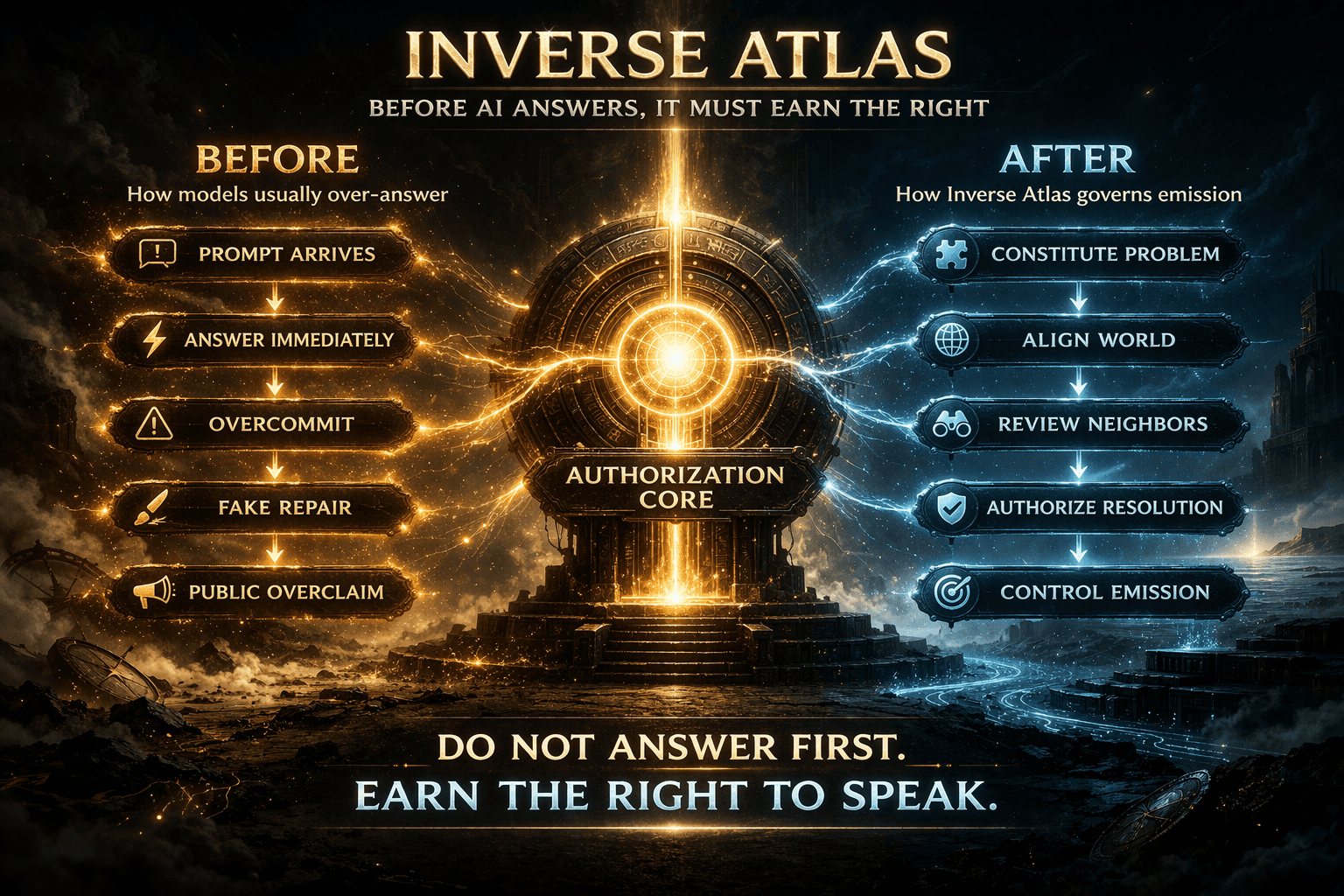
8 public killer cases · 7 legality dimensions · 4 lawful output states
🧭 A Different Order of Operations
Conventional AI flow tends to answer first, soften later, and patch only after overclaim has already been emitted.
Inverse Atlas reverses that order.
It asks the system to constitute the problem first, align the world first, test whether the route is stable, and authorize only what can be lawfully said under current support.
The goal is not decorative caution.
The goal is lawful resolution under real uncertainty.

🧱 Why This Is Not Just Another Prompt
Inverse Atlas is not a style tweak, a softer wrapper, or a stricter wording template.
Its core move is deeper than that.
It changes the object of governance.
Instead of focusing only on whether an answer sounds good, looks safe, or appears useful after it is produced, Inverse Atlas asks whether that answer has earned the right to be produced with that level of force in the first place.
That is the shift.
This is not answer polishing.
This is pre emission legitimacy control.
In the current MVP, that logic is exposed through a prompt based runtime so people can inspect and reproduce the behavior today.
But the methodology is larger than the current surface.
The runtime is the first public carrier of the method.
It is not the full boundary of the method itself.
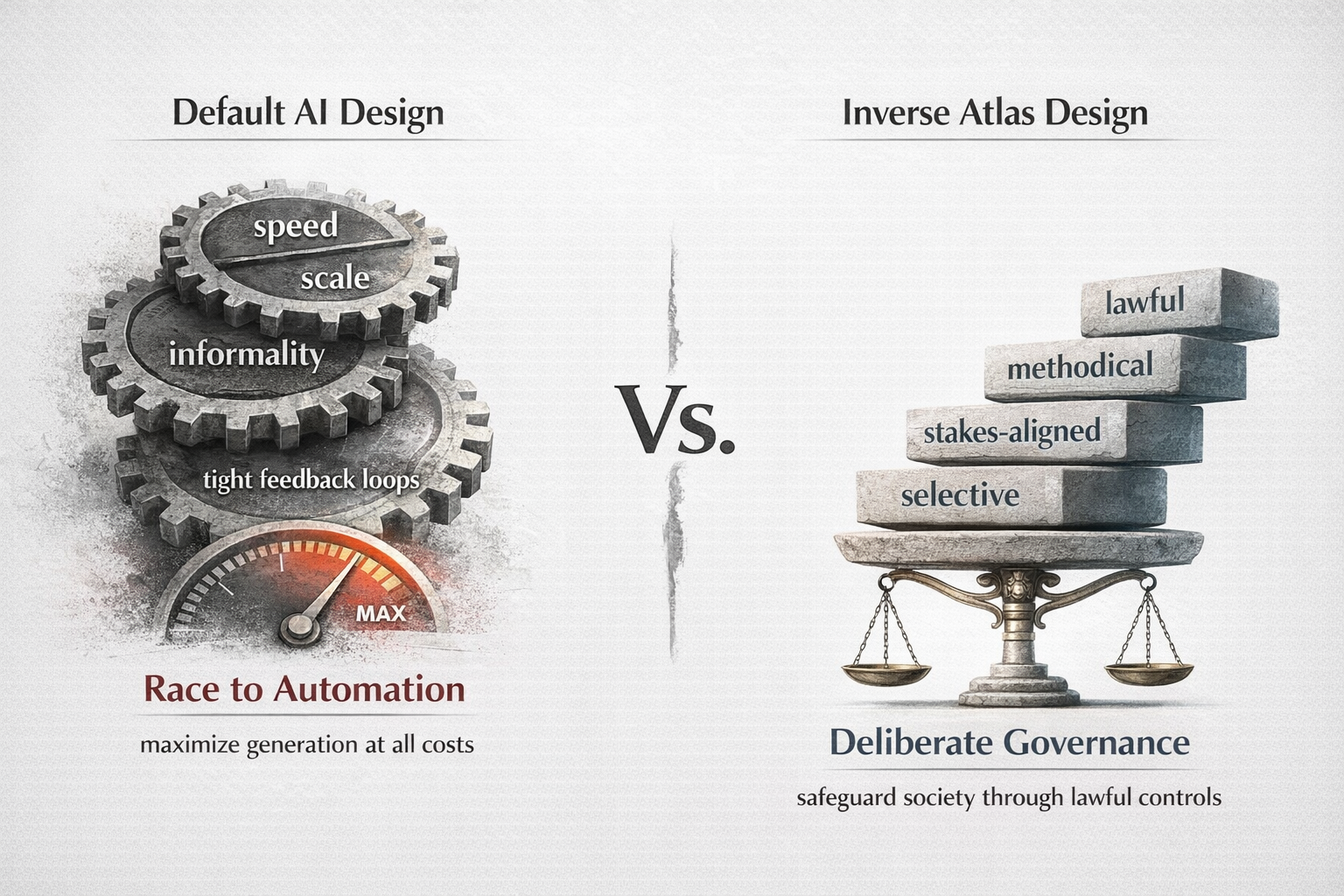
🗺️ What Inverse Atlas Governs Before an Answer Appears
Inverse Atlas does not treat output as a single yes or no event.
It governs the path that leads to emission.
Before a strong resolution is allowed, the system must pass through a sequence of pre generative checks.
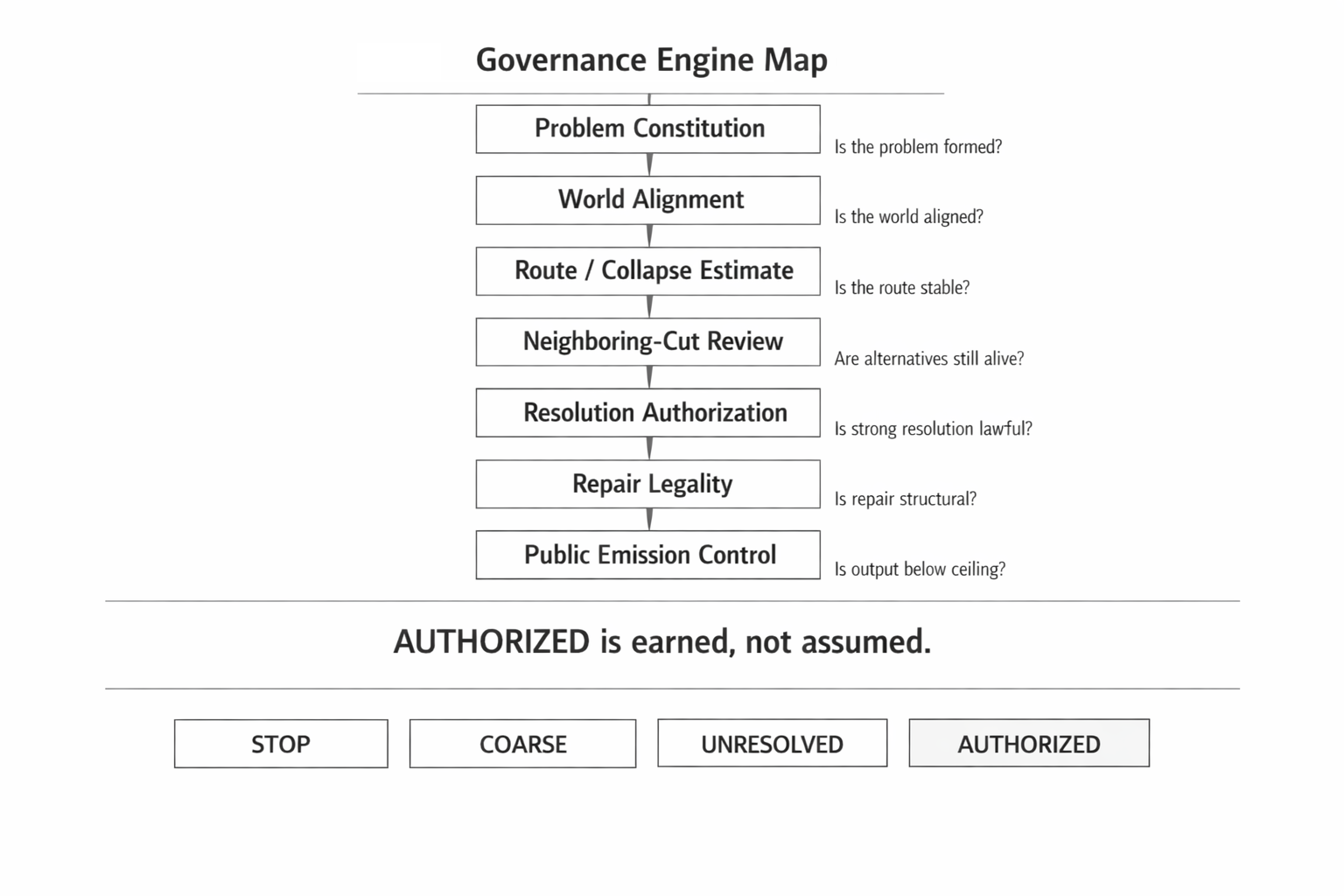
These checks test whether the problem has been properly constituted, whether the world model is aligned enough, whether the route is stable enough to continue, whether neighboring cuts have been separated, whether repair is actually lawful, and whether the public claim stays within the current emission ceiling.
This produces a controlled output state rather than a reflexive answer stream.
In Inverse Atlas, AUTHORIZED is earned, not assumed.
🚪 The Seven Governance Gates
Inverse Atlas evaluates whether a response is even eligible to become a strong public resolution.
Its current governance path is organized around seven gates:
- Problem Constitution
- World Alignment
- Collapse Geometry Estimate
- Neighboring Cut Review
- Resolution Authorization
- Repair Legality
- Public Emission Control
🚦 The Four Output States
Instead of pretending every prompt deserves a fully formed answer, Inverse Atlas allows different lawful stopping levels.
- STOP means the system should not continue as if the problem were already validly formed.
- COARSE means only low resolution framing is currently legitimate.
- UNRESOLVED means important distinctions remain open and must stay open.
- AUTHORIZED means a stronger answer has actually earned the right to appear.
This state structure is one of the clearest visible signs that Inverse Atlas is not merely a prompt style.
It is a governance logic for emission.
🚫 What Failures This Methodology Is Designed to Stop
Inverse Atlas is designed to reduce a specific family of upstream AI failures.
Early illegal resolution
The system resolves before the problem has earned a stable shape.
False certainty under thin support
The answer closes too strongly relative to the actual evidence.
Neighboring cut collapse
Two nearby interpretations are treated as one, and the system commits too early.
Cosmetic repair inflation
Surface cleanup is mistaken for real repair.
Public overclaim
The emitted answer exceeds what can currently be justified in public form.
These failures are common across reasoning, planning, tool use, retrieval, long context handling, and model assisted development.
Inverse Atlas exists to govern that zone before overconfident emission locks in the wrong direction.
Inverse Atlas does not merely help AI answer.
It helps AI answer lawfully.
🔍 What You Can Already Inspect Today
Inverse Atlas is not presented here as a vague future claim.
The current MVP already exposes several inspectable surfaces:
- A runtime layer that lets you experience the governance logic directly
- A demo harness for baseline versus governed comparison
- An evaluator layer that scores output legality rather than presentation confidence
- A growing set of cases, experiments, and public evidence snapshots
The purpose of this repository is not to pretend the methodology is finished.
The purpose is to make its current public surface inspectable, reproducible, and debatable now.
🧩 Current Public Surfaces
Runtime
Demo and evaluation
- Demo Harness
- Evaluator
- Case Pack
- Experiments Hub
- Showcase Cases
- Evidence Snapshot
- Case Studies
- Reproduce in 60 Seconds
- Colab
Theory
This is already enough to make the current layer visible, testable, comparable, and publicly attackable.
⚡ Try the Current MVP in 60 Seconds
If the fastest path is what you need, start here.
- Start with Inverse Atlas Advanced
- Run one case through the Demo Harness
- Compare baseline and governed output with the Evaluator
This is the fastest way to experience the difference between default emission behavior and pre governed emission behavior.
The current runtime is the easiest public entry point.
It is not the full scope of the method.
It is the first practical surface through which the method can already be tested.
Helpful entry docs
🛠️ How to Experience the Methodology Today
The current MVP is exposed through three public runtime surfaces.
Advanced
The best first experience for understanding the full logic of Inverse Atlas.
Basic
A lower friction preview for quick everyday use.
Strict
A tighter surface for pressure testing, audit style trials, and harder boundary checking.
These are not three different philosophies.
They are three different exposure levels of the same methodology.
Recommended starting rule
- Start with Advanced
- Use Basic for lower friction
- Use Strict for harder legality pressure
🌉 Why Inverse Atlas Had to Exist Beside Troubleshooting Atlas
Troubleshooting Atlas improved the first structural cut.
It helped the system map the problem before rushing into the wrong fix path.
But one problem remained:
even if a route looks promising, that does not automatically mean the model has earned the right to emit a strong answer yet
That second half is the job of Inverse Atlas.
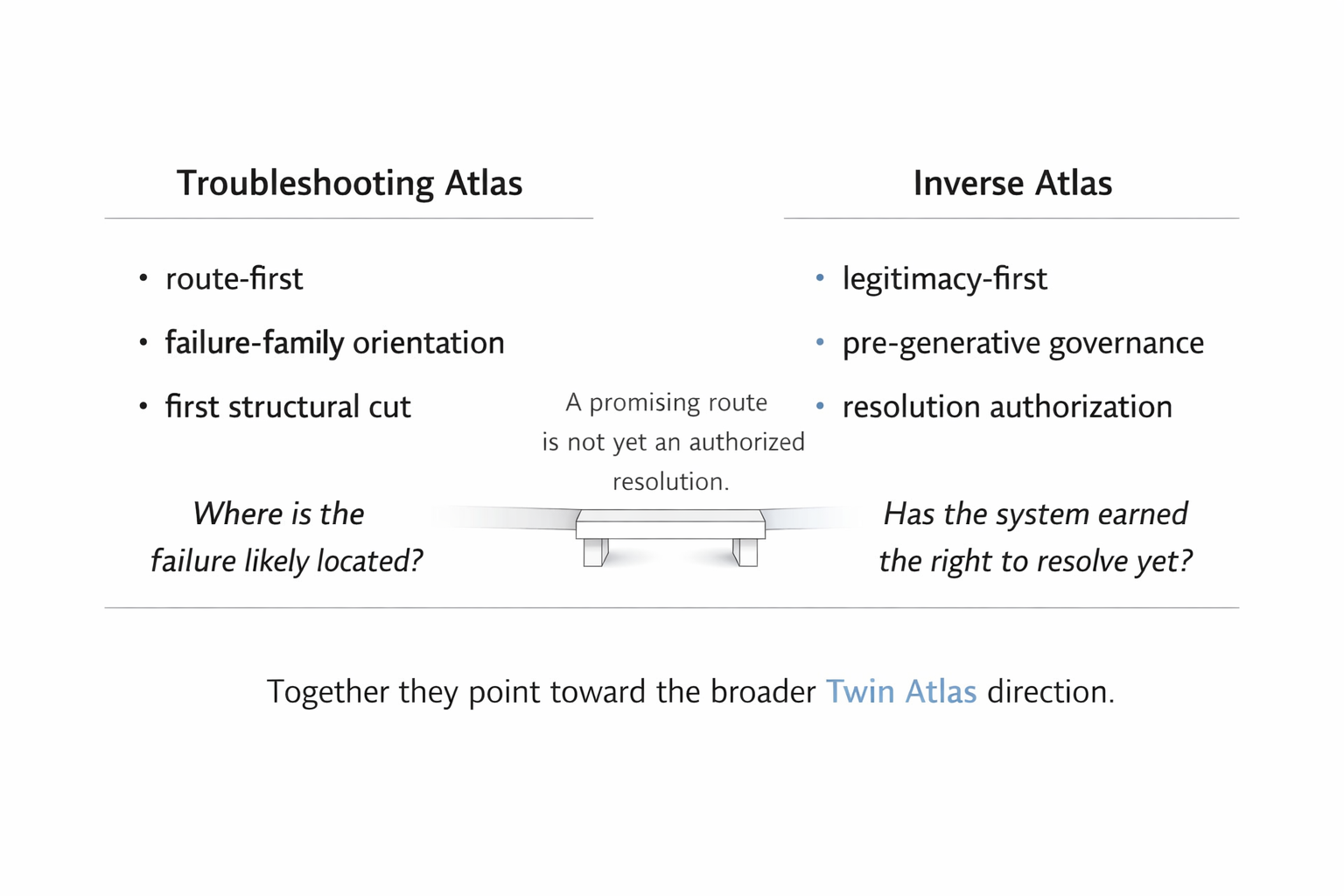
A promising route is not yet an authorized resolution.
This is why a second atlas line became necessary.
🧬 Atlas Family Positioning
-
Troubleshooting Atlas
Route first structural orientation.
Main question: where is the failure likely located? -
Inverse Atlas
Legitimacy first generation governance.
Main question: has the system earned the right to resolve this yet? -
Twin Atlas README
The broader conceptual pairing direction.
📏 What This Page Is Claiming, and What It Is Not Claiming
This repository does claim that Inverse Atlas already exists as a public and inspectable MVP methodology surface.
It does not claim that every part of the long term implementation is already finished.
It does not claim:
- full hallucination elimination
- universal superiority across all tasks
- a completed production operating system
- a finished forward plus inverse closed loop
- a fully completed WFGY 4.0 bridge implementation
What it does claim is narrower and more important:
A new pre generative governance methodology has been defined, surfaced, and made publicly testable.
❓ Quick FAQ
Is this just a stricter prompt?
No. It changes the order of generation. Instead of answer first and clean up later, it asks whether the answer is lawful enough to emit.
Which runtime should I start with?
Start with Advanced. It is the recommended default.
What does the demo actually show?
It shows where a plausible direct answer baseline escalates too early, overclaims certainty, skips neighboring cut honesty, or presents cosmetic repair as structural.
Do I need the full experiment stack to understand it?
No. Start with Advanced, the Demo Harness, and one case. The experiment layer gives you a cleaner public comparison surface.
📚 Go Deeper
If you want to go further, choose the path that fits your interest.
Methodology
Experiments
Deployment and usage
Inverse Atlas begins from a simple discipline:
Do not let the system speak more strongly than it has earned.
That discipline is now public.