 aef3e704b4
* fix(installer): tighten verifier base-url + clarify test helper

Three small refinements from the second review pass:

- normalizeHttpsBaseUrl rejects everything except https, since real release
  URLs are always HTTPS. Accepting http previously would let an operator
  silently target a stale or attacker-controlled mirror.
- Drop EXPECTED_RELEASE_ASSET_NAMES from the public exports; it was only
  used internally for the verification log line.
- Rename the test helper standaloneChecksumContent to
  placeholderChecksumContent and document that the hashes in its output are
  placeholders — the remote verifier does not download archives or compare
  hashes, it only validates that SHA256SUMS lists the expected names and
  that each archive URL is reachable.

The non-https rejection test now also covers `http://` in addition to the
existing `file://` case.

* style(installer): align installer completion output

* revert(installer): keep hosted installer output unchanged

* fix(installer): address release validation review feedback

* docs: switch public install commands to standalone hosted entrypoint

Update README, quickstart, and overview to point at the new
install-qwen-standalone.sh / install-qwen-standalone.ps1 hosted URLs.
Add standalone uninstall instructions to Uninstall.md. Remove the
staged-rollout note from INSTALLATION_GUIDE.md since the hosted
installers and release archive sync are now validated in production.

* docs: clarify pull request size guidance

* fix(installation): harden standalone release validation

* fix(installation): redact release verifier credentials

* feat(installer): add visual branding to Linux/macOS install script

Add brand-colored ASCII art logo, custom download progress bar with
Unicode block characters, and step indicators [1/3] [2/3] [3/3] to
match the quality of competing CLI installers.

* fix(test): update stale assertion after guide text was removed

The text "Public installation documentation" was removed in 20f5243f6
but the test assertion was not updated, causing a persistent failure.

* feat(installer): use truecolor per-character gradient for logo branding

Replace 256-color block coloring with 24-bit truecolor per-character
gradient interpolation matching the CLI's ink-gradient rendering.
Colors follow the fallback gradient: #4796E4 → #847ACE → #C3677F.
Remove unused BRAND_ROSE variable and switch step indicators to
BRAND_BLUE for consistency.

* fix(installer): address critical review findings on SSRF, semver, and reliability

- Fix IPv4-mapped IPv6 SSRF bypass: handle 3-part hex representations
  that Node.js produces (e.g. ::ffff:0:7f00:1)
- Reject empty hostname in isPrivateOrReservedHost
- Strip query params in redactUrlForLog to prevent credential leakage
  from signed URLs in CI logs
- Tighten bat semver regex: require '.' or '-' separator before suffix
  (rejects 1.2.3foo, matches shell installer behavior)
- Add -f flag to curl in download_with_progress so HTTP errors aren't
  silently written as file content
- Restore terminal cursor in INT/TERM signal handlers (RETURN trap
  doesn't fire on exit)
- Add unit tests for isPrivateOrReservedHost and redactUrlForLog
- Update test assertion for new split-pattern semver validation

* fix(installer): close release validation review gaps

* test(installer): cover shadowed qwen installs

* fix(installer): avoid npm auto-update for standalone installs

* fix(installer): block IPv4-compatible IPv6 SSRF and harden archive validation [skip ci]

- Add ipv4FromCompatibleIpv6() to detect deprecated RFC 4291 §2.5.5.1
  addresses (e.g. ::7f00:1 → 127.0.0.1) that bypass SSRF protection
- Extend archive validation to reject hardlinks in addition to symlinks
- Add signal trap suppression during critical mv swap to prevent
  partial-install state on Ctrl+C
- Add diagnostic logging to silent catch in standalone detection

* fix(installer): finish standalone install follow-ups

* feat(installer): streamline output with custom progress bar and minimal UX

Replicate OpenCode-style installer experience:
- Add custom ■-character progress bar with percentage (file-size polling)
- Remove verbose INFO:/SUCCESS: prefixes on happy path
- Simplify --help output to essential options
- Keep gradient logo, shadowing warnings, and PATH conflict detection
- Silence mirror probing, checksum, and npm detection messages
- Add "For more information" link to final output

Both .sh and .bat scripts updated consistently.
All 95 tests pass.

* feat(installer): add progress bar and logo to Windows installer

- Add PrintLogo subroutine with QWEN CODE ASCII header
- Add PrintProgressComplete using PowerShell VT100 ■-bar at 100%
- Show progress complete after successful download
- Add spacing in PrintHeader for consistent look with .sh

* fix(installer): address review findings on progress bar

- Replace `sleep 0.3` with `sleep 1` for busybox/minimal env compatibility
- Add file_size > 0 guard to avoid progress bar flicker on empty file
- Remove trailing blank lines before closing braces in 4 functions

* fix(installer): finalize Windows UX — suppress curl progress, fix logo

- Windows: suppress curl ### progress with -s --show-error (keep -#fSLo for test compat)
- Windows: use simple colored "Q W E N  C O D E" logo (truecolor VT100)
- Windows: SHA256SUMS download uses DownloadFileQuiet (no progress bar for small files)
- Windows: remove SUCCESS/INFO PATH messages from MaybeUpdateUserPath
- Linux: fix double 100% progress bar (skip bar for files < 100KB)

* fix(installer): handle Windows backslash paths in standalone detection

`fs.realpathSync` returns backslash paths on Windows (e.g. C:\Users\...\lib\cli.js).
Normalize to forward slashes before matching the /lib/cli.js suffix so standalone
install detection works correctly on Windows.

Fixes CI: Test (windows-latest, Node 22.x)

* fix(installer): normalize expected paths in Windows standalone test

The existsSync mock built expected paths with path.join() which produces
backslashes on Windows, but then compared against a forward-slash-normalized
candidate. Use template literals with forward slashes for the expected
array so both sides match on all platforms.

* refactor(installer): simplify post-install output

Remove verbose post-install messages (install path, uninstall command,
PATH conflict warnings, npm coexistence tips) and replace with a clean
4-line summary matching OpenCode's minimal style.

* refactor(installer): simplify Windows post-install output

Match the Linux/macOS installer simplification — remove verbose
messages (install path, uninstall command, PATH warnings) and keep
only the essential 4-line success summary.

* refactor(installer): suppress verbose Windows messages

Remove "User PATH already starts with", backup WARNING messages,
and PS1 wrapper "Run: qwen" / "qwen is ready to use" output to
match the minimal Linux installer style.

* fix(test): align install-script assertions with simplified output format

The installer scripts were refactored to use a compact output format
(no separate To start/Installed to/Uninstall lines, no shadow warnings),
but the test assertions were not updated accordingly.

* fix(installer): align hardlink detection and expand test coverage

- Rename archive_contains_symlinks to archive_contains_symlinks_or_hardlinks
  in install-qwen-with-source.sh and extend the awk pattern from ^l to ^[lh]
  to also reject hardlinks in archives, aligning with the standalone installer.

- Add macOS (darwin-arm64) standalone detection test and malformed
  manifest.json fallback test in installationInfo.test.ts.

- Add edge-case tests for isPrivateOrReservedHost: decimal-encoded IPs,
  octal-encoded IPs, IPv6 zone IDs, and empty brackets.
21 KiB




An open-source AI agent that lives in your terminal.
中文 | Deutsch | français | 日本語 | Русский | Português (Brasil)
🎉 News
-
2026-04-15: Qwen OAuth free tier has been discontinued. To continue using Qwen Code, switch to Alibaba Cloud Coding Plan, OpenRouter, Fireworks AI, or bring your own API key. Run
qwen authto configure. -
2026-04-13: Qwen OAuth free tier policy update: daily quota adjusted to 100 requests/day (from 1,000).
-
2026-04-02: Qwen3.6-Plus is now live! Get an API key from Alibaba Cloud ModelStudio to access it through the OpenAI-compatible API.
-
2026-02-16: Qwen3.5-Plus is now live!
Why Qwen Code?
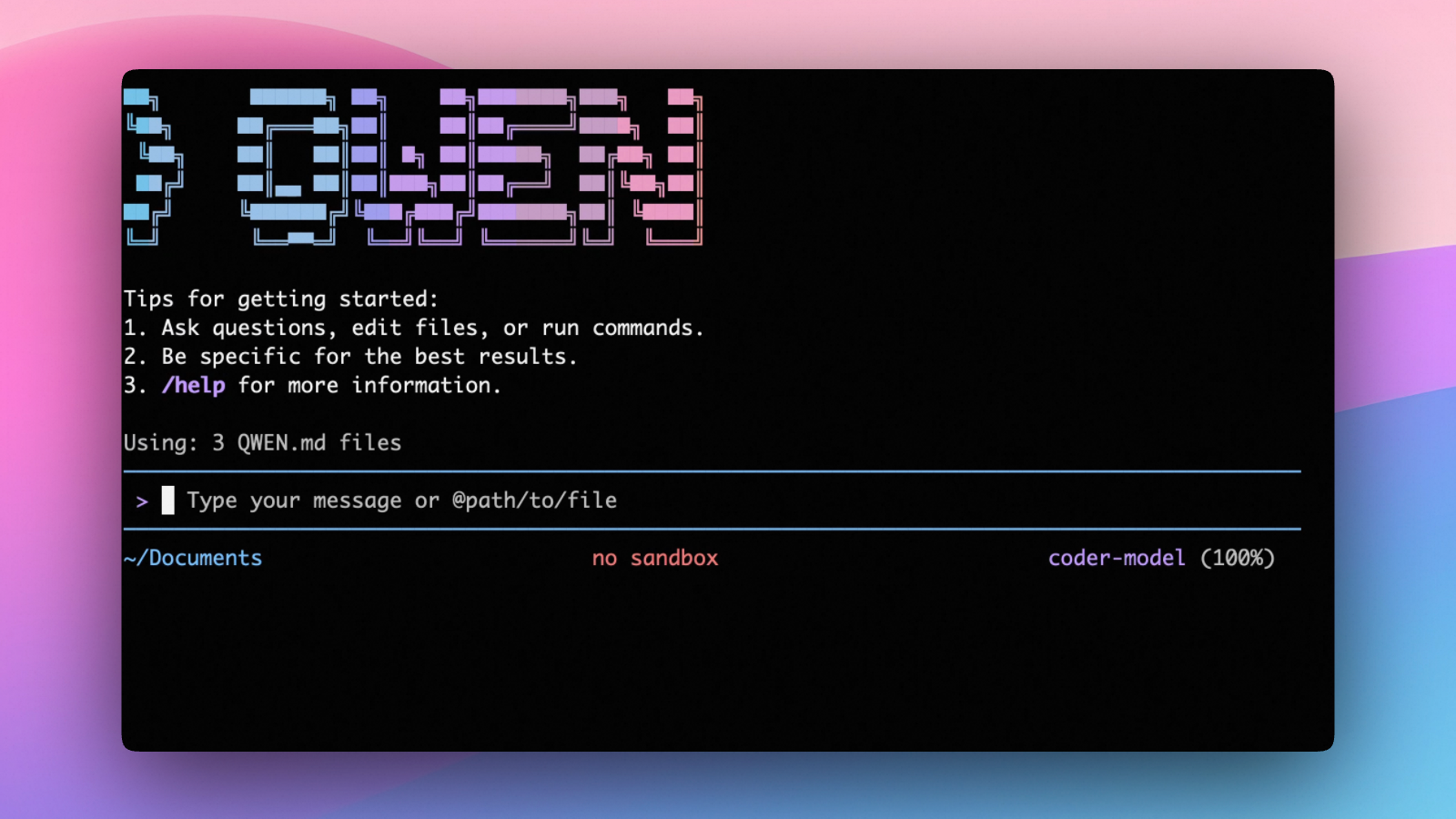
Qwen Code is an open-source AI agent for the terminal, optimized for Qwen series models. It helps you understand large codebases, automate tedious work, and ship faster.
- Multi-protocol, flexible providers: use OpenAI / Anthropic / Gemini-compatible APIs, Alibaba Cloud Coding Plan, OpenRouter, Fireworks AI, or bring your own API key.
- Open-source, co-evolving: both the framework and the Qwen3-Coder model are open-source—and they ship and evolve together.
- Agentic workflow, feature-rich: rich built-in tools (Skills, SubAgents) for a full agentic workflow and a Claude Code-like experience.
- Terminal-first, IDE-friendly: built for developers who live in the command line, with optional integration for VS Code, Zed, and JetBrains IDEs.
Installation
Quick Install (Recommended)
Linux / macOS
curl -fsSL https://qwen-code-assets.oss-cn-hangzhou.aliyuncs.com/installation/install-qwen-standalone.sh | bash
Windows
irm https://qwen-code-assets.oss-cn-hangzhou.aliyuncs.com/installation/install-qwen-standalone.ps1 | iex
Note
: It's recommended to restart your terminal after installation to ensure environment variables take effect.
Manual Installation
Prerequisites
Make sure you have Node.js 22 or later installed. Download it from nodejs.org.
NPM
npm install -g @qwen-code/qwen-code@latest
Homebrew (macOS, Linux)
brew install qwen-code
Quick Start
# Start Qwen Code (interactive)
qwen

# Then, in the session:
/help
/auth
On first use, you'll be prompted to sign in. You can run /auth anytime to switch authentication methods.
Example prompts:
What does this project do?
Explain the codebase structure.
Help me refactor this function.
Generate unit tests for this module.
Click to watch a demo video
🦞 Use Qwen Code for Coding Tasks in Claw
Copy the prompt below and paste it into your agent:
Use Qwen Code as a coding agent. First, fetch and read this skill reference:
https://raw.githubusercontent.com/QwenLM/qwen-code/refs/heads/main/.qwen/skills/qwen-code-claw/SKILL.md
Then follow the instructions inside to install, authenticate, and use Qwen Code via acpx for all coding tasks.
Authentication
Qwen Code supports the following authentication methods:
- API Key (recommended): use an API key from Alibaba Cloud Model Studio (Beijing / intl) or any supported provider (OpenAI, Anthropic, Google GenAI, and other compatible endpoints).
- Coding Plan: subscribe to the Alibaba Cloud Coding Plan (Beijing / intl) for a fixed monthly fee with higher quotas.
⚠️ Qwen OAuth was discontinued on April 15, 2026. If you were previously using Qwen OAuth, please switch to one of the methods above. Run
qwenand then/authto reconfigure.
API Key (recommended)
Use an API key to connect to Alibaba Cloud Model Studio or any supported provider. Supports multiple protocols:
- OpenAI-compatible: Alibaba Cloud ModelStudio, ModelScope, OpenAI, OpenRouter, and other OpenAI-compatible providers
- Anthropic: Claude models
- Google GenAI: Gemini models
The recommended way to configure models and providers is by editing ~/.qwen/settings.json (create it if it doesn't exist). This file lets you define all available models, API keys, and default settings in one place.
Quick Setup in 3 Steps
Step 1: Create or edit ~/.qwen/settings.json
Here is a complete example:
{
  "modelProviders": {
    "openai": [
      {
        "id": "qwen3.6-plus",
        "name": "qwen3.6-plus",
        "baseUrl": "https://dashscope.aliyuncs.com/compatible-mode/v1",
        "description": "Qwen3-Coder via Dashscope",
        "envKey": "DASHSCOPE_API_KEY"
      }
    ]
  },
  "env": {
    "DASHSCOPE_API_KEY": "sk-xxxxxxxxxxxxx"
  },
  "security": {
    "auth": {
      "selectedType": "openai"
    }
  },
  "model": {
    "name": "qwen3.6-plus"
  }
}
Step 2: Understand each field
| Field | What it does |
|---|---|
modelProviders |
Declares which models are available and how to connect to them. Keys like openai, anthropic, gemini represent the API protocol. |
modelProviders[].id |
The model ID sent to the API (e.g. qwen3.6-plus, gpt-4o). |
modelProviders[].envKey |
The name of the environment variable that holds your API key. |
modelProviders[].baseUrl |
The API endpoint URL (required for non-default endpoints). |
env |
A fallback place to store API keys (lowest priority; prefer .env files or export for sensitive keys). |
security.auth.selectedType |
The protocol to use on startup (openai, anthropic, gemini, vertex-ai). |
model.name |
The default model to use when Qwen Code starts. |
Step 3: Start Qwen Code — your configuration takes effect automatically:
qwen
Use the /model command at any time to switch between all configured models.
More Examples
Coding Plan (Alibaba Cloud ModelStudio) — fixed monthly fee, higher quotas
{
  "modelProviders": {
    "openai": [
      {
        "id": "qwen3.6-plus",
        "name": "qwen3.6-plus (Coding Plan)",
        "baseUrl": "https://coding.dashscope.aliyuncs.com/v1",
        "description": "qwen3.6-plus from ModelStudio Coding Plan",
        "envKey": "BAILIAN_CODING_PLAN_API_KEY"
      },
      {
        "id": "qwen3.5-plus",
        "name": "qwen3.5-plus (Coding Plan)",
        "baseUrl": "https://coding.dashscope.aliyuncs.com/v1",
        "description": "qwen3.5-plus with thinking enabled from ModelStudio Coding Plan",
        "envKey": "BAILIAN_CODING_PLAN_API_KEY",
        "generationConfig": {
          "extra_body": {
            "enable_thinking": true
          }
        }
      },
      {
        "id": "glm-4.7",
        "name": "glm-4.7 (Coding Plan)",
        "baseUrl": "https://coding.dashscope.aliyuncs.com/v1",
        "description": "glm-4.7 with thinking enabled from ModelStudio Coding Plan",
        "envKey": "BAILIAN_CODING_PLAN_API_KEY",
        "generationConfig": {
          "extra_body": {
            "enable_thinking": true
          }
        }
      },
      {
        "id": "kimi-k2.5",
        "name": "kimi-k2.5 (Coding Plan)",
        "baseUrl": "https://coding.dashscope.aliyuncs.com/v1",
        "description": "kimi-k2.5 with thinking enabled from ModelStudio Coding Plan",
        "envKey": "BAILIAN_CODING_PLAN_API_KEY",
        "generationConfig": {
          "extra_body": {
            "enable_thinking": true
          }
        }
      }
    ]
  },
  "env": {
    "BAILIAN_CODING_PLAN_API_KEY": "sk-xxxxxxxxxxxxx"
  },
  "security": {
    "auth": {
      "selectedType": "openai"
    }
  },
  "model": {
    "name": "qwen3.6-plus"
  }
}
Subscribe to the Coding Plan and get your API key at Alibaba Cloud ModelStudio(Beijing) or Alibaba Cloud ModelStudio(intl).
Multiple providers (OpenAI + Anthropic + Gemini)
{
  "modelProviders": {
    "openai": [
      {
        "id": "gpt-4o",
        "name": "GPT-4o",
        "envKey": "OPENAI_API_KEY",
        "baseUrl": "https://api.openai.com/v1"
      }
    ],
    "anthropic": [
      {
        "id": "claude-sonnet-4-20250514",
        "name": "Claude Sonnet 4",
        "envKey": "ANTHROPIC_API_KEY"
      }
    ],
    "gemini": [
      {
        "id": "gemini-2.5-pro",
        "name": "Gemini 2.5 Pro",
        "envKey": "GEMINI_API_KEY"
      }
    ]
  },
  "env": {
    "OPENAI_API_KEY": "sk-xxxxxxxxxxxxx",
    "ANTHROPIC_API_KEY": "sk-ant-xxxxxxxxxxxxx",
    "GEMINI_API_KEY": "AIzaxxxxxxxxxxxxx"
  },
  "security": {
    "auth": {
      "selectedType": "openai"
    }
  },
  "model": {
    "name": "gpt-4o"
  }
}
Enable thinking mode (for supported models like qwen3.5-plus)
{
  "modelProviders": {
    "openai": [
      {
        "id": "qwen3.5-plus",
        "name": "qwen3.5-plus (thinking)",
        "envKey": "DASHSCOPE_API_KEY",
        "baseUrl": "https://dashscope.aliyuncs.com/compatible-mode/v1",
        "generationConfig": {
          "extra_body": {
            "enable_thinking": true
          }
        }
      }
    ]
  },
  "env": {
    "DASHSCOPE_API_KEY": "sk-xxxxxxxxxxxxx"
  },
  "security": {
    "auth": {
      "selectedType": "openai"
    }
  },
  "model": {
    "name": "qwen3.5-plus"
  }
}
Tip: You can also set API keys via
exportin your shell or.envfiles, which take higher priority thansettings.json→env. See the authentication guide for full details.
Security note: Never commit API keys to version control. The
~/.qwen/settings.jsonfile is in your home directory and should stay private.
Local Model Setup (Ollama / vLLM)
You can also run models locally — no API key or cloud account needed. This is not an authentication method; instead, configure your local model endpoint in ~/.qwen/settings.json using the modelProviders field.
Set generationConfig.contextWindowSize inside the matching provider entry
and adjust it to the context length configured on your local server.
Ollama setup
- Install Ollama from ollama.com
- Pull a model:
ollama pull qwen3:32b - Configure
~/.qwen/settings.json:
{
  "modelProviders": {
    "openai": [
      {
        "id": "qwen3:32b",
        "name": "Qwen3 32B (Ollama)",
        "baseUrl": "http://localhost:11434/v1",
        "description": "Qwen3 32B running locally via Ollama",
        "generationConfig": {
          "contextWindowSize": 131072
        }
      }
    ]
  },
  "security": {
    "auth": {
      "selectedType": "openai"
    }
  },
  "model": {
    "name": "qwen3:32b"
  }
}
vLLM setup
- Install vLLM:
pip install vllm - Start the server:
vllm serve Qwen/Qwen3-32B - Configure
~/.qwen/settings.json:
{
  "modelProviders": {
    "openai": [
      {
        "id": "Qwen/Qwen3-32B",
        "name": "Qwen3 32B (vLLM)",
        "baseUrl": "http://localhost:8000/v1",
        "description": "Qwen3 32B running locally via vLLM",
        "generationConfig": {
          "contextWindowSize": 131072
        }
      }
    ]
  },
  "security": {
    "auth": {
      "selectedType": "openai"
    }
  },
  "model": {
    "name": "Qwen/Qwen3-32B"
  }
}
Usage
As an open-source terminal agent, you can use Qwen Code in five primary ways:
- Interactive mode (terminal UI)
- Headless mode (scripts, CI)
- IDE integration (VS Code, Zed)
- SDKs (TypeScript, Python, Java)
- Daemon mode —
qwen serveexposes ACP over HTTP+SSE so multiple clients share one agent (experimental)
Interactive mode
cd your-project/
qwen
Run qwen in your project folder to launch the interactive terminal UI. Use @ to reference local files (for example @src/main.ts).
Headless mode
cd your-project/
qwen -p "your question"
Use -p to run Qwen Code without the interactive UI—ideal for scripts, automation, and CI/CD. Learn more: Headless mode.
IDE integration
Use Qwen Code inside your editor (VS Code, Zed, and JetBrains IDEs):
Daemon mode (qwen serve, experimental)
cd your-project/
qwen serve
# → qwen serve listening on http://127.0.0.1:4170 (mode=http-bridge)
Run Qwen Code as a local HTTP daemon so IDE plugins, web UIs, CI scripts and custom CLIs all share one agent session over HTTP+SSE — instead of each spawning their own subprocess. Loopback bind has no auth by default (set QWEN_SERVER_TOKEN to enable bearer auth even on loopback); remote binds (--hostname 0.0.0.0) require a token — boot refuses without one. See:
SDKs
Build on top of Qwen Code with the available SDKs:
- TypeScript: Use the Qwen Code SDK
- Python: Use the Python SDK
- Java: Use the Java SDK
Python SDK example:
import asyncio

from qwen_code_sdk import is_sdk_result_message, query


async def main() -> None:
    result = query(
        "Summarize the repository layout.",
        {
            "cwd": "/path/to/project",
            "path_to_qwen_executable": "qwen",
        },
    )

    async for message in result:
        if is_sdk_result_message(message):
            print(message["result"])


asyncio.run(main())
Commands & Shortcuts
Session Commands
/help- Display available commands/clear- Clear conversation history/compress- Compress history to save tokens/stats- Show current session information/bug- Submit a bug report/exitor/quit- Exit Qwen Code
Keyboard Shortcuts
Ctrl+C- Cancel current operationCtrl+D- Exit (on empty line)Up/Down- Navigate command history
Learn more about Commands
Tip: In YOLO mode (
--yolo), vision switching happens automatically without prompts when images are detected. Learn more about Approval Mode
Configuration
Qwen Code can be configured via settings.json, environment variables, and CLI flags.
| File | Scope | Description |
|---|---|---|
~/.qwen/settings.json |
User (global) | Applies to all your Qwen Code sessions. Recommended for modelProviders and env. |
.qwen/settings.json |
Project | Applies only when running Qwen Code in this project. Overrides user settings. |
The most commonly used top-level fields in settings.json:
| Field | Description |
|---|---|
modelProviders |
Define available models per protocol (openai, anthropic, gemini, vertex-ai). |
env |
Fallback environment variables (e.g. API keys). Lower priority than shell export and .env files. |
security.auth.selectedType |
The protocol to use on startup (e.g. openai). |
model.name |
The default model to use when Qwen Code starts. |
See the Authentication section above for complete
settings.jsonexamples, and the settings reference for all available options.
Benchmark Results
Terminal-Bench Performance
| Agent | Model | Accuracy |
|---|---|---|
| Qwen Code | Qwen3-Coder-480A35 | 37.5% |
| Qwen Code | Qwen3-Coder-30BA3B | 31.3% |
Ecosystem
Looking for a graphical interface?
- AionUi A modern GUI for command-line AI tools including Qwen Code
- Gemini CLI Desktop A cross-platform desktop/web/mobile UI for Qwen Code
Troubleshooting
If you encounter issues, check the troubleshooting guide.
Common issues:
Qwen OAuth free tier was discontinued on 2026-04-15: Qwen OAuth is no longer available. Runqwen→/authand switch to API Key or Coding Plan. See the Authentication section above for setup instructions.
To report a bug from within the CLI, run /bug and include a short title and repro steps.
Connect with Us
- Discord: https://discord.gg/RN7tqZCeDK
- Dingtalk: https://qr.dingtalk.com/action/joingroup?code=v1,k1,+FX6Gf/ZDlTahTIRi8AEQhIaBlqykA0j+eBKKdhLeAE=&_dt_no_comment=1&origin=1
Acknowledgments
This project is based on Google Gemini CLI. We acknowledge and appreciate the excellent work of the Gemini CLI team. Our main contribution focuses on parser-level adaptations to better support Qwen-Coder models.