
5.9 KiB
Authentication
Qwen Code supports two authentication methods. Pick the one that matches how you want to run the CLI:
- Qwen OAuth (recommended): sign in with your
qwen.aiaccount in a browser. - OpenAI-compatible API: use an API key (OpenAI or any OpenAI-compatible provider / endpoint).
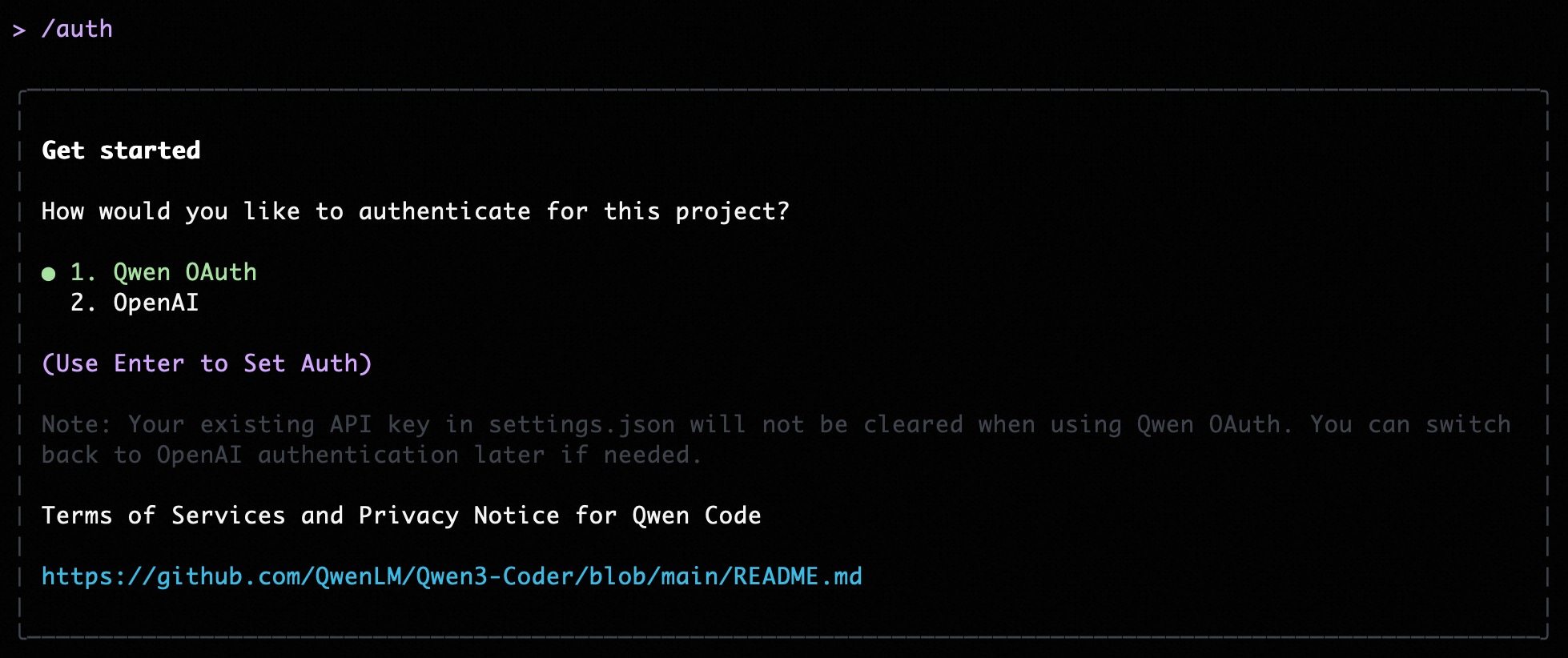
Option 1: Qwen OAuth (recommended & free) 👍
Use this if you want the simplest setup and you're using Qwen models.
- How it works: on first start, Qwen Code opens a browser login page. After you finish, credentials are cached locally so you usually won't need to log in again.
- Requirements: a
qwen.aiaccount + internet access (at least for the first login). - Benefits: no API key management, automatic credential refresh.
- Cost & quota: free, with a quota of 60 requests/minute and 2,000 requests/day.
Start the CLI and follow the browser flow:
qwen
Option 2: OpenAI-compatible API (API key)
Use this if you want to use OpenAI models or any provider that exposes an OpenAI-compatible API (e.g. OpenAI, Azure OpenAI, OpenRouter, ModelScope, Alibaba Cloud Bailian, or a self-hosted compatible endpoint).
Recommended: Coding Plan (subscription-based) 🚀
Use this if you want predictable costs with higher usage quotas for the qwen3-coder-plus model.
Important
Coding Plan is only available for users in China mainland (Beijing region).
- How it works: subscribe to the Coding Plan with a fixed monthly fee, then configure Qwen Code to use the dedicated endpoint and your subscription API key.
- Requirements: an active Coding Plan subscription from Alibaba Cloud Bailian.
- Benefits: higher usage quotas, predictable monthly costs, access to latest qwen3-coder-plus model.
- Cost & quota: varies by plan (see table below).
Coding Plan Pricing & Quotas
| Feature | Lite Basic Plan | Pro Advanced Plan |
|---|---|---|
| Price | ¥40/month | ¥200/month |
| 5-Hour Limit | Up to 1,200 requests | Up to 6,000 requests |
| Weekly Limit | Up to 9,000 requests | Up to 45,000 requests |
| Monthly Limit | Up to 18,000 requests | Up to 90,000 requests |
| Supported Model | qwen3-coder-plus | qwen3-coder-plus |
Quick Setup for Coding Plan
When you select the OpenAI-compatible option in the CLI, enter these values:
- API key:
sk-sp-xxxxx - Base URL:
https://coding.dashscope.aliyuncs.com/v1 - Model:
qwen3-coder-plus
Note
: Coding Plan API keys have the format
sk-sp-xxxxx, which is different from standard Alibaba Cloud API keys.
Configure via Environment Variables
Set these environment variables to use Coding Plan:
export OPENAI_API_KEY="your-coding-plan-api-key"  # Format: sk-sp-xxxxx
export OPENAI_BASE_URL="https://coding.dashscope.aliyuncs.com/v1"
export OPENAI_MODEL="qwen3-coder-plus"
For more details about Coding Plan, including subscription options and troubleshooting, see the full Coding Plan documentation.
Other OpenAI-compatible Providers
If you are using other providers (OpenAI, Azure, local LLMs, etc.), use the following configuration methods.
Configure via command-line arguments
# API key only
qwen-code --openai-api-key "your-api-key-here"

# Custom base URL (OpenAI-compatible endpoint)
qwen-code --openai-api-key "your-api-key-here" --openai-base-url "https://your-endpoint.com/v1"

# Custom model
qwen-code --openai-api-key "your-api-key-here" --model "gpt-4o-mini"
Configure via environment variables
You can set these in your shell profile, CI, or an .env file:
export OPENAI_API_KEY="your-api-key-here"
export OPENAI_BASE_URL="https://api.openai.com/v1"  # optional
export OPENAI_MODEL="gpt-4o"                        # optional
Persisting env vars with .env / .qwen/.env
Qwen Code will auto-load environment variables from the first .env file it finds (variables are not merged across multiple files).
Search order:
- From the current directory, walking upward toward
/:.qwen/.env.env
- If nothing is found, it falls back to your home directory:
~/.qwen/.env~/.env
.qwen/.env is recommended to keep Qwen Code variables isolated from other tools. Some variables (like DEBUG and DEBUG_MODE) are excluded from project .env files to avoid interfering with qwen-code behavior.
Examples:
# Project-specific settings (recommended)
mkdir -p .qwen
cat >> .qwen/.env <<'EOF'
OPENAI_API_KEY="your-api-key"
OPENAI_BASE_URL="https://api-inference.modelscope.cn/v1"
OPENAI_MODEL="Qwen/Qwen3-Coder-480B-A35B-Instruct"
EOF
# User-wide settings (available everywhere)
mkdir -p ~/.qwen
cat >> ~/.qwen/.env <<'EOF'
OPENAI_API_KEY="your-api-key"
OPENAI_BASE_URL="https://dashscope.aliyuncs.com/compatible-mode/v1"
OPENAI_MODEL="qwen3-coder-plus"
EOF
Switch authentication method (without restarting)
In the Qwen Code UI, run:
/auth
Non-interactive / headless environments (CI, SSH, containers)
In a non-interactive terminal you typically cannot complete the OAuth browser login flow. Use the OpenAI-compatible API method via environment variables:
- Set at least
OPENAI_API_KEY. - Optionally set
OPENAI_BASE_URLandOPENAI_MODEL.
If none of these are set in a non-interactive session, Qwen Code will exit with an error.
Security notes
- Don’t commit API keys to version control.
- Prefer
.qwen/.envfor project-local secrets (and keep it out of git). - Treat your terminal output as sensitive if it prints credentials for verification.