mirror of
https://github.com/nfstream/nfstream.git
synced 2026-04-30 16:09:28 +00:00

542 lines
22 KiB
Markdown
542 lines
22 KiB
Markdown

|
||
|
||
--------------------------------------------------------------------------------
|
||
[**NFStream**][repo] is a Python framework providing fast, flexible, and expressive data structures designed to make
|
||
working with **online** or **offline** network data both easy and intuitive. It aims to be the fundamental high-level
|
||
building block for doing practical, **real world** network data analysis in Python. Additionally, it has the broader
|
||
goal of becoming **a common network data analytics framework for researchers** providing data reproducibility
|
||
across experiments.
|
||
|
||
<table>
|
||
<tr>
|
||
<td><b>Live Notebook</b></td>
|
||
<td>
|
||
<a href="https://mybinder.org/v2/gh/nfstream/nfstream-tutorials/master?filepath=demo_notebook.ipynb">
|
||
<img src="https://img.shields.io/badge/notebook-launch-blue?logo=jupyter&style=for-the-badge" alt="live notebook" />
|
||
</a>
|
||
</td>
|
||
</tr>
|
||
<tr>
|
||
<td><b>Project Website</b></td>
|
||
<td>
|
||
<a href="https://www.nfstream.org/">
|
||
<img src="https://img.shields.io/website?down_color=red&down_message=down&label=nfstream.org&logo=github&up_color=blue&up_message=up&url=https%3A%2F%2Fnfstream.org%2F&style=for-the-badge" alt="website" />
|
||
</a>
|
||
</td>
|
||
</tr>
|
||
<tr>
|
||
<td><b>Discussion Channel</b></td>
|
||
<td>
|
||
<a href="https://gitter.im/nfstream/community">
|
||
<img src="https://img.shields.io/badge/chat-on%20gitter-blue?color=blue&logo=gitter&style=for-the-badge" alt="Gitter" />
|
||
</a>
|
||
</td>
|
||
</tr>
|
||
<tr>
|
||
<td><b>Latest Release</b></td>
|
||
<td>
|
||
<a href="https://pypi.python.org/pypi/nfstream">
|
||
<img src="https://img.shields.io/pypi/v/nfstream.svg?logo=pypi&style=for-the-badge" alt="latest release" />
|
||
</a>
|
||
</td>
|
||
</tr>
|
||
|
||
<tr>
|
||
<td><b>Supported Versions</b></td>
|
||
<td>
|
||
<a href="https://github.com/nfstream/nfstream/actions?query=workflow%3Abuild">
|
||
<img src="https://img.shields.io/pypi/pyversions/nfstream?logo=python&style=for-the-badge" alt="python3" />
|
||
</a>
|
||
<a href="https://github.com/nfstream/nfstream/actions?query=workflow%3Abuild">
|
||
<img src="https://img.shields.io/badge/pypy-3.6%20%7C%203.7-blue?logo=pypy&style=for-the-badge" alt="pypy3" />
|
||
</a>
|
||
</td>
|
||
</tr>
|
||
<tr>
|
||
<td><b>Project License</b></td>
|
||
<td>
|
||
<a href="https://github.com/nfstream/nfstream/blob/master/LICENSE">
|
||
<img src="https://img.shields.io/pypi/l/nfstream?logo=gnu&style=for-the-badge&color=blue" alt="License" />
|
||
</a>
|
||
</td>
|
||
</tr>
|
||
<tr>
|
||
<td><b>Continuous Integration</b></td>
|
||
<td>
|
||
<a href="https://github.com/nfstream/nfstream/actions?query=workflow%3Abuild_test_publish_linux">
|
||
<img src="https://img.shields.io/github/workflow/status/nfstream/nfstream/build_test_publish_linux/master?logo=linux&style=for-the-badge&label=linux" alt="Linux WorkFlows" />
|
||
</a>
|
||
<a href="https://github.com/nfstream/nfstream/actions?query=workflow%3Abuild_test_publish_macos">
|
||
<img src="https://img.shields.io/github/workflow/status/nfstream/nfstream/build_test_publish_macos/master?logo=apple&style=for-the-badge&label=macos" alt="MacOS WorkFlows" />
|
||
</a>
|
||
<a href="https://github.com/nfstream/nfstream/actions?query=workflow%3Abuild_test_publish_windows">
|
||
<img src="https://img.shields.io/github/workflow/status/nfstream/nfstream/build_test_publish_windows/master?logo=windows&style=for-the-badge&label=windows" alt="Windows WorkFlows" />
|
||
</a>
|
||
</td>
|
||
</tr>
|
||
<tr>
|
||
<td><b>Code Quality</b></td>
|
||
<td>
|
||
<a href="https://lgtm.com/projects/g/nfstream/nfstream/context:python">
|
||
<img src="https://img.shields.io/lgtm/grade/python/github/nfstream/nfstream?label=LGTM%3A%20Python&logo=lgtm&style=for-the-badge&logoWidth=18)" alt="Quality" />
|
||
</a>
|
||
<a href="https://www.codefactor.io/repository/github/nfstream/nfstream">
|
||
<img src="https://img.shields.io/codefactor/grade/github/nfstream/nfstream?label=codefactor%3A%20Python%2C%20C&logo=codefactor&style=for-the-badge&logoWidth=18)" alt="Quality" />
|
||
</a>
|
||
</td>
|
||
</tr>
|
||
<tr>
|
||
<td><b>Code Coverage</b></td>
|
||
<td>
|
||
<a href="https://codecov.io/gh/nfstream/nfstream/">
|
||
<img src="https://img.shields.io/codecov/c/github/nfstream/nfstream?color=brightgreen&logo=codecov&style=for-the-badge" alt="Coverage" />
|
||
</a>
|
||
</td>
|
||
</tr>
|
||
</table>
|
||
|
||
## Table of Contents
|
||
|
||
* [**Main Features**](#main-features)
|
||
* [**How to get it?**](#how-to-get-it)
|
||
* [**How to use it?**](#how-to-use-it)
|
||
* [**Encrypted application identification and metadata extraction**](#encrypted-application-identification-and-metadata-extraction)
|
||
* [**Post-mortem statistical flow features extraction**](#post-mortem-statistical-flow-features-extraction)
|
||
* [**Early statistical flow features extraction**](#early-statistical-flow-features-extraction)
|
||
* [**Pandas export interface**](#pandas-export-interface)
|
||
* [**CSV export interface**](#csv-export-interface)
|
||
* [**Extending NFStream**](#extending-nfstream)
|
||
* [**Machine Learning models training and deployment**](#machine-learning-models-training-and-deployment)
|
||
* [**Training the model**](#training-the-model)
|
||
* [**ML powered streamer on live traffic**](#ml-powered-streamer-on-live-traffic)
|
||
* [**Building from sources**](#building-from-sources--)
|
||
* [**Contributing**](#contributing)
|
||
* [**Ethics**](#ethics)
|
||
* [**Credits**](#credits)
|
||
* [**Authors**](#authors)
|
||
* [**Supporting organizations**](#supporting-organizations)
|
||
* [**Publications that use NFStream**](#publications-that-use-nfstream)
|
||
* [**License**](#license)
|
||
|
||
## Main Features
|
||
|
||
* **Performance:** NFStream is designed to be fast: AF_PACKETV3/FANOUT on Linux, parallel processing, native C
|
||
(using [**CFFI**][cffi]) for critical computation and [**PyPy**][pypy] support.
|
||
* **Encrypted layer-7 visibility:** NFStream deep packet inspection is based on [**nDPI**][ndpi].
|
||
It allows NFStream to perform [**reliable**][reliable] encrypted applications identification and metadata
|
||
fingerprinting (e.g. TLS, SSH, DHCP, HTTP).
|
||
* **Statistical features extraction:** NFStream provides state of the art of flow-based statistical feature extraction.
|
||
It includes both post-mortem statistical features (e.g. min, mean, stddev and max of packet size and inter arrival time)
|
||
and early flow features (e.g. sequence of first n packets sizes, inter arrival times and
|
||
directions).
|
||
* **Flexibility:** NFStream is easily extensible using [**NFPlugins**][nfplugin]. It allows to create a new
|
||
feature within a few lines of Python.
|
||
* **Machine Learning oriented:** NFStream aims to make Machine Learning Approaches for network traffic management
|
||
reproducible and deployable. By using NFStream as a common framework, researchers ensure that models are trained using
|
||
the same feature computation logic and thus, a fair comparison is possible. Moreover, trained models can be deployed
|
||
and evaluated on live network using [**NFPlugins**][nfplugin].
|
||
|
||
## How to get it?
|
||
|
||
Binary installers for the latest released version are available on Pypi.
|
||
|
||
```bash
|
||
pip install nfstream
|
||
```
|
||
|
||
## How to use it?
|
||
|
||
### Encrypted application identification and metadata extraction
|
||
|
||
Dealing with a big pcap file and just want to aggregate into labeled network flows? **NFStream** make this path easier
|
||
in few lines:
|
||
|
||
```python
|
||
from nfstream import NFStreamer
|
||
# We display all streamer parameters with their default values.
|
||
# See documentation for detailed information about each parameter.
|
||
# https://www.nfstream.org/docs/api#nfstreamer
|
||
my_streamer = NFStreamer(source="facebook.pcap", # or network interface
|
||
decode_tunnels=True,
|
||
bpf_filter=None,
|
||
promiscuous_mode=True,
|
||
snapshot_length=1536,
|
||
idle_timeout=120,
|
||
active_timeout=1800,
|
||
accounting_mode=0,
|
||
udps=None,
|
||
n_dissections=20,
|
||
statistical_analysis=False,
|
||
splt_analysis=0,
|
||
n_meters=0,
|
||
performance_report=0)
|
||
|
||
for flow in my_streamer:
|
||
print(flow) # print it.
|
||
```
|
||
|
||
```python
|
||
# See documentation for each feature detailed description.
|
||
# https://www.nfstream.org/docs/api#nflow
|
||
NFlow(id=0,
|
||
expiration_id=0,
|
||
src_ip='192.168.43.18',
|
||
src_mac='30:52:cb:6c:9c:1b',
|
||
src_oui='30:52:cb',
|
||
src_port=52066,
|
||
dst_ip='66.220.156.68',
|
||
dst_mac='98:0c:82:d3:3c:7c',
|
||
dst_oui='98:0c:82',
|
||
dst_port=443,
|
||
protocol=6,
|
||
ip_version=4,
|
||
vlan_id=0,
|
||
tunnel_id=0,
|
||
bidirectional_first_seen_ms=1472393122365,
|
||
bidirectional_last_seen_ms=1472393123665,
|
||
bidirectional_duration_ms=1300,
|
||
bidirectional_packets=19,
|
||
bidirectional_bytes=5745,
|
||
src2dst_first_seen_ms=1472393122365,
|
||
src2dst_last_seen_ms=1472393123408,
|
||
src2dst_duration_ms=1043,
|
||
src2dst_packets=9,
|
||
src2dst_bytes=1345,
|
||
dst2src_first_seen_ms=1472393122668,
|
||
dst2src_last_seen_ms=1472393123665,
|
||
dst2src_duration_ms=997,
|
||
dst2src_packets=10,
|
||
dst2src_bytes=4400,
|
||
application_name='TLS.Facebook',
|
||
application_category_name='SocialNetwork',
|
||
application_is_guessed=0,
|
||
requested_server_name='facebook.com',
|
||
client_fingerprint='bfcc1a3891601edb4f137ab7ab25b840',
|
||
server_fingerprint='2d1eb5817ece335c24904f516ad5da12',
|
||
user_agent='',
|
||
content_type='')
|
||
```
|
||
|
||
### Post-mortem statistical flow features extraction
|
||
|
||
NFStream performs 48 post mortem flow statistical features extraction which include detailed TCP flags analysis,
|
||
minimum, mean, maximum and standard deviation of both packet size and interarrival time in each direction.
|
||
|
||
```python
|
||
from nfstream import NFStreamer
|
||
my_streamer = NFStreamer(source="facebook.pcap",
|
||
# Disable L7 dissection for readability purpose.
|
||
n_dissections=0,
|
||
statistical_analysis=True)
|
||
for flow in my_streamer:
|
||
print(flow)
|
||
```
|
||
|
||
```python
|
||
# See documentation for each feature detailed description.
|
||
# https://www.nfstream.org/docs/api#nflow
|
||
NFlow(id=0,
|
||
expiration_id=0,
|
||
src_ip='192.168.43.18',
|
||
src_mac='30:52:cb:6c:9c:1b',
|
||
src_oui='30:52:cb',
|
||
src_port=52066,
|
||
dst_ip='66.220.156.68',
|
||
dst_mac='98:0c:82:d3:3c:7c',
|
||
dst_oui='98:0c:82',
|
||
dst_port=443,
|
||
protocol=6,
|
||
ip_version=4,
|
||
vlan_id=0,
|
||
tunnel_id=0,
|
||
bidirectional_first_seen_ms=1472393122365,
|
||
bidirectional_last_seen_ms=1472393123665,
|
||
bidirectional_duration_ms=1300,
|
||
bidirectional_packets=19,
|
||
bidirectional_bytes=5745,
|
||
src2dst_first_seen_ms=1472393122365,
|
||
src2dst_last_seen_ms=1472393123408,
|
||
src2dst_duration_ms=1043,
|
||
src2dst_packets=9,
|
||
src2dst_bytes=1345,
|
||
dst2src_first_seen_ms=1472393122668,
|
||
dst2src_last_seen_ms=1472393123665,
|
||
dst2src_duration_ms=997,
|
||
dst2src_packets=10,
|
||
dst2src_bytes=4400,
|
||
bidirectional_min_ps=66,
|
||
bidirectional_mean_ps=302.36842105263156,
|
||
bidirectional_stddev_ps=425.53315715259754,
|
||
bidirectional_max_ps=1454,
|
||
src2dst_min_ps=66,
|
||
src2dst_mean_ps=149.44444444444446,
|
||
src2dst_stddev_ps=132.20354676701294,
|
||
src2dst_max_ps=449,
|
||
dst2src_min_ps=66,
|
||
dst2src_mean_ps=440.0,
|
||
dst2src_stddev_ps=549.7164925870628,
|
||
dst2src_max_ps=1454,
|
||
bidirectional_min_piat_ms=0,
|
||
bidirectional_mean_piat_ms=72.22222222222223,
|
||
bidirectional_stddev_piat_ms=137.34994188549086,
|
||
bidirectional_max_piat_ms=398,
|
||
src2dst_min_piat_ms=0,
|
||
src2dst_mean_piat_ms=130.375,
|
||
src2dst_stddev_piat_ms=179.72036811192467,
|
||
src2dst_max_piat_ms=415,
|
||
dst2src_min_piat_ms=0,
|
||
dst2src_mean_piat_ms=110.77777777777777,
|
||
dst2src_stddev_piat_ms=169.51458475436397,
|
||
dst2src_max_piat_ms=409,
|
||
bidirectional_syn_packets=2,
|
||
bidirectional_cwr_packets=0,
|
||
bidirectional_ece_packets=0,
|
||
bidirectional_urg_packets=0,
|
||
bidirectional_ack_packets=18,
|
||
bidirectional_psh_packets=9,
|
||
bidirectional_rst_packets=0,
|
||
bidirectional_fin_packets=0,
|
||
src2dst_syn_packets=1,
|
||
src2dst_cwr_packets=0,
|
||
src2dst_ece_packets=0,
|
||
src2dst_urg_packets=0,
|
||
src2dst_ack_packets=8,
|
||
src2dst_psh_packets=4,
|
||
src2dst_rst_packets=0,
|
||
src2dst_fin_packets=0,
|
||
dst2src_syn_packets=1,
|
||
dst2src_cwr_packets=0,
|
||
dst2src_ece_packets=0,
|
||
dst2src_urg_packets=0,
|
||
dst2src_ack_packets=10,
|
||
dst2src_psh_packets=5,
|
||
dst2src_rst_packets=0,
|
||
dst2src_fin_packets=0)
|
||
```
|
||
|
||
### Early statistical flow features extraction
|
||
NFStream performs early (up to 255 packets) flow statistical features extraction (also referred as SPLT analysis in the
|
||
literature). It is summarized as a sequence a these packets directions, sizes and interarrival times.
|
||
|
||
```python
|
||
from nfstream import NFStreamer
|
||
my_streamer = NFStreamer(source="facebook.pcap",
|
||
# We disable both l7 dissection and statistical analysis
|
||
# for readability purpose.
|
||
n_dissections=0,
|
||
statistical_analysis=False,
|
||
splt_analysis=10)
|
||
for flow in my_streamer:
|
||
print(flow)
|
||
```
|
||
|
||
```python
|
||
# See documentation for each feature detailed description.
|
||
# https://www.nfstream.org/docs/api#nflow
|
||
NFlow(id=0,
|
||
expiration_id=0,
|
||
src_ip='192.168.43.18',
|
||
src_mac='30:52:cb:6c:9c:1b',
|
||
src_oui='30:52:cb',
|
||
src_port=52066,
|
||
dst_ip='66.220.156.68',
|
||
dst_mac='98:0c:82:d3:3c:7c',
|
||
dst_oui='98:0c:82',
|
||
dst_port=443,
|
||
protocol=6,
|
||
ip_version=4,
|
||
vlan_id=0,
|
||
tunnel_id=0,
|
||
bidirectional_first_seen_ms=1472393122365,
|
||
bidirectional_last_seen_ms=1472393123665,
|
||
bidirectional_duration_ms=1300,
|
||
bidirectional_packets=19,
|
||
bidirectional_bytes=5745,
|
||
src2dst_first_seen_ms=1472393122365,
|
||
src2dst_last_seen_ms=1472393123408,
|
||
src2dst_duration_ms=1043,
|
||
src2dst_packets=9,
|
||
src2dst_bytes=1345,
|
||
dst2src_first_seen_ms=1472393122668,
|
||
dst2src_last_seen_ms=1472393123665,
|
||
dst2src_duration_ms=997,
|
||
dst2src_packets=10,
|
||
dst2src_bytes=4400,
|
||
# The sequence of 10 first packet direction, size and inter arrival time.
|
||
splt_direction=[0, 1, 0, 0, 1, 1, 0, 1, 0, 1],
|
||
splt_ps=[74, 74, 66, 262, 66, 1454, 66, 1454, 66, 463],
|
||
splt_piat_ms=[0, 303, 0, 0, 313, 0, 0, 0, 0, 1])
|
||
```
|
||
|
||
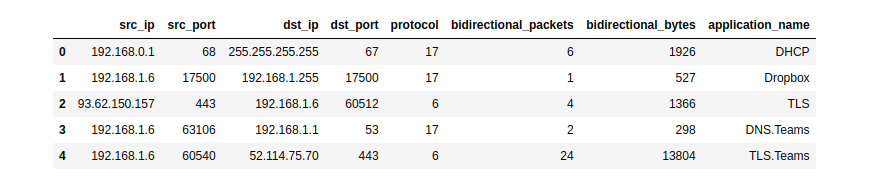
### Pandas export interface
|
||
|
||
NFStream natively supports Pandas as export interface.
|
||
|
||
```python
|
||
# See documentation for more details.
|
||
# https://www.nfstream.org/docs/api#pandas-dataframe-conversion
|
||
from nfstream import NFStreamer
|
||
my_dataframe = NFStreamer(source='teams.pcap').to_pandas()[["src_ip",
|
||
"src_port",
|
||
"dst_ip",
|
||
"dst_port",
|
||
"protocol",
|
||
"bidirectional_packets",
|
||
"bidirectional_bytes",
|
||
"application_name"]]
|
||
my_dataframe.head(5)
|
||
```
|
||
|
||
|
||
|
||
|
||
### CSV export interface
|
||
|
||
NFStream natively supports CSV file format as export interface.
|
||
|
||
```python
|
||
# See documentation for more details.
|
||
# https://www.nfstream.org/docs/api#csv-file-conversion
|
||
flows_count = NFStreamer(source='facebook.pcap').to_csv(path=None,
|
||
flows_per_file=0,
|
||
columns_to_anonymize=[])
|
||
```
|
||
|
||
### Extending NFStream
|
||
|
||
Didn't find a specific flow feature? add a plugin to **NFStream** in few lines:
|
||
|
||
```python
|
||
from nfstream import NFPlugin
|
||
|
||
class MyCustomFeature(NFPlugin):
|
||
def on_init(self, packet, flow):
|
||
# flow creation with the first packet
|
||
if packet.raw_size == self.custom_size:
|
||
flow.udps.packet_with_custom_size = 1
|
||
else:
|
||
flow.udps.packet_with_custom_size = 0
|
||
|
||
def on_update(self, packet, flow):
|
||
# flow update with each packet belonging to the flow
|
||
if packet.raw_size == self.custom_size:
|
||
flow.udps.packet_with_custom_size += 1
|
||
|
||
|
||
extended_streamer = NFStreamer(source='facebook.pcap',
|
||
udps=MyCustomFeature(custom_size=555))
|
||
|
||
for flow in extended_streamer:
|
||
# see your dynamically created metric in generated flows
|
||
print(flow.udps.packet_with_custom_size)
|
||
```
|
||
|
||
### Machine Learning models training and deployment
|
||
|
||
In the following example, we demonstrate a simplistic machine learning approach training and deployment.
|
||
We suppose that we want to run a classification of Social Network category flows based on bidirectional_packets and
|
||
bidirectional_bytes as features. For the sake of brevity, we decide to predict only at flow expiration stage.
|
||
|
||
#### Training the model
|
||
|
||
```python
|
||
from nfstream import NFPlugin, NFStreamer
|
||
import numpy
|
||
from sklearn.ensemble import RandomForestClassifier
|
||
|
||
df = NFStreamer(source="training_traffic.pcap").to_pandas()
|
||
X = df[["bidirectional_packets", "bidirectional_bytes"]]
|
||
y = df["application_category_name"].apply(lambda x: 1 if 'SocialNetwork' in x else 0)
|
||
model = RandomForestClassifier()
|
||
model.fit(X, y)
|
||
```
|
||
|
||
#### ML powered streamer on live traffic
|
||
|
||
```python
|
||
class ModelPrediction(NFPlugin):
|
||
def on_init(self, packet, flow):
|
||
flow.udps.model_prediction = 0
|
||
def on_expire(self, flow):
|
||
# You can do the same in on_update entrypoint and force expiration with custom id.
|
||
to_predict = numpy.array([flow.bidirectional_packets,
|
||
flow.bidirectional_bytes]).reshape((1,-1))
|
||
flow.udps.model_prediction = self.my_model.predict(to_predict)
|
||
|
||
ml_streamer = NFStreamer(source="eth0", udps=ModelPrediction(my_model=model))
|
||
for flow in ml_streamer:
|
||
print(flow.udps.model_prediction)
|
||
```
|
||
|
||
More NFPlugin examples and details are provided on the official [**documentation**][documentation]. You can also test
|
||
NFStream without installation using our [**live demo notebook**][demo].
|
||
|
||
## Building from sources ![l] ![m]
|
||
|
||
If you want to build **NFStream** from sources. Please read the [**installation guide**][install].
|
||
|
||
## Contributing
|
||
|
||
Please read [**Contributing**][contribute] for details on our code of conduct, and the process for submitting pull
|
||
requests to us.
|
||
|
||
## Ethics
|
||
|
||
**NFStream** is intended for network data research and forensics.
|
||
Researchers and network data scientists can use these framework to build reliable datasets, train and evaluate
|
||
network applied machine learning models.
|
||
As with any packet monitoring tool, **NFStream** could potentially be misused.
|
||
**Do not run it on any network of which you are not the owner or the administrator**.
|
||
|
||
## Credits
|
||
|
||
### Authors
|
||
|
||
The following people contributed to NFStream:
|
||
* [**Zied Aouini**](mailto:aouinizied@gmail.com): Creator and main developer.
|
||
* [**Adrian Pekar**](mailto:adrian.pekar@gmail.com): Testing, datasets generation and storage.
|
||
* [**Romain Picard**](mailto:romain.picard@oakbits.com): Several Plugins implementation.
|
||
* [**Radion Bikmukhamedov**](mailto:radion.bikmukhamedov@pm.me): Initial work on SPLT analysis NFPlugin.
|
||
|
||
### Supporting organizations
|
||
|
||
The following organizations are supporting NFStream:
|
||
* [**SoftAtHome**](https://www.softathome.com/): Main supporter of NFStream development.
|
||
* [**Technical University of Košice**](https://www.tuke.sk/): Hardware and infrastructure for datasets generation and
|
||
storage.
|
||
* [**ntop**](https://www.ntop.org/): Technical support of nDPI integration.
|
||
|
||
[![sah]](https://www.softathome.com/) [![tuke]](https://www.tuke.sk/) [![ntop]](https://www.ntop.org/)
|
||
|
||
## Publications that use NFStream
|
||
|
||
* [**Ranking Network Devices for Alarm Prioritisation: Intrusion Detection Case Study**](https://ieeexplore.ieee.org/abstract/document/9559086)
|
||
* [**Network Flows-Based Malware Detection Using A Combined Approach of Crawling And Deep Learning**](https://ieeexplore.ieee.org/document/9500920)
|
||
* [**Generative Transformer Framework For Network Traffic Generation And Classification**](https://cyberleninka.ru/article/n/generative-transformer-framework-for-network-traffic-generation-and-classification)
|
||
* [**Multi-Class Network Traffic Generators and Classifiers Based on Neural Networks**](https://ieeexplore.ieee.org/document/9416067)
|
||
* [**Using Embedded Feature Selection and CNN for Classification on CCD-INID-V1 A New IoT Dataset**](https://www.mdpi.com/1424-8220/21/14/4834)
|
||
* [**An Approach Based on Knowledge-Defined Networking for Identifying Video Streaming Flows in 5G Networks**](https://latamt.ieeer9.org/index.php/transactions/article/view/5083/1116)
|
||
* [**Knowledge Discovery: Can It Shed New Light on Threshold Definition for Heavy‑Hitter Detection?**](https://link.springer.com/content/pdf/10.1007/s10922-021-09593-w.pdf)
|
||
* [**Collecting and analyzing Tor exit node traffic**](https://www.diva-portal.org/smash/get/diva2:1575255/FULLTEXT01.pdf)
|
||
|
||
## License
|
||
|
||
This project is licensed under the LGPLv3 License - see the [**License**][license] file for details
|
||
|
||
[license]: https://github.com/nfstream/nfstream/blob/master/LICENSE
|
||
[contribute]: https://nfstream.org/docs/community
|
||
[contributors]: https://github.com/nfstream/nfstream/graphs/contributors
|
||
[documentation]: https://nfstream.org/
|
||
[ndpi]: https://github.com/ntop/nDPI
|
||
[nfplugin]: https://nfstream.org/docs/api#nfplugin
|
||
[reliable]: http://people.ac.upc.edu/pbarlet/papers/ground-truth.pam2014.pdf
|
||
[repo]: https://nfstream.org/
|
||
[demo]: https://mybinder.org/v2/gh/nfstream/nfstream/master?filepath=demo_notebook.ipynb
|
||
[pypy]: https://www.pypy.org/
|
||
[cffi]: https://cffi.readthedocs.io/en/latest/index.html
|
||
[sah]:https://raw.githubusercontent.com/nfstream/nfstream/master/assets/sah_logo.png?raw=true
|
||
[tuke]:https://raw.githubusercontent.com/nfstream/nfstream/master/assets/tuke_logo.png?raw=true
|
||
[ntop]:https://raw.githubusercontent.com/nfstream/nfstream/master/assets/ntop_logo.png?raw=true
|
||
[l]:https://github.com/ryanoasis/nerd-fonts/wiki/screenshots/v1.0.x/linux-pass-sm.png
|
||
[m]:https://github.com/ryanoasis/nerd-fonts/wiki/screenshots/v1.0.x/mac-pass-sm.png
|
||
[install]: https://www.nfstream.org/docs/#building-nfstream-from-sources
|