 fa7fdbca01
* fix(core): clamp max_tokens to the context window; retire the output reservation Auto-compaction was firing far too early — a 200K-window session compacted at roughly half the window. The cause was not the compaction engine but that every request manufactured a large max_tokens, which forced a defensive reservation of that output budget out of the window before computing compaction thresholds. The reservation shrank the effective window, pulled the trigger down, and spawned a chain of band-aids. Size max_tokens to the room actually left in the window instead — the smaller of the model's output ceiling and (window − prompt − margin) — so an oversized request can never exceed the context limit. Once output is guaranteed to fit, the reservation is unnecessary and is removed; compaction gates on the full window again. Raise the default proportional threshold from 0.70 to 0.85, and replace the temporary half-window reservation cap with a flat 64K output ceiling. This resolves early compaction, the 400 "maximum context length" error on request, the "hard limit: 0" pre-send NOOP for env-configured models, and retires the half-window reservation cap, while keeping max_tokens on the wire for both OpenAI- and Anthropic-shaped providers. Fixes #5950 Fixes #6384 Claude-Session: https://claude.ai/code/session_014DW2TynKHLjsbRqTBSyQue * test(cli): update /context threshold expectations for 85% default The auto-compaction default moved from 70% to 85% and the output reservation was removed, so computeThresholds(200K) now yields warn=150K / auto=170K (was 147K / 167K). Update the /context command tests that hard-coded the old ladder. * fix(core): apply window clamp to samplingParams users who omit max_tokens Previously a samplingParams config without a max_tokens key sent no max_tokens on the wire (OpenAI path), so those users bypassed the prompt + max_tokens <= window clamp — inconsistent with the Anthropic path, which always injects the clamped value. Mirror the Anthropic fallback (reconcile ?? config ?? request) so the clamped maxOutputTokens is injected when samplingParams omits max_tokens. Guard the injection: when samplingParams targets a provider-specific output-budget key (max_completion_tokens for GPT-5/o-series, max_new_tokens), leave it verbatim — adding max_tokens alongside double-specifies the budget and those endpoints reject the pair. * fix(core): clamp provider output-budget keys to the window in samplingParams A samplingParams config carrying a provider-specific output-budget key (max_completion_tokens for GPT-5/o-series, max_new_tokens) but no max_tokens previously passed the key through verbatim, so its value escaped the prompt + output <= window clamp — e.g. max_completion_tokens: 200000 on a 200K window with a 150K prompt. Clamp the key's value in place to the remaining window (min with the request maxOutputTokens) instead of injecting a separate max_tokens: sending both keys double-specifies the output budget and o-series rejects the pair. The value only shrinks when the window is tight; when there is room it passes through unchanged, matching how max_tokens is already treated. * fix(core): compact on the window ceiling, not the max of the threshold ladder (#6583) * fix(core): compact on the window ceiling (min), not the max of the ladder computeThresholds combined the proportional term (pct*window) and the absolute term (effectiveWindow - AUTOCOMPACT_BUFFER) with Math.max, which pushed the auto-compaction trigger toward the top of the window on large windows — a 1M-token window compacted at ~97%, leaving ~33K headroom. The absolute term is structurally a ceiling ("compact before the prompt leaves too little room for the summarization side-query, which needs up to SUMMARY_RESERVE of output"), so it composes with Math.min, matching the claude-code reference (services/compact/autoCompact.ts, which uses Math.min and whose default trigger is the absolute term alone). auto = absoluteCeiling > 0 ? min(pct*window, absoluteCeiling) : pct*window warn = max(0, auto - WARN_BUFFER) // WARN_PCT_OFFSET retired hard = unchanged Effect: large windows compact at ~85% (the DEFAULT_PCT ceiling) instead of ~97%; small/mid windows keep room to run compaction (a 128K window's summary now provably fits); sub-33K windows are unchanged. A lower context.autoCompactThreshold now pulls compaction earlier on large windows, matching the reference's Math.min override semantics. Updates the threshold unit tests, the settings schema description, and the user docs to describe the setting as a ceiling on the trigger. * refactor(core): trim threshold doc comments; name the hard-edge term Post-review cleanup (no behavior change): - Collapse the duplicated regime explanation shared between the DEFAULT_PCT and computeThresholds doc comments into one canonical block; point the constant's doc at computeThresholds. - Rename rawHard -> hardEdge and note it is the window-edge ceiling, so the two roles of the hard tier (window edge vs. auto + HARD_BUFFER) are legible. - Shorten the context.autoCompactThreshold description in settings.md to the concise schema wording (also un-widens the docs table). * fix(core): clamp provider output-budget keys on every samplingParams exit A config carrying both max_tokens and a provider-specific output-budget key (max_completion_tokens / max_new_tokens) took the max_tokens early return, spreading the provider key onto the wire unclamped — on backends honoring the larger key, prompt + output could exceed the window. Collapse the two returns into a single exit that always runs the provider-key clamp, so no output-budget key escapes the window clamp regardless of which combination of keys is present. --------- Co-authored-by: 易良 <1204183885@qq.com> |
||
|---|---|---|
| .github | ||
| .husky | ||
| .qwen | ||
| .vscode | ||
| docs | ||
| docs-site | ||
| eslint-rules | ||
| integration-tests | ||
| packages | ||
| patches | ||
| scripts | ||
| .dockerignore | ||
| .editorconfig | ||
| .gitattributes | ||
| .gitignore | ||
| .npmrc | ||
| .nvmrc | ||
| .prettierignore | ||
| .prettierrc.json | ||
| .yamllint.yml | ||
| AGENTS.md | ||
| CHANGELOG.md | ||
| CLAUDE.md | ||
| CONTRIBUTING.md | ||
| Dockerfile | ||
| esbuild.config.js | ||
| eslint.config.js | ||
| eslint.legacy-filenames.mjs | ||
| LICENSE | ||
| Makefile | ||
| package-lock.json | ||
| package.json | ||
| README.md | ||
| SECURITY.md | ||
| tsconfig.json | ||
| vitest.config.ts | ||




The open-source AI coding agent that lives in your terminal.
中文 | Deutsch | français | 日本語 | Русский | Português (Brasil)
Why Qwen Code?
- Agentic out of the box — Auto-Memory, Auto-Skills, SubAgents, Agent Teams, and MCP. Dynamic workflows, zero setup.
- Open-source, inside and out — The framework and the Qwen models are open-source. They evolve together. No vendor lock-in.
- Multi-protocol — Supports OpenAI, Anthropic, Gemini, and Qwen APIs. Any third-party provider or local model (Ollama / vLLM). Switch at runtime.
- Beyond the terminal — IDE plugins, Desktop app, daemon mode, SDKs, and IM bots (Telegram / DingTalk / WeChat / Feishu).
Tip
Qwen Code is actively iterating on itself — using its own agent and models to file issues, submit PRs, review code, and run tests. Powered by the community, driven by AI.
Installation
Linux / macOS:
curl -fsSL https://qwen-code-assets.oss-cn-hangzhou.aliyuncs.com/installation/install-qwen-standalone.sh | bash
Windows:
irm https://qwen-code-assets.oss-cn-hangzhou.aliyuncs.com/installation/install-qwen-standalone.ps1 | iex
Restart your terminal after installation to ensure environment variables take effect.
NPM / Homebrew
NPM (requires Node.js 22+):
npm install -g @qwen-code/qwen-code@latest
Homebrew (macOS / Linux):
brew install qwen-code
Quick Start
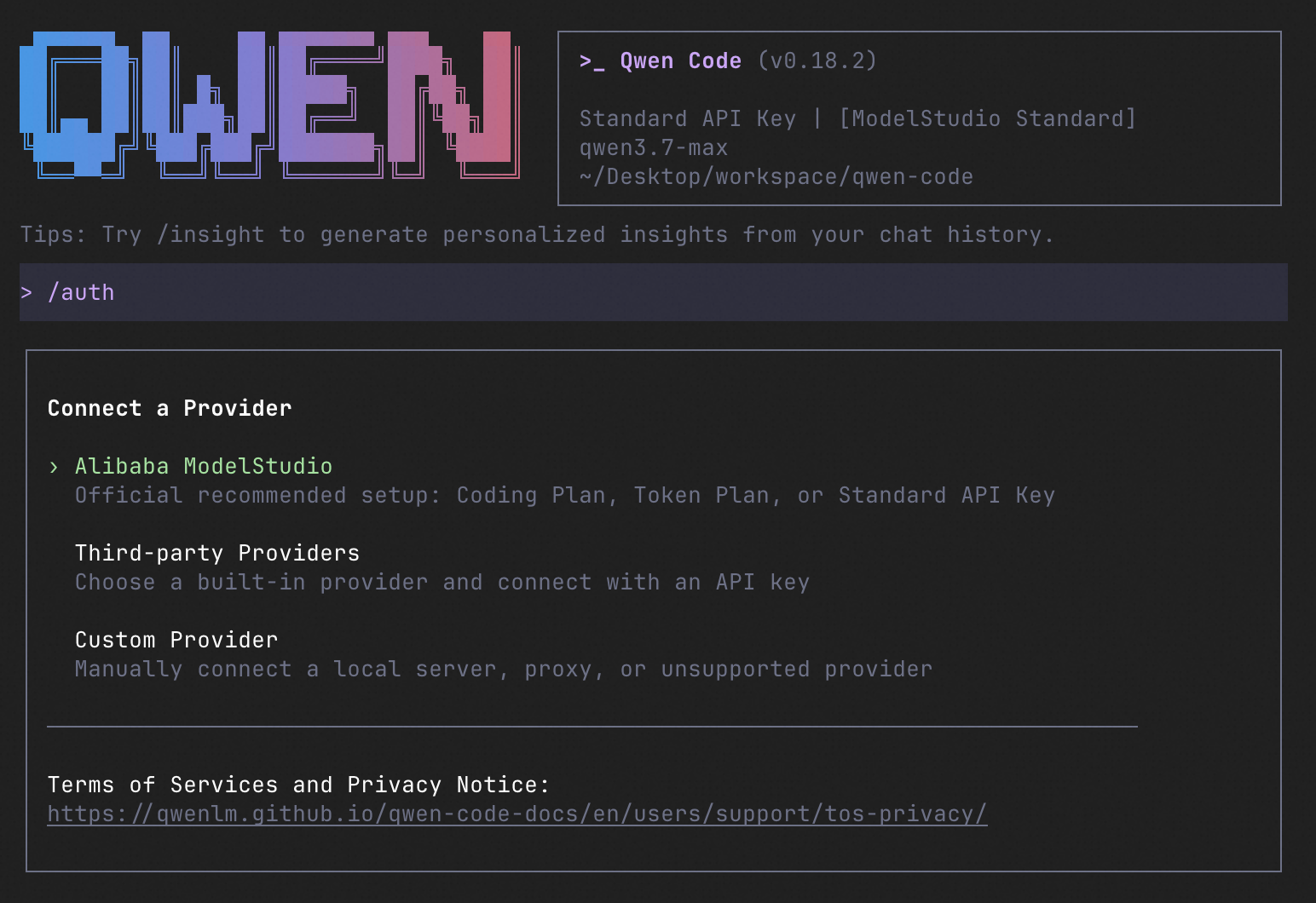
qwen          # Launch interactive terminal UI
# Inside the session:
/auth         # Configure your provider and API key
See the Authentication Guide and Settings Reference for detailed setup.
How to Use Qwen Code
| Mode | Command | Use Case |
|---|---|---|
| Interactive | qwen |
Terminal UI with rich rendering, @file references, slash commands |
| Headless | qwen -p "..." |
Scripts, CI/CD, batch processing — no UI |
| IDE | — | VS Code, Zed, JetBrains |
| Desktop | — | Qwen Code Desktop — GUI for macOS, Windows, Linux |
| Daemon | qwen serve |
Shared agent session over HTTP+SSE (ACP). Multiple clients, one agent. (experimental) Docs |
| SDK | — | TypeScript, Python, Java |
| IM Bot | qwen channel |
Connect to Telegram, DingTalk, WeChat, or Feishu |
SDK example (Python)
import asyncio

from qwen_code_sdk import is_sdk_result_message, query


async def main() -> None:
    result = query(
        "Summarize the repository layout.",
        {
            "cwd": "/path/to/project",
            "path_to_qwen_executable": "qwen",
        },
    )

    async for message in result:
        if is_sdk_result_message(message):
            print(message["result"])


asyncio.run(main())
Capabilities
If you know Claude Code, you already know Qwen Code — and then some. We've put significant effort into bringing Qwen Code to feature parity with Claude Code, improving both breadth and reliability across the board.
| Feature | Qwen Code | Claude Code |
|---|---|---|
| SubAgents, Agent Teams, Dynamic Workflows | ✓ | ✓ |
| Auto-Memory, Auto-Skills, Hooks | ✓ | ✓ |
| Built-in Skills (/review, /batch, /loop, /bugfix…) | ✓ | ✓ |
| MCP, Plan Mode, LSP Integration | ✓ | ✓ |
| Auto Mode, Sandbox, Git Worktrees | ✓ | ✓ |
| Computer Use (desktop automation) | ✓ | ✓ |
| IDE Plugins (VS Code / JetBrains / Zed) | ✓ | ✓ |
| SDK | ✓ | ✓ |
| Headless Mode, Session Management | ✓ | ✓ |
| Open-source — model and framework | ✓ | — |
| Multi-protocol (OpenAI / Anthropic / Gemini / Qwen + any provider) | ✓ | — |
| Agent Arena (multi-model head-to-head on same task) | ✓ | — |
Daemon Mode — qwen serve (multi-client shared agent) |
✓ | — |
| IM Channels (Telegram / DingTalk / WeChat / Feishu) | ✓ | — |
Ecosystem
-
Qwen Code Desktop — Official desktop app for macOS, Windows, and Linux
-
AionUi — A modern GUI for command-line AI tools including Qwen Code
-
Gemini CLI Desktop — A cross-platform desktop/web/mobile UI for Qwen Code
-
🦞 Qwen Code Claw — Let other agents (Claude, Codex, etc.) delegate coding tasks to Qwen Code via ACP. Paste this prompt into your agent:
Use Qwen Code as a coding agent. First, fetch and read this skill reference:
https://raw.githubusercontent.com/QwenLM/qwen-code/refs/heads/main/.qwen/skills/qwen-code-claw/SKILL.md
Then follow the instructions inside to install, authenticate, and use Qwen Code via acpx for all coding tasks.
Contributing
Contributions are welcome! See CONTRIBUTING.md for guidelines.
Acknowledgments
This project was originally based on Google Gemini CLI v0.8.2. We gratefully acknowledge the Gemini CLI team's excellent work. Starting from Qwen Code v0.1, we stopped syncing with upstream and began independent development as a multi-protocol, multi-platform agent framework with deep integrations for Qwen models and beyond.