 f4802031d0
* perf(ci): run docs-only automatic reviews at medium effort

A 1-line docs PR costs the same 57-180 minute high-effort review as a code
change, and on a diff with zero source lines the passes medium drops - the
adversarial personas and the reverse audit - have no failure mode to hunt.
Counterfactual analysis over six dissected CI runs showed the one case
where those passes caught a real Critical was a source PR, which this gate
never touches: classification reuses the Test workflow's conservative
classify-profile.mjs (docs/**.md(x) + root prose only; markdown under any
src/ tree stays full, matching the review skill's own source rule), and
any fetch or classifier failure falls back to the full review.

Only the automatic pull_request_target review downgrades; every explicit
request (workflow_dispatch, @qwen-code /review) keeps full high effort.
Because an effective --comment forces high and medium never posts, the
downgrade drops --comment and a new step relays the review CLI's verbatim
"Review complete:" line - its machine-readable completion contract - as a
single PR comment, with a pointer for requesting the full review. The
docs-only budget is the size-aware timeout halved with a 90-minute floor.

* perf(ci): address review feedback on the docs-only medium gate

All nine review suggestions, each verified before fixing:

- review_requested is an explicit ask: the AUTO_REVIEW flag now excludes
  that action (authorize write-permission-checks its requester), so a
  maintainer requesting the bot's review gets the full high-effort run.
- The fetch-and-classify wrapper is extracted to
  .github/scripts/ci/classify-pr-profile.sh and consumed by both ci.yml
  and the review gate, so the classifier's input contract lives in one
  place; distinct exit codes preserve each caller's fallback messages.
- Neither completion-line fallback mints the reserved "Review complete: "
  prefix anymore, and the relayed line passes a strict not-posted
  disposition allowlist - on this never-posts path any posted-form
  disposition is false by definition (the measured phantom APPROVE
  posted), so it falls back to a neutral non-scrapable form.
- The relay upserts by its marker (mirroring the queued-acknowledgement
  step) instead of stacking a comment per push, retries the POST/PATCH
  three times, and never fails the job - a failed relay after a
  successful review must not trip the failure fallback into announcing
  a review failure that never happened.
- The Chinese relay copy no longer parses as "发行" and renders
  high-effort as 高强度 rather than 高档.
- The qwen-review docs-only-medium marker is registered in all six
  BOT_COMMENT_FILTER sites in qwen-autofix.yml, so clean docs-only
  relays cannot select PRs into autofix rounds as actionable feedback.
- The gate's behavioral invariants are pinned in
  scripts/tests/qwen-pr-review-workflow.test.js by executing the
  extracted bash: prompt-branch order (--effort medium instead of
  --comment), the halve-with-90-minute-floor arithmetic, the
  completion-line allowlist including the phantom shapes, AUTO_REVIEW
  exclusivity, the six-site marker registration, and the shared-wrapper
  routing in both workflows.

* perf(ci): harden the docs-only gate against round-2 review findings

Thirteen findings across two review passes; every fix is executed by a
test rather than asserted as text where the finding was behavioral.

- The relay marker exclusion in qwen-autofix.yml is author-scoped at all
  six filter sites: only the relay bot's own marker comment is filtered,
  so a human quoting the marker stays actionable feedback.
- classify-pr-profile.sh guards the 3,000-file listing cap (any mismatch
  against the PR's declared changed_files classifies full), uses
  mktemp+trap instead of a fixed path on the shared persistent pool, and
  ships its own node:test suite (renamed source→docs pins the projection
  contract; exit codes 2/3 pinned) registered in HELPER_TESTS.
- classify-profile.mjs restricts reserved root prose basenames to inert
  extensions - README.js / SECURITY.ts / LICENSE.sh classify full.
- The completion-line allowlist binds to pr-<number> and to the only
  verdict a medium run can produce (Comment, not posted) - a stale line
  for another PR or an Approve-shaped injection falls back to neutral.
- A dedicated review_completed output gates the relay: the state/head
  guards exit 0 without running the review, and outcome==success alone
  would have announced a review that never ran.
- The relay upsert filters by the authenticated bot login, re-resolves
  the comment id on every attempt, and falls back to POST when the PATCH
  target is gone - a participant posting the marker can no longer capture
  the upsert, a transient listing failure no longer mints duplicates.
- The gate and relay are now executed under stubbed executables in
  qwen-pr-review-workflow.test.js (docs_only/full/failure/explicit
  scenarios; POST/PATCH/never-fail branches), the AUTO_REVIEW pin covers
  both guard halves, and the marker contract is pinned producer-side and
  filter-side.

* perf(ci): fix the medium Request-changes swallow and the stale docs badge

Round-3 review findings (2 Critical, 8 test-gap Suggestions), each fix
executed by a test where the finding was behavioral:

- The completion-line allowlist accepts `Request changes, not posted` -
  compose-review caps only Approve at medium, so a docs-only run that
  verifies a Critical legitimately emits Request changes, and the old
  Comment-only allowlist swallowed exactly the blocker-finding outcome
  into the neutral fallback. Target binding to pr-<number> is unchanged
  and now pinned by a test, as is the last-line selection over a stale or
  injected earlier completion line.
- A stale docs-only badge can no longer outlive its revision: the full
  automatic review path now supersedes the bot-authored marker comment
  (strikethrough + superseded note) via a new --update-only mode that
  never mints a badge where none existed.
- The marker+author upsert protocol is extracted to
  .github/scripts/upsert-bot-comment.sh - one implementation shared by
  the relay and the supersede step (the per-step copies had already
  drifted), with its own node:test suite covering the author scope, the
  per-attempt re-resolution (deleted-mid-retry falls back to POST), and
  the --update-only no-op; registered in HELPER_TESTS.
- The classify-pr-profile gh stub now applies the wrapper's own --jq
  argument with real jq over API-shaped fixtures, so the projection
  contract is genuinely under test (negative control: dropping `status`
  turns the renamed-source scenario red).
- New pins: review_completed wiring end to end (run-step emit + both
  consumers' if clauses), the auto_review output->env wiring at both
  links, and both AUTO_REVIEW guard halves.

* perf(ci): never let a failed lookup mint or keep a stale docs badge

Round-4 review findings (1 Critical, 7 Suggestions):

- The upsert script no longer conflates failed lookups with empty
  results: the authenticated login, the listing, and the jq extraction
  are all resolved inside the retry loop as one prerequisite chain, an
  attempt whose prerequisites failed retries instead of falling through
  to POST (the shape that minted a permanent duplicate badge off one
  transient 5xx), and --update-only exits 1 on a failed lookup so the
  supersede warning fires instead of a false no-op success. New tests
  pin the failed-listing-then-PATCH path, the persistent identity
  failure, the update-only failure exit, and the update-only PATCH.
- Supersede now covers every path that owes the correction: a FAILED
  full review and an EXPLICIT requested review (the badge's own CTA)
  both retire the badge, gated only on docs_only_medium == 'false' -
  empty on runs that failed before classifying, so a badge is never
  superseded on ignorance. The body is cause-neutral: it asserts only
  that the badge described an earlier revision.
- The marker literal is defined once per step (MARKER variable, the
  qwen-triage convention) and shared between body and lookup argument;
  a pin requires the definition and --update-only on the supersede
  invocation.
- New behavioral pins: the Approve verdict stays rejected by the
  allowlist, github_ci_only never downgrades (CI helpers are
  executable), and review_completed's emit position is asserted AFTER
  the closed-PR and stale-head guards (the hoist mutant survived
  position-independent contains checks).

* perf(ci): make docs_only_medium three-valued and pin the untested guards

Round-5 review findings (1 Critical, 6 Suggestions):

- docs_only_medium no longer conflates "determined not docs-only" with
  "never determined": the output is three-valued ('' when the
  classification failed or never ran), so a transient classifier failure
  or a dispatch dry-run can no longer retire a still-accurate badge. The
  supersede condition names its two licensed paths explicitly - a
  POSITIVE not-docs-only determination (without requiring review
  success), or an explicit comment-mode review that completed (the
  badge's CTA; report-mode dry runs retire nothing).
- The count-mismatch fallback in classify-pr-profile.sh logs to stderr,
  so a systematic divergence is distinguishable from every PR genuinely
  classifying full.
- Six probed surviving mutants now each turn a test red: the supersede
  body is executed (existing-badge PATCH and the never-fail guard),
  ci.yml's rc-handling fragment is executed (exit 0/2/3 with the
  full fallback), the changed_files fetch failure exits 2, duplicate
  badges PATCH the last (newest) comment, and the relay's POSTed body
  must carry the marker that keys both the upsert and the supersede.

* perf(ci): bind the docs badge to the reviewed head and retire it on failure

MDX pages are executable (imported components, expressions), so the
classifier no longer treats them as inert docs-only changes. The relay
and supersede writes re-read the live PR state/head immediately before
the mutation and skip unless the PR is still open at the reviewed SHA,
the badge body names that SHA, a failed docs-only review now retires the
singleton badge instead of leaving the previous revision's outcome
visible, and the retired wording is cause-neutral (an explicit review
can complete on the very head the badge describes).

Co-authored-by: Qwen-Coder <qwen-coder@alibabacloud.com>

---------

Co-authored-by: verify <verify@local>
Co-authored-by: Qwen-Coder <qwen-coder@alibabacloud.com>
Co-authored-by: qwen-code-dev-bot <qwen-code-dev-bot@users.noreply.github.com>
|
||
|---|---|---|
| .github | ||
| .husky | ||
| .qwen | ||
| .vscode | ||
| docs | ||
| docs-site | ||
| eslint-rules | ||
| integration-tests | ||
| integrations/external-context | ||
| packages | ||
| patches | ||
| scripts | ||
| .dockerignore | ||
| .editorconfig | ||
| .gitattributes | ||
| .gitignore | ||
| .npmrc | ||
| .nvmrc | ||
| .prettierignore | ||
| .prettierrc.json | ||
| .yamllint.yml | ||
| AGENTS.md | ||
| CHANGELOG.md | ||
| CLAUDE.md | ||
| CONTRIBUTING.md | ||
| Dockerfile | ||
| esbuild.config.js | ||
| eslint.config.js | ||
| eslint.legacy-filenames.mjs | ||
| LICENSE | ||
| Makefile | ||
| package-lock.json | ||
| package.json | ||
| README.md | ||
| SECURITY.md | ||
| tsconfig.json | ||
| vitest.config.ts | ||




The open-source AI coding agent that lives in your terminal.
中文 | Deutsch | français | 日本語 | Русский | Português (Brasil)
Why Qwen Code?
- Agentic out of the box — Auto-Memory, Auto-Skills, SubAgents, Agent Teams, and MCP. Dynamic workflows, zero setup.
- Open-source, inside and out — The framework and the Qwen models are open-source. They evolve together. No vendor lock-in.
- Multi-protocol — Supports OpenAI, Anthropic, Gemini, and Qwen APIs. Any third-party provider or local model (Ollama / vLLM). Switch at runtime.
- Beyond the terminal — IDE plugins, Desktop app, daemon mode, SDKs, and IM bots (Telegram / DingTalk / WeChat / Feishu).
Tip
Qwen Code is actively iterating on itself — using its own agent and models to file issues, submit PRs, review code, and run tests. Powered by the community, driven by AI.
Installation
Linux / macOS:
curl -fsSL https://qwen-code-assets.oss-cn-hangzhou.aliyuncs.com/installation/install-qwen-standalone.sh | bash
Windows:
irm https://qwen-code-assets.oss-cn-hangzhou.aliyuncs.com/installation/install-qwen-standalone.ps1 | iex
Restart your terminal after installation to ensure environment variables take effect.
NPM / Homebrew
NPM (requires Node.js 22+):
npm install -g @qwen-code/qwen-code@latest
Homebrew (macOS / Linux):
brew install qwen-code
Quick Start
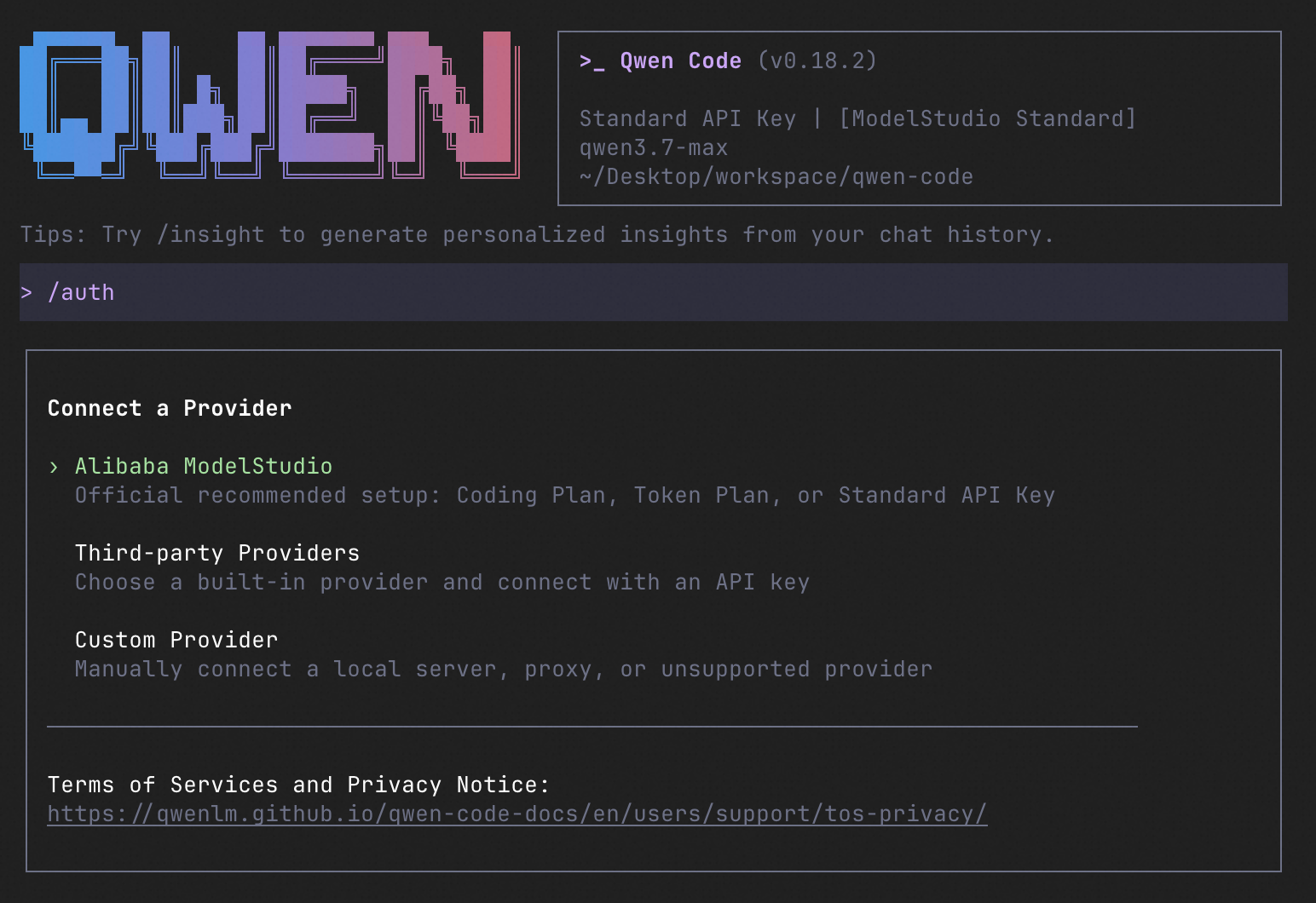
qwen          # Launch interactive terminal UI
# Inside the session:
/auth         # Configure your provider and API key
See the Authentication Guide and Settings Reference for detailed setup.
How to Use Qwen Code
| Mode | Command | Use Case |
|---|---|---|
| Interactive | qwen |
Terminal UI with rich rendering, @file references, slash commands |
| Headless | qwen -p "..." |
Scripts, CI/CD, batch processing — no UI |
| IDE | — | VS Code, Zed, JetBrains |
| Desktop | — | Qwen Code Desktop — GUI for macOS, Windows, Linux |
| Daemon | qwen serve |
Shared agent session over HTTP+SSE (ACP). Multiple clients, one agent. (experimental) Docs |
| SDK | — | TypeScript, Python, Java |
| IM Bot | qwen channel |
Connect to Telegram, DingTalk, WeChat, or Feishu |
SDK example (Python)
import asyncio

from qwen_code_sdk import is_sdk_result_message, query


async def main() -> None:
    result = query(
        "Summarize the repository layout.",
        {
            "cwd": "/path/to/project",
            "path_to_qwen_executable": "qwen",
        },
    )

    async for message in result:
        if is_sdk_result_message(message):
            print(message["result"])


asyncio.run(main())
Capabilities
If you know Claude Code, you already know Qwen Code — and then some. We've put significant effort into bringing Qwen Code to feature parity with Claude Code, improving both breadth and reliability across the board.
| Feature | Qwen Code | Claude Code |
|---|---|---|
| SubAgents, Agent Teams, Dynamic Workflows | ✓ | ✓ |
| Auto-Memory, Auto-Skills, Hooks | ✓ | ✓ |
| Built-in Skills (/review, /batch, /loop, /bugfix…) | ✓ | ✓ |
| MCP, Plan Mode, LSP Integration | ✓ | ✓ |
| Auto Mode, Sandbox, Git Worktrees | ✓ | ✓ |
| Computer Use (desktop automation) | ✓ | ✓ |
| IDE Plugins (VS Code / JetBrains / Zed) | ✓ | ✓ |
| SDK | ✓ | ✓ |
| Headless Mode, Session Management | ✓ | ✓ |
| Open-source — model and framework | ✓ | — |
| Multi-protocol (OpenAI / Anthropic / Gemini / Qwen + any provider) | ✓ | — |
| Agent Arena (multi-model head-to-head on same task) | ✓ | — |
Daemon Mode — qwen serve (multi-client shared agent) |
✓ | — |
| IM Channels (Telegram / DingTalk / WeChat / Feishu) | ✓ | — |
Ecosystem
-
Qwen Code Desktop — Official desktop app for macOS, Windows, and Linux
-
AionUi — A modern GUI for command-line AI tools including Qwen Code
-
Gemini CLI Desktop — A cross-platform desktop/web/mobile UI for Qwen Code
-
🦞 Qwen Code Claw — Let other agents (Claude, Codex, etc.) delegate coding tasks to Qwen Code via ACP. Paste this prompt into your agent:
Use Qwen Code as a coding agent. First, fetch and read this skill reference:
https://raw.githubusercontent.com/QwenLM/qwen-code/refs/heads/main/.qwen/skills/qwen-code-claw/SKILL.md
Then follow the instructions inside to install, authenticate, and use Qwen Code via acpx for all coding tasks.
Contributing
Contributions are welcome! See CONTRIBUTING.md for guidelines.
Acknowledgments
This project was originally based on Google Gemini CLI v0.8.2. We gratefully acknowledge the Gemini CLI team's excellent work. Starting from Qwen Code v0.1, we stopped syncing with upstream and began independent development as a multi-protocol, multi-platform agent framework with deep integrations for Qwen models and beyond.