 f420742831
Some checks are pending
Qwen Code CI / Test-6 (push) Blocked by required conditions
Qwen Code CI / Test-7 (push) Blocked by required conditions
Qwen Code CI / Test-8 (push) Blocked by required conditions
Qwen Code CI / Post Coverage Comment (push) Blocked by required conditions
Qwen Code CI / CodeQL (push) Waiting to run
E2E Tests / E2E Test (Linux) - sandbox:docker (push) Waiting to run
E2E Tests / E2E Test (Linux) - sandbox:none (push) Waiting to run
E2E Tests / E2E Test - macOS (push) Waiting to run
Qwen Code CI / Lint (push) Waiting to run
Qwen Code CI / Test (push) Blocked by required conditions
Qwen Code CI / Test-1 (push) Blocked by required conditions
Qwen Code CI / Test-2 (push) Blocked by required conditions
Qwen Code CI / Test-3 (push) Blocked by required conditions
Qwen Code CI / Test-4 (push) Blocked by required conditions
Qwen Code CI / Test-5 (push) Blocked by required conditions
* feat(cli,core): generate tool-use summaries for compact mode

After each tool batch completes, fire a parallel fast-model call to
generate a short git-commit-subject-style label summarizing what the
batch accomplished (e.g. "Read txt files", "Searched in auth/"). In
compact mode the label replaces the generic "Tool × N" header so N
parallel tool calls collapse to a single semantic row.

The fast-model call (~1s) runs fire-and-forget, overlapped with the
next turn's API stream, so there is no perceived latency. Missing
fast model, aborted turns, and model failures all degrade silently to
the existing rendering.

The summary is also emitted as a `tool_use_summary` history entry
with `precedingToolUseIds`, keeping the shape compatible with SDK
clients that want to render collapsed tool views on their own.

Gated by `experimental.emitToolUseSummaries` (default on). Can be
overridden per-session with `QWEN_CODE_EMIT_TOOL_USE_SUMMARIES=0|1`.

The system prompt and truncation rules (300 chars per tool field,
200 chars of trailing assistant text as intent prefix) match the
existing behavior seen in other tools that emit the same message
type, so SDK consumers see a consistent shape across clients.

* fix(core): bound cleanSummary quote-strip regex to avoid ReDoS

CodeQL js/polynomial-redos flagged the /^["'`]+|["'`]+$/g pattern in
cleanSummary because its input comes from an LLM (treated as
uncontrolled). The original regex is anchored and linear in practice,
but tightening the quantifier to {1,10} both satisfies the static
check and caps engine work on pathological model output with a long
run of quotes. Ten opening/closing quotes is well past anything a real
label would produce.

* fix(cli): render tool_use_summary inline so full mode also shows the label

The summary was only visible in compact mode because the full-mode
ToolGroupMessage ignored the compactLabel prop. Compact mode got away
with this because mergeCompactToolGroups triggers refreshStatic(),
which re-renders the merged tool_group with its newly-looked-up
label. Full mode has no such refresh path, so when the fast-model
call resolves *after* the tool_group has been committed to the
append-only <Static>, there is no way to retroactively decorate it.

Switch to rendering `tool_use_summary` as its own inline history item
(a single dim `● <label>` line). New items append cleanly to <Static>,
so the summary flows in naturally once the fast-model call resolves.
Compact mode still replaces the merged tool_group header with the
label and hides the standalone summary line via the `compactMode`
guard.

With this, the feature works under the default `ui.compactMode: false`
— not just the opt-in compact view.

* docs: tool-use-summaries feature guide, settings entry, and design doc

Three new docs matching the existing fast-model feature docs layout:

- docs/users/features/tool-use-summaries.md — user-facing guide
  covering full + compact rendering, configuration (settings + env),
  failure modes, cost, and cross-links to followup-suggestions.

- docs/users/configuration/settings.md — register the new
  experimental.emitToolUseSummaries setting next to the other
  fast-model-driven UI settings.

- docs/design/tool-use-summary/tool-use-summary-design.md — deep dive
  matching the compact-mode-design.md competitive-analysis style.
  Documents the Claude Code port (prompt, truncation, timing, gate),
  the deviations (settings layer, default on, cleanSummary, dual
  render paths), and the Ink <Static> append-only rationale that
  drove the inline full-mode render vs header-replacement split.

* docs: add Recommended pairing section to tool-use-summaries

Full-mode rendering of the summary works, but for small same-type
batches (Read × 3 and similar) the label visibly restates what the
tool lines already show. Pairing with ui.compactMode: true folds
the whole batch into a single labeled row, which is the cleanest
transcript shape once the label is available.

Adds a dedicated section showing the paired settings.json snippet
and explicitly calling out when each mode wins (and when to turn
the feature off instead).

* fix: address review feedback on tool-use summary generation

Addresses multiple issues from @chiga0's review:

Blocking — compact-mode label invisible for single-batch turns.
mergeCompactToolGroups's adjacency-only gating left a trailing
tool_use_summary in the merged result whenever there was no second
batch to merge across. That pushed mergedHistory.length lock-step
with history.length and MainContent's refreshStatic heuristic
(currMLen <= prevMLen) never fired, so Ink's append-only <Static>
never repainted the tool_group with its newly-looked-up label.
Drop tool_use_summary items unconditionally now; gemini_thought
still survives to avoid unnecessary repaints. New tests cover
the single-batch case and the summary-before-user-message case.

Blocking — stale summary appears after Ctrl+C on the next turn.
summarySignal captured the CURRENT turn's AbortController, but the
summary resolves during the NEXT turn's streaming window. The next
turn's submitQuery allocates a fresh controller, so the captured
signal was never aborted — Ctrl+C during the new turn used to let
the previous turn's summary land in the transcript seconds later.
Fix: dedicated per-batch AbortController tracked in a ref set,
aborted eagerly from cancelOngoingRequest; resolve-time check reads
the live abort state and turnCancelledRef.

High — summarizer input pollution.
geminiTools contained error/cancelled tools; retry-loop warnings
and "Cancelled by user" strings were feeding the fast model.
cleanSummary can only reject error-shaped output, not prevent the
model from hallucinating a plausible label from bad input (the PR's
own tmux screenshot showed "Read txt files · 5 tools" where 4 of
the 5 were prior-retry failures). Filter to status === 'success'
before building the prompt; skip the call entirely if nothing's
left.

High — unstable label on merged groups.
getCompactLabel iterated all callIds and returned the first hit,
so asynchronous resolution order made the header visibly flip
from SB to SA when batch A resolved after batch B. Lock onto
item.tools[0].callId to keep stable "leading batch governs"
semantics.

High — force-expanded groups in compact mode had no label at all.
Compact mode routes non-force-expand groups through
CompactToolGroupDisplay (consumes compactLabel) and force-expand
groups through the full ToolGroupMessage (ignores compactLabel);
the standalone ● line was gated on !compactMode, creating a dead
zone — exactly the diagnostically valuable case. MainContent now
computes absorbedCallIds (which groups actually consume the
header replacement) and passes summaryAbsorbed to
HistoryItemDisplay; force-expand groups in compact mode get the
standalone line as the label's only path to the screen.

Medium — cleanSummary robustness.
Extend quote-strip to Unicode curly + CJK corner brackets; strip
markdown emphasis (**bold**, _italic_); broaden refusal-prefix
rejection to curly-apostrophe "I can't", Chinese "我无法 / 我不能 /
抱歉 / 无法", and "Failed to / Sorry, / Request failed". 7 new
cleanSummary tests cover the added cases.

Low — concurrent-rendering safety.
Move historyRef.current = history from render phase into
useLayoutEffect so bailed renders can't leave a dropped value.

Low — CompactToolGroupDisplay readability.
Extract renderSummaryHeader / renderDefaultHeader helpers and
document the toolCalls.length > 1 count-suffix guard so a future
"fix" to >= 1 doesn't reintroduce "Read config.json · 1 tools".

Docs — add Scope & Lifecycle section to tool-use-summaries.md
covering (1) one generation per batch shared by both modes,
(2) no backfill on toggle / session resume, (3) main-agent batches
only with the Task-tool clarification.

* fix: address second-round review feedback on tool-use summaries

Critical — force-expand groups lost their summary entirely.
Previous round's "drop tool_use_summary unconditionally" merge fix
also stripped summaries for force-expanded groups, defeating the
exact case (errors, confirmations, focused shell) where the
standalone ● label is the label's only path to the screen. The
merge function now takes an absorbedCallIds set: summaries whose
preceding callIds are all absorbed by a compact tool_group header
are dropped (so refreshStatic still fires), but force-expanded
summaries pass through to be rendered standalone by
HistoryItemDisplay. MainContent computes absorbedCallIds from raw
history and passes it in. New tests cover both the absorbed-drop
and the force-expand-preserve cases plus the empty-set default
for callers that don't compute absorption.

Suggestion — late-arriving summaries could land out of order.
A slow fast-model call could resolve after the next turn's
content was committed, planting the ● label between later items
in full mode. The resolve callback now captures the first batch
callId, locates the corresponding tool_group at resolve time,
and drops the summary if a newer tool_group has already appeared
in history. New test exercises this with a manually-resolved
fast-model promise.

Suggestion — truncateJson allocated full JSON for large strings.
A 10MB ReadFile result was being JSON.stringify'd in full only to
be sliced down to 300 chars. Added preTruncate that walks the
value (depth-bounded to 4) and slices string leaves to maxLength
before serialization. Tests verify the input never reaches its
full pre-cap form.

Suggestion — settings description over-claimed SDK emission.
The description said summaries are emitted to SDK clients as a
tool_use_summary message; the SDK plumbing isn't actually wired
in this PR (the factory is exported for follow-up). Updated
settings.json description and regenerated the vscode schema to
state CLI-only scope explicitly.

Suggestion — fastModel data-boundary not documented.
When fastModel uses a different provider than the main session
model, tool inputs/outputs cross a new auth boundary that users
may not expect. Added "Data flow & privacy" section to the user
feature doc spelling out: same-provider fast model = no scope
change; different-provider = strictly larger sharing scope; two
escape hatches (same-provider fast model OR feature off).
Code-level mitigation (metadata-only mode) deferred.
|
||
|---|---|---|
| .github | ||
| .husky | ||
| .qwen | ||
| .vscode | ||
| docs | ||
| docs-site | ||
| eslint-rules | ||
| integration-tests | ||
| packages | ||
| scripts | ||
| .dockerignore | ||
| .editorconfig | ||
| .gitattributes | ||
| .gitignore | ||
| .npmrc | ||
| .nvmrc | ||
| .prettierignore | ||
| .prettierrc.json | ||
| .yamllint.yml | ||
| AGENTS.md | ||
| CONTRIBUTING.md | ||
| Dockerfile | ||
| esbuild.config.js | ||
| eslint.config.js | ||
| LICENSE | ||
| Makefile | ||
| package-lock.json | ||
| package.json | ||
| README.md | ||
| SECURITY.md | ||
| tsconfig.json | ||
| vitest.config.ts | ||




An open-source AI agent that lives in your terminal.
中文 | Deutsch | français | 日本語 | Русский | Português (Brasil)
🎉 News
-
2026-04-15: Qwen OAuth free tier has been discontinued. To continue using Qwen Code, switch to Alibaba Cloud Coding Plan, OpenRouter, Fireworks AI, or bring your own API key. Run
qwen authto configure. -
2026-04-13: Qwen OAuth free tier policy update: daily quota adjusted to 100 requests/day (from 1,000).
-
2026-04-02: Qwen3.6-Plus is now live! Get an API key from Alibaba Cloud ModelStudio to access it through the OpenAI-compatible API.
-
2026-02-16: Qwen3.5-Plus is now live!
Why Qwen Code?
Qwen Code is an open-source AI agent for the terminal, optimized for Qwen series models. It helps you understand large codebases, automate tedious work, and ship faster.
- Multi-protocol, flexible providers: use OpenAI / Anthropic / Gemini-compatible APIs, Alibaba Cloud Coding Plan, OpenRouter, Fireworks AI, or bring your own API key.
- Open-source, co-evolving: both the framework and the Qwen3-Coder model are open-source—and they ship and evolve together.
- Agentic workflow, feature-rich: rich built-in tools (Skills, SubAgents) for a full agentic workflow and a Claude Code-like experience.
- Terminal-first, IDE-friendly: built for developers who live in the command line, with optional integration for VS Code, Zed, and JetBrains IDEs.
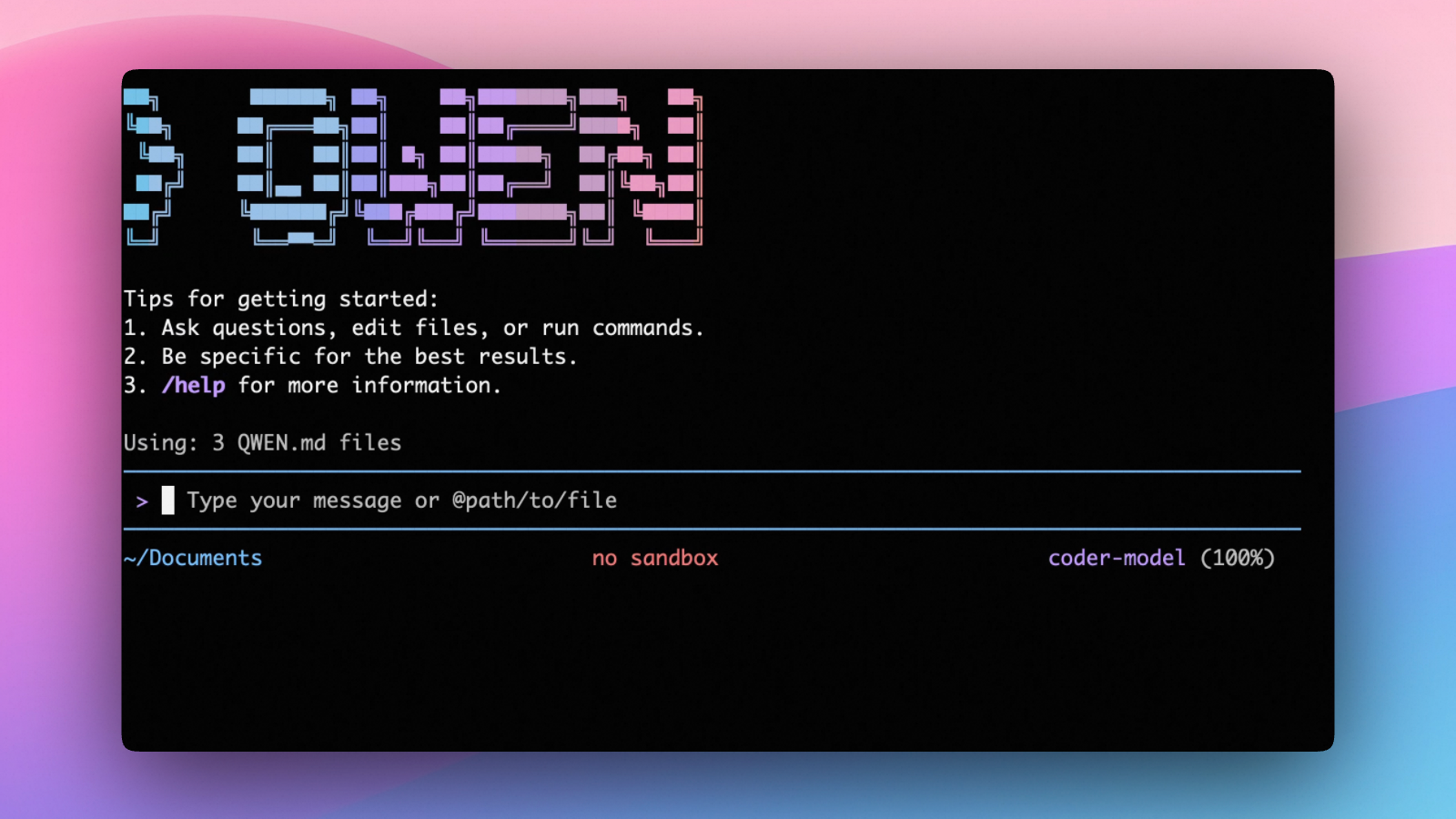
Installation
Quick Install (Recommended)
Linux / macOS
bash -c "$(curl -fsSL https://qwen-code-assets.oss-cn-hangzhou.aliyuncs.com/installation/install-qwen.sh)"
Windows (Run as Administrator)
Works in both Command Prompt and PowerShell:
powershell -Command "Invoke-WebRequest 'https://qwen-code-assets.oss-cn-hangzhou.aliyuncs.com/installation/install-qwen.bat' -OutFile (Join-Path $env:TEMP 'install-qwen.bat'); & (Join-Path $env:TEMP 'install-qwen.bat')"
Note
: It's recommended to restart your terminal after installation to ensure environment variables take effect.
Manual Installation
Prerequisites
Make sure you have Node.js 20 or later installed. Download it from nodejs.org.
NPM
npm install -g @qwen-code/qwen-code@latest
Homebrew (macOS, Linux)
brew install qwen-code
Quick Start
# Start Qwen Code (interactive)
qwen

# Then, in the session:
/help
/auth
On first use, you'll be prompted to sign in. You can run /auth anytime to switch authentication methods.
Example prompts:
What does this project do?
Explain the codebase structure.
Help me refactor this function.
Generate unit tests for this module.
Click to watch a demo video
🦞 Use Qwen Code for Coding Tasks in Claw
Copy the prompt below and paste it into your agent:
Use Qwen Code as a coding agent. First, fetch and read this skill reference:
https://raw.githubusercontent.com/QwenLM/qwen-code/refs/heads/main/.qwen/skills/qwen-code-claw/SKILL.md
Then follow the instructions inside to install, authenticate, and use Qwen Code via acpx for all coding tasks.
Authentication
Qwen Code supports the following authentication methods:
- API Key (recommended): use an API key from Alibaba Cloud Model Studio (Beijing / intl) or any supported provider (OpenAI, Anthropic, Google GenAI, and other compatible endpoints).
- Coding Plan: subscribe to the Alibaba Cloud Coding Plan (Beijing / intl) for a fixed monthly fee with higher quotas.
⚠️ Qwen OAuth was discontinued on April 15, 2026. If you were previously using Qwen OAuth, please switch to one of the methods above. Run
qwenand then/authto reconfigure.
API Key (recommended)
Use an API key to connect to Alibaba Cloud Model Studio or any supported provider. Supports multiple protocols:
- OpenAI-compatible: Alibaba Cloud ModelStudio, ModelScope, OpenAI, OpenRouter, and other OpenAI-compatible providers
- Anthropic: Claude models
- Google GenAI: Gemini models
The recommended way to configure models and providers is by editing ~/.qwen/settings.json (create it if it doesn't exist). This file lets you define all available models, API keys, and default settings in one place.
Quick Setup in 3 Steps
Step 1: Create or edit ~/.qwen/settings.json
Here is a complete example:
{
  "modelProviders": {
    "openai": [
      {
        "id": "qwen3.6-plus",
        "name": "qwen3.6-plus",
        "baseUrl": "https://dashscope.aliyuncs.com/compatible-mode/v1",
        "description": "Qwen3-Coder via Dashscope",
        "envKey": "DASHSCOPE_API_KEY"
      }
    ]
  },
  "env": {
    "DASHSCOPE_API_KEY": "sk-xxxxxxxxxxxxx"
  },
  "security": {
    "auth": {
      "selectedType": "openai"
    }
  },
  "model": {
    "name": "qwen3.6-plus"
  }
}
Step 2: Understand each field
| Field | What it does |
|---|---|
modelProviders |
Declares which models are available and how to connect to them. Keys like openai, anthropic, gemini represent the API protocol. |
modelProviders[].id |
The model ID sent to the API (e.g. qwen3.6-plus, gpt-4o). |
modelProviders[].envKey |
The name of the environment variable that holds your API key. |
modelProviders[].baseUrl |
The API endpoint URL (required for non-default endpoints). |
env |
A fallback place to store API keys (lowest priority; prefer .env files or export for sensitive keys). |
security.auth.selectedType |
The protocol to use on startup (openai, anthropic, gemini, vertex-ai). |
model.name |
The default model to use when Qwen Code starts. |
Step 3: Start Qwen Code — your configuration takes effect automatically:
qwen
Use the /model command at any time to switch between all configured models.
More Examples
Coding Plan (Alibaba Cloud ModelStudio) — fixed monthly fee, higher quotas
{
  "modelProviders": {
    "openai": [
      {
        "id": "qwen3.6-plus",
        "name": "qwen3.6-plus (Coding Plan)",
        "baseUrl": "https://coding.dashscope.aliyuncs.com/v1",
        "description": "qwen3.6-plus from ModelStudio Coding Plan",
        "envKey": "BAILIAN_CODING_PLAN_API_KEY"
      },
      {
        "id": "qwen3.5-plus",
        "name": "qwen3.5-plus (Coding Plan)",
        "baseUrl": "https://coding.dashscope.aliyuncs.com/v1",
        "description": "qwen3.5-plus with thinking enabled from ModelStudio Coding Plan",
        "envKey": "BAILIAN_CODING_PLAN_API_KEY",
        "generationConfig": {
          "extra_body": {
            "enable_thinking": true
          }
        }
      },
      {
        "id": "glm-4.7",
        "name": "glm-4.7 (Coding Plan)",
        "baseUrl": "https://coding.dashscope.aliyuncs.com/v1",
        "description": "glm-4.7 with thinking enabled from ModelStudio Coding Plan",
        "envKey": "BAILIAN_CODING_PLAN_API_KEY",
        "generationConfig": {
          "extra_body": {
            "enable_thinking": true
          }
        }
      },
      {
        "id": "kimi-k2.5",
        "name": "kimi-k2.5 (Coding Plan)",
        "baseUrl": "https://coding.dashscope.aliyuncs.com/v1",
        "description": "kimi-k2.5 with thinking enabled from ModelStudio Coding Plan",
        "envKey": "BAILIAN_CODING_PLAN_API_KEY",
        "generationConfig": {
          "extra_body": {
            "enable_thinking": true
          }
        }
      }
    ]
  },
  "env": {
    "BAILIAN_CODING_PLAN_API_KEY": "sk-xxxxxxxxxxxxx"
  },
  "security": {
    "auth": {
      "selectedType": "openai"
    }
  },
  "model": {
    "name": "qwen3.6-plus"
  }
}
Subscribe to the Coding Plan and get your API key at Alibaba Cloud ModelStudio(Beijing) or Alibaba Cloud ModelStudio(intl).
Multiple providers (OpenAI + Anthropic + Gemini)
{
  "modelProviders": {
    "openai": [
      {
        "id": "gpt-4o",
        "name": "GPT-4o",
        "envKey": "OPENAI_API_KEY",
        "baseUrl": "https://api.openai.com/v1"
      }
    ],
    "anthropic": [
      {
        "id": "claude-sonnet-4-20250514",
        "name": "Claude Sonnet 4",
        "envKey": "ANTHROPIC_API_KEY"
      }
    ],
    "gemini": [
      {
        "id": "gemini-2.5-pro",
        "name": "Gemini 2.5 Pro",
        "envKey": "GEMINI_API_KEY"
      }
    ]
  },
  "env": {
    "OPENAI_API_KEY": "sk-xxxxxxxxxxxxx",
    "ANTHROPIC_API_KEY": "sk-ant-xxxxxxxxxxxxx",
    "GEMINI_API_KEY": "AIzaxxxxxxxxxxxxx"
  },
  "security": {
    "auth": {
      "selectedType": "openai"
    }
  },
  "model": {
    "name": "gpt-4o"
  }
}
Enable thinking mode (for supported models like qwen3.5-plus)
{
  "modelProviders": {
    "openai": [
      {
        "id": "qwen3.5-plus",
        "name": "qwen3.5-plus (thinking)",
        "envKey": "DASHSCOPE_API_KEY",
        "baseUrl": "https://dashscope.aliyuncs.com/compatible-mode/v1",
        "generationConfig": {
          "extra_body": {
            "enable_thinking": true
          }
        }
      }
    ]
  },
  "env": {
    "DASHSCOPE_API_KEY": "sk-xxxxxxxxxxxxx"
  },
  "security": {
    "auth": {
      "selectedType": "openai"
    }
  },
  "model": {
    "name": "qwen3.5-plus"
  }
}
Tip: You can also set API keys via
exportin your shell or.envfiles, which take higher priority thansettings.json→env. See the authentication guide for full details.
Security note: Never commit API keys to version control. The
~/.qwen/settings.jsonfile is in your home directory and should stay private.
Local Model Setup (Ollama / vLLM)
You can also run models locally — no API key or cloud account needed. This is not an authentication method; instead, configure your local model endpoint in ~/.qwen/settings.json using the modelProviders field.
Ollama setup
- Install Ollama from ollama.com
- Pull a model:
ollama pull qwen3:32b - Configure
~/.qwen/settings.json:
{
  "modelProviders": {
    "openai": [
      {
        "id": "qwen3:32b",
        "name": "Qwen3 32B (Ollama)",
        "baseUrl": "http://localhost:11434/v1",
        "description": "Qwen3 32B running locally via Ollama"
      }
    ]
  },
  "security": {
    "auth": {
      "selectedType": "openai"
    }
  },
  "model": {
    "name": "qwen3:32b"
  }
}
vLLM setup
- Install vLLM:
pip install vllm - Start the server:
vllm serve Qwen/Qwen3-32B - Configure
~/.qwen/settings.json:
{
  "modelProviders": {
    "openai": [
      {
        "id": "Qwen/Qwen3-32B",
        "name": "Qwen3 32B (vLLM)",
        "baseUrl": "http://localhost:8000/v1",
        "description": "Qwen3 32B running locally via vLLM"
      }
    ]
  },
  "security": {
    "auth": {
      "selectedType": "openai"
    }
  },
  "model": {
    "name": "Qwen/Qwen3-32B"
  }
}
Usage
As an open-source terminal agent, you can use Qwen Code in four primary ways:
- Interactive mode (terminal UI)
- Headless mode (scripts, CI)
- IDE integration (VS Code, Zed)
- SDKs (TypeScript, Python, Java)
Interactive mode
cd your-project/
qwen
Run qwen in your project folder to launch the interactive terminal UI. Use @ to reference local files (for example @src/main.ts).
Headless mode
cd your-project/
qwen -p "your question"
Use -p to run Qwen Code without the interactive UI—ideal for scripts, automation, and CI/CD. Learn more: Headless mode.
IDE integration
Use Qwen Code inside your editor (VS Code, Zed, and JetBrains IDEs):
SDKs
Build on top of Qwen Code with the available SDKs:
- TypeScript: Use the Qwen Code SDK
- Python: Use the Python SDK
- Java: Use the Java SDK
Python SDK example:
import asyncio

from qwen_code_sdk import is_sdk_result_message, query


async def main() -> None:
    result = query(
        "Summarize the repository layout.",
        {
            "cwd": "/path/to/project",
            "path_to_qwen_executable": "qwen",
        },
    )

    async for message in result:
        if is_sdk_result_message(message):
            print(message["result"])


asyncio.run(main())
Commands & Shortcuts
Session Commands
/help- Display available commands/clear- Clear conversation history/compress- Compress history to save tokens/stats- Show current session information/bug- Submit a bug report/exitor/quit- Exit Qwen Code
Keyboard Shortcuts
Ctrl+C- Cancel current operationCtrl+D- Exit (on empty line)Up/Down- Navigate command history
Learn more about Commands
Tip: In YOLO mode (
--yolo), vision switching happens automatically without prompts when images are detected. Learn more about Approval Mode
Configuration
Qwen Code can be configured via settings.json, environment variables, and CLI flags.
| File | Scope | Description |
|---|---|---|
~/.qwen/settings.json |
User (global) | Applies to all your Qwen Code sessions. Recommended for modelProviders and env. |
.qwen/settings.json |
Project | Applies only when running Qwen Code in this project. Overrides user settings. |
The most commonly used top-level fields in settings.json:
| Field | Description |
|---|---|
modelProviders |
Define available models per protocol (openai, anthropic, gemini, vertex-ai). |
env |
Fallback environment variables (e.g. API keys). Lower priority than shell export and .env files. |
security.auth.selectedType |
The protocol to use on startup (e.g. openai). |
model.name |
The default model to use when Qwen Code starts. |
See the Authentication section above for complete
settings.jsonexamples, and the settings reference for all available options.
Benchmark Results
Terminal-Bench Performance
| Agent | Model | Accuracy |
|---|---|---|
| Qwen Code | Qwen3-Coder-480A35 | 37.5% |
| Qwen Code | Qwen3-Coder-30BA3B | 31.3% |
Ecosystem
Looking for a graphical interface?
- AionUi A modern GUI for command-line AI tools including Qwen Code
- Gemini CLI Desktop A cross-platform desktop/web/mobile UI for Qwen Code
Troubleshooting
If you encounter issues, check the troubleshooting guide.
Common issues:
Qwen OAuth free tier was discontinued on 2026-04-15: Qwen OAuth is no longer available. Runqwen→/authand switch to API Key or Coding Plan. See the Authentication section above for setup instructions.
To report a bug from within the CLI, run /bug and include a short title and repro steps.
Connect with Us
- Discord: https://discord.gg/RN7tqZCeDK
- Dingtalk: https://qr.dingtalk.com/action/joingroup?code=v1,k1,+FX6Gf/ZDlTahTIRi8AEQhIaBlqykA0j+eBKKdhLeAE=&_dt_no_comment=1&origin=1
Acknowledgments
This project is based on Google Gemini CLI. We acknowledge and appreciate the excellent work of the Gemini CLI team. Our main contribution focuses on parser-level adaptations to better support Qwen-Coder models.