 ee0cc79739
* ci(autofix): fan out review targets and stop route-scan starvation

Two throughput fixes for the review loop, both observed live:

- review-scan emitted ONE newest-first target per scan ("single-target
  worker"). With sparse cron ticks this starves older armed PRs for hours —
  an armed PR sat unprocessed for 16h while newer PRs took every tick. Emit
  EVERY eligible target instead: the address matrix's max-parallel (3) bounds
  simultaneity and the per-PR concurrency groups already prevent duplicate
  same-PR runs, so one surviving scan drains the whole backlog.

- route used a single shared concurrency group with cancel-in-progress. Under
  runner backlog a route job sits QUEUED for minutes, and any newer event
  (review submissions arrive constantly) cancelled it — five consecutive
  dispatched scans died this way; during event storms no full scan survived
  at all. Cron ticks keep deduping through a shared 'route-cron' group, but
  dispatches and review/issue events now get unique per-run groups: route is
  a seconds-long job, so never cancelling it costs nothing and every trigger
  is guaranteed to route.

Contract test updated: fan-out asserted (no single-target break, matrix
max-parallel), new route concurrency expression pinned. 50/50.

* ci(autofix): cap targets emitted per scan (review defense-in-depth)

Review note on the fan-out: bound the scan's output for a pathological
backlog. Clarifications recorded in-thread — the loop lives in review-scan
(timeout 15m), not route (5m), and the pre-change worst case already walked
the full candidate list (break fired on the first ELIGIBLE PR, not the first
candidate) — but an explicit bound is good hygiene: emit at most
MAX_TARGETS_PER_SCAN (10) targets, LOG the deferral (never a silent cap),
and let the next scan pick up the remainder since their signals persist.
Contract test pins the cap, the deferral log, and the slice.

* ci(autofix): review round 2 — per-target route coalescing, busy-PR skip, in-loop budget

Both criticals and the suggestion from review, each verified against live
campaign observations:

- Route concurrency is now keyed by TARGET: cron ticks still coalesce with
  each other; review events coalesce PER PR (near-simultaneous reviews on one
  PR route once — the one useful side effect of the old shared group,
  restored — without events on other PRs cancelling this one); issue events
  coalesce per issue; dispatches stay unique and are never cancelled. This
  keeps the starvation fix while closing the duplicate-forced-scan window the
  per-run_id grouping had opened.
- The scan now skips any PR whose review-address job is RUNNING OR QUEUED in
  a live autofix run (one runs-list plus a jobs-view per live run). A
  fanned-out matrix holds queued jobs past a 10-minute tick and
  schedule/dispatch runs never surface in the PR's checks, so without this
  the next scan re-emitted the same PRs and per-PR groups accumulated
  duplicates that later replayed stale watermarks — the exact duplicate-round
  behavior observed live on the fleet.
- The per-scan target budget now BREAKS the candidate loop instead of slicing
  after it, so it genuinely bounds scan runtime and API usage (each candidate
  costs several serial reads); the deferral is logged and the remainder keeps
  its signals for the next scan.

Contract test updated for all three (route expression per target, busy-skip
message + capture regex, in-loop budget break). 50/50.

* ci(autofix): discard stale duplicate targets via live-watermark revalidation

Review: the busy-set closes the queued-matrix window but not the pre-matrix
one — two near-simultaneous same-PR triggers can both scan before either has
emitted a matrix job, so both emit the PR with the same stale watermark, and
the per-PR address group QUEUES (not discards) the duplicate.

That queueing is exactly what makes revalidation sound: address jobs for one
PR run strictly one at a time, so when the duplicate reaches prepare, the
first job's eval marker is already posted. Prepare now recomputes the
watermark from LIVE markers; if it advanced past the matrix watermark and
nothing (reviews / inline / issue comments / failed checks) is newer — and
there is no conflict — the run marks itself stale and the address + verify
steps are skipped entirely: no agent run, no marker, no comment, no push.
Contract test pins the revalidation, both step gates, and the now-three
shared address-carve-out sites. 50/50.

* ci(autofix): filter live runs server-side in the busy-set listing

A client-side status filter over the 15 newest runs loses a long-lived
fanned-out run once cron traffic (~6 runs/hr) pushes it past the
window — its queued review-address PRs silently stop looking busy and
the next scan re-emits them with a stale watermark. Query in_progress
and queued server-side instead, so the limit applies to LIVE runs only
(at most a handful) and the window cannot be starved by completed runs.
One status query failing does not hide the other (|| true per query);
an empty set stays fail-open by design — the address-side live-marker
revalidation is the second line of defense.

* ci(autofix): document route-group cases and busy-set fail-open contract

Review notes (non-blocking, adopted): a four-case summary above the
chained route-concurrency ternary for the next reader hitting it in a
blame, and an explicit contract at the busy-set listing — a double
status-query failure is deliberately fail-open because the skip is an
optimization and the address-side live-marker revalidation is the
correctness gate; if that revalidation is ever removed, this read must
become fail-closed.

* ci(autofix): discard conflict-only duplicates; fix dead recount in the stale gate

Review round: the ts-only revalidation missed a conflict-only
duplicate. Two overlapping scans emit the same conflicted PR with
watermark W; the first serialized job resolves the conflict and — with
no newer feedback — its marker keeps ts=W while its round advances.
The second job then sees CONFLICT=false live but LIVE_EVAL_WM == W, so
the strict > gate never fired and the agent re-ran against resolved
work. The gate now also extracts LIVE_MAX_ROUND and treats
same-ts-with-newer-round (conflict cleared) as a duplicate signature,
still subject to the nothing-newer recount.

The behavioral replay the reviewer asked for immediately caught a
latent bug in the previous fix: the recount jq opened with '((' and
never closed it, so it failed to compile, LIVE_NEW stayed empty, and
the whole stale gate was dead code in production. Fixed to a single
paren; the replay now proves five transitions (conflict-only duplicate
discards, first conflict job proceeds, live conflict always proceeds,
ts-advanced duplicate discards, round-advanced-with-new-feedback
proceeds).

---------

Co-authored-by: wenshao <wenshao@example.com>
|
||
|---|---|---|
| .github | ||
| .husky | ||
| .qwen | ||
| .vscode | ||
| docs | ||
| docs-site | ||
| eslint-rules | ||
| integration-tests | ||
| packages | ||
| patches | ||
| scripts | ||
| .dockerignore | ||
| .editorconfig | ||
| .gitattributes | ||
| .gitignore | ||
| .npmrc | ||
| .nvmrc | ||
| .prettierignore | ||
| .prettierrc.json | ||
| .yamllint.yml | ||
| AGENTS.md | ||
| CHANGELOG.md | ||
| CLAUDE.md | ||
| CONTRIBUTING.md | ||
| Dockerfile | ||
| esbuild.config.js | ||
| eslint.config.js | ||
| eslint.legacy-filenames.mjs | ||
| LICENSE | ||
| Makefile | ||
| package-lock.json | ||
| package.json | ||
| README.md | ||
| SECURITY.md | ||
| tsconfig.json | ||
| vitest.config.ts | ||




The open-source AI coding agent that lives in your terminal.
中文 | Deutsch | français | 日本語 | Русский | Português (Brasil)
Why Qwen Code?
- Agentic out of the box — Auto-Memory, Auto-Skills, SubAgents, Agent Teams, and MCP. Dynamic workflows, zero setup.
- Open-source, inside and out — The framework and the Qwen models are open-source. They evolve together. No vendor lock-in.
- Multi-protocol — Supports OpenAI, Anthropic, Gemini, and Qwen APIs. Any third-party provider or local model (Ollama / vLLM). Switch at runtime.
- Beyond the terminal — IDE plugins, Desktop app, daemon mode, SDKs, and IM bots (Telegram / DingTalk / WeChat / Feishu).
Tip
Qwen Code is actively iterating on itself — using its own agent and models to file issues, submit PRs, review code, and run tests. Powered by the community, driven by AI.
Installation
Linux / macOS:
curl -fsSL https://qwen-code-assets.oss-cn-hangzhou.aliyuncs.com/installation/install-qwen-standalone.sh | bash
Windows:
irm https://qwen-code-assets.oss-cn-hangzhou.aliyuncs.com/installation/install-qwen-standalone.ps1 | iex
Restart your terminal after installation to ensure environment variables take effect.
NPM / Homebrew
NPM (requires Node.js 22+):
npm install -g @qwen-code/qwen-code@latest
Homebrew (macOS / Linux):
brew install qwen-code
Quick Start
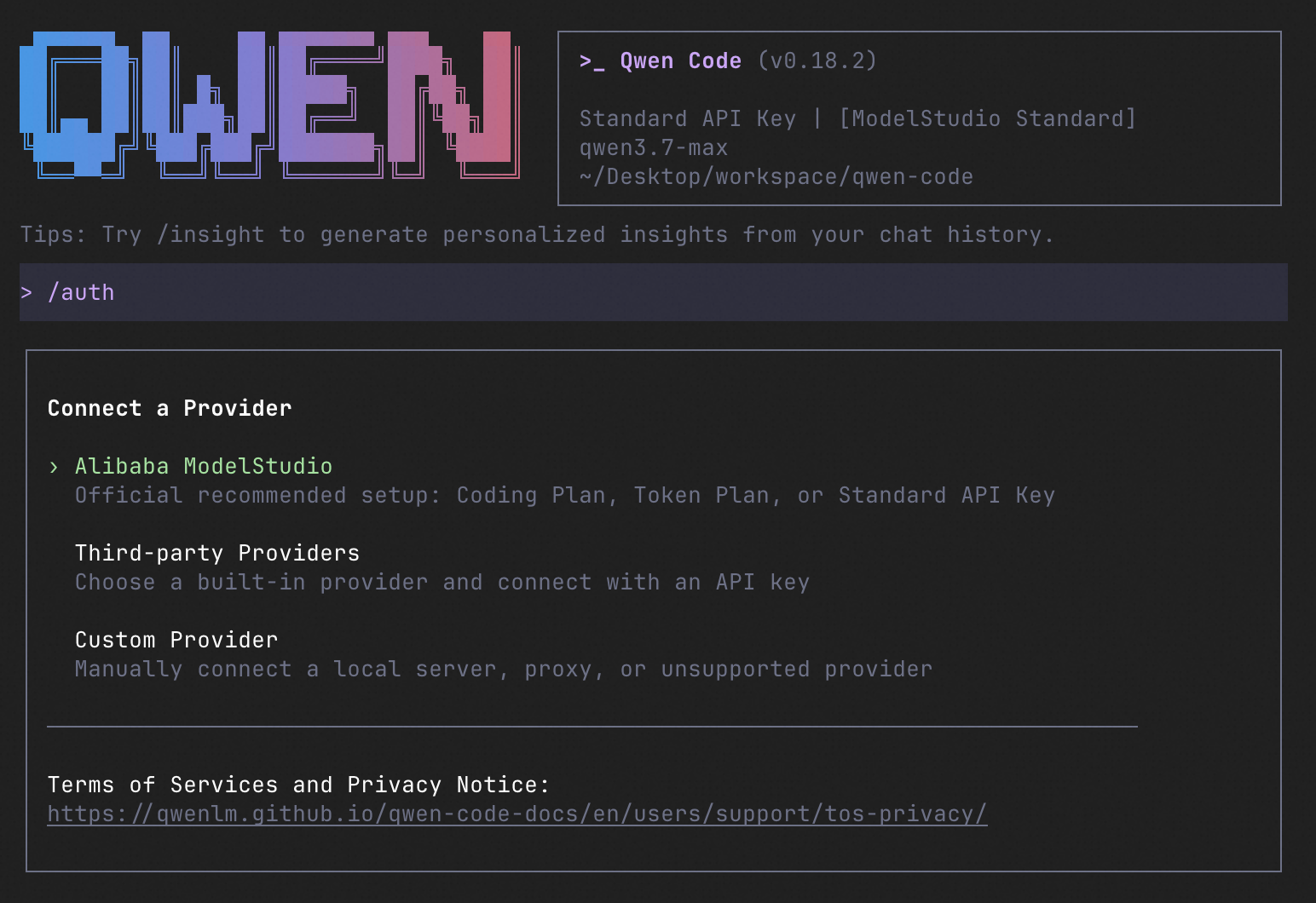
qwen          # Launch interactive terminal UI
# Inside the session:
/auth         # Configure your provider and API key
See the Authentication Guide and Settings Reference for detailed setup.
How to Use Qwen Code
| Mode | Command | Use Case |
|---|---|---|
| Interactive | qwen |
Terminal UI with rich rendering, @file references, slash commands |
| Headless | qwen -p "..." |
Scripts, CI/CD, batch processing — no UI |
| IDE | — | VS Code, Zed, JetBrains |
| Desktop | — | Qwen Code Desktop — GUI for macOS, Windows, Linux |
| Daemon | qwen serve |
Shared agent session over HTTP+SSE (ACP). Multiple clients, one agent. (experimental) Docs |
| SDK | — | TypeScript, Python, Java |
| IM Bot | qwen channel |
Connect to Telegram, DingTalk, WeChat, or Feishu |
SDK example (Python)
import asyncio

from qwen_code_sdk import is_sdk_result_message, query


async def main() -> None:
    result = query(
        "Summarize the repository layout.",
        {
            "cwd": "/path/to/project",
            "path_to_qwen_executable": "qwen",
        },
    )

    async for message in result:
        if is_sdk_result_message(message):
            print(message["result"])


asyncio.run(main())
Capabilities
If you know Claude Code, you already know Qwen Code — and then some. We've put significant effort into bringing Qwen Code to feature parity with Claude Code, improving both breadth and reliability across the board.
| Feature | Qwen Code | Claude Code |
|---|---|---|
| SubAgents, Agent Teams, Dynamic Workflows | ✓ | ✓ |
| Auto-Memory, Auto-Skills, Hooks | ✓ | ✓ |
| Built-in Skills (/review, /batch, /loop, /bugfix…) | ✓ | ✓ |
| MCP, Plan Mode, LSP Integration | ✓ | ✓ |
| Auto Mode, Sandbox, Git Worktrees | ✓ | ✓ |
| Computer Use (desktop automation) | ✓ | ✓ |
| IDE Plugins (VS Code / JetBrains / Zed) | ✓ | ✓ |
| SDK | ✓ | ✓ |
| Headless Mode, Session Management | ✓ | ✓ |
| Open-source — model and framework | ✓ | — |
| Multi-protocol (OpenAI / Anthropic / Gemini / Qwen + any provider) | ✓ | — |
| Agent Arena (multi-model head-to-head on same task) | ✓ | — |
Daemon Mode — qwen serve (multi-client shared agent) |
✓ | — |
| IM Channels (Telegram / DingTalk / WeChat / Feishu) | ✓ | — |
Ecosystem
-
Qwen Code Desktop — Official desktop app for macOS, Windows, and Linux
-
AionUi — A modern GUI for command-line AI tools including Qwen Code
-
Gemini CLI Desktop — A cross-platform desktop/web/mobile UI for Qwen Code
-
🦞 Qwen Code Claw — Let other agents (Claude, Codex, etc.) delegate coding tasks to Qwen Code via ACP. Paste this prompt into your agent:
Use Qwen Code as a coding agent. First, fetch and read this skill reference:
https://raw.githubusercontent.com/QwenLM/qwen-code/refs/heads/main/.qwen/skills/qwen-code-claw/SKILL.md
Then follow the instructions inside to install, authenticate, and use Qwen Code via acpx for all coding tasks.
Contributing
Contributions are welcome! See CONTRIBUTING.md for guidelines.
Acknowledgments
This project was originally based on Google Gemini CLI v0.8.2. We gratefully acknowledge the Gemini CLI team's excellent work. Starting from Qwen Code v0.1, we stopped syncing with upstream and began independent development as a multi-protocol, multi-platform agent framework with deep integrations for Qwen models and beyond.