 e7362d5d08
* fix(web-shell): add explicit ::selection for message content in Firefox Firefox does not paint the default selection highlight for text whose element chain passes through a display:contents element (the data-user-selectable wrapper on MessageItem). The logical selection (copy, selectionchange popup) works fine - only the visual highlight is missing. An explicit ::selection background makes Firefox paint the highlight where the default painting fails. Fixes #8214 * fix: use fixed color instead of non-existent CSS variable --selection-bg was never defined in the codebase (only --chat-editor-selection-bg exists in App.module.css). Use a fixed hsl(210 100% 50% / 30%) to avoid confusion. * test(web-shell): pin ::selection rule and soften root-cause framing Reframe the standalone.css comment and PR description as a defensive workaround, not a confirmed root-cause fix: the data-user-selectable wrapper is shared by user and assistant rows, and the reporter's screenshot shows an embedding-page toolbar this package does not ship. Add a getComputedStyle(..., '::selection') assertion to the smoke e2e so a future cleanup cannot silently drop the rule. * fix(web-shell): move ::selection rule to component-scoped globals.css The defensive ::selection rule for [data-user-selectable] message content was in standalone.css, which is only loaded by the standalone app entry (client/main.tsx) and the e2e harness. The npm package entry (client/index.tsx via vite.lib.config.ts) never loads standalone.css, so embedded deployments of @qwen-code/web-shell - including the reporter of #8214 - did not receive the rule and still saw no selection highlight. Move it to globals.css, which is imported by App.tsx and WebShellTranscript.tsx and therefore ships with the component-scoped stylesheet. Verified against the lib build: the rule now appears in dist/index.js correctly scoped under [data-web-shell-root][data-web-shell-shadcn]. The standalone app also loads globals.css, so the e2e smoke pin still passes. Addresses the review finding on standalone.css:119. * test(web-shell): pin ::selection across all rows and in the lib bundle Address review findings on the round-3 move to globals.css: - The smoke e2e only sampled the first [data-user-selectable] row (the user row in this fixture). Assert the rule on every selectable row so a future narrowing to user rows keeps assistant rows covered. - Nothing asserted the rule survives in the npm lib bundle - the deployment this fix exists for. Add a build-artifact test that parses the injected component CSS in dist/index.js and pins the scoped [data-user-selectable] ::selection rule under [data-web-shell-root]. * test(web-shell): assert ::selection on selectable wrapper rows, not descendants Per review: querySelectorAll('[data-user-selectable] *') counts element descendants, not the wrapper rows themselves - a single user row renders 4+ descendants, so the >=2 invariant did not actually enforce that both roles are present. Match the [data-user-selectable] wrappers directly and sample one descendant per row. * test(web-shell): match ::selection lib-bundle pin by effect, not notation Per review (R6-1): the pin matched an exact selector substring (including the space) and an exact prop name, coupling to the current notation. A maintainer switching 'background' to 'background-color' (the CSS Pseudo-Elements-4 name) would fail this test with a misleading message while the e2e pin stayed green. Match the two selector halves independently and accept either prop name. --------- Co-authored-by: Shaojin Wen <shaojin.wensj@alibaba-inc.com> |
||
|---|---|---|
| .github | ||
| .husky | ||
| .qwen | ||
| .vscode | ||
| docs | ||
| docs-site | ||
| eslint-rules | ||
| integration-tests | ||
| integrations/external-context | ||
| packages | ||
| patches | ||
| scripts | ||
| .dockerignore | ||
| .editorconfig | ||
| .gitattributes | ||
| .gitignore | ||
| .npmrc | ||
| .nvmrc | ||
| .prettierignore | ||
| .prettierrc.json | ||
| .yamllint.yml | ||
| AGENTS.md | ||
| CHANGELOG.md | ||
| CLAUDE.md | ||
| CONTRIBUTING.md | ||
| Dockerfile | ||
| esbuild.config.js | ||
| eslint.config.js | ||
| eslint.legacy-filenames.mjs | ||
| LICENSE | ||
| Makefile | ||
| package-lock.json | ||
| package.json | ||
| README.md | ||
| SECURITY.md | ||
| tsconfig.json | ||
| vitest.config.ts | ||




The open-source AI coding agent that lives in your terminal.
中文 | Deutsch | français | 日本語 | Русский | Português (Brasil)
Why Qwen Code?
- Agentic out of the box — Auto-Memory, Auto-Skills, SubAgents, Agent Teams, and MCP. Dynamic workflows, zero setup.
- Open-source, inside and out — The framework and the Qwen models are open-source. They evolve together. No vendor lock-in.
- Multi-protocol — Supports OpenAI, Anthropic, Gemini, and Qwen APIs. Any third-party provider or local model (Ollama / vLLM). Switch at runtime.
- Beyond the terminal — IDE plugins, Desktop app, daemon mode, SDKs, and IM bots (Telegram / DingTalk / WeChat / Feishu).
Tip
Qwen Code is actively iterating on itself — using its own agent and models to file issues, submit PRs, review code, and run tests. Powered by the community, driven by AI.
Installation
Linux / macOS:
curl -fsSL https://qwen-code-assets.oss-cn-hangzhou.aliyuncs.com/installation/install-qwen-standalone.sh | bash
Windows:
irm https://qwen-code-assets.oss-cn-hangzhou.aliyuncs.com/installation/install-qwen-standalone.ps1 | iex
Restart your terminal after installation to ensure environment variables take effect.
NPM / Homebrew
NPM (requires Node.js 22+):
npm install -g @qwen-code/qwen-code@latest
Homebrew (macOS / Linux):
brew install qwen-code
Quick Start
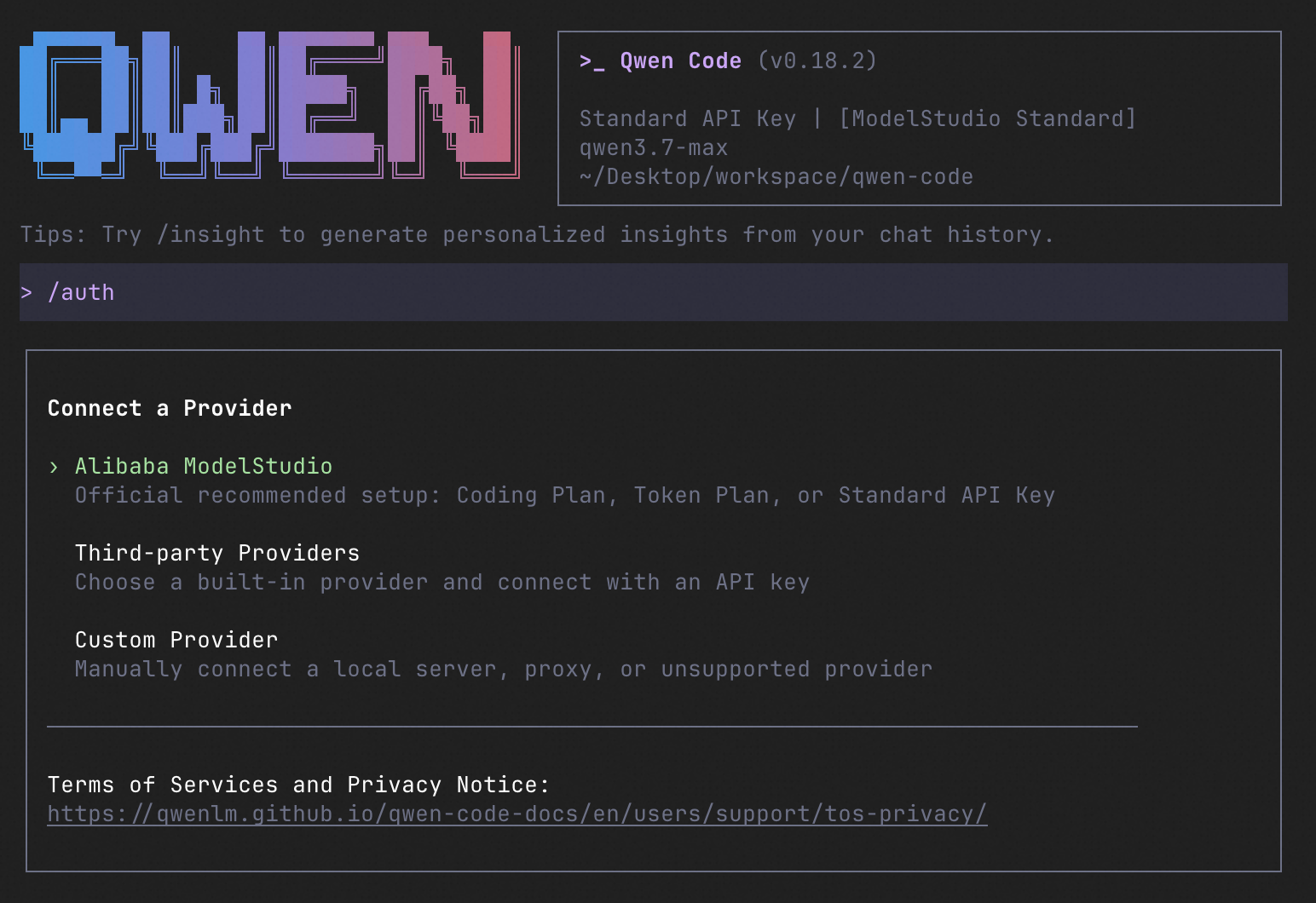
qwen          # Launch interactive terminal UI
# Inside the session:
/auth         # Configure your provider and API key
See the Authentication Guide and Settings Reference for detailed setup.
How to Use Qwen Code
| Mode | Command | Use Case |
|---|---|---|
| Interactive | qwen |
Terminal UI with rich rendering, @file references, slash commands |
| Headless | qwen -p "..." |
Scripts, CI/CD, batch processing — no UI |
| IDE | — | VS Code, Zed, JetBrains |
| Desktop | — | Qwen Code Desktop — GUI for macOS, Windows, Linux |
| Daemon | qwen serve |
Shared agent session over HTTP+SSE (ACP). Multiple clients, one agent. (experimental) Docs |
| SDK | — | TypeScript, Python, Java |
| IM Bot | qwen channel |
Connect to Telegram, DingTalk, WeChat, or Feishu |
SDK example (Python)
import asyncio

from qwen_code_sdk import is_sdk_result_message, query


async def main() -> None:
    result = query(
        "Summarize the repository layout.",
        {
            "cwd": "/path/to/project",
            "path_to_qwen_executable": "qwen",
        },
    )

    async for message in result:
        if is_sdk_result_message(message):
            print(message["result"])


asyncio.run(main())
Capabilities
If you know Claude Code, you already know Qwen Code — and then some. We've put significant effort into bringing Qwen Code to feature parity with Claude Code, improving both breadth and reliability across the board.
| Feature | Qwen Code | Claude Code |
|---|---|---|
| SubAgents, Agent Teams, Dynamic Workflows | ✓ | ✓ |
| Auto-Memory, Auto-Skills, Hooks | ✓ | ✓ |
| Built-in Skills (/review, /batch, /loop, /bugfix…) | ✓ | ✓ |
| MCP, Plan Mode, LSP Integration | ✓ | ✓ |
| Auto Mode, Sandbox, Git Worktrees | ✓ | ✓ |
| Computer Use (desktop automation) | ✓ | ✓ |
| IDE Plugins (VS Code / JetBrains / Zed) | ✓ | ✓ |
| SDK | ✓ | ✓ |
| Headless Mode, Session Management | ✓ | ✓ |
| Open-source — model and framework | ✓ | — |
| Multi-protocol (OpenAI / Anthropic / Gemini / Qwen + any provider) | ✓ | — |
| Agent Arena (multi-model head-to-head on same task) | ✓ | — |
Daemon Mode — qwen serve (multi-client shared agent) |
✓ | — |
| IM Channels (Telegram / DingTalk / WeChat / Feishu) | ✓ | — |
Ecosystem
-
Qwen Code Desktop — Official desktop app for macOS, Windows, and Linux
-
AionUi — A modern GUI for command-line AI tools including Qwen Code
-
Gemini CLI Desktop — A cross-platform desktop/web/mobile UI for Qwen Code
-
🦞 Qwen Code Claw — Let other agents (Claude, Codex, etc.) delegate coding tasks to Qwen Code via ACP. Paste this prompt into your agent:
Use Qwen Code as a coding agent. First, fetch and read this skill reference:
https://raw.githubusercontent.com/QwenLM/qwen-code/refs/heads/main/.qwen/skills/qwen-code-claw/SKILL.md
Then follow the instructions inside to install, authenticate, and use Qwen Code via acpx for all coding tasks.
Contributing
Contributions are welcome! See CONTRIBUTING.md for guidelines.
Acknowledgments
This project was originally based on Google Gemini CLI v0.8.2. We gratefully acknowledge the Gemini CLI team's excellent work. Starting from Qwen Code v0.1, we stopped syncing with upstream and began independent development as a multi-protocol, multi-platform agent framework with deep integrations for Qwen models and beyond.