 db0519563d
Some checks are pending
E2E Tests / E2E Test (Linux) - sandbox:docker - shard 1/3 (push) Waiting to run
E2E Tests / E2E Test (Linux) - sandbox:docker - shard 2/3 (push) Waiting to run
E2E Tests / E2E Test (Linux) - sandbox:docker - shard 3/3 (push) Waiting to run
E2E Tests / E2E Test (Linux) - sandbox:none - shard 1/3 (push) Waiting to run
E2E Tests / E2E Test (Linux) - sandbox:none - shard 2/3 (push) Waiting to run
E2E Tests / E2E Test (Linux) - sandbox:none - shard 3/3 (push) Waiting to run
E2E Tests / E2E Test - macOS - shard 1/2 (push) Waiting to run
E2E Tests / E2E Test - macOS - shard 2/2 (push) Waiting to run
E2E Tests / channel-plugin E2E (nightly) (push) Waiting to run
E2E Tests / cron-interactive E2E (nightly) (push) Waiting to run
E2E Tests / web-shell Browser Regression (push) Waiting to run
npm cache producer / Save npm cache (push) Waiting to run
SDK Java / ubuntu-latest / Java 11 (push) Waiting to run
SDK Java / ubuntu-latest / Java 17 (push) Waiting to run
SDK Java / macos-latest / Java 21 (push) Waiting to run
SDK Java / ubuntu-latest / Java 21 (push) Waiting to run
SDK Java / windows-latest / Java 21 (push) Waiting to run
SDK Java / Real daemon E2E / Java 11 (push) Waiting to run
Security Checks / Dependency CVE audit (push) Waiting to run
Security Checks / Secret scan (TruffleHog) (push) Waiting to run
* fix(core): parse the workflow meta literal instead of evaluating it

`extractAndStripMeta` evaluated the model-authored `export const meta = {...}`
block in a vm and then walked the result. Both halves are unbounded, and each
hangs the host on its own:

  { name: (function () { while (true) {} })() }   // spins during evaluation
  { get phases() { while (true) {} } }            // spins during the walk

The loops are synchronous, so the event loop is blocked outright — no timer
fires and nothing in-process can cancel it. Bounding them turned out to be a
moving target: a vm timeout does not reach a getter invoked on the host, and
moving the walk into the vm still leaves promise reactions, proxy traps and
runaway allocation. Each fix invited the next.

Meta is a declaration, not a computation. Every contract field is a string, and
upstream states the rule outright: the meta object must be a pure literal, with
no variables, calls, spreads or interpolation. Given that contract, evaluating
it was the wrong mechanism. Parse it instead.

A parser has no execution semantics, so none of those failures are bounded —
they are unrepresentable. There is nothing to time out, sandbox or isolate. The
vm context, the timeout and the thenable walker all go away.

The grammar is JSON's value grammar plus the spellings a model actually writes:
unquoted keys, single-quoted and substitution-free template strings, trailing
commas, and comments. Anything meaning "evaluate something" is rejected by name
so the diagnostic tells the author which rule they hit.

This narrows the contract. A meta block that computed a value used to work if
the computed field was outside the contract surface, because validateMeta
dropped it silently; now the whole literal is refused. Verified against every
meta literal in the existing suite: of the ten the parser refuses and the vm
accepted, nine are the attacks above, and the tenth is a regex literal in a
non-contract field. Zero cases where both accept and disagree on the value.
No workflow scripts ship in the repo, so nothing in tree changes behaviour.

Parsing is also ~70x faster than the vm path it replaces, which matters because
this call is on the path to the confirmation dialog and saved-workflow
enumeration.

Co-Authored-By: Claude Opus 5 (1M context) <noreply@anthropic.com>

* fix(core): handle workflow meta line terminators

---------

Co-authored-by: Claude Opus 5 (1M context) <noreply@anthropic.com>
Co-authored-by: qqqys <266654365+qqqys@users.noreply.github.com>
|
||
|---|---|---|
| .github | ||
| .husky | ||
| .qwen | ||
| .vscode | ||
| docs | ||
| docs-site | ||
| eslint-rules | ||
| integration-tests | ||
| integrations/external-context | ||
| packages | ||
| patches | ||
| scripts | ||
| .dockerignore | ||
| .editorconfig | ||
| .gitattributes | ||
| .gitignore | ||
| .npmrc | ||
| .nvmrc | ||
| .prettierignore | ||
| .prettierrc.json | ||
| .yamllint.yml | ||
| AGENTS.md | ||
| CHANGELOG.md | ||
| CLAUDE.md | ||
| CONTRIBUTING.md | ||
| Dockerfile | ||
| esbuild.config.js | ||
| eslint.config.js | ||
| eslint.legacy-filenames.mjs | ||
| LICENSE | ||
| Makefile | ||
| package-lock.json | ||
| package.json | ||
| README.md | ||
| SECURITY.md | ||
| tsconfig.json | ||
| vitest.config.ts | ||




The open-source AI coding agent that lives in your terminal.
中文 | Deutsch | français | 日本語 | Русский | Português (Brasil) | 한국어
Why Qwen Code?
- Agentic out of the box — Auto-Memory, Auto-Skills, SubAgents, Agent Teams, and MCP. Dynamic workflows, zero setup.
- Open-source, inside and out — The framework and the Qwen models are open-source. They evolve together. No vendor lock-in.
- Multi-protocol — Supports OpenAI, Anthropic, Gemini, and Qwen APIs. Any third-party provider or local model (Ollama / vLLM). Switch at runtime.
- Beyond the terminal — IDE plugins, Desktop app, daemon mode, SDKs, and IM bots (Telegram / DingTalk / WeChat / Feishu).
Tip
Qwen Code is actively iterating on itself — using its own agent and models to file issues, submit PRs, review code, and run tests. Powered by the community, driven by AI.
Installation
Linux / macOS:
curl -fsSL https://qwen-code-assets.oss-cn-hangzhou.aliyuncs.com/installation/install-qwen-standalone.sh | bash
Windows:
irm https://qwen-code-assets.oss-cn-hangzhou.aliyuncs.com/installation/install-qwen-standalone.ps1 | iex
Restart your terminal after installation to ensure environment variables take effect.
NPM / Homebrew
NPM (requires Node.js 22+):
npm install -g @qwen-code/qwen-code@latest
Homebrew (macOS / Linux):
brew install qwen-code
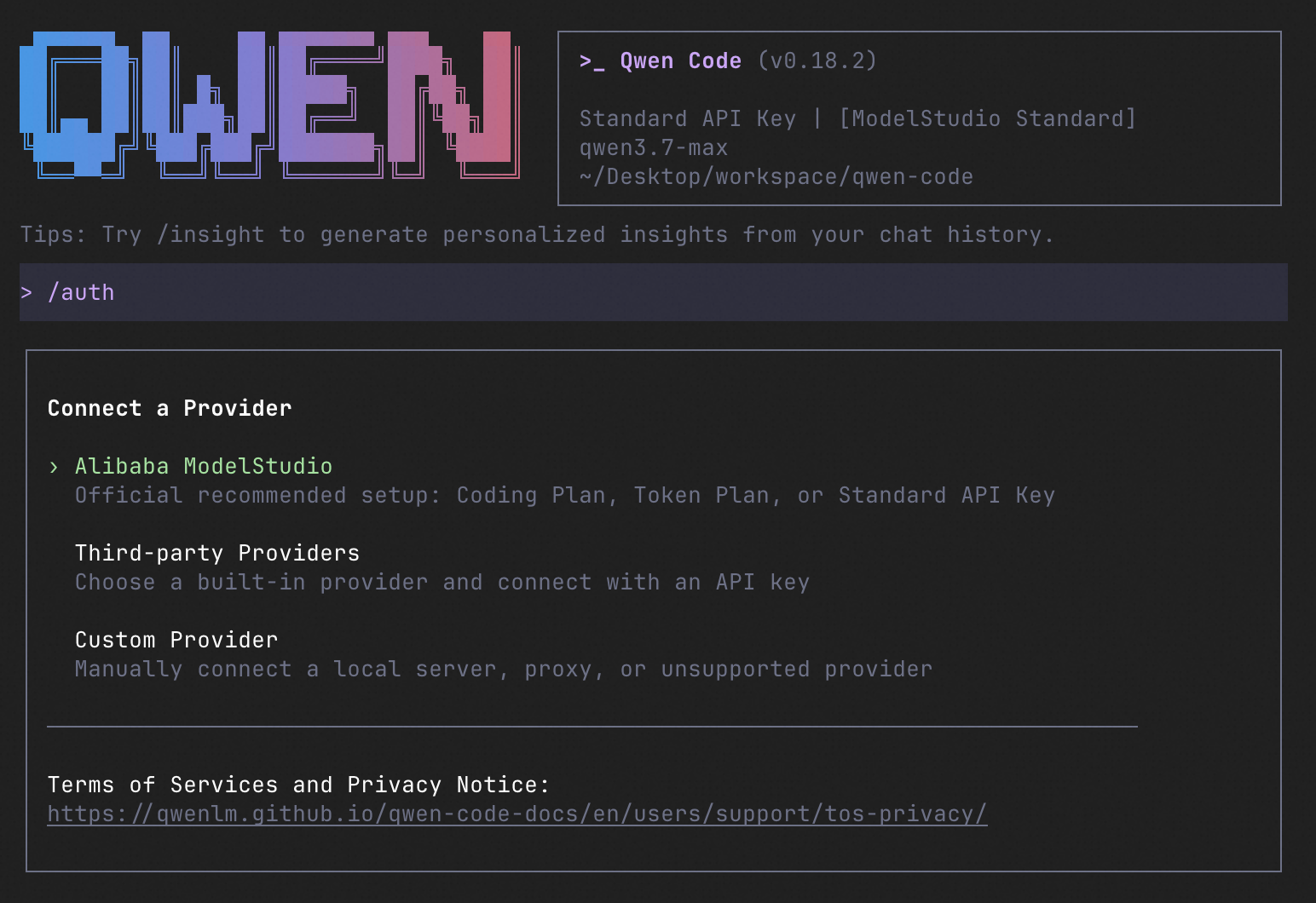
Quick Start
qwen          # Launch interactive terminal UI
# Inside the session:
/auth         # Configure your provider and API key
See the Authentication Guide and Settings Reference for detailed setup.
How to Use Qwen Code
| Mode | Command | Use Case |
|---|---|---|
| Interactive | qwen |
Terminal UI with rich rendering, @file references, slash commands |
| Headless | qwen -p "..." |
Scripts, CI/CD, batch processing — no UI |
| IDE | — | VS Code, Zed, JetBrains |
| Desktop | — | Qwen Code Desktop — GUI for macOS, Windows, Linux |
| Daemon | qwen serve |
Shared agent session over HTTP+SSE (ACP). Multiple clients, one agent. (experimental) Docs |
| SDK | — | TypeScript, Python, Java |
| IM Bot | qwen channel |
Connect to Telegram, DingTalk, WeChat, or Feishu |
SDK example (Python)
import asyncio

from qwen_code_sdk import is_sdk_result_message, query


async def main() -> None:
    result = query(
        "Summarize the repository layout.",
        {
            "cwd": "/path/to/project",
            "path_to_qwen_executable": "qwen",
        },
    )

    async for message in result:
        if is_sdk_result_message(message):
            print(message["result"])


asyncio.run(main())
Capabilities
If you know Claude Code, you already know Qwen Code — and then some. We've put significant effort into bringing Qwen Code to feature parity with Claude Code, improving both breadth and reliability across the board.
| Feature | Qwen Code | Claude Code |
|---|---|---|
| SubAgents, Agent Teams, Dynamic Workflows | ✓ | ✓ |
| Auto-Memory, Auto-Skills, Hooks | ✓ | ✓ |
| Built-in Skills (/review, /batch, /loop, /bugfix…) | ✓ | ✓ |
| MCP, Plan Mode, LSP Integration | ✓ | ✓ |
| Auto Mode, Sandbox, Git Worktrees | ✓ | ✓ |
| Computer Use (desktop automation) | ✓ | ✓ |
| IDE Plugins (VS Code / JetBrains / Zed) | ✓ | ✓ |
| SDK | ✓ | ✓ |
| Headless Mode, Session Management | ✓ | ✓ |
| Open-source — model and framework | ✓ | — |
| Multi-protocol (OpenAI / Anthropic / Gemini / Qwen + any provider) | ✓ | — |
| Agent Arena (multi-model head-to-head on same task) | ✓ | — |
Daemon Mode — qwen serve (multi-client shared agent) |
✓ | — |
| IM Channels (Telegram / DingTalk / WeChat / Feishu) | ✓ | — |
Ecosystem
-
Qwen Code Desktop — Official desktop app for macOS, Windows, and Linux
-
AionUi — A modern GUI for command-line AI tools including Qwen Code
-
Gemini CLI Desktop — A cross-platform desktop/web/mobile UI for Qwen Code
-
🦞 Qwen Code Claw — Let other agents (Claude, Codex, etc.) delegate coding tasks to Qwen Code via ACP. Paste this prompt into your agent:
Use Qwen Code as a coding agent. First, fetch and read this skill reference:
https://raw.githubusercontent.com/QwenLM/qwen-code/refs/heads/main/.qwen/skills/qwen-code-claw/SKILL.md
Then follow the instructions inside to install, authenticate, and use Qwen Code via acpx for all coding tasks.
- Aliyun Model Studio CLI — Official CLI for Aliyun's AI platform (
bailian-cli). Extends Qwen Code with image/video generation, knowledge retrieval, app orchestration, and model deployment
Contributing
Contributions are welcome! See CONTRIBUTING.md for guidelines.
Acknowledgments
This project was originally based on Google Gemini CLI v0.8.2. We gratefully acknowledge the Gemini CLI team's excellent work. Starting from Qwen Code v0.1, we stopped syncing with upstream and began independent development as a multi-protocol, multi-platform agent framework with deep integrations for Qwen models and beyond.