 ca61d7827e
* chore: ignore local worktrees * docs(channels): design identity and task lifecycle p0 * docs(channels): plan identity and task lifecycle p0 * feat(channels): add identity and task lifecycle metadata * fix(channels): suppress cancelled tool call lifecycle * fix(channels): cover loop lifecycle metadata * fix(channels): harden lifecycle event edges * fix(channels): finalize cancelled lifecycle before cleanup * fix(channels): address lifecycle review suggestions * fix(channels): close lifecycle cancellation races * fix(channels): separate pending cancel state * fix(channels): order clear cancellation lifecycle * fix(channels): suppress loop chunks during pending cancel * test(channels): use active session in cancel regression * fix(channels): sanitize lifecycle tool fields * fix(channels): route shared tool call lifecycle * fix(channels): preserve pending cancel intent * fix(channels): preserve responses after failed cancel * fix(channels): tighten lifecycle cancellation reasons * fix(channels): close lifecycle cancel races and validate identity config Address the outstanding review findings on #6105: - carry a typed reason on ChannelLoopSkippedError and report disabled loops as 'dropped' instead of 'timeout' - treat a turn as committed once delivery starts: /cancel re-checks deliveryStarted after the cancel RPC settles, and neither prompt path lets a late-settling cancel rewrite a delivered turn into cancelled (or follow a /clear cancellation with completed) - tag failed lifecycle events with phase: agent vs delivery - validate identity/memoryScope shape at config parse time instead of throwing an opaque TypeError on the first prompt of every session - guard onPromptStart hooks, pass job.id to loop onPromptStart/End, append the boundary block after operator instructions, gate /who + /status identity lines on configured identity/memoryScope, cache the boundary prompt, and route error logs through lifecycleError() Co-authored-by: Qwen-Coder <qwen-coder@alibabacloud.com> * fix(channels): keep failed terminal event when cancel settles post-delivery Self-review follow-up: once delivery started, the catch paths no longer reconcile a pending cancel — a late-resolving cancel RPC used to flip cancelled=true there, suppressing the failed emit while the /cancel handler (seeing deliveryStarted) also declined to emit, leaving a started task with no terminal lifecycle event at all. Co-authored-by: Qwen-Coder <qwen-coder@alibabacloud.com> * fix(channels): hold streamed chunks while a cancel is pending Chunks arriving while a /cancel RPC is in flight were pushed straight into the BlockStreamer, which can send a block on a size/paragraph threshold before the cancel resolves — leaking output a successful cancel can never recall. Hold the pending-window chunks instead: replay them (block streaming + text_chunk transcript) when the cancel fails, discard them when it succeeds. onResponseChunk stays live through the window so adapter-accumulated display state has no permanent hole on a failed cancel; adapters gate visible updates on their own stop flags. Also stop passing the loop job id to onPromptStart/onPromptEnd (and the /clear eviction path): the hook contract is inbound platform message ids, and adapters act on them — cards and reactions keyed to a fake id. Lifecycle events still carry job.id for correlation. Co-authored-by: Qwen-Coder <qwen-coder@alibabacloud.com> * fix(channels): defer adapter chunks while cancel is pending --------- Co-authored-by: Shaojin Wen <shaojin.wensj@alibaba-inc.com> Co-authored-by: Qwen-Coder <qwen-coder@alibabacloud.com> |
||
|---|---|---|
| .github | ||
| .husky | ||
| .qwen | ||
| .vscode | ||
| docs | ||
| docs-site | ||
| eslint-rules | ||
| integration-tests | ||
| packages | ||
| patches | ||
| scripts | ||
| .dockerignore | ||
| .editorconfig | ||
| .gitattributes | ||
| .gitignore | ||
| .npmrc | ||
| .nvmrc | ||
| .prettierignore | ||
| .prettierrc.json | ||
| .yamllint.yml | ||
| AGENTS.md | ||
| CHANGELOG.md | ||
| CLAUDE.md | ||
| CONTRIBUTING.md | ||
| Dockerfile | ||
| esbuild.config.js | ||
| eslint.config.js | ||
| eslint.legacy-filenames.mjs | ||
| LICENSE | ||
| Makefile | ||
| package-lock.json | ||
| package.json | ||
| README.md | ||
| SECURITY.md | ||
| tsconfig.json | ||
| vitest.config.ts | ||




The open-source AI coding agent that lives in your terminal.
中文 | Deutsch | français | 日本語 | Русский | Português (Brasil)
Why Qwen Code?
- Agentic out of the box — Auto-Memory, Auto-Skills, SubAgents, Agent Teams, and MCP. Dynamic workflows, zero setup.
- Open-source, inside and out — The framework and the Qwen models are open-source. They evolve together. No vendor lock-in.
- Multi-protocol — Supports OpenAI, Anthropic, Gemini, and Qwen APIs. Any third-party provider or local model (Ollama / vLLM). Switch at runtime.
- Beyond the terminal — IDE plugins, Desktop app, daemon mode, SDKs, and IM bots (Telegram / DingTalk / WeChat / Feishu).
Tip
Qwen Code is actively iterating on itself — using its own agent and models to file issues, submit PRs, review code, and run tests. Powered by the community, driven by AI.
Installation
Linux / macOS:
curl -fsSL https://qwen-code-assets.oss-cn-hangzhou.aliyuncs.com/installation/install-qwen-standalone.sh | bash
Windows:
irm https://qwen-code-assets.oss-cn-hangzhou.aliyuncs.com/installation/install-qwen-standalone.ps1 | iex
Restart your terminal after installation to ensure environment variables take effect.
NPM / Homebrew
NPM (requires Node.js 22+):
npm install -g @qwen-code/qwen-code@latest
Homebrew (macOS / Linux):
brew install qwen-code
Quick Start
qwen          # Launch interactive terminal UI
# Inside the session:
/auth         # Configure your provider and API key
See the Authentication Guide and Settings Reference for detailed setup.
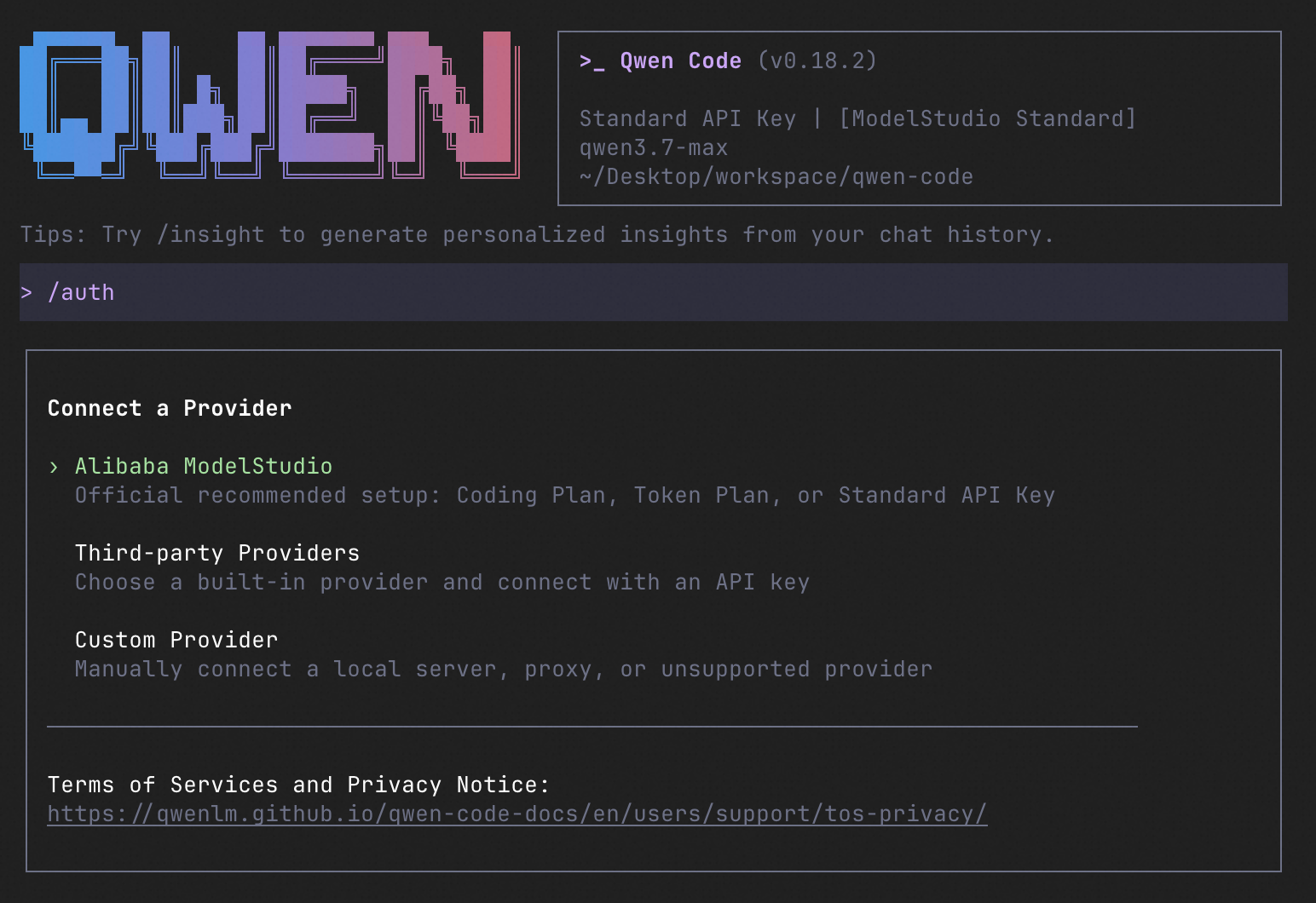
How to Use Qwen Code
| Mode | Command | Use Case |
|---|---|---|
| Interactive | qwen |
Terminal UI with rich rendering, @file references, slash commands |
| Headless | qwen -p "..." |
Scripts, CI/CD, batch processing — no UI |
| IDE | — | VS Code, Zed, JetBrains |
| Desktop | — | Qwen Code Desktop — GUI for macOS, Windows, Linux |
| Daemon | qwen serve |
Shared agent session over HTTP+SSE (ACP). Multiple clients, one agent. (experimental) Docs |
| SDK | — | TypeScript, Python, Java |
| IM Bot | qwen channel |
Connect to Telegram, DingTalk, WeChat, or Feishu |
SDK example (Python)
import asyncio

from qwen_code_sdk import is_sdk_result_message, query


async def main() -> None:
    result = query(
        "Summarize the repository layout.",
        {
            "cwd": "/path/to/project",
            "path_to_qwen_executable": "qwen",
        },
    )

    async for message in result:
        if is_sdk_result_message(message):
            print(message["result"])


asyncio.run(main())
Capabilities
If you know Claude Code, you already know Qwen Code — and then some. We've put significant effort into bringing Qwen Code to feature parity with Claude Code, improving both breadth and reliability across the board.
| Feature | Qwen Code | Claude Code |
|---|---|---|
| SubAgents, Agent Teams, Dynamic Workflows | ✓ | ✓ |
| Auto-Memory, Auto-Skills, Hooks | ✓ | ✓ |
| Built-in Skills (/review, /batch, /loop, /bugfix…) | ✓ | ✓ |
| MCP, Plan Mode, LSP Integration | ✓ | ✓ |
| Auto Mode, Sandbox, Git Worktrees | ✓ | ✓ |
| Computer Use (desktop automation) | ✓ | ✓ |
| IDE Plugins (VS Code / JetBrains / Zed) | ✓ | ✓ |
| SDK | ✓ | ✓ |
| Headless Mode, Session Management | ✓ | ✓ |
| Open-source — model and framework | ✓ | — |
| Multi-protocol (OpenAI / Anthropic / Gemini / Qwen + any provider) | ✓ | — |
| Agent Arena (multi-model head-to-head on same task) | ✓ | — |
Daemon Mode — qwen serve (multi-client shared agent) |
✓ | — |
| IM Channels (Telegram / DingTalk / WeChat / Feishu) | ✓ | — |
Ecosystem
-
Qwen Code Desktop — Official desktop app for macOS, Windows, and Linux
-
AionUi — A modern GUI for command-line AI tools including Qwen Code
-
Gemini CLI Desktop — A cross-platform desktop/web/mobile UI for Qwen Code
-
🦞 Qwen Code Claw — Let other agents (Claude, Codex, etc.) delegate coding tasks to Qwen Code via ACP. Paste this prompt into your agent:
Use Qwen Code as a coding agent. First, fetch and read this skill reference:
https://raw.githubusercontent.com/QwenLM/qwen-code/refs/heads/main/.qwen/skills/qwen-code-claw/SKILL.md
Then follow the instructions inside to install, authenticate, and use Qwen Code via acpx for all coding tasks.
Contributing
Contributions are welcome! See CONTRIBUTING.md for guidelines.
Acknowledgments
This project was originally based on Google Gemini CLI v0.8.2. We gratefully acknowledge the Gemini CLI team's excellent work. Starting from Qwen Code v0.1, we stopped syncing with upstream and began independent development as a multi-protocol, multi-platform agent framework with deep integrations for Qwen models and beyond.