 c538bd70d2
* feat(core): emit liveness heartbeats for silent foreground shell commands Silent foreground commands previously produced no events between spawn and settle, so ACP gateways and stream-json consumers could not tell a long-running command from a dead session. The shell tool now emits a structured ShellProgressData through the existing updateOutput channel whenever no display update has fired for tools.shell.heartbeatIntervalMs (default 10s, 0 disables). Heartbeats carry liveness stats only - never command output - and never enter model context. Consumers: the ACP session forwards heartbeats as meta-only tool_call_update frames (gated so a tick racing the settle path cannot regress status after completion) and records heartbeat span attributes; stream-json forwards them as tool_progress events behind includePartialMessages; the TUI scheduler, React hook, and subagent runtime ignore them so live output views are not replaced by stats objects. * docs(design): add silent command heartbeat design doc * fix(acp): keep tool_call_update heartbeats from breaking in-repo consumers Codex review of the heartbeat change found that in-repo ACP consumers did not tolerate the new meta-only in_progress frames. A full sweep of tool_call_update consumers found three that mishandled them, each now guarded with a regression test: - The desktop agent converted every tool_call_update into a terminal tool_result, so the first heartbeat would prematurely complete the command with an empty result. It now skips in_progress updates. - DaemonChannelBridge requires kind on tool_call_update and flagged the kind-less heartbeat as a malformed-protocol error every interval. It now drops kind-less in_progress frames silently. - The web-shell daemon UI normalizer derived the tool block title from _meta.toolName, overwriting the human-readable title on every heartbeat. It now drops heartbeat frames outright. The remaining consumers (VS Code companion, acp-bridge compaction, session export, daemon TUI adapter) merge updates conditionally and are heartbeat-safe without changes. * fix(core): address PR review — heartbeat monotonic gate, guard scope, telemetry Review round 1 on #6876 (yiliang114, wenshao, chiga0, qwen3.7-max): - shell.ts: the silent-idle gate now uses the monotonic performance.now() clock (via lastOutputPerfTime, falling back to spawn time) instead of the Date.now()-based lastUpdateTime, so an NTP step can neither skew the payload nor misfire a heartbeat — matching the design doc's monotonic commitment. It also keys off actual output arrival rather than the throttled display update. - session-tracing.ts: endToolExecutionSpan now applies caller-supplied attributes BEFORE the canonical keys (duration_ms, success, error) so a passthrough attribute can never mask the span's own outcome fields. - desktop qwen-agent.ts: the in_progress drop guard is now scoped to frames carrying _meta.shellProgress, matching the daemon bridge and web-shell normalizer guards, so a future non-heartbeat in_progress frame is not silently swallowed. - Tests: the desktop regression test now pins result==='done' (previously it stayed green even with the guard removed); added a Session.test assertion that heartbeat counts reach the tool-execution span attributes. * fix(acp): align desktop heartbeat guard with normalizer; test kind pass-through Review round 2 on #6876 (qwen3.7-max via ci-bot): - The desktop qwen-agent in_progress drop guard was broader than the web-shell normalizer's: it dropped any in_progress + shellProgress frame regardless of kind, while the normalizer only drops kind-less ones. The comment claimed they matched. Added the kind-absent check so the desktop guard matches the normalizer exactly — a kind-bearing frame now passes through on both platforms (heartbeats emitted by the ACP session never carry a kind, so real behavior is unchanged). - Added pass-through tests on both sides (daemonUi + desktop) asserting an in_progress frame WITH a kind normalizes to a tool.update / tool_result rather than being dropped, so the load-bearing kind-absent condition is no longer only exercised on the drop path. * fix(channels): scope daemon bridge heartbeat drop to shellProgress frames Review round 3 on #6876 (qwen3.7-max via ci-bot): the DaemonChannelBridge heartbeat guard lived in the shared tool_call / tool_call_update case and dropped ANY kind-less in_progress frame, so a genuinely malformed kind-less tool_call (status in_progress, no shellProgress) was silently swallowed instead of reaching emitProtocolError. Gate the drop on _meta.shellProgress — matching the qwen-agent and web-shell normalizer guards — so real heartbeats are still dropped while malformed frames are flagged. Added a regression test for the malformed path. |
||
|---|---|---|
| .github | ||
| .husky | ||
| .qwen | ||
| .vscode | ||
| docs | ||
| docs-site | ||
| eslint-rules | ||
| integration-tests | ||
| packages | ||
| patches | ||
| scripts | ||
| .dockerignore | ||
| .editorconfig | ||
| .gitattributes | ||
| .gitignore | ||
| .npmrc | ||
| .nvmrc | ||
| .prettierignore | ||
| .prettierrc.json | ||
| .yamllint.yml | ||
| AGENTS.md | ||
| CHANGELOG.md | ||
| CLAUDE.md | ||
| CONTRIBUTING.md | ||
| Dockerfile | ||
| esbuild.config.js | ||
| eslint.config.js | ||
| eslint.legacy-filenames.mjs | ||
| LICENSE | ||
| Makefile | ||
| package-lock.json | ||
| package.json | ||
| README.md | ||
| SECURITY.md | ||
| tsconfig.json | ||
| vitest.config.ts | ||




The open-source AI coding agent that lives in your terminal.
中文 | Deutsch | français | 日本語 | Русский | Português (Brasil)
Why Qwen Code?
- Agentic out of the box — Auto-Memory, Auto-Skills, SubAgents, Agent Teams, and MCP. Dynamic workflows, zero setup.
- Open-source, inside and out — The framework and the Qwen models are open-source. They evolve together. No vendor lock-in.
- Multi-protocol — Supports OpenAI, Anthropic, Gemini, and Qwen APIs. Any third-party provider or local model (Ollama / vLLM). Switch at runtime.
- Beyond the terminal — IDE plugins, Desktop app, daemon mode, SDKs, and IM bots (Telegram / DingTalk / WeChat / Feishu).
Tip
Qwen Code is actively iterating on itself — using its own agent and models to file issues, submit PRs, review code, and run tests. Powered by the community, driven by AI.
Installation
Linux / macOS:
curl -fsSL https://qwen-code-assets.oss-cn-hangzhou.aliyuncs.com/installation/install-qwen-standalone.sh | bash
Windows:
irm https://qwen-code-assets.oss-cn-hangzhou.aliyuncs.com/installation/install-qwen-standalone.ps1 | iex
Restart your terminal after installation to ensure environment variables take effect.
NPM / Homebrew
NPM (requires Node.js 22+):
npm install -g @qwen-code/qwen-code@latest
Homebrew (macOS / Linux):
brew install qwen-code
Quick Start
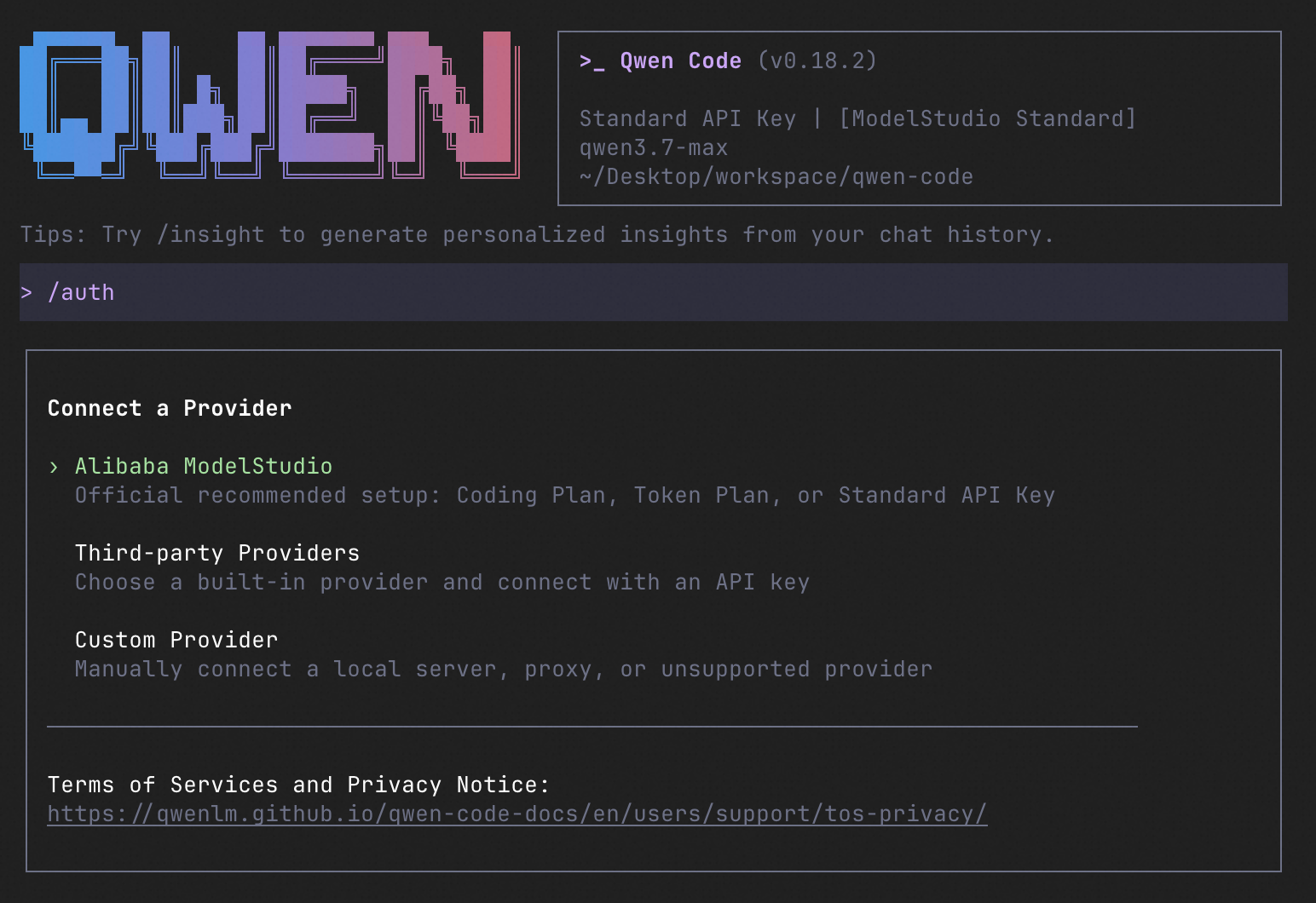
qwen          # Launch interactive terminal UI
# Inside the session:
/auth         # Configure your provider and API key
See the Authentication Guide and Settings Reference for detailed setup.
How to Use Qwen Code
| Mode | Command | Use Case |
|---|---|---|
| Interactive | qwen |
Terminal UI with rich rendering, @file references, slash commands |
| Headless | qwen -p "..." |
Scripts, CI/CD, batch processing — no UI |
| IDE | — | VS Code, Zed, JetBrains |
| Desktop | — | Qwen Code Desktop — GUI for macOS, Windows, Linux |
| Daemon | qwen serve |
Shared agent session over HTTP+SSE (ACP). Multiple clients, one agent. (experimental) Docs |
| SDK | — | TypeScript, Python, Java |
| IM Bot | qwen channel |
Connect to Telegram, DingTalk, WeChat, or Feishu |
SDK example (Python)
import asyncio

from qwen_code_sdk import is_sdk_result_message, query


async def main() -> None:
    result = query(
        "Summarize the repository layout.",
        {
            "cwd": "/path/to/project",
            "path_to_qwen_executable": "qwen",
        },
    )

    async for message in result:
        if is_sdk_result_message(message):
            print(message["result"])


asyncio.run(main())
Capabilities
If you know Claude Code, you already know Qwen Code — and then some. We've put significant effort into bringing Qwen Code to feature parity with Claude Code, improving both breadth and reliability across the board.
| Feature | Qwen Code | Claude Code |
|---|---|---|
| SubAgents, Agent Teams, Dynamic Workflows | ✓ | ✓ |
| Auto-Memory, Auto-Skills, Hooks | ✓ | ✓ |
| Built-in Skills (/review, /batch, /loop, /bugfix…) | ✓ | ✓ |
| MCP, Plan Mode, LSP Integration | ✓ | ✓ |
| Auto Mode, Sandbox, Git Worktrees | ✓ | ✓ |
| Computer Use (desktop automation) | ✓ | ✓ |
| IDE Plugins (VS Code / JetBrains / Zed) | ✓ | ✓ |
| SDK | ✓ | ✓ |
| Headless Mode, Session Management | ✓ | ✓ |
| Open-source — model and framework | ✓ | — |
| Multi-protocol (OpenAI / Anthropic / Gemini / Qwen + any provider) | ✓ | — |
| Agent Arena (multi-model head-to-head on same task) | ✓ | — |
Daemon Mode — qwen serve (multi-client shared agent) |
✓ | — |
| IM Channels (Telegram / DingTalk / WeChat / Feishu) | ✓ | — |
Ecosystem
-
Qwen Code Desktop — Official desktop app for macOS, Windows, and Linux
-
AionUi — A modern GUI for command-line AI tools including Qwen Code
-
Gemini CLI Desktop — A cross-platform desktop/web/mobile UI for Qwen Code
-
🦞 Qwen Code Claw — Let other agents (Claude, Codex, etc.) delegate coding tasks to Qwen Code via ACP. Paste this prompt into your agent:
Use Qwen Code as a coding agent. First, fetch and read this skill reference:
https://raw.githubusercontent.com/QwenLM/qwen-code/refs/heads/main/.qwen/skills/qwen-code-claw/SKILL.md
Then follow the instructions inside to install, authenticate, and use Qwen Code via acpx for all coding tasks.
Contributing
Contributions are welcome! See CONTRIBUTING.md for guidelines.
Acknowledgments
This project was originally based on Google Gemini CLI v0.8.2. We gratefully acknowledge the Gemini CLI team's excellent work. Starting from Qwen Code v0.1, we stopped syncing with upstream and began independent development as a multi-protocol, multi-platform agent framework with deep integrations for Qwen models and beyond.