 be891657f7
* feat(core): add persistent Node REPL runtime * fix(core): align Node REPL phase-one contract * fix(core): align Node REPL module compatibility * fix(core): remove unused Node REPL host broker * refactor(node-repl)!: deliver as a standalone MCP server, revert core tools Replaces the three built-in `packages/core` node_repl tools with a self-contained MCP server package, `@qwen-code/node-repl-mcp`. Why --- Issue #9333 triage accepted the runtime only "for exploration" and gated it on an open maintainer decision: built-in core tool vs MCP-server-first. Reversing OpenAI Codex 0.149.0 settled the shape — it ships code mode as a standalone host with an in-process fallback, and its real-Node `js_repl` (not the restricted V8 `exec`) is the analogue this roadmap needs, because stage 3 (#9335) imports cua-driver's N-API addons, which only real Node can load. Delivering out-of-core also keeps a security-relevant subsystem out of the maintainer-gated `packages/core` until its value is proven. What changed ------------ - New `packages/node-repl`: the kernel, module loader, cell transform, protocol and kernel manager, ported and now dependency-free (local `debug-log`/`win-path`/`tokenizer` replace core utils; `output-adapter` emits MCP content blocks in place of `result-converter`). - Reverted every `packages/core` change, the ~11 packaging files that existed only to ship the runtime assets into six distribution layouts, and the two design/plan docs describing the core delivery. - Deleted the trusted-package/sha256 layer: it was empty and unreachable in production (`module-loader.mjs` 882 -> 483 lines). - Wired the package into `scripts/build.js` and the root `vitest.config.ts`. Net effect: `packages/core` is untouched relative to main; the tool is opt-in via `mcpServers` instead of registered unconditionally for every user. Correctness fixes made while porting ------------------------------------ - Stack line numbers were wrong and drifted with binding count (source line 4 reported as 87). The prelude is now one physical line and the cell compiles with `lineOffset: -1`. - Top-level `var` nested in blocks/try/switch/loops was silently dropped; collection now walks the statement subtree, pruning at function boundaries. Verified against real Node for 16 constructs. - A binding named `nodeRepl` permanently broke the output channel; such cells are now rejected. Ordinary globals stay shadowable, matching plain Node. - Errors thrown by imported modules lost their class, `code` and stack. - A throwing frame handler could discard buffered protocol frames. - A hoisted `var` assigned before a throw is now kept, as Node does. - Unhandled rejections settling after a cell no longer vanish. - Live sandbox timers are capped, so one runaway loop cannot saturate the session's event loop. - Image MIME types are matched case-insensitively on both input paths. - Binding sort no longer depends on host locale collation. - The published bin lacked a shebang and mis-detected its entry point, and the server plus its kernel leaked on every host disconnect. Tests: 146 across 14 files, including a compiled N-API addon fixture, 100 consecutive cells, 10 concurrent isolated kernels, stack-line fidelity, and hoisting semantics. Three smoke scripts cover the adapter, the MCP wire and process lifecycle; the packed tarball was installed into a clean project and driven end to end. Refs #9333 * fix(node-repl): pin zod to the hoisted 3.x so the workspace build type-checks `packages/node-repl` declared `zod ^4.1.13`, so `npm ci` installed a nested zod 4.4.3 for it while `@modelcontextprotocol/sdk` resolved the hoisted zod 3.25.76. Two zod type identities in one compilation made every `registerTool` input schema unassignable (`Type 'ZodString' is not assignable to type 'AnySchema'`), failing `npm run build` for this workspace — and with it the install step of every CI job that builds workspaces. The SDK accepts `^3.25 || ^4.0`, so pin the hoisted 3.x line and drop the now-stale nested lockfile entry. One deduped zod, no behaviour change. This only reproduced with a lockfile-driven install; the local tree had no nested copy, which is why the build passed locally and failed in CI. * fix(lint): lint package .mjs node scripts with the node env The eslint "scripts we run with node" override matched `packages/*/scripts/**/*.js` but not `.mjs`, nor a package-root `build.mjs`. `packages/node-repl` is `type: module`, so its `build.mjs` and `scripts/*.mjs` were linted as browser code and `eslint .` failed with `'process' is not defined` / `'console' is not defined` / `'setTimeout' is not defined`. The pre-commit hook only lints `*.{js,jsx,ts,tsx}`, so `.mjs` files are not checked locally — this only surfaced in the root CI lint step. Add `packages/*/scripts/**/*.mjs` and `packages/*/build.mjs` to the override, matching the existing `.js` entries. Generic, additive, no behaviour change. * fix(node-repl): address round-3 review findings (resolution, error identity, image bound) Triaged the bot's round-3 critical findings against the ported code and fixed the three that were genuine defects here; each has a regression test. - R3-5 (resolution): a symlinked `<cwd>/node_modules` — the norm under pnpm, monorepo hoisting and shared CI caches — was silently dropped, so the documented zero-config `await import('pkg')` failed with "cannot resolve from 0 module roots" while plain Node resolved it. The implicit cwd root was applying a re-link self-comparison that only makes sense for registered roots (which carry a registration-time canonical baseline). Follow the symlink for the implicit root, but skip it entirely when the cwd node_modules is itself a registered root, so the registered root's revocation guard is not undermined. - R3-3 (error identity): an error thrown by a host builtin inside imported code (e.g. `fs.readFileSync` → ENOENT) was rewrapped message-only, dropping `code`/`errno`/`syscall`/`cause`/`stack` — so `catch (e) { if (e.code === 'ENOENT') }`, a ubiquitous Node idiom, silently took the wrong branch. Carry those fields onto the realm-wrapped error. - R3-6 (image bound): image-frame `mimeType` was unbounded — only `data.length` counted against the raw image budget — so a malformed/forged frame could retain a huge string that also got interpolated into a notice and tokenized. Bound the MIME at frame ingestion (a real image MIME is a few dozen chars). - R3-4 is by design (the runtime is not a security boundary), but the tool description recommended `createRequire` without noting it is not subject to the process denial or module-root containment the import path enforces; the description now says so. - R3-1 / R3-2 (the `.mjs` lint failure) were already fixed in an earlier commit. Suite: 148 tests (added symlinked-cwd resolution and host-builtin error-code regressions). The symlink fix initially defeated the registered-root revocation test; the registered-root deferral above resolves both. * docs(node-repl): note top-level function/class re-declaration needs a fresh name Round-3 review R3-12/R3-33: re-declaring an existing top-level function or class in a later cell is a link-time SyntaxError (they persist as `let`, which the prelude re-declares), whereas a plain Node REPL accepts it. A correct fix needs declaration-kind tracking the manager does not carry today; until then the tool description's rerun guidance ('prefer var') is corrected, since a function cannot be made rerunnable via var. --------- Co-authored-by: Claude <noreply@anthropic.com> |
||
|---|---|---|
| .github | ||
| .husky | ||
| .qwen | ||
| .vscode | ||
| docs | ||
| docs-site | ||
| eslint-rules | ||
| integration-tests | ||
| integrations/external-context | ||
| packages | ||
| patches | ||
| scripts | ||
| .dockerignore | ||
| .editorconfig | ||
| .gitattributes | ||
| .gitignore | ||
| .npmrc | ||
| .nvmrc | ||
| .prettierignore | ||
| .prettierrc.json | ||
| .yamllint.yml | ||
| AGENTS.md | ||
| CHANGELOG.md | ||
| CLAUDE.md | ||
| CONTRIBUTING.md | ||
| Dockerfile | ||
| esbuild.config.js | ||
| eslint.config.js | ||
| eslint.legacy-filenames.mjs | ||
| LICENSE | ||
| Makefile | ||
| package-lock.json | ||
| package.json | ||
| README.md | ||
| SECURITY.md | ||
| tsconfig.json | ||
| vitest.config.ts | ||




The open-source AI coding agent that lives in your terminal.
中文 | Deutsch | français | 日本語 | Русский | Português (Brasil) | 한국어
Why Qwen Code?
- Agentic out of the box — Auto-Memory, Auto-Skills, SubAgents, Agent Teams, and MCP. Dynamic workflows, zero setup.
- Open-source, inside and out — The framework and the Qwen models are open-source. They evolve together. No vendor lock-in.
- Multi-protocol — Supports OpenAI, Anthropic, Gemini, and Qwen APIs. Any third-party provider or local model (Ollama / vLLM). Switch at runtime.
- Beyond the terminal — IDE plugins, Desktop app, daemon mode, SDKs, and IM bots (Telegram / DingTalk / WeChat / Feishu).
Tip
Qwen Code is actively iterating on itself — using its own agent and models to file issues, submit PRs, review code, and run tests. Powered by the community, driven by AI.
Installation
Linux / macOS:
curl -fsSL https://qwen-code-assets.oss-cn-hangzhou.aliyuncs.com/installation/install-qwen-standalone.sh | bash
Windows:
irm https://qwen-code-assets.oss-cn-hangzhou.aliyuncs.com/installation/install-qwen-standalone.ps1 | iex
Restart your terminal after installation to ensure environment variables take effect.
NPM / Homebrew
NPM (requires Node.js 22+):
npm install -g @qwen-code/qwen-code@latest
Homebrew (macOS / Linux):
brew install qwen-code
Quick Start
qwen          # Launch interactive terminal UI
# Inside the session:
/auth         # Configure your provider and API key
See the Authentication Guide and Settings Reference for detailed setup.
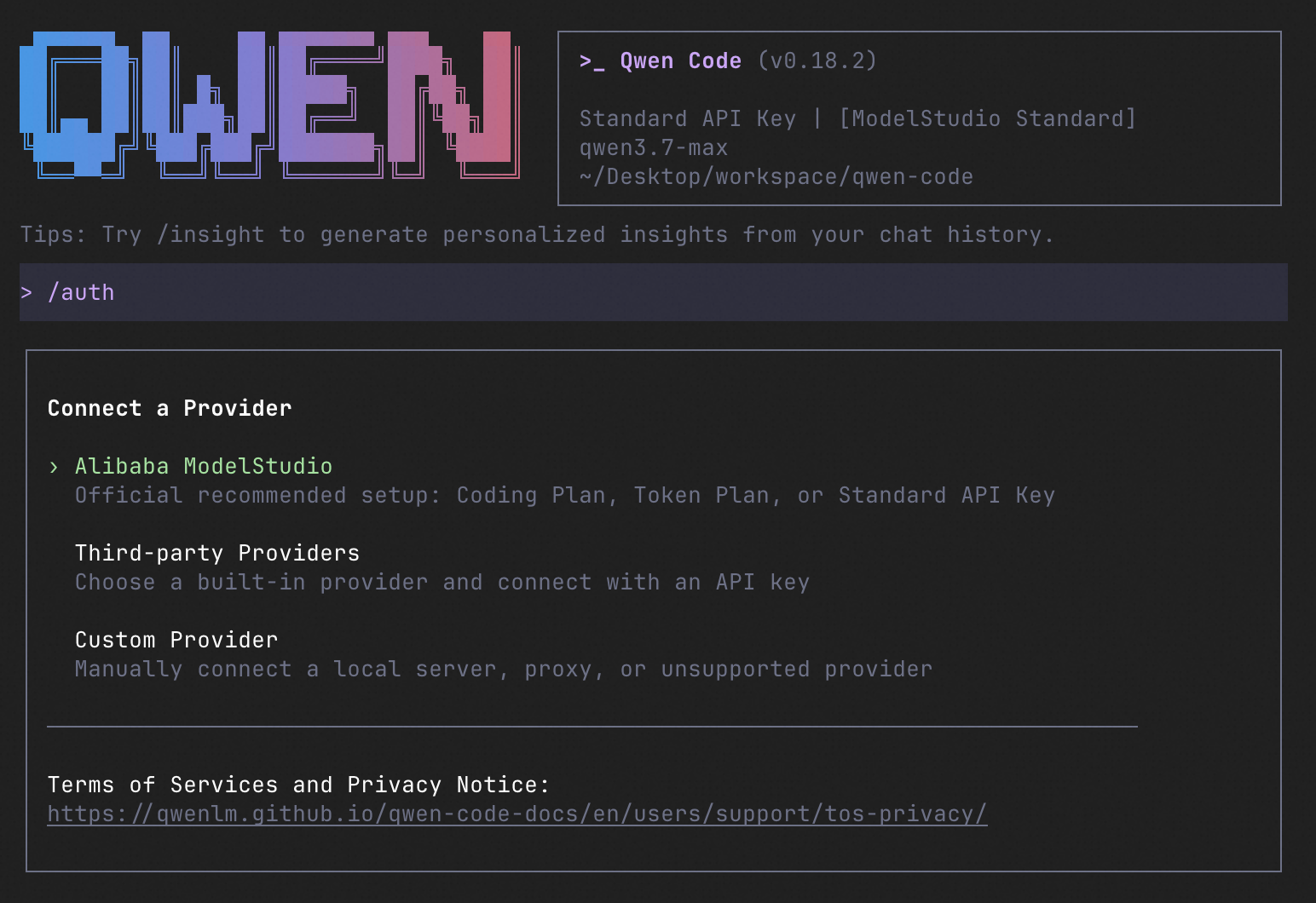
How to Use Qwen Code
| Mode | Command | Use Case |
|---|---|---|
| Interactive | qwen |
Terminal UI with rich rendering, @file references, slash commands |
| Headless | qwen -p "..." |
Scripts, CI/CD, batch processing — no UI |
| IDE | — | VS Code, Zed, JetBrains |
| Desktop | — | Qwen Code Desktop — GUI for macOS, Windows, Linux |
| Daemon | qwen serve |
Shared agent session over HTTP+SSE (ACP). Multiple clients, one agent. (experimental) Docs |
| SDK | — | TypeScript, Python, Java |
| IM Bot | qwen channel |
Connect to Telegram, DingTalk, WeChat, or Feishu |
SDK example (Python)
import asyncio

from qwen_code_sdk import is_sdk_result_message, query


async def main() -> None:
    result = query(
        "Summarize the repository layout.",
        {
            "cwd": "/path/to/project",
            "path_to_qwen_executable": "qwen",
        },
    )

    async for message in result:
        if is_sdk_result_message(message):
            print(message["result"])


asyncio.run(main())
Capabilities
If you know Claude Code, you already know Qwen Code — and then some. We've put significant effort into bringing Qwen Code to feature parity with Claude Code, improving both breadth and reliability across the board.
| Feature | Qwen Code | Claude Code |
|---|---|---|
| SubAgents, Agent Teams, Dynamic Workflows | ✓ | ✓ |
| Auto-Memory, Auto-Skills, Hooks | ✓ | ✓ |
| Built-in Skills (/review, /batch, /loop, /bugfix…) | ✓ | ✓ |
| MCP, Plan Mode, LSP Integration | ✓ | ✓ |
| Auto Mode, Sandbox, Git Worktrees | ✓ | ✓ |
| Computer Use (desktop automation) | ✓ | ✓ |
| IDE Plugins (VS Code / JetBrains / Zed) | ✓ | ✓ |
| SDK | ✓ | ✓ |
| Headless Mode, Session Management | ✓ | ✓ |
| Open-source — model and framework | ✓ | — |
| Multi-protocol (OpenAI / Anthropic / Gemini / Qwen + any provider) | ✓ | — |
| Agent Arena (multi-model head-to-head on same task) | ✓ | — |
Daemon Mode — qwen serve (multi-client shared agent) |
✓ | — |
| IM Channels (Telegram / DingTalk / WeChat / Feishu) | ✓ | — |
Ecosystem
-
Qwen Code Desktop — Official desktop app for macOS, Windows, and Linux
-
AionUi — A modern GUI for command-line AI tools including Qwen Code
-
Gemini CLI Desktop — A cross-platform desktop/web/mobile UI for Qwen Code
-
🦞 Qwen Code Claw — Let other agents (Claude, Codex, etc.) delegate coding tasks to Qwen Code via ACP. Paste this prompt into your agent:
Use Qwen Code as a coding agent. First, fetch and read this skill reference:
https://raw.githubusercontent.com/QwenLM/qwen-code/refs/heads/main/.qwen/skills/qwen-code-claw/SKILL.md
Then follow the instructions inside to install, authenticate, and use Qwen Code via acpx for all coding tasks.
- Aliyun Model Studio CLI — Official CLI for Aliyun's AI platform (
bailian-cli). Extends Qwen Code with image/video generation, knowledge retrieval, app orchestration, and model deployment
Contributing
Contributions are welcome! See CONTRIBUTING.md for guidelines.
Acknowledgments
This project was originally based on Google Gemini CLI v0.8.2. We gratefully acknowledge the Gemini CLI team's excellent work. Starting from Qwen Code v0.1, we stopped syncing with upstream and began independent development as a multi-protocol, multi-platform agent framework with deep integrations for Qwen models and beyond.