 bdd5b602de
* feat(core): improve Anthropic proxy compatibility and enable global prompt cache scope
- Use authToken instead of apiKey to send Authorization: Bearer header,
avoiding dual-header conflicts with IdeaLab-style proxies
- Set User-Agent to claude-cli format and add x-app header for proxy
Team rule compatibility
- Add adaptive thinking support for Claude 4.6+ models
- Enable prompt-caching-scope-2026-01-05 beta header and scope: global
on system prompt cache_control to improve cross-session cache hit rates
* test: update tests for User-Agent, beta header, and cache_control changes
* fix(core): scope anthropic proxy workarounds to non-native baseURLs only
Address review feedback on PR #4020 by narrowing each workaround to where
it actually applies, instead of shipping it globally.
- Gate `Authorization: Bearer` (`authToken`), `claude-cli` User-Agent, and
`x-app: cli` to non-Anthropic-native baseURLs. Direct `api.anthropic.com`
users keep the SDK-default `x-api-key` (`apiKey`) auth and a truthful
`QwenCode` User-Agent so usage isn't misattributed in Anthropic's
logs/quotas, and so a stricter Anthropic backend doesn't 401 on a
`Bearer`-shaped header.
- Gate the `prompt-caching-scope-2026-01-05` beta on `enableCacheControl`.
When the converter isn't attaching `cache_control` to the body the beta
is dead weight and risks 4xx responses from anthropic-compatible
backends that don't recognize it. Restores the `betas.length === 0`
early-return for the all-disabled case.
- Detect adaptive-thinking models with numeric major/minor compare instead
of `[6-9]`. The character class missed `claude-haiku-4-6` entirely and
would silently fall through to `budget_tokens` on `claude-opus-4-10` /
`claude-opus-5-1` once those ship — tripping HTTP 400 with a shape the
server no longer accepts.
- Honor explicit `reasoning.budget_tokens` before the adaptive branch.
Adaptive omits `budget_tokens` from the wire shape, so checking it
second silently dropped a user-supplied escape-hatch budget on Claude
4.6+ models.
- Add `scope: 'global'` on the tool `cache_control` entry so the largest,
slowest-changing prefix actually participates in cross-session caching
under the new beta — the system-only attachment was capturing maybe
half the available hit-rate improvement.
- Replace the misleading `as { type: 'ephemeral' }` cast on the system
block (which erased `scope` from the type while leaving it on the
wire) with a `AnthropicTextBlockParam` type that mirrors the existing
`AnthropicToolParam` widening, so types match the runtime shape.
* fix(core): keep enableCacheControl live in the converter
Follow-up on PR #4020 review: `Config.setModel()` mutates
`enableCacheControl` in place (it's in `MODEL_GENERATION_CONFIG_FIELDS`),
but the converter captured it once at construction. On a hot flip the
generator's per-request `prompt-caching-scope-2026-01-05` beta gate would
sample the new value while the converter still emitted the old body-side
`cache_control` — beta-header and body could disagree.
- Thread the live `contentGeneratorConfig.enableCacheControl` into the
converter via a per-call options override on both
`convertGeminiRequestToAnthropic` and `convertGeminiToolsToAnthropic`,
falling back to the constructor-time default when the caller doesn't
pass one. The generator samples the value once per `buildRequest` and
forwards it to both convert calls so the body and beta header always
agree within a request, even across `setModel` flips.
- Regression test: hot-flip `enableCacheControl` from `true` to `false`
on a live generator, verify the 2nd request drops both the beta header
AND the body-side `cache_control` in lockstep.
- Tighten two existing beta-header tests that used `toContain` only on
`interleaved-thinking` / `effort` — they now also assert
`prompt-caching-scope-2026-01-05` is present (per-request keep-default
and streaming paths), so accidental removal trips the test.
- Add coverage for the two previously-uncovered branches of
`isAnthropicNativeBaseUrl`: `*.anthropic.com` subdomains
(Anthropic-native) and a malformed baseURL (URL parse failure → proxy
fallthrough). Also add an `anthropic.com.evil.com` hostname-spoof case
mirroring the existing DeepSeek spoof test.
* refactor(core): consolidate anthropic generator shapes & document edge cases
Follow-up on PR #4020 review:
- Extract `AnthropicThinkingParam` type alias. The thinking union
`{ type: 'enabled'; budget_tokens } | { type: 'adaptive' }` was repeated
verbatim in three places: the `MessageCreateParamsWithThinking` field,
the streaming-request intersection, and `buildThinkingConfig`'s return
type. Once a third shape ships, forgetting one site would silently
narrow a runtime value — single alias keeps them locked.
- Compute `useProxyIdentity` once in the constructor and pass it into
`buildHeaders`. Previously `useBearerAuth` and `useProxyIdentity` named
the same predicate at two call sites; collapsing them clarifies that
Bearer auth + `claude-cli` UA + `x-app: cli` are one bundle that
should never be split.
- Document that `modelSupportsAdaptiveThinking`'s regex is intentionally
unanchored so reseller-prefixed names (`bedrock/claude-opus-4-7`,
`vertex_ai/claude-sonnet-4-6@…`, `idealab:claude-opus-4-6`, …) keep
matching. Tightening to `^claude-` would silently regress those.
- Soften the `prompt-caching-scope` beta comment so it describes what
the code enforces (gate on the `enableCacheControl` flag) rather than
promising a stronger "only ship when cache_control is on the body"
invariant — the converter still skips `cache_control` on niche shapes
(e.g. no system text, no tools, last user block isn't text). The
looser gate is intentional; Anthropic-native ignores unused betas.
- Pin the wire shape for the `reasoning: undefined` + 4.6+ model corner.
`resolveEffectiveEffort` returns undefined on `reasoning === undefined`,
so `buildThinkingConfig` ships `{ type: 'adaptive' }` with no
`output_config` and no `effort-2025-11-24` beta. If Anthropic ever
starts requiring `output_config.effort` alongside adaptive, this test
will fail at CI rather than at runtime as a server 400.
* fix(core): gate cache-scope on Anthropic-native baseURL, mirror auth gate
Follow-up on PR #4020 review: the `prompt-caching-scope-2026-01-05` beta
header and the body-side `scope: 'global'` field together comprise an
Anthropic-only wire-shape extension. Shipping them to non-Anthropic
backends (DeepSeek, IdeaLab) leaned on "unknown betas are ignored" —
true on Anthropic-native, but unverified for proxies and silently
inconsistent with the auth/identity gate, which already uses
`isAnthropicNativeBaseUrl` to bind Bearer / claude-cli / x-app to the
proxy path only.
- Add `useGlobalCacheScope` predicate on the generator. True iff
`enableCacheControl !== false` AND the resolved baseURL is
Anthropic-native. Plumbed per-request into both
`convertGeminiRequestToAnthropic` and `convertGeminiToolsToAnthropic`;
the same predicate also gates the `prompt-caching-scope-2026-01-05`
beta in `buildPerRequestHeaders` so beta + scope field always travel
together.
- Converter emits `cache_control: { type: 'ephemeral' }` (per-session)
when scope is off and `{ type: 'ephemeral', scope: 'global' }` when on.
Non-Anthropic baseURLs go back to their pre-PR per-session caching
shape; existing prompt caching keeps working with no new beta.
- Document the intentional `scope: 'global'` omission on
`addCacheControlToMessages`. The last user message changes every
turn (live prompt + immediate tool_results), so cross-session reuse
has effectively zero hit rate; cross-session caching is concentrated
on system + tool prefixes only.
Tests:
- DeepSeek baseURL pins the proxy auth/identity path
(`authToken` / claude-cli UA / `x-app: cli`). Documents the
contract assumption that DeepSeek's anthropic-compatible endpoint
accepts `Authorization: Bearer` — any future deviation surfaces
here rather than at runtime for users.
- Non-Anthropic baseURL strips the cache-scope beta AND
`scope: 'global'` from the wire shape, while keeping per-session
`cache_control: { type: 'ephemeral' }` on system / tools.
- Hot-flip test extended to assert tool `cache_control` flips alongside
system / user / beta header.
- Converter-level tests for per-call `enableCacheControl` and
`useGlobalCacheScope` overrides — both directions of the constructor
default (true→false, false→true) and the scope-independent-of-source
case (cache on, scope off → per-session shape).
- baseConfig in the per-request anthropic-beta block now targets
`api.anthropic.com` so cache-scope assertions remain meaningful; the
proxy-baseURL behavior is covered separately.
* docs(core): tighten useGlobalCacheScope JSDoc — baseUrl is NOT hot-mutated
#4020 review: the JSDoc claimed `Config.setModel()` mutates both
`enableCacheControl` AND `baseUrl` in place. Per the current Config
implementation, only the qwen-oauth hot-update path mutates
`enableCacheControl` in place; non-qwen-oauth providers go through
the refresh path which recreates the ContentGenerator (so `baseUrl`
is captured fresh at construct time, not mutated).
Tightened the wording to reflect actual behavior + kept the
read-both-each-request defense (cheap and avoids stale-cache
surprises if the hot-update list ever expands).
* fix(core)!: suppress env back-fill so proxy auth doesn't leak real Anthropic key
#4020 review (tanzhenxin, severity high): the IdeaLab-proxy branch
spread `{ authToken: <key> }` and omitted `apiKey` entirely. The
Anthropic SDK constructor destructures with defaults
(`apiKey = readEnv('ANTHROPIC_API_KEY') ?? null`), and destructuring
defaults only fire for `undefined` — so an omitted `apiKey` lets
`ANTHROPIC_API_KEY` back-fill it. The SDK's auth resolver then prefers
`apiKey` over `authToken`, shipping `X-Api-Key` (not
`Authorization: Bearer`) on the wire. Concrete impact: a user with
`ANTHROPIC_API_KEY=sk-ant-…` exported (normal for anyone also running
Claude Code in the same shell) configuring qwen-code with an IdeaLab
proxy plus an IdeaLab token would leak their real Anthropic key as
`X-Api-Key` to the third-party proxy endpoint.
- Pass `apiKey: null` explicitly on the proxy branch and `authToken: null`
on the Anthropic-native branch. Explicit `null` suppresses the
destructuring default; the env back-fill no longer fires.
- New helper `resolveEffectiveBaseUrl` mirrors the SDK's own
destructuring order (config → `ANTHROPIC_BASE_URL` env → SDK default).
`isAnthropicNativeBaseUrl` now consults the env too, so a user
configuring the proxy purely through `ANTHROPIC_BASE_URL` (qwen-code
`baseUrl` unset) gets the proxy identity bundle instead of silently
shipping native auth + UA + cache-scope beta to the proxy.
Tests:
- ANTHROPIC_API_KEY env + proxy baseURL → ctor receives `apiKey: null`
and `authToken: our-key`. Locks in the credential-leak fix.
- ANTHROPIC_AUTH_TOKEN env + Anthropic-native baseURL → ctor receives
`authToken: null` and `apiKey: our-key`. Symmetric guard for the
inverse direction.
- ANTHROPIC_BASE_URL env points to proxy, config.baseUrl unset → proxy
identity bundle (claude-cli UA, x-app, Bearer auth) applies.
- ANTHROPIC_BASE_URL unset → SDK default api.anthropic.com path keeps
native identity (predicate doesn't misclassify the SDK default as a
proxy).
- config.baseUrl wins over ANTHROPIC_BASE_URL — mirrors the SDK's own
resolution order.
- Existing 7 identity tests updated from `toBeUndefined()` to
`toBeNull()` to match the new explicit-suppression contract.
* refactor(core): gate cache-scope beta on body presence, not just predicate
#4020 review (Copilot): the comment promised "beta and body-side
scope: 'global' field always ship together" but the gate was just
`useGlobalCacheScope()`. In the degenerate case where the predicate is
true but the request body has no system text AND no tools, the beta
would still ship without any matching `cache_control.scope: 'global'`
on the wire — overstating the contract and shipping dead weight.
- New `hasGlobalCacheScopeOnWire(req)` scans the assembled request body
(system block when shaped as `TextBlockParam[]`, tools array) for any
`cache_control: { …, scope: 'global' }` entry. `buildPerRequestHeaders`
gates the `prompt-caching-scope-2026-01-05` beta on this scan, so the
beta and the body field share a single source of truth. No window
between sampling the predicate and emitting the body where the two
could diverge.
- `useGlobalCacheScope()` is still sampled once per `buildRequest` and
threaded into the converter to decide whether to ATTACH
`scope: 'global'` to the body. The body-scan downstream then derives
the beta from what actually landed.
Tests:
- New: empty systemInstruction + no tools + Anthropic-native + cache on
→ beta NOT shipped (degenerate body-scan case).
- New: empty systemInstruction + non-empty tools → beta shipped
(tool scope:'global' triggers the scan).
- Existing per-request beta tests now include a `systemInstruction` so
the body has the scope field; degenerate case is covered by the new
dedicated test.
Also tightened two stale comments (#3217834451, #3217834505) that
claimed `Config.setModel()` mutates both `enableCacheControl` and
`baseUrl` in place — only `enableCacheControl` is hot-mutated (qwen-oauth
path); non-qwen-oauth providers recreate the generator on refresh, so
`baseUrl` is captured fresh at construct time. Comments now describe the
real in-place mutation and note the qwen-oauth boundary.
* fix(core): trim config.baseUrl and document x-app in buildHeaders
#4020 review (Copilot): two low-stakes follow-ups on
|
||
|---|---|---|
| .github | ||
| .husky | ||
| .qwen | ||
| .vscode | ||
| docs | ||
| docs-site | ||
| eslint-rules | ||
| integration-tests | ||
| packages | ||
| scripts | ||
| .dockerignore | ||
| .editorconfig | ||
| .gitattributes | ||
| .gitignore | ||
| .npmrc | ||
| .nvmrc | ||
| .prettierignore | ||
| .prettierrc.json | ||
| .yamllint.yml | ||
| AGENTS.md | ||
| CONTRIBUTING.md | ||
| Dockerfile | ||
| esbuild.config.js | ||
| eslint.config.js | ||
| LICENSE | ||
| Makefile | ||
| package-lock.json | ||
| package.json | ||
| README.md | ||
| SECURITY.md | ||
| tsconfig.json | ||
| vitest.config.ts | ||




An open-source AI agent that lives in your terminal.
中文 | Deutsch | français | 日本語 | Русский | Português (Brasil)
🎉 News
-
2026-04-15: Qwen OAuth free tier has been discontinued. To continue using Qwen Code, switch to Alibaba Cloud Coding Plan, OpenRouter, Fireworks AI, or bring your own API key. Run
qwen authto configure. -
2026-04-13: Qwen OAuth free tier policy update: daily quota adjusted to 100 requests/day (from 1,000).
-
2026-04-02: Qwen3.6-Plus is now live! Get an API key from Alibaba Cloud ModelStudio to access it through the OpenAI-compatible API.
-
2026-02-16: Qwen3.5-Plus is now live!
Why Qwen Code?
Qwen Code is an open-source AI agent for the terminal, optimized for Qwen series models. It helps you understand large codebases, automate tedious work, and ship faster.
- Multi-protocol, flexible providers: use OpenAI / Anthropic / Gemini-compatible APIs, Alibaba Cloud Coding Plan, OpenRouter, Fireworks AI, or bring your own API key.
- Open-source, co-evolving: both the framework and the Qwen3-Coder model are open-source—and they ship and evolve together.
- Agentic workflow, feature-rich: rich built-in tools (Skills, SubAgents) for a full agentic workflow and a Claude Code-like experience.
- Terminal-first, IDE-friendly: built for developers who live in the command line, with optional integration for VS Code, Zed, and JetBrains IDEs.
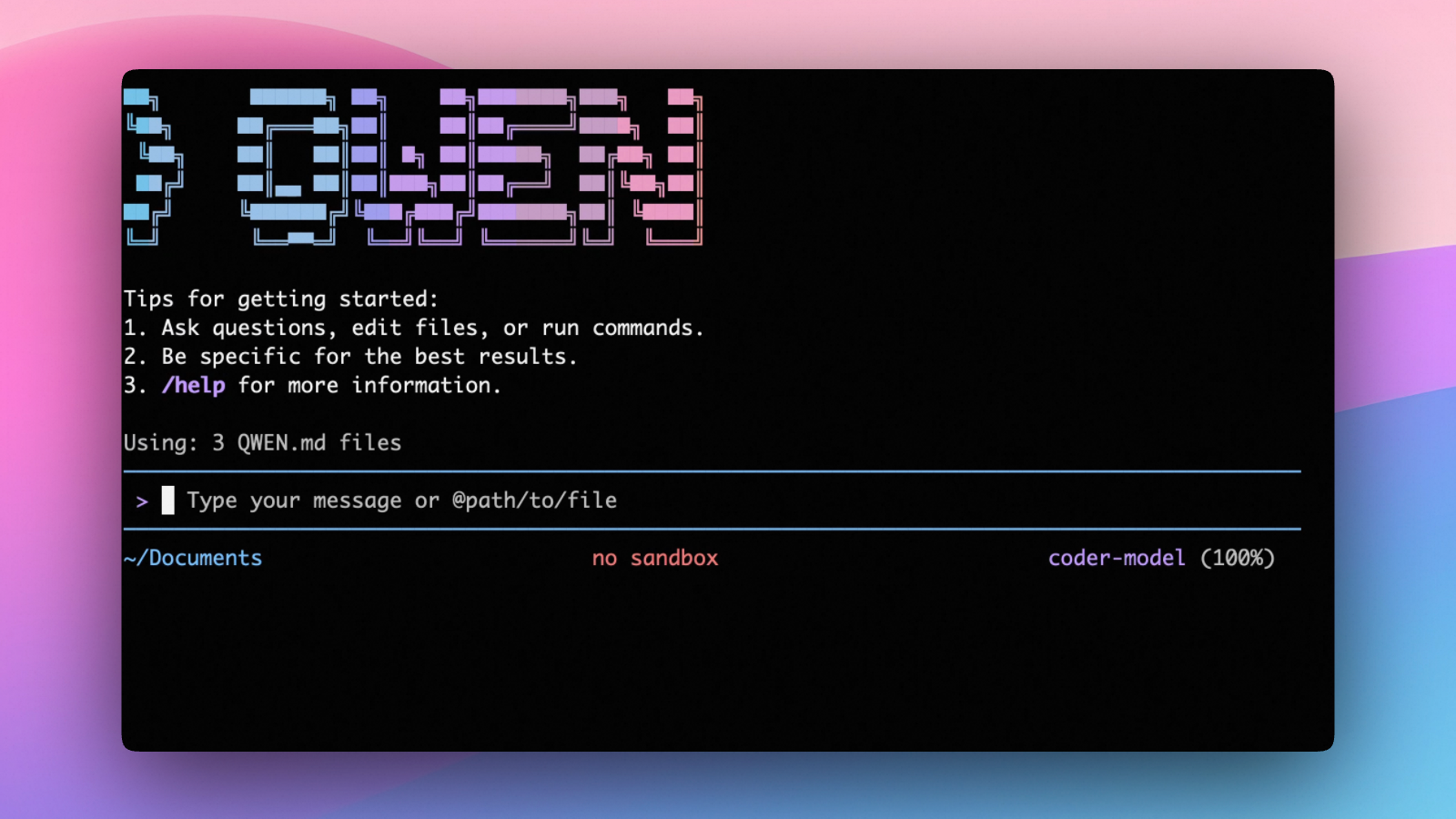
Installation
Quick Install (Recommended)
Linux / macOS
bash -c "$(curl -fsSL https://qwen-code-assets.oss-cn-hangzhou.aliyuncs.com/installation/install-qwen.sh)"
Windows (Run as Administrator)
Works in both Command Prompt and PowerShell:
powershell -Command "Invoke-WebRequest 'https://qwen-code-assets.oss-cn-hangzhou.aliyuncs.com/installation/install-qwen.bat' -OutFile (Join-Path $env:TEMP 'install-qwen.bat'); & (Join-Path $env:TEMP 'install-qwen.bat')"
Note
: It's recommended to restart your terminal after installation to ensure environment variables take effect.
Manual Installation
Prerequisites
Make sure you have Node.js 22 or later installed. Download it from nodejs.org.
NPM
npm install -g @qwen-code/qwen-code@latest
Homebrew (macOS, Linux)
brew install qwen-code
Quick Start
# Start Qwen Code (interactive)
qwen

# Then, in the session:
/help
/auth
On first use, you'll be prompted to sign in. You can run /auth anytime to switch authentication methods.
Example prompts:
What does this project do?
Explain the codebase structure.
Help me refactor this function.
Generate unit tests for this module.
Click to watch a demo video
🦞 Use Qwen Code for Coding Tasks in Claw
Copy the prompt below and paste it into your agent:
Use Qwen Code as a coding agent. First, fetch and read this skill reference:
https://raw.githubusercontent.com/QwenLM/qwen-code/refs/heads/main/.qwen/skills/qwen-code-claw/SKILL.md
Then follow the instructions inside to install, authenticate, and use Qwen Code via acpx for all coding tasks.
Authentication
Qwen Code supports the following authentication methods:
- API Key (recommended): use an API key from Alibaba Cloud Model Studio (Beijing / intl) or any supported provider (OpenAI, Anthropic, Google GenAI, and other compatible endpoints).
- Coding Plan: subscribe to the Alibaba Cloud Coding Plan (Beijing / intl) for a fixed monthly fee with higher quotas.
⚠️ Qwen OAuth was discontinued on April 15, 2026. If you were previously using Qwen OAuth, please switch to one of the methods above. Run
qwenand then/authto reconfigure.
API Key (recommended)
Use an API key to connect to Alibaba Cloud Model Studio or any supported provider. Supports multiple protocols:
- OpenAI-compatible: Alibaba Cloud ModelStudio, ModelScope, OpenAI, OpenRouter, and other OpenAI-compatible providers
- Anthropic: Claude models
- Google GenAI: Gemini models
The recommended way to configure models and providers is by editing ~/.qwen/settings.json (create it if it doesn't exist). This file lets you define all available models, API keys, and default settings in one place.
Quick Setup in 3 Steps
Step 1: Create or edit ~/.qwen/settings.json
Here is a complete example:
{
  "modelProviders": {
    "openai": [
      {
        "id": "qwen3.6-plus",
        "name": "qwen3.6-plus",
        "baseUrl": "https://dashscope.aliyuncs.com/compatible-mode/v1",
        "description": "Qwen3-Coder via Dashscope",
        "envKey": "DASHSCOPE_API_KEY"
      }
    ]
  },
  "env": {
    "DASHSCOPE_API_KEY": "sk-xxxxxxxxxxxxx"
  },
  "security": {
    "auth": {
      "selectedType": "openai"
    }
  },
  "model": {
    "name": "qwen3.6-plus"
  }
}
Step 2: Understand each field
| Field | What it does |
|---|---|
modelProviders |
Declares which models are available and how to connect to them. Keys like openai, anthropic, gemini represent the API protocol. |
modelProviders[].id |
The model ID sent to the API (e.g. qwen3.6-plus, gpt-4o). |
modelProviders[].envKey |
The name of the environment variable that holds your API key. |
modelProviders[].baseUrl |
The API endpoint URL (required for non-default endpoints). |
env |
A fallback place to store API keys (lowest priority; prefer .env files or export for sensitive keys). |
security.auth.selectedType |
The protocol to use on startup (openai, anthropic, gemini, vertex-ai). |
model.name |
The default model to use when Qwen Code starts. |
Step 3: Start Qwen Code — your configuration takes effect automatically:
qwen
Use the /model command at any time to switch between all configured models.
More Examples
Coding Plan (Alibaba Cloud ModelStudio) — fixed monthly fee, higher quotas
{
  "modelProviders": {
    "openai": [
      {
        "id": "qwen3.6-plus",
        "name": "qwen3.6-plus (Coding Plan)",
        "baseUrl": "https://coding.dashscope.aliyuncs.com/v1",
        "description": "qwen3.6-plus from ModelStudio Coding Plan",
        "envKey": "BAILIAN_CODING_PLAN_API_KEY"
      },
      {
        "id": "qwen3.5-plus",
        "name": "qwen3.5-plus (Coding Plan)",
        "baseUrl": "https://coding.dashscope.aliyuncs.com/v1",
        "description": "qwen3.5-plus with thinking enabled from ModelStudio Coding Plan",
        "envKey": "BAILIAN_CODING_PLAN_API_KEY",
        "generationConfig": {
          "extra_body": {
            "enable_thinking": true
          }
        }
      },
      {
        "id": "glm-4.7",
        "name": "glm-4.7 (Coding Plan)",
        "baseUrl": "https://coding.dashscope.aliyuncs.com/v1",
        "description": "glm-4.7 with thinking enabled from ModelStudio Coding Plan",
        "envKey": "BAILIAN_CODING_PLAN_API_KEY",
        "generationConfig": {
          "extra_body": {
            "enable_thinking": true
          }
        }
      },
      {
        "id": "kimi-k2.5",
        "name": "kimi-k2.5 (Coding Plan)",
        "baseUrl": "https://coding.dashscope.aliyuncs.com/v1",
        "description": "kimi-k2.5 with thinking enabled from ModelStudio Coding Plan",
        "envKey": "BAILIAN_CODING_PLAN_API_KEY",
        "generationConfig": {
          "extra_body": {
            "enable_thinking": true
          }
        }
      }
    ]
  },
  "env": {
    "BAILIAN_CODING_PLAN_API_KEY": "sk-xxxxxxxxxxxxx"
  },
  "security": {
    "auth": {
      "selectedType": "openai"
    }
  },
  "model": {
    "name": "qwen3.6-plus"
  }
}
Subscribe to the Coding Plan and get your API key at Alibaba Cloud ModelStudio(Beijing) or Alibaba Cloud ModelStudio(intl).
Multiple providers (OpenAI + Anthropic + Gemini)
{
  "modelProviders": {
    "openai": [
      {
        "id": "gpt-4o",
        "name": "GPT-4o",
        "envKey": "OPENAI_API_KEY",
        "baseUrl": "https://api.openai.com/v1"
      }
    ],
    "anthropic": [
      {
        "id": "claude-sonnet-4-20250514",
        "name": "Claude Sonnet 4",
        "envKey": "ANTHROPIC_API_KEY"
      }
    ],
    "gemini": [
      {
        "id": "gemini-2.5-pro",
        "name": "Gemini 2.5 Pro",
        "envKey": "GEMINI_API_KEY"
      }
    ]
  },
  "env": {
    "OPENAI_API_KEY": "sk-xxxxxxxxxxxxx",
    "ANTHROPIC_API_KEY": "sk-ant-xxxxxxxxxxxxx",
    "GEMINI_API_KEY": "AIzaxxxxxxxxxxxxx"
  },
  "security": {
    "auth": {
      "selectedType": "openai"
    }
  },
  "model": {
    "name": "gpt-4o"
  }
}
Enable thinking mode (for supported models like qwen3.5-plus)
{
  "modelProviders": {
    "openai": [
      {
        "id": "qwen3.5-plus",
        "name": "qwen3.5-plus (thinking)",
        "envKey": "DASHSCOPE_API_KEY",
        "baseUrl": "https://dashscope.aliyuncs.com/compatible-mode/v1",
        "generationConfig": {
          "extra_body": {
            "enable_thinking": true
          }
        }
      }
    ]
  },
  "env": {
    "DASHSCOPE_API_KEY": "sk-xxxxxxxxxxxxx"
  },
  "security": {
    "auth": {
      "selectedType": "openai"
    }
  },
  "model": {
    "name": "qwen3.5-plus"
  }
}
Tip: You can also set API keys via
exportin your shell or.envfiles, which take higher priority thansettings.json→env. See the authentication guide for full details.
Security note: Never commit API keys to version control. The
~/.qwen/settings.jsonfile is in your home directory and should stay private.
Local Model Setup (Ollama / vLLM)
You can also run models locally — no API key or cloud account needed. This is not an authentication method; instead, configure your local model endpoint in ~/.qwen/settings.json using the modelProviders field.
Set generationConfig.contextWindowSize inside the matching provider entry
and adjust it to the context length configured on your local server.
Ollama setup
- Install Ollama from ollama.com
- Pull a model:
ollama pull qwen3:32b - Configure
~/.qwen/settings.json:
{
  "modelProviders": {
    "openai": [
      {
        "id": "qwen3:32b",
        "name": "Qwen3 32B (Ollama)",
        "baseUrl": "http://localhost:11434/v1",
        "description": "Qwen3 32B running locally via Ollama",
        "generationConfig": {
          "contextWindowSize": 131072
        }
      }
    ]
  },
  "security": {
    "auth": {
      "selectedType": "openai"
    }
  },
  "model": {
    "name": "qwen3:32b"
  }
}
vLLM setup
- Install vLLM:
pip install vllm - Start the server:
vllm serve Qwen/Qwen3-32B - Configure
~/.qwen/settings.json:
{
  "modelProviders": {
    "openai": [
      {
        "id": "Qwen/Qwen3-32B",
        "name": "Qwen3 32B (vLLM)",
        "baseUrl": "http://localhost:8000/v1",
        "description": "Qwen3 32B running locally via vLLM",
        "generationConfig": {
          "contextWindowSize": 131072
        }
      }
    ]
  },
  "security": {
    "auth": {
      "selectedType": "openai"
    }
  },
  "model": {
    "name": "Qwen/Qwen3-32B"
  }
}
Usage
As an open-source terminal agent, you can use Qwen Code in four primary ways:
- Interactive mode (terminal UI)
- Headless mode (scripts, CI)
- IDE integration (VS Code, Zed)
- SDKs (TypeScript, Python, Java)
Interactive mode
cd your-project/
qwen
Run qwen in your project folder to launch the interactive terminal UI. Use @ to reference local files (for example @src/main.ts).
Headless mode
cd your-project/
qwen -p "your question"
Use -p to run Qwen Code without the interactive UI—ideal for scripts, automation, and CI/CD. Learn more: Headless mode.
IDE integration
Use Qwen Code inside your editor (VS Code, Zed, and JetBrains IDEs):
SDKs
Build on top of Qwen Code with the available SDKs:
- TypeScript: Use the Qwen Code SDK
- Python: Use the Python SDK
- Java: Use the Java SDK
Python SDK example:
import asyncio

from qwen_code_sdk import is_sdk_result_message, query


async def main() -> None:
    result = query(
        "Summarize the repository layout.",
        {
            "cwd": "/path/to/project",
            "path_to_qwen_executable": "qwen",
        },
    )

    async for message in result:
        if is_sdk_result_message(message):
            print(message["result"])


asyncio.run(main())
Commands & Shortcuts
Session Commands
/help- Display available commands/clear- Clear conversation history/compress- Compress history to save tokens/stats- Show current session information/bug- Submit a bug report/exitor/quit- Exit Qwen Code
Keyboard Shortcuts
Ctrl+C- Cancel current operationCtrl+D- Exit (on empty line)Up/Down- Navigate command history
Learn more about Commands
Tip: In YOLO mode (
--yolo), vision switching happens automatically without prompts when images are detected. Learn more about Approval Mode
Configuration
Qwen Code can be configured via settings.json, environment variables, and CLI flags.
| File | Scope | Description |
|---|---|---|
~/.qwen/settings.json |
User (global) | Applies to all your Qwen Code sessions. Recommended for modelProviders and env. |
.qwen/settings.json |
Project | Applies only when running Qwen Code in this project. Overrides user settings. |
The most commonly used top-level fields in settings.json:
| Field | Description |
|---|---|
modelProviders |
Define available models per protocol (openai, anthropic, gemini, vertex-ai). |
env |
Fallback environment variables (e.g. API keys). Lower priority than shell export and .env files. |
security.auth.selectedType |
The protocol to use on startup (e.g. openai). |
model.name |
The default model to use when Qwen Code starts. |
See the Authentication section above for complete
settings.jsonexamples, and the settings reference for all available options.
Benchmark Results
Terminal-Bench Performance
| Agent | Model | Accuracy |
|---|---|---|
| Qwen Code | Qwen3-Coder-480A35 | 37.5% |
| Qwen Code | Qwen3-Coder-30BA3B | 31.3% |
Ecosystem
Looking for a graphical interface?
- AionUi A modern GUI for command-line AI tools including Qwen Code
- Gemini CLI Desktop A cross-platform desktop/web/mobile UI for Qwen Code
Troubleshooting
If you encounter issues, check the troubleshooting guide.
Common issues:
Qwen OAuth free tier was discontinued on 2026-04-15: Qwen OAuth is no longer available. Runqwen→/authand switch to API Key or Coding Plan. See the Authentication section above for setup instructions.
To report a bug from within the CLI, run /bug and include a short title and repro steps.
Connect with Us
- Discord: https://discord.gg/RN7tqZCeDK
- Dingtalk: https://qr.dingtalk.com/action/joingroup?code=v1,k1,+FX6Gf/ZDlTahTIRi8AEQhIaBlqykA0j+eBKKdhLeAE=&_dt_no_comment=1&origin=1
Acknowledgments
This project is based on Google Gemini CLI. We acknowledge and appreciate the excellent work of the Gemini CLI team. Our main contribution focuses on parser-level adaptations to better support Qwen-Coder models.