 ad23c7ab34
* docs: add user + design docs for --json-schema structured output Follows up #3598 (cli/core feature shipped to main, no docs). **User doc** `docs/users/features/structured-output.md` — covers quick-start, schema input forms (inline + `@path`), output shapes per `--output-format`, parse-time restrictions, retry/failure modes, privacy redaction, permission gating, MCP shadow-tool handling, and a worked `jq`-piped pipeline example. Registered under the existing `features/_meta.ts` so it shows up in the docs sidebar between "Headless Mode" and "Dual Output". **Design doc** `docs/design/structured-output/structured-output.md` — why the synthetic-tool-whose-param-schema-is-the-user-schema approach, the four-stage parse-time validation pipeline, `schemaRootAcceptsObject`'s decided-vs-deferred boundaries, main-turn vs drain-turn parity via `processToolCallBatch`, the structured- success terminal block, the cross-surface privacy redaction sharing `STRUCTURED_OUTPUT_REDACTED_ARGS`, subagent context handling (`forSubAgent`), MCP shadow-tool guard, the compatibility surface, alternatives considered (and why rejected), and a file-by-file index. Both docs are English-only — repo convention is English-only for both `docs/users/features/` (zero zh-CN siblings) and `docs/design/` (only `customize-banner-area/` has a zh-CN twin). Open to adding zh-CN translations as a separate PR if there's demand. * docs(structured-output): address PR review feedback User doc: - explicit stdout-vs-stderr contract and `{}`-schema behavior. - 500 ms shutdown-holdback latency note. - ReDoS warning for user-supplied `pattern` keywords. - root `$ref` rejection + `allOf` workaround. - per-retry token cost note. - sibling-suppression success vs retry paths split out. - numeric exit codes (1 / 53 / 130) for every failure mode. - new "Session resumption" section for --continue / --resume. Design doc: - gloss the ToolSearch on-demand-loading reference. - `not` row: drop the array-indexing-lookalike `[…]`. - 500 ms holdback is best-effort, not guaranteed. - redaction rationale extends to validation-failure retries. - `CORE_TOOLS` phrasing: structured_output is excluded FROM the set; skill is in a separate dynamically-discovered category. - subagent suppression maintainer note (single brittle call path). - `--bare` parenthetical lists the three retained core tools. - PR #4001 status (closed 2026-05-11, superseded). * docs(structured-output): correct empty-schema / holdback / SIGINT claims Three doc claims were stronger than the actual code behaviour: - **Empty schema produces `{}`, not `null`.** `turn.ts` normalises the tool args via `(fnCall.args || {})` before they land in `structuredSubmission`, so a zero-arg call against `{}` is emitted as `{}` on stdout. The `?? null` in the adapter is defence-in-depth for the strictly-undefined case, which the upstream path doesn't produce. - **Holdback is a cap, not a fixed wait.** The loop guard is `Date.now() < deadline && registry.hasUnfinalizedTasks()`, so it exits immediately when nothing is in flight. Reword as "capped at ~500 ms" with an early-exit note. - **SIGINT can still flush a captured result.** The holdback loop does not poll the abort signal, so a SIGINT after the structured call is captured but before `adapter.emitResult` finishes may still land on stdout. Treat exit code 130 as the source of truth. Also addresses the new auto-review summary suggestion about per-turn schema cost: pull the cost callout up out of the bullet list (so it covers both retry cost and schema-embedded-every-turn cost), since the schema-embedding cost isn't retry-specific. * docs(structured-output): correct stdout/stderr + json-mode envelope claims Two doc claims didn't match `JsonOutputAdapter.emitResult`: - **Model prose doesn't go to stderr in text mode.** Only error messages and log lines do. Successful runs emit just the JSON-stringified payload on stdout; accumulated assistant prose is discarded entirely (not mirrored to stderr). Point users at `--output-format json` / `stream-json` when they need the prose. - **`--output-format json` emits a JSON array, not a single document with top-level fields.** The adapter calls `JSON.stringify(this.messages)` where `messages` is an array of message objects. `structured_result` lives on the final `type: "result"` element of that array, not at the document root, so consumers must read `.[-1].structured_result` rather than `.structured_result`. * docs(structured-output): note schema-itself reaches the provider The Privacy section so far only described `structured_output` *args* being redacted from local on-device surfaces (telemetry + chat recording). The schema body is a separate exposure surface — it ships as the function declaration's `parameters` block on every model request, so `enum`, `const`, `default`, `examples`, `description`, `$comment`, etc. travel to the provider in cleartext. Users defaulting to "redaction covers everything" could legitimately leak secrets via schema-literal fields. Add a callout in the user doc, plus a parallel paragraph in the design doc explaining why the redaction stops at on-device surfaces (the model needs the schema to satisfy the tool-call contract, so provider-side redaction isn't possible). * docs(structured-output): correct stdout-on-failure / ReDoS example / hooks / --bare deny / typo Five issues from the latest /qreview pass: - **stdout-vs-stderr is text-mode only.** In `--output-format json` and `stream-json`, the failure result message is emitted on stdout (final element of the JSON array, or the terminating `result` line on the JSONL stream). Wrappers in those modes must switch on `is_error`, not on whether stdout is empty. - **ReDoS example didn't actually demonstrate the threat.** JSON Schema `pattern` only fires on string instances, and tool args are always objects, so the bare `{"pattern": "(a+)+b"}` schema doesn't constrain anything the model can supply. Move the pattern inside a string-typed property. - **Hooks see raw `tool_input`.** `PreToolUse` / `PostToolUse` / `PostToolUseFailure` receive the unredacted args — including HTTP hooks that can forward off-device. Call this out explicitly so users with audit-style catch-all hooks know to filter or add hook-side redaction. - **`--bare` drops settings-level deny.** Bare mode builds `mergedDeny` as `[...(bareMode ? [] : settings.permissions.deny), …]` — settings-level denies are skipped while the synthetic tool stays registered. Argv-level `--exclude-tools` still applies. Document this exception in the user doc and the design doc. - **`maxSessionTurns` hint typo.** The hint points at "schema is unsatisfiable" — the original text inverted the polarity. * feat(core): PR-2.5 — post-promote stream redirect + natural-exit registry settle Closes the two limitations PR-2 (#3894) deferred for the Phase D part (b) Ctrl+B promote flow (#3831): 1. **Post-promote stream redirect**: today the `bg_xxx.output` file is frozen at promote time because `ShellExecutionService` detaches its data listener as part of PR-1's ownership-transfer contract. PR-2.5 wires a caller-side `onPostPromoteData` callback so bytes from the still-running child append to the file via an `fs.createWriteStream` opened in `handlePromotedForeground`. 2. **Natural-exit registry settle**: today the registry entry stays `'running'` until `task_stop` / session-end `abortAll` fires its abort listener. PR-2.5 wires `onPostPromoteSettle` so natural child exit transitions the entry to `'completed'` / `'failed'` with the right exitCode / signal / error message. ## Service (`shellExecutionService.ts`) - New exported types: `ShellExecuteOptions`, `ShellPostPromoteHandlers`, `ShellPostPromoteSettleInfo`. - `execute()` options bag now accepts `postPromote?: { onData, onSettle }`. Threaded through to both `executeWithPty` and `childProcessFallback`. - PTY's `performBackgroundPromote` (line ~1159): after disposing the foreground data + exit + error listeners, RE-ATTACH minimal forwarders that call `postPromote.onData` / `postPromote.onSettle` when the caller opted in. Backwards compat: when `postPromote` is unset the PR-2 detach-everything contract is preserved (the re-attach is gated on each callback being defined). - `childProcessFallback`'s `performBackgroundPromote` (line ~706): same pattern — re-attach `stdout.on('data', ...)`, `stderr.on('data', ...)`, `child.once('exit', ...)`, `child.once('error', ...)` when the caller opted in. `error` listener routes through `onSettle` with `error` populated, so spawn-side errors after the foreground errorHandler detached don't crash the daemon via the default unhandled `'error'` event. - Both paths wrap caller callbacks in try/catch so a thrown handler doesn't crash the child's data loop / unhandled-rejection the service. ## Shell tool (`shell.ts`) - New `PromoteArtifacts` type — slots shared between the foreground `execute()` postPromote handlers (which fire on the service side as soon as promote happens) and the post-resolve `handlePromotedForeground` finalizer (which runs after `await resultPromise` returns). The two race; the buffer + settle-queue absorb that race so neither chunks nor the eventual exit info are lost. - `executeForeground` wires `postPromote` handlers that route data to either `promoteArtifacts.stream` (if open) or `promoteArtifacts.buffer` (drained when the stream opens), and queue settle info if the wired handler isn't yet installed. - `handlePromotedForeground` opens `fs.createWriteStream(outputPath, { flags: 'w' })`, writes the initial snapshot first, drains the buffer, then registers the entry and wires `onSettleWired` with the full registry decision table: - `error` set → `registry.fail(shellId, error.message, endTime)` - `exitCode === 0` → `registry.complete(shellId, 0, endTime)` - non-zero exitCode → `registry.fail(shellId, "Exited with code N", endTime)` - signal !== null → `registry.fail(shellId, "Terminated by signal N", endTime)` - all-null fallback → `registry.fail(shellId, "Exited with unknown status", endTime)` - Fires queued settle synchronously after wiring so a fast command that exits between promote and finalizer doesn't get lost. - Self-audit catch: closes the output stream on the `registry.register` throw path so the FD doesn't leak past the orphan-child kill. ## Tests - 3 new in `shellExecutionService.test.ts`: - `post-promote bytes route to postPromote.onData when callback provided` - `postPromote.onSettle fires on natural child exit after promote` - `backwards compat: without postPromote, listeners stay fully detached` - 3 new in `shell.test.ts` under a `foreground → background promote PR-2.5` describe block: - `post-promote bytes APPEND to bg_xxx.output via write stream` - `natural child exit transitions registry entry to "completed"` - `non-zero exit / signal / error → "failed" with descriptive message` - Bulk-replaced 50 prior `{},` (empty 6th-arg shellExecutionConfig) with `expect.objectContaining({}),` + added `expect.objectContaining({ postPromote: expect.any(Object) }),` as the 7th-arg expectation for the foreground execute call. - Updated the existing `registers a bg_xxx entry on result.promoted` test to assert on `fs.createWriteStream` + `stream.write` instead of the now-removed `fs.writeFileSync` snapshot path. 182/182 shell.test.ts pass + 73/73 shellExecutionService.test.ts pass + 111/111 coreToolScheduler.test.ts pass + 60/60 AppContainer.test.tsx pass; tsc + ESLint clean. Self-audit: 3 rounds (positive / reverse / cross-file) found one issue — output stream FD leak on `registry.register` throw — and fixed it before flagging complete. All flagged edge cases (stream errors, child-exits-before-wire-up race, task_stop during natural- exit window, promote-never-happens cleanup, backwards compat without callbacks) have explicit handling and / or test pinning. * fix(core): #4102 review wave — 3 Critical + UTF-8 + tests 3 Critical race/correctness issues + 1 multibyte-corruption suggestion + 3 test coverage gaps addressed: **Critical 1 — child_process late-chunk drop (service)** Settle was fired on 'exit', but stdout/stderr can emit buffered data between 'exit' and 'close'. Late chunks landed in `promoteArtifacts.buffer` after shell.ts had already closed the stream + transitioned the registry → silently dropped → truncated `bg_xxx.output`. Switched to listening on 'close' which guarantees all stdio is fully drained. (code, signal) payload is identical to 'exit', just with proper ordering. **Critical 2 — stream-flush wait before registry transition (shell)** `stream.end()` is asynchronous; pending writes can still be in the libuv queue when it returns. The old code transitioned the registry immediately after `.end()`, so a /tasks consumer could observe a `completed` entry and read the output file BEFORE the trailing bytes were on disk. Fixed: wired settle now `stream.once('finish', ...)` BEFORE calling `registry.complete/fail`. `error` event also short-circuits to the transition so a late ENOSPC doesn't hang the settle path forever. **Critical 3 — stream-open-fail buffer leak (shell)** If `fs.createWriteStream` threw, the catch path set `stream = null` but the foreground `onData` handler would still take the `stream === null` branch and push chunks into `promoteArtifacts.buffer` — unbounded growth under a sustained child whose output file couldn't be opened. Added a `streamFailed: boolean` latch on `PromoteArtifacts`. When set, `onData` drops chunks (with a debug log) instead of buffering. The catch branch sets the latch. **Suggestion — shared TextDecoder corrupts multibyte UTF-8 (service)** child_process post-promote used ONE TextDecoder for both stdout AND stderr. The decoder's continuation-byte state machine assumes one byte source; interleaved multibyte chunks corrupted. Now uses separate decoders + flushes both with `decode()` (no `stream: true`) on settle so trailing bytes surface as their final characters. **Suggestion — llmContent reflects already-settled status (shell)** When the queued-settle drain transitions the registry synchronously (fast-exit race), the model-facing copy was still saying "Status: running. … task_stop({...})". Updated to branch on `postPromoteAlreadySettled` / `postPromoteFinalStatus` — when the process is already gone, the copy says "Status: completed/failed" and replaces the `task_stop` suggestion with "Process has already exited; no `task_stop` needed". **Suggestion — test coverage gaps** Added: (a) `queued-settle race: onSettle BEFORE handlePromotedForeground completes` — custom service impl fires onSettle synchronously before resolving the promote promise, pins the drain path. (b) child_process post-promote tests for stdout/stderr forwarding + 'close'-not-'exit' settle + spawn-error settle. **Self-audit**: Round 1 + reverse audit. Stream.once mock added to fire 'finish' synchronously so existing tests don't hang on the new flush wait. 76/76 shellExecutionService.test.ts (+3) + 183/183 shell.test.ts (+1) pass; tsc + ESLint clean. * fix(core): #4102 review wave-2 — 3 more from gpt-5.5 C1 (shell.ts:2227): the WriteStream `'error'` event handler only logged. `fs.createWriteStream` reports common open failures (ENOENT / EACCES / ENOSPC) asynchronously via that event rather than throwing. Result: `promoteArtifacts.stream` kept pointing at the failed stream; `onSettleWired` attached a `.once('finish')` listener that would never fire → registry stuck on `running` forever. Latch the failure (null the shared `stream` slot, set `streamFailed`); `onSettleWired`'s existing `if (!stream)` branch then transitions the registry immediately. C2 (shellExecutionService.ts:1468): the promote handoff removes the foreground `ptyErrorHandler` and only re-attaches data + exit listeners. A subsequent PTY `error` event had no listener — Node treats an unhandled `error` from an EventEmitter as a fatal exception that takes the whole CLI down. Attach a post-promote forwarder that ignores expected PTY read-exit codes (EIO / EAGAIN, same filter the foreground handler uses) and routes unexpected errors through `postPromote.onSettle` with `error` populated. Single-fire latch shared with `onExit` so settle never fires twice. C3 (shell.ts:2503): `onSettleWired` waits for the stream's asynchronous `'finish'` event before flipping `postPromoteAlreadySettled`, but the model-facing `statusLine` was built immediately after invoking `onSettleWired` on the queued settle. A fast-exited promoted command could therefore land "Status: running" + a `task_stop` instruction in production even though settle was already observed. Split into two flags: `postPromoteSettleObserved` (set synchronously when settle is classified) drives the model copy; the registry transition stays behind the stream flush. Tests: +1 PR-2.5 wave-2 PTY error-routing test; +2 shell.ts tests (stream open async error → registry still transitions; async `'finish'` after queued-settle drain → llmContent says 'completed' before registry transition fires). * fix(core): #4102 review wave-3 — 4 actionable from deepseek-v4-pro T2 (shell.ts:2456) — Critical buffer-leak race `onSettleWired` previously set `promoteArtifacts.stream = null` BEFORE calling `stream.end()`. Any `postPromote.onData` chunk that landed between that null assignment and the actual flush completing saw `stream === null && streamFailed === false` and pushed into `promoteArtifacts.buffer` — a buffer that has no further drain path (the foreground finalizer has already returned). Result: chunks stranded indefinitely; PTY mode in particular hits this because `onExit` can fire while kernel buffers still hold data. Fix drains the pre-settle buffer to the stream BEFORE nulling AND latches `streamFailed = true` so any subsequent chunk drops via the existing `else if (streamFailed)` arm in `onData` instead of leaking. Updates the `streamFailed` doc to cover both setters (open-fail and settle-done) so the dual semantic is explicit. T3 (shell.ts:2262) — silent chunk-drop in catch path When `fs.createWriteStream` throws synchronously (rare: ENOENT on a vanished tmpdir), chunks already in `promoteArtifacts.buffer` were silently lost with no observability — oncall reading a truncated `bg_xxx.output` had no way to distinguish "stream open failed" from "child produced nothing." Logs the dropped chunk count and empties the buffer. T5 (shell.ts:2443) — opaque all-null fallback The "Exited with unknown status" fallback fired the registry to 'failed' without any context about which fields were null. This branch is meant to be unreachable; hitting it indicates the service emitted a defective settle info object. Includes the field values in both the fail message and a warn log so the oncall engineer can tell this path apart from the other "failed" branches. T6 (shellExecutionService.ts:1452) — leaked PTY post-promote listeners `ptyProcess.onData(...)` returns an `IDisposable` that was being discarded; same for `onExit`. The `'error'` listener function was also not captured (no way to `removeListener` it). EventEmitter holds refs to listener closures, which transitively hold refs to `onPostData` / `onPostSettle` / the caller's `promoteArtifacts`. While bounded by the PTY's lifetime, the closures keep the caller's state pinned for the post-settle delay window. Captures all three handles into `postPromoteDataDisposable` / `postPromoteExitDisposable` / `postPromoteErrorListener`, then releases them via a shared `disposePostPromoteListeners()` call from `firePostSettle` (idempotent — each slot null-checked and nulled after disposal). Tests: +1 service test for IDisposable + error-listener cleanup; +2 shell.ts tests for buffer drain race and catch-path snapshot fallback. Existing tests stay green (262 → 265 in the touched suites; 7819 → 7822 across the core package). * fix(core/test): drop unused 'registry' in wave-3 T2 test (TS6133) CI build failed across all platforms with src/tools/shell.test.ts(4395,15): error TS6133. The variable was a leftover from copying the queued-settle test pattern; the wave-3 T2 test inspects writeStreamMock.write call history directly and never reads the registry, so the assignment is dead code. Drop it. * fix(core): #4102 review wave-4 — 6 actionable from gpt-5.5 + deepseek-v4-pro T1 (Critical, shellExecutionService.ts:860 child_process onSettle exactly-once) The PTY path used a `firePostSettle` latch but child_process wired `close` and `error` independently to `onPostSettle`. A spawn-side error followed by Node's auto-emitted `'close'` would call the caller's settle TWICE, racing the registry transition. Added the same single-fire latch on the child_process path. T2 (Critical, shell.ts:2264 handoff race reorder) Original order was `write(snapshot) -> drain buffer -> assign stream`. Synchronous today (no race in current code), but assign-after-drain leaves a hazard for any future refactor that adds an `await` inside the drain loop — a chunk arriving in that window would land in `promoteArtifacts.buffer`, then post-assign chunks would write to the stream first, producing out-of-order bytes until the settle drain. Reordered to `write(snapshot) -> assign stream -> drain buffer`, which closes the hazard regardless of future async additions. T3 (Suggestion, shellExecutionService.ts:816 decoder flush gated on onSettle) The trailing-multibyte flush ran inside the `child.once('close', ...)` handler, which was only installed when `onSettle` was set. An `onData`-only caller (no onSettle) lost trailing continuation bytes silently. Hoisted flush into `flushPostPromoteDecoders` called from `firePostSettle`, and made `firePostSettle` available on the `'close'` path independent of onSettle (T6 install). T4 (Suggestion, shell.ts:1700 promoted ANSI passthrough) The regular `executeBackground` path strips ANSI before writing to `bg_xxx.output`; the promoted-foreground onData path appended raw chunks. Reading `bg_xxx.output` after Ctrl+B showed plain text up to the snapshot then raw `\x1b[31m` / cursor-move / clear-screen sequences for the post-promote tail — unreadable. Apply `stripAnsi(rawChunk)` before write/buffer, matching the executeBackground contract. T5 (Suggestion, shellExecutionService.ts:786 UTF-8 hardcoded) The post-promote child_process decoders were hard-coded to `new TextDecoder('utf-8')`, but the foreground decoder runs encoding detection via `getCachedEncodingForBuffer`. On a non-UTF-8 child (e.g. GBK on a Chinese Windows shell), the snapshot decoded correctly but the post-promote tail was mojibake. Capture the foreground decoder's `.encoding` property and reuse it for post-promote (with utf-8 fallback if foreground hadn't seen any bytes yet, and a try/catch around `new TextDecoder` for the rare unsupported-encoding case). T6 (Suggestion, shellExecutionService.ts:1540 `error` listener gated on onSettle) The post-promote `error` listener was attached only when `onSettle` was set. An `onData`-only caller still had the foreground errorHandler detached; a post-promote spawn error would then crash the CLI via Node's unhandled-error default. Hoisted the close + error listeners into `if (postPromote)` so any caller opting into post-promote gets crash protection; if `onSettle` is absent the listeners log + drop instead of routing. T7 (Suggestion, shellExecutionService.ts:791 onSettle-only pipe-block deadlock) Same root cause as T6: when only `onSettle` is set, the foreground `stdout`/`stderr` 'data' listeners are detached and no post-promote listener replaces them. The Readables stay paused, the OS pipe buffer fills (~64KB on Linux), the child blocks on `stdout.write`, 'close' never fires, onSettle never fires. Added `child.stdout?.resume()` and `child.stderr?.resume()` in the no-onData branch so the child can drain its pipes and reach exit. T8 (Suggestion, shell.ts:2614 dead inspectLine ternary) `inspectLine`'s ternary returned the same string on both sides — copy-paste leftover from when the other two adjacent ternaries (statusLine / stopLine) were correctly varied. Collapsed to a single string assignment. Tests: +5 regression tests (4 child_process: T1 double-fire latch, T3 onData-only flush, T6 onData-only error survives, T7 onSettle- only resume; +1 shell.ts: T4 ANSI strip). 265 -> 270 in the touched suites; 7822 -> 7827 across the core package; full suite green. * fix(core/test): use ShellOutputEvent type in wave-4 onData callbacks (TS2345) CI lint failed on the wave-4 (T3 / T6) tests with TS2345: pushing ShellOutputEvent into Array<{type:string;chunk:unknown}> narrows incompatibly. Switch to ShellOutputEvent[] (matches earlier helpers at lines 758/966) and discriminate the union via .type === 'data' when reading .chunk so the narrowed multibyte assertion still type-checks. * docs(structured-output): address doudouOUC's four review findings - Tighten JSON/stream-json paragraph: not all failures emit a result to stdout (exit 53 / exit 130 are stderr-only); check exit code first - Fix suppressed-sibling retry guidance: re-issue in a separate turn that does not include structured_output (avoids re-suppression) - Distinguish settings-deny (exit 53) from --exclude-tools (exit 1) in Permission gating section - Replace <projectDir> placeholder with actual path ~/.qwen/projects/<sanitized-cwd>/chats/<sessionId>.jsonl in both docs Co-Authored-By: Claude Opus 4.6 <noreply@anthropic.com> * docs(structured-output): fix Permission gating — both deny paths strip registration Forward audit against source code found that the Permission gating section incorrectly distinguished settings.permissions.deny (claiming tool stays visible, exit 53) from --exclude-tools (claiming declaration stripped, exit 1). Both go through the same mergedDeny → isToolEnabled path and both prevent registration — the model never sees the tool. Corrected both docs to reflect the actual mechanism: typical outcome is plain text (exit 1), with maxSessionTurns (exit 53) as the fallback if the model loops through other tools. * docs(structured-output): address doudouOUC's May 17 review (5 items) - Clarify validation is client-side Ajv, not provider-side - Qualify "same way" with DeclarativeTool abstraction parenthetical - Match symptom→cause structure for maxSessionTurns hint - Expand $ref workaround with concrete $defs example - Clarify Dual Output See Also doesn't require --json-schema * docs(structured-output): address 2 unresolved design-doc suggestions 1. Privacy/redaction section: note hooks as intentionally non-redacted surface (matches user-doc "Hooks see raw args" callout). 2. Dual call-site section: clarify differing post-helper termination flow between main-turn (direct return) and drain-turn (sentinel hop). * docs(structured-output): address doudouOUC's May 17 review (2 nits) 1. Failure-paths table: align "three common causes" cell with the symptom→cause framing already used at parse-time validation pipeline section ("common stuck-run symptom and its two likely causes"). 2. Dual call-site section: fix factual inaccuracy from prior commit — `drainOneItem` is `async (): Promise<void>` and returns nothing. The two-hop termination is via closure-mutated `structuredSubmission` (set by `processToolCallBatch`, checked by `drainLocalQueue` and the holdback loop), not a return-value sentinel. --------- Co-authored-by: Claude Opus 4.6 <noreply@anthropic.com> |
||
|---|---|---|
| .github | ||
| .husky | ||
| .qwen | ||
| .vscode | ||
| docs | ||
| docs-site | ||
| eslint-rules | ||
| integration-tests | ||
| packages | ||
| scripts | ||
| .dockerignore | ||
| .editorconfig | ||
| .gitattributes | ||
| .gitignore | ||
| .npmrc | ||
| .nvmrc | ||
| .prettierignore | ||
| .prettierrc.json | ||
| .yamllint.yml | ||
| AGENTS.md | ||
| CONTRIBUTING.md | ||
| Dockerfile | ||
| esbuild.config.js | ||
| eslint.config.js | ||
| LICENSE | ||
| Makefile | ||
| package-lock.json | ||
| package.json | ||
| README.md | ||
| SECURITY.md | ||
| tsconfig.json | ||
| vitest.config.ts | ||




An open-source AI agent that lives in your terminal.
中文 | Deutsch | français | 日本語 | Русский | Português (Brasil)
🎉 News
-
2026-04-15: Qwen OAuth free tier has been discontinued. To continue using Qwen Code, switch to Alibaba Cloud Coding Plan, OpenRouter, Fireworks AI, or bring your own API key. Run
qwen authto configure. -
2026-04-13: Qwen OAuth free tier policy update: daily quota adjusted to 100 requests/day (from 1,000).
-
2026-04-02: Qwen3.6-Plus is now live! Get an API key from Alibaba Cloud ModelStudio to access it through the OpenAI-compatible API.
-
2026-02-16: Qwen3.5-Plus is now live!
Why Qwen Code?
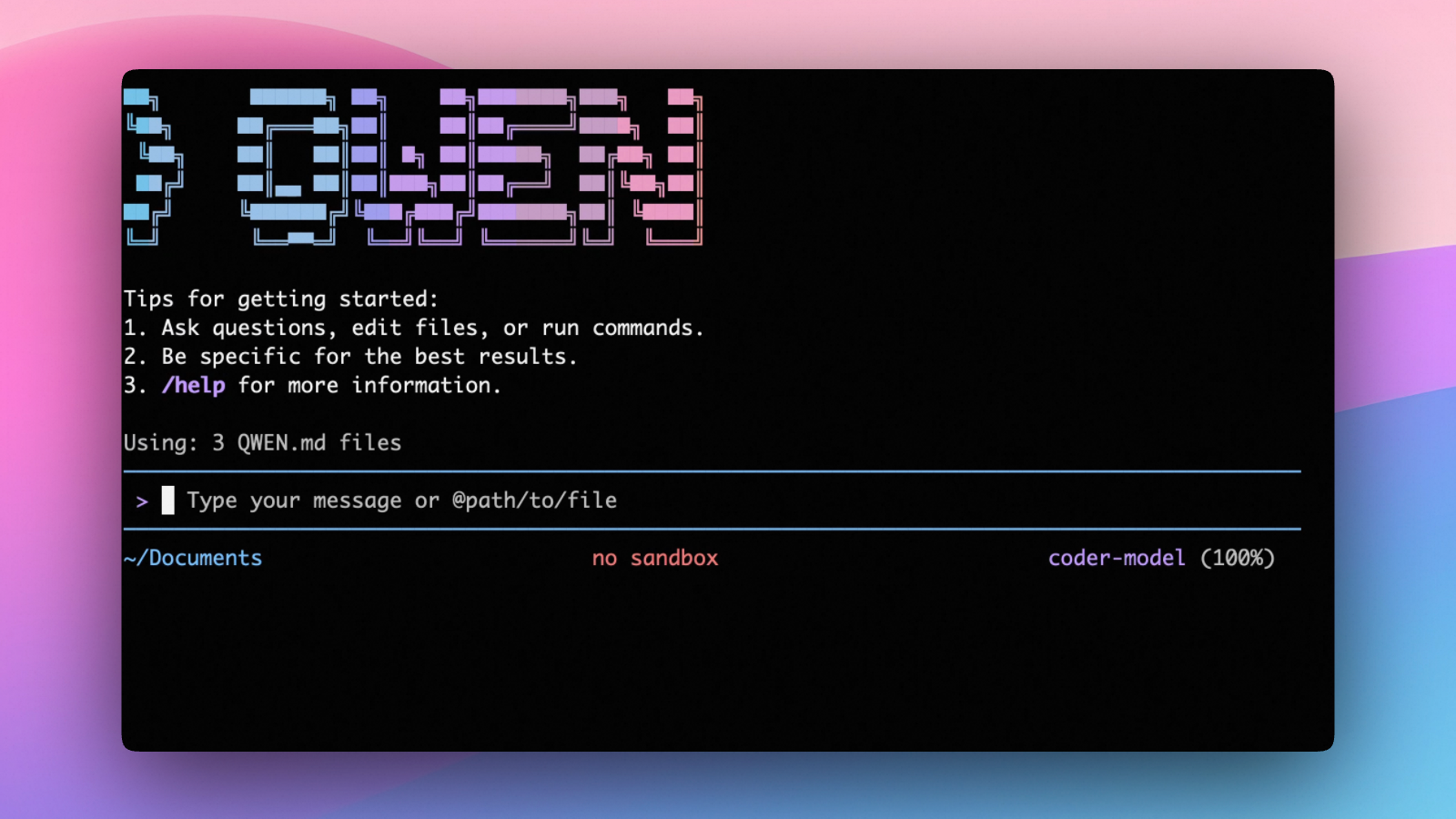
Qwen Code is an open-source AI agent for the terminal, optimized for Qwen series models. It helps you understand large codebases, automate tedious work, and ship faster.
- Multi-protocol, flexible providers: use OpenAI / Anthropic / Gemini-compatible APIs, Alibaba Cloud Coding Plan, OpenRouter, Fireworks AI, or bring your own API key.
- Open-source, co-evolving: both the framework and the Qwen3-Coder model are open-source—and they ship and evolve together.
- Agentic workflow, feature-rich: rich built-in tools (Skills, SubAgents) for a full agentic workflow and a Claude Code-like experience.
- Terminal-first, IDE-friendly: built for developers who live in the command line, with optional integration for VS Code, Zed, and JetBrains IDEs.
Installation
Quick Install (Recommended)
Linux / macOS
bash -c "$(curl -fsSL https://qwen-code-assets.oss-cn-hangzhou.aliyuncs.com/installation/install-qwen.sh)"
Windows (Run as Administrator)
Works in both Command Prompt and PowerShell:
powershell -Command "Invoke-WebRequest 'https://qwen-code-assets.oss-cn-hangzhou.aliyuncs.com/installation/install-qwen.bat' -OutFile (Join-Path $env:TEMP 'install-qwen.bat'); & (Join-Path $env:TEMP 'install-qwen.bat')"
Note
: It's recommended to restart your terminal after installation to ensure environment variables take effect.
Manual Installation
Prerequisites
Make sure you have Node.js 22 or later installed. Download it from nodejs.org.
NPM
npm install -g @qwen-code/qwen-code@latest
Homebrew (macOS, Linux)
brew install qwen-code
Quick Start
# Start Qwen Code (interactive)
qwen

# Then, in the session:
/help
/auth
On first use, you'll be prompted to sign in. You can run /auth anytime to switch authentication methods.
Example prompts:
What does this project do?
Explain the codebase structure.
Help me refactor this function.
Generate unit tests for this module.
Click to watch a demo video
🦞 Use Qwen Code for Coding Tasks in Claw
Copy the prompt below and paste it into your agent:
Use Qwen Code as a coding agent. First, fetch and read this skill reference:
https://raw.githubusercontent.com/QwenLM/qwen-code/refs/heads/main/.qwen/skills/qwen-code-claw/SKILL.md
Then follow the instructions inside to install, authenticate, and use Qwen Code via acpx for all coding tasks.
Authentication
Qwen Code supports the following authentication methods:
- API Key (recommended): use an API key from Alibaba Cloud Model Studio (Beijing / intl) or any supported provider (OpenAI, Anthropic, Google GenAI, and other compatible endpoints).
- Coding Plan: subscribe to the Alibaba Cloud Coding Plan (Beijing / intl) for a fixed monthly fee with higher quotas.
⚠️ Qwen OAuth was discontinued on April 15, 2026. If you were previously using Qwen OAuth, please switch to one of the methods above. Run
qwenand then/authto reconfigure.
API Key (recommended)
Use an API key to connect to Alibaba Cloud Model Studio or any supported provider. Supports multiple protocols:
- OpenAI-compatible: Alibaba Cloud ModelStudio, ModelScope, OpenAI, OpenRouter, and other OpenAI-compatible providers
- Anthropic: Claude models
- Google GenAI: Gemini models
The recommended way to configure models and providers is by editing ~/.qwen/settings.json (create it if it doesn't exist). This file lets you define all available models, API keys, and default settings in one place.
Quick Setup in 3 Steps
Step 1: Create or edit ~/.qwen/settings.json
Here is a complete example:
{
  "modelProviders": {
    "openai": [
      {
        "id": "qwen3.6-plus",
        "name": "qwen3.6-plus",
        "baseUrl": "https://dashscope.aliyuncs.com/compatible-mode/v1",
        "description": "Qwen3-Coder via Dashscope",
        "envKey": "DASHSCOPE_API_KEY"
      }
    ]
  },
  "env": {
    "DASHSCOPE_API_KEY": "sk-xxxxxxxxxxxxx"
  },
  "security": {
    "auth": {
      "selectedType": "openai"
    }
  },
  "model": {
    "name": "qwen3.6-plus"
  }
}
Step 2: Understand each field
| Field | What it does |
|---|---|
modelProviders |
Declares which models are available and how to connect to them. Keys like openai, anthropic, gemini represent the API protocol. |
modelProviders[].id |
The model ID sent to the API (e.g. qwen3.6-plus, gpt-4o). |
modelProviders[].envKey |
The name of the environment variable that holds your API key. |
modelProviders[].baseUrl |
The API endpoint URL (required for non-default endpoints). |
env |
A fallback place to store API keys (lowest priority; prefer .env files or export for sensitive keys). |
security.auth.selectedType |
The protocol to use on startup (openai, anthropic, gemini, vertex-ai). |
model.name |
The default model to use when Qwen Code starts. |
Step 3: Start Qwen Code — your configuration takes effect automatically:
qwen
Use the /model command at any time to switch between all configured models.
More Examples
Coding Plan (Alibaba Cloud ModelStudio) — fixed monthly fee, higher quotas
{
  "modelProviders": {
    "openai": [
      {
        "id": "qwen3.6-plus",
        "name": "qwen3.6-plus (Coding Plan)",
        "baseUrl": "https://coding.dashscope.aliyuncs.com/v1",
        "description": "qwen3.6-plus from ModelStudio Coding Plan",
        "envKey": "BAILIAN_CODING_PLAN_API_KEY"
      },
      {
        "id": "qwen3.5-plus",
        "name": "qwen3.5-plus (Coding Plan)",
        "baseUrl": "https://coding.dashscope.aliyuncs.com/v1",
        "description": "qwen3.5-plus with thinking enabled from ModelStudio Coding Plan",
        "envKey": "BAILIAN_CODING_PLAN_API_KEY",
        "generationConfig": {
          "extra_body": {
            "enable_thinking": true
          }
        }
      },
      {
        "id": "glm-4.7",
        "name": "glm-4.7 (Coding Plan)",
        "baseUrl": "https://coding.dashscope.aliyuncs.com/v1",
        "description": "glm-4.7 with thinking enabled from ModelStudio Coding Plan",
        "envKey": "BAILIAN_CODING_PLAN_API_KEY",
        "generationConfig": {
          "extra_body": {
            "enable_thinking": true
          }
        }
      },
      {
        "id": "kimi-k2.5",
        "name": "kimi-k2.5 (Coding Plan)",
        "baseUrl": "https://coding.dashscope.aliyuncs.com/v1",
        "description": "kimi-k2.5 with thinking enabled from ModelStudio Coding Plan",
        "envKey": "BAILIAN_CODING_PLAN_API_KEY",
        "generationConfig": {
          "extra_body": {
            "enable_thinking": true
          }
        }
      }
    ]
  },
  "env": {
    "BAILIAN_CODING_PLAN_API_KEY": "sk-xxxxxxxxxxxxx"
  },
  "security": {
    "auth": {
      "selectedType": "openai"
    }
  },
  "model": {
    "name": "qwen3.6-plus"
  }
}
Subscribe to the Coding Plan and get your API key at Alibaba Cloud ModelStudio(Beijing) or Alibaba Cloud ModelStudio(intl).
Multiple providers (OpenAI + Anthropic + Gemini)
{
  "modelProviders": {
    "openai": [
      {
        "id": "gpt-4o",
        "name": "GPT-4o",
        "envKey": "OPENAI_API_KEY",
        "baseUrl": "https://api.openai.com/v1"
      }
    ],
    "anthropic": [
      {
        "id": "claude-sonnet-4-20250514",
        "name": "Claude Sonnet 4",
        "envKey": "ANTHROPIC_API_KEY"
      }
    ],
    "gemini": [
      {
        "id": "gemini-2.5-pro",
        "name": "Gemini 2.5 Pro",
        "envKey": "GEMINI_API_KEY"
      }
    ]
  },
  "env": {
    "OPENAI_API_KEY": "sk-xxxxxxxxxxxxx",
    "ANTHROPIC_API_KEY": "sk-ant-xxxxxxxxxxxxx",
    "GEMINI_API_KEY": "AIzaxxxxxxxxxxxxx"
  },
  "security": {
    "auth": {
      "selectedType": "openai"
    }
  },
  "model": {
    "name": "gpt-4o"
  }
}
Enable thinking mode (for supported models like qwen3.5-plus)
{
  "modelProviders": {
    "openai": [
      {
        "id": "qwen3.5-plus",
        "name": "qwen3.5-plus (thinking)",
        "envKey": "DASHSCOPE_API_KEY",
        "baseUrl": "https://dashscope.aliyuncs.com/compatible-mode/v1",
        "generationConfig": {
          "extra_body": {
            "enable_thinking": true
          }
        }
      }
    ]
  },
  "env": {
    "DASHSCOPE_API_KEY": "sk-xxxxxxxxxxxxx"
  },
  "security": {
    "auth": {
      "selectedType": "openai"
    }
  },
  "model": {
    "name": "qwen3.5-plus"
  }
}
Tip: You can also set API keys via
exportin your shell or.envfiles, which take higher priority thansettings.json→env. See the authentication guide for full details.
Security note: Never commit API keys to version control. The
~/.qwen/settings.jsonfile is in your home directory and should stay private.
Local Model Setup (Ollama / vLLM)
You can also run models locally — no API key or cloud account needed. This is not an authentication method; instead, configure your local model endpoint in ~/.qwen/settings.json using the modelProviders field.
Set generationConfig.contextWindowSize inside the matching provider entry
and adjust it to the context length configured on your local server.
Ollama setup
- Install Ollama from ollama.com
- Pull a model:
ollama pull qwen3:32b - Configure
~/.qwen/settings.json:
{
  "modelProviders": {
    "openai": [
      {
        "id": "qwen3:32b",
        "name": "Qwen3 32B (Ollama)",
        "baseUrl": "http://localhost:11434/v1",
        "description": "Qwen3 32B running locally via Ollama",
        "generationConfig": {
          "contextWindowSize": 131072
        }
      }
    ]
  },
  "security": {
    "auth": {
      "selectedType": "openai"
    }
  },
  "model": {
    "name": "qwen3:32b"
  }
}
vLLM setup
- Install vLLM:
pip install vllm - Start the server:
vllm serve Qwen/Qwen3-32B - Configure
~/.qwen/settings.json:
{
  "modelProviders": {
    "openai": [
      {
        "id": "Qwen/Qwen3-32B",
        "name": "Qwen3 32B (vLLM)",
        "baseUrl": "http://localhost:8000/v1",
        "description": "Qwen3 32B running locally via vLLM",
        "generationConfig": {
          "contextWindowSize": 131072
        }
      }
    ]
  },
  "security": {
    "auth": {
      "selectedType": "openai"
    }
  },
  "model": {
    "name": "Qwen/Qwen3-32B"
  }
}
Usage
As an open-source terminal agent, you can use Qwen Code in five primary ways:
- Interactive mode (terminal UI)
- Headless mode (scripts, CI)
- IDE integration (VS Code, Zed)
- SDKs (TypeScript, Python, Java)
- Daemon mode —
qwen serveexposes ACP over HTTP+SSE so multiple clients share one agent (experimental)
Interactive mode
cd your-project/
qwen
Run qwen in your project folder to launch the interactive terminal UI. Use @ to reference local files (for example @src/main.ts).
Headless mode
cd your-project/
qwen -p "your question"
Use -p to run Qwen Code without the interactive UI—ideal for scripts, automation, and CI/CD. Learn more: Headless mode.
IDE integration
Use Qwen Code inside your editor (VS Code, Zed, and JetBrains IDEs):
Daemon mode (qwen serve, experimental)
cd your-project/
qwen serve
# → qwen serve listening on http://127.0.0.1:4170 (mode=http-bridge)
Run Qwen Code as a local HTTP daemon so IDE plugins, web UIs, CI scripts and custom CLIs all share one agent session over HTTP+SSE — instead of each spawning their own subprocess. Loopback bind has no auth by default (set QWEN_SERVER_TOKEN to enable bearer auth even on loopback); remote binds (--hostname 0.0.0.0) require a token — boot refuses without one. See:
SDKs
Build on top of Qwen Code with the available SDKs:
- TypeScript: Use the Qwen Code SDK
- Python: Use the Python SDK
- Java: Use the Java SDK
Python SDK example:
import asyncio

from qwen_code_sdk import is_sdk_result_message, query


async def main() -> None:
    result = query(
        "Summarize the repository layout.",
        {
            "cwd": "/path/to/project",
            "path_to_qwen_executable": "qwen",
        },
    )

    async for message in result:
        if is_sdk_result_message(message):
            print(message["result"])


asyncio.run(main())
Commands & Shortcuts
Session Commands
/help- Display available commands/clear- Clear conversation history/compress- Compress history to save tokens/stats- Show current session information/bug- Submit a bug report/exitor/quit- Exit Qwen Code
Keyboard Shortcuts
Ctrl+C- Cancel current operationCtrl+D- Exit (on empty line)Up/Down- Navigate command history
Learn more about Commands
Tip: In YOLO mode (
--yolo), vision switching happens automatically without prompts when images are detected. Learn more about Approval Mode
Configuration
Qwen Code can be configured via settings.json, environment variables, and CLI flags.
| File | Scope | Description |
|---|---|---|
~/.qwen/settings.json |
User (global) | Applies to all your Qwen Code sessions. Recommended for modelProviders and env. |
.qwen/settings.json |
Project | Applies only when running Qwen Code in this project. Overrides user settings. |
The most commonly used top-level fields in settings.json:
| Field | Description |
|---|---|
modelProviders |
Define available models per protocol (openai, anthropic, gemini, vertex-ai). |
env |
Fallback environment variables (e.g. API keys). Lower priority than shell export and .env files. |
security.auth.selectedType |
The protocol to use on startup (e.g. openai). |
model.name |
The default model to use when Qwen Code starts. |
See the Authentication section above for complete
settings.jsonexamples, and the settings reference for all available options.
Benchmark Results
Terminal-Bench Performance
| Agent | Model | Accuracy |
|---|---|---|
| Qwen Code | Qwen3-Coder-480A35 | 37.5% |
| Qwen Code | Qwen3-Coder-30BA3B | 31.3% |
Ecosystem
Looking for a graphical interface?
- AionUi A modern GUI for command-line AI tools including Qwen Code
- Gemini CLI Desktop A cross-platform desktop/web/mobile UI for Qwen Code
Troubleshooting
If you encounter issues, check the troubleshooting guide.
Common issues:
Qwen OAuth free tier was discontinued on 2026-04-15: Qwen OAuth is no longer available. Runqwen→/authand switch to API Key or Coding Plan. See the Authentication section above for setup instructions.
To report a bug from within the CLI, run /bug and include a short title and repro steps.
Connect with Us
- Discord: https://discord.gg/RN7tqZCeDK
- Dingtalk: https://qr.dingtalk.com/action/joingroup?code=v1,k1,+FX6Gf/ZDlTahTIRi8AEQhIaBlqykA0j+eBKKdhLeAE=&_dt_no_comment=1&origin=1
Acknowledgments
This project is based on Google Gemini CLI. We acknowledge and appreciate the excellent work of the Gemini CLI team. Our main contribution focuses on parser-level adaptations to better support Qwen-Coder models.