 a810f7e16c
* fix(serve): make session restore timeouts safe Co-authored-by: Qwen-Coder <qwen-coder@alibabacloud.com> * fix(cli): restore missing core mock exports in the ACP worktree suite The restore-tracing change added `extractDaemonTraceContext` and `withDaemonSpan` to `acpAgent.ts`, but `acpAgent.worktree.test.ts` replaces `@qwen-code/qwen-code-core` with a full mock factory that never listed them. `loadSession` then failed on an undefined export, taking all three cases down and producing teardown rejections from the half-built agent. The sibling suite was updated; this one was missed. Co-Authored-By: Claude Opus 5 <noreply@anthropic.com> * fix(serve): bound and disambiguate the abandoned restore lifecycle Four follow-ups from review of the restore timeout work. A startup budget may now raise the restore budget but never lower it. Taking an explicitly configured `initializeTimeoutMs` as the restore fallback meant a deployment that tightened its child-initialize check still inherited a sub-default restore deadline — exactly the failure this change exists to remove. An explicit `sessionRestoreTimeoutMs` still wins outright, including below the default, for deployments that want restore to fail fast. Validation now names the field actually at fault. A restore fenced behind a timed-out predecessor is no longer reported as an ordinary in-flight restore. It carries `reason: awaiting_abandoned_cleanup` and a retry hint of one restore budget (capped at 120s) instead of the ordinary 5 seconds, because the fence cannot clear until the non-cancellable ACP request settles and a 5-second cadence just spins the caller against a 409 it cannot resolve. Whether a channel is condemned is now derived rather than sticky. A timeout recorded `emptyReapPending` permanently, so any channel that had ever seen one was guaranteed to be reaped once its remaining work drained, forcing a cold respawn even when the late restore had landed and closed cleanly. The reap condition is now computed from an outstanding `unsettledAbandonedRestores` set, quarantine, or an ordinary pending empty reap; real settlement clears the entry and hands the channel back to the configured idle policy. Abandonment no longer retains ownership without bound. One further restore budget after the deadline, a still-unsettled restore marks the channel `restoreSettlementOverdue`: existing sessions and workspace control keep working, but fresh session work is refused so the channel can drain, since closing the transport is the only lever that releases a permanently hung request. Releasing capacity while hidden work runs would allow unbounded oversubscription, and force-killing a channel with live siblings would reintroduce the failure this work removes, so neither is done. Fresh-admission blocking is now scanned across alive channels rather than tracked in a single reference, so a second condemned channel cannot silently displace the first. Co-Authored-By: Claude Opus 5 <noreply@anthropic.com> * fix(serve): keep the abandoned restore lifecycle off ids it no longer owns Two correctness gaps in the abandoned-restore machinery introduced by this PR, both reported by automated review and both confirmed by mutation testing (each new test fails when its fix is reverted). A caller-supplied `sessionId` is used verbatim by the agent, but `spawnOrAttach` never consulted `inFlightRestores`. A fresh spawn could therefore take an id that a restore still owns, in either lifecycle phase. The consequences were silent: `abandonedRestoreIds` suppresses session updates, guardrail events, and child notifications, so the new session would have registered successfully and then emitted nothing; and a late `settleAbandonedRestore` would have closed and tombstoned it out from under its owner. Such a spawn is now rejected with the same `RestoreInProgressError` and reason the restore path uses, so the caller gets the correct retry hint for whichever phase is holding the id. The cleanup path is guarded independently, because the request-level check only covers the id the caller asked for and a session registers under the id the child returns. An abandoned restore never reaches `createSessionEntry` — the deadline rejects before registration — so any live entry under that id belongs to someone else. Cleanup now detects that and returns without closing or tombstoning, releasing its own bookkeeping instead. The notification fence has no TTL and was only cleared by `markRestoreInFlight`, which covers a subsequent restore and nothing else. `createSessionEntry` now clears it for every registration route, so a legitimate owner of the id is never handed a session that silently drops everything the child sends it. Also tightens two tests that could not observe the values they pin. The SDK default restore timeout admitted any value in (30s, 70s]; it is now split at the exact boundary, so collapsing the default onto the 60s server budget — which would make the client abort race the daemon's own deadline and cost the caller its structured 504 — fails. And the advertised-budget propagation from capabilities through to the SDK call had no live-path assertion; dropping the capabilities argument at the real call site left every existing test green. The `as never` casts are replaced with typed `DaemonCapabilities` values so a field rename fails typecheck. Co-Authored-By: Claude Opus 5 <noreply@anthropic.com> * fix(serve): let a condemned channel drain without its wedged child Merging main's active-work close protocol (#8588) into this PR's abandoned restore bound produced a deadlock that neither side has on its own, and the conflict resolution was committed without running tests. `maybeCloseIdleSession` now routes through `confirmChildUnheld`, which asks the child whether it still holds work before closing a session nobody is attached to. That is right in general and wrong for a channel this PR has already condemned. `restoreSettlementOverdue` and quarantine exist precisely because the child stopped being answerable, and their whole premise is that visible work drains so the channel can be reaped — closing the transport is the only thing that can release a restore we cannot cancel. Making that drain depend on a round trip to the wedged child inverts it: a child stuck in a non-cancellable restore is exactly the one that cannot reply inside `ACTIVE_WORK_CLOSE_TIMEOUT_MS`, so the sessions never close, the channel never drains, the reap never fires, and the bound never takes effect. A channel condemned by the restore lifecycle now skips the round trip and proceeds to local teardown. Nothing is attached to the session by then — `maybeCloseIdleSession` gates on that — and the sibling-safety invariant is untouched: this closes sessions whose clients have already left, it does not force-kill a channel that still has live ones. The regression test drives an overdue channel whose child never answers the close-if-unheld probe and asserts the detach still reaps it. Reverting the guard reproduces the deadlock as a test timeout. Co-Authored-By: Claude Opus 5 <noreply@anthropic.com> * test(serve): pin the restore-timeout contract the review found unasserted Automated review identified eleven places where the restore-timeout work's behavior was correct but unpinned — each with a mutation that ships green. Every fix below was verified the same way: apply the mutation, watch the new assertion fail, revert, watch it pass. The timeout path's telemetry had no coverage at all, which is the sharpest gap given that observability is what this work exists to deliver. A shared recorder now asserts the public timeout result and its kill_empty-vs- fence_shared signal, the late arrival, and the cleanup outcome for both the closed and quarantined cases. The deadline timer's cancellation on a successful restore was likewise unpinned: deleting both `clearTimeout` calls kept the whole suite green, while in production the stale timer fires one budget after a successful restore and abandons a live session — fencing its frames, closing its event bus, and emitting a spurious timeout. A success-path test now advances past the deadline and asserts no second public result. Three more bridge assertions proved less than they claimed: the concurrent- restore case never checked that the abandoned restore settles, the workspace-control case never checked that the deferred reap eventually fires, and the resolver never pinned the accepting side of the MAX boundary (a `>` to `>=` mutation rejects the largest legal delay at boot). The workspace-control case also needed a positive channel idle budget, since with the default zero the idle-timer kill substitutes for the reap junction under test; its assertions are rewritten around the derived reap semantics rather than the sticky flag they predate. Outside the bridge: the scheduled-task timeout wiring had no test, so deleting the arguments silently fell back to the helpers' own defaults; the cold restore path never asserted that `live_restore_ms` is absent; the SDK's per-request validation and its over-ceiling clamp were untested; the WebUI watchdog test jumped straight to its own value, staying green for any watchdog at or below it, including the 30s attach value that would recreate the original symptom in the browser; and the two new known error types were unexercised, so dropping either would relabel every restore-timeout and quarantine error as unknown. Two review items are deliberately not taken here and are recorded in the design doc's non-goals instead: transcript materialization is still not separately attributable from `config_setup`, which needs instrumentation inside the core session loader that P1/P2 restructures anyway, and sibling event-loop latency during a large restore remains unmeasured. Co-Authored-By: Claude Opus 5 <noreply@anthropic.com> * fix(serve): bound the condemned-channel close and complete the fence contract Second automated review round, on the code the first round produced. One Critical and twelve suggestions; all verified by mutation before and after. **The Critical is a regression I introduced.** Letting a condemned channel skip the bounded hold probe routed it into `closeSessionImpl`, whose agent close is unbounded when it throws on failure — so the fix traded a bounded wait on a wedged child for an unbounded one. A settlement-overdue channel with an unresponsive child would hang `detachClient` forever, strand the session in `closing`, never drain, never reap, and 503 every new session until restart: strictly worse than before. `CloseSessionOpts` now carries an `agentCloseTimeoutMs` that the condemned path sets, so a hang lands in the existing unknown-outcome recovery, which kills the channel — the teardown the drain was waiting for. The earlier test missed this because its fake child still answered the plain close; it now answers nothing at all, and asserts the detach itself returns. **The fence was invisible on the transports clients actually use.** `toRpcError` had no `RestoreInProgressError` case, so over acp-http and acp-ws — which SDK negotiation prefers over REST — the fence degraded to an opaque internal 500 with no code, reason, or hint, and the backoff contract this work documents was impossible to honor. **Two retry hints still advertised five seconds for states that outlive a budget.** The restore 504 creates the fence, and quarantine lasts until the channel drains; a fresh-id caller never reaches the 409 that carries the real hint, so its header was the only signal it got. Both now derive from the budget through one shared clamp helper, which also replaces the formula that was inlined in the bridge and gives the documented 5-120s bounds a test. **A spawn collision reported an operation the caller never issued**, naming the restore owner's action as both the active and the requested one and telling the caller to retry an endpoint it never called. The rest: five places still described the initialize-timeout fallback as a plain chain rather than raise-only, contradicting sibling docs shipped in this same PR; the design doc omitted the retry-hint clamp; the protocol reference omitted the new spawn emission site; the error taxonomy omitted `restore_settlement_overdue`, which matters because its audience is monitoring. Test-only gaps: the dynamic 409 had no HTTP-layer coverage, the 120-second cap was unpinned, and the SDK's precedence of an explicit global timeout over the advertised budget was pinned only branch-by-branch. Co-Authored-By: Claude Opus 5 <noreply@anthropic.com> * fix(serve): preserve restore session ownership handoff Co-authored-by: Qwen-Coder <qwen-coder@alibabacloud.com> --------- Co-authored-by: Qwen-Coder <qwen-coder@alibabacloud.com> Co-authored-by: Claude Opus 5 <noreply@anthropic.com> Co-authored-by: qwen-code-dev-bot <qwen-code-dev-bot@users.noreply.github.com> |
||
|---|---|---|
| .github | ||
| .husky | ||
| .qwen | ||
| .vscode | ||
| docs | ||
| docs-site | ||
| eslint-rules | ||
| integration-tests | ||
| integrations/external-context | ||
| packages | ||
| patches | ||
| scripts | ||
| .dockerignore | ||
| .editorconfig | ||
| .gitattributes | ||
| .gitignore | ||
| .npmrc | ||
| .nvmrc | ||
| .prettierignore | ||
| .prettierrc.json | ||
| .yamllint.yml | ||
| AGENTS.md | ||
| CHANGELOG.md | ||
| CLAUDE.md | ||
| CONTRIBUTING.md | ||
| Dockerfile | ||
| esbuild.config.js | ||
| eslint.config.js | ||
| eslint.legacy-filenames.mjs | ||
| LICENSE | ||
| Makefile | ||
| package-lock.json | ||
| package.json | ||
| README.md | ||
| SECURITY.md | ||
| tsconfig.json | ||
| vitest.config.ts | ||




The open-source AI coding agent that lives in your terminal.
中文 | Deutsch | français | 日本語 | Русский | Português (Brasil)
Why Qwen Code?
- Agentic out of the box — Auto-Memory, Auto-Skills, SubAgents, Agent Teams, and MCP. Dynamic workflows, zero setup.
- Open-source, inside and out — The framework and the Qwen models are open-source. They evolve together. No vendor lock-in.
- Multi-protocol — Supports OpenAI, Anthropic, Gemini, and Qwen APIs. Any third-party provider or local model (Ollama / vLLM). Switch at runtime.
- Beyond the terminal — IDE plugins, Desktop app, daemon mode, SDKs, and IM bots (Telegram / DingTalk / WeChat / Feishu).
Tip
Qwen Code is actively iterating on itself — using its own agent and models to file issues, submit PRs, review code, and run tests. Powered by the community, driven by AI.
Installation
Linux / macOS:
curl -fsSL https://qwen-code-assets.oss-cn-hangzhou.aliyuncs.com/installation/install-qwen-standalone.sh | bash
Windows:
irm https://qwen-code-assets.oss-cn-hangzhou.aliyuncs.com/installation/install-qwen-standalone.ps1 | iex
Restart your terminal after installation to ensure environment variables take effect.
NPM / Homebrew
NPM (requires Node.js 22+):
npm install -g @qwen-code/qwen-code@latest
Homebrew (macOS / Linux):
brew install qwen-code
Quick Start
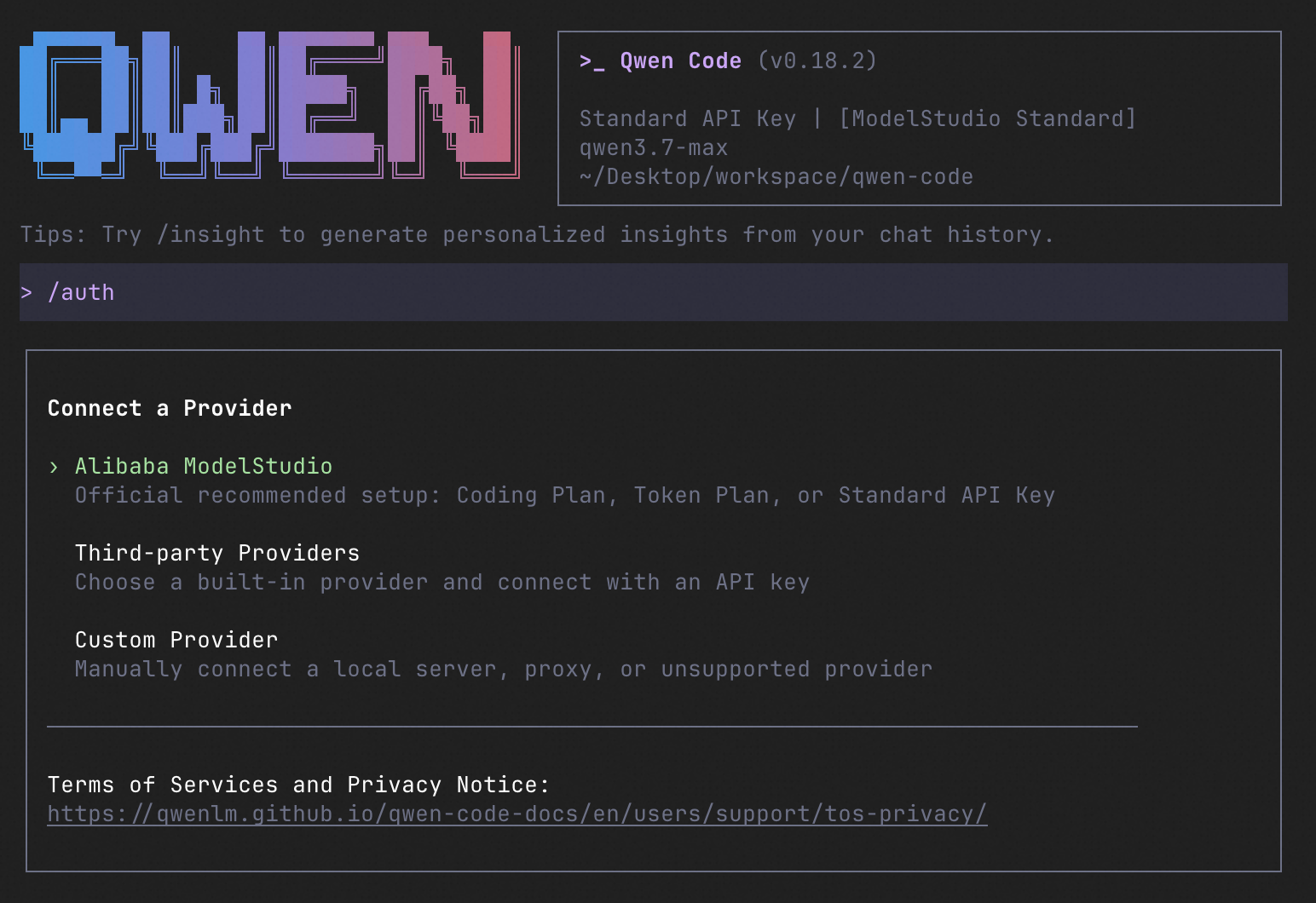
qwen          # Launch interactive terminal UI
# Inside the session:
/auth         # Configure your provider and API key
See the Authentication Guide and Settings Reference for detailed setup.
How to Use Qwen Code
| Mode | Command | Use Case |
|---|---|---|
| Interactive | qwen |
Terminal UI with rich rendering, @file references, slash commands |
| Headless | qwen -p "..." |
Scripts, CI/CD, batch processing — no UI |
| IDE | — | VS Code, Zed, JetBrains |
| Desktop | — | Qwen Code Desktop — GUI for macOS, Windows, Linux |
| Daemon | qwen serve |
Shared agent session over HTTP+SSE (ACP). Multiple clients, one agent. (experimental) Docs |
| SDK | — | TypeScript, Python, Java |
| IM Bot | qwen channel |
Connect to Telegram, DingTalk, WeChat, or Feishu |
SDK example (Python)
import asyncio

from qwen_code_sdk import is_sdk_result_message, query


async def main() -> None:
    result = query(
        "Summarize the repository layout.",
        {
            "cwd": "/path/to/project",
            "path_to_qwen_executable": "qwen",
        },
    )

    async for message in result:
        if is_sdk_result_message(message):
            print(message["result"])


asyncio.run(main())
Capabilities
If you know Claude Code, you already know Qwen Code — and then some. We've put significant effort into bringing Qwen Code to feature parity with Claude Code, improving both breadth and reliability across the board.
| Feature | Qwen Code | Claude Code |
|---|---|---|
| SubAgents, Agent Teams, Dynamic Workflows | ✓ | ✓ |
| Auto-Memory, Auto-Skills, Hooks | ✓ | ✓ |
| Built-in Skills (/review, /batch, /loop, /bugfix…) | ✓ | ✓ |
| MCP, Plan Mode, LSP Integration | ✓ | ✓ |
| Auto Mode, Sandbox, Git Worktrees | ✓ | ✓ |
| Computer Use (desktop automation) | ✓ | ✓ |
| IDE Plugins (VS Code / JetBrains / Zed) | ✓ | ✓ |
| SDK | ✓ | ✓ |
| Headless Mode, Session Management | ✓ | ✓ |
| Open-source — model and framework | ✓ | — |
| Multi-protocol (OpenAI / Anthropic / Gemini / Qwen + any provider) | ✓ | — |
| Agent Arena (multi-model head-to-head on same task) | ✓ | — |
Daemon Mode — qwen serve (multi-client shared agent) |
✓ | — |
| IM Channels (Telegram / DingTalk / WeChat / Feishu) | ✓ | — |
Ecosystem
-
Qwen Code Desktop — Official desktop app for macOS, Windows, and Linux
-
AionUi — A modern GUI for command-line AI tools including Qwen Code
-
Gemini CLI Desktop — A cross-platform desktop/web/mobile UI for Qwen Code
-
🦞 Qwen Code Claw — Let other agents (Claude, Codex, etc.) delegate coding tasks to Qwen Code via ACP. Paste this prompt into your agent:
Use Qwen Code as a coding agent. First, fetch and read this skill reference:
https://raw.githubusercontent.com/QwenLM/qwen-code/refs/heads/main/.qwen/skills/qwen-code-claw/SKILL.md
Then follow the instructions inside to install, authenticate, and use Qwen Code via acpx for all coding tasks.
- Aliyun Model Studio CLI — Official CLI for Aliyun's AI platform (
bailian-cli). Extends Qwen Code with image/video generation, knowledge retrieval, app orchestration, and model deployment
Contributing
Contributions are welcome! See CONTRIBUTING.md for guidelines.
Acknowledgments
This project was originally based on Google Gemini CLI v0.8.2. We gratefully acknowledge the Gemini CLI team's excellent work. Starting from Qwen Code v0.1, we stopped syncing with upstream and began independent development as a multi-protocol, multi-platform agent framework with deep integrations for Qwen models and beyond.