 a6a1258077
* fix(triage): strengthen PR gate with batch detection, problem existence check, and red flag patterns The PR triage gate was too permissive — it approved 20 validation-noise PRs from an AI bot in a single day without blocking any. Root cause: the gate asked "is the direction correct?" (easy to pass) but never asked "does this problem actually exist?" (the real question). Three new checks added to pr-workflow.md: 1. Gate Philosophy — explicit stance: the gate says no by default, burden of proof is on the author. AI-bot volume does not equal value. 2. Stage 0: Batch Pattern Detection — before individual review, check if the same author has 3+ similar PRs in 7 days. If so, evaluate as a group and close the noise batch together. 3. Stage 1b: Problem Existence Check — mandatory before direction review. Distinguishes observed bugs (with reproduction) from theoretical hardening (without). Includes red flag phrases that signal "no real problem" (e.g. "the runtime validators already enforce..."). Also updated Stage 1 comment template and Stage 3 reflection questions. * fix(triage): fix broken jq filter, add missing stop instructions, and tighten prompt - Fix jq date comparison: string '7 days ago' always false, use fromdateiso8601 - Fix --state all to --state open to match '3+ open PRs' prose - Add terminal exit list after Stage 1 comment (1b problem-existence was missing) - Fix Stage 3 batch threshold (10+) to reference Stage 0 (3+) - Compress Gate Philosophy, Stage 0, and 1b for conciseness * feat(triage): add core module scope gate to reject unsolicited refactors Add Stage 0b that flatly rejects community-contributed refactor PRs touching core infrastructure (packages/core, auth, providers, models, config, tools, services). No exceptions — core refactors must be maintainer-initiated with prior design discussion. Triggered by PR #5089: 75-file refactor across core/auth/providers/models that should never have been accepted from a community contributor. * docs(agents): add core infrastructure maintainer-only policy to Working Principles * feat(triage): gate must verify it truly understands PR impact before approving The meta-principle: 'the direction looks correct' is the most dangerous sentence in triage — it means the gate understood intent but not impact. For core module changes, the gate must name every downstream consumer; if it cannot, escalate to maintainer. 100% confidence or escalate. Updated both pr-workflow.md (Stage 0b) and AGENTS.md (Working Principles). * fix(triage): make core module gate a hard block with no judgment allowed Previous version asked the gate to 'assess whether it understands the impact' — too soft, AI will always rationalize that it understands enough. New version: non-maintainer + core paths = instant reject. No evaluation, no thinking, no exceptions. The gate is not qualified to judge core refactors. Period. * fix(triage): two-tier core module gate — hard block large, 100% confidence for small Large-scope core changes (10+ files / 500+ lines) are a hard block — no evaluation, no exceptions. Small-scope core changes may proceed only if the gate is 100% confident; any doubt triggers maintainer escalation. Previous versions were either too soft ('assess your understanding') or too blunt ('all non-maintainer core PRs rejected'). Two-tier approach allows legitimate small bugfixes through while walling off refactors. * refactor(triage): remove Stage 0 batch pattern detection — low ROI, always returns empty for human contributors Co-authored-by: Qwen-Coder <qwen-coder@alibabacloud.com> * fix(triage): address review feedback on pr-workflow and AGENTS.md - Fix "Closing" vs "request changes" inconsistency in Stage 1b template (both EN and CN) — align with terminal exits list - Add Stage 0b to terminal exits list and terminal gate exception - Add gh pr review command to Tier 1 hard block (was missing delivery mechanism) - Clarify Tier 1 "500+ lines" as additions + deletions combined - Add maintainer-authored exception to Tier 1 hard block - Use concrete path patterns for core infrastructure definition - Fix dangling Stage 0 reference in Stage 3 reflection (Stage 0 was removed) - Scope AGENTS.md core rule to triage gate, add cross-package changes to definition * fix(triage): rename Stage 0b→0, fix close ambiguity, add stage labels to exits - Rename "Stage 0b" to "Stage 0" (no more Stage 0a since batch detection was removed) - Fix ambiguous "close" in Stage 1b → "leave for maintainer to decide" (agent recommends, maintainer executes gh pr close) - Add explicit stage labels to all terminal exits (Stage 0, 1a, 1b, 1c) * fix(triage): hard-block on net size, not file breadth wenshao: a low-risk sweep (rename, import-path update, lint/format autofix, a repeated null-guard) can touch 10+ core files while changing a line or two each, yet the 'OR 10+ files' trigger hard-blocked it with 'open an issue to discuss', while a deep risky rewrite under 10 files slipped into the lenient Tier 2 path. Breadth was treated as risk; depth was ignored. Make the hard block fire on size alone (500+ changed lines), which still catches a deep rewrite concentrated in a few files. Route pure file-count breadth to maintainer escalation / Tier 2 judgement on the actual diff instead of an auto-reject. Co-Authored-By: Qwen-Coder <noreply@qwen.ai> * fix(triage): make re-run escalation concrete; align breadth wording across files - Stage 1b: replace vague 'leave for maintainer to decide' with concrete escalate-to-maintainer + stop (no Stage 2), matching the escalation vocabulary used in Stage 1c/Stage 3. - AGENTS.md: clarify that a file-breadth sweep is escalated for awareness and otherwise judged under Tier 2's 100%-confidence bar, aligning with pr-workflow.md's Breadth-ne-size paragraph (removes terminal-stop ambiguity). Co-Authored-By: Qwen-Coder <noreply@qwen.ai> * fix(triage): remove dead problem-does-not-exist branch, clarify escalate/size wording - Drop the `<If problem does not exist:>` Stage 1 comment branch: it is a terminal exit that submits a CHANGES_REQUESTED review and must not also post a Stage 1 comment, so the template branch was unreachable. - Reword the breadth-sweep case to "flag for the maintainer's awareness" so "escalate" consistently means stop/hand-off across the file. - Clarify AGENTS.md 500-line threshold as additions + deletions combined, matching pr-workflow.md. Co-authored-by: Qwen-Coder <qwen-coder@alibabacloud.com> * fix(triage): address 4 review threads — Stage 1b command, re-run carve-out, Tier 2 wording, AGENTS.md exemption - Add concrete gh pr review --request-changes command block with body template and <!-- qwen-triage stage=1b --> marker to Stage 1b, matching every other terminal gate's invocation pattern. - Add terminal-exit review carve-out to re-runs section: PR reviews cannot be edited via PATCH API, so on re-run check for existing CHANGES_REQUESTED review before re-submitting. - Fix Tier 2 precondition wording: 'Small-scope' → 'below 500-line threshold' and 'fewer files' → 'few files, or a breadth-sweep flagged above' so the breadth carve-out PRs are not excluded by the Tier 2 description alone. - Fix AGENTS.md 'No evaluation, no exceptions' → 'Skip evaluation entirely — the maintainer exemption above is the sole exception' to eliminate the apparent contradiction with the parenthetical maintainer exemption. --------- Co-authored-by: Qwen-Coder <qwen-coder@alibabacloud.com> Co-authored-by: Qwen-Coder <noreply@qwen.ai> |
||
|---|---|---|
| .github | ||
| .husky | ||
| .qwen | ||
| .vscode | ||
| docs | ||
| docs-site | ||
| eslint-rules | ||
| integration-tests | ||
| packages | ||
| patches | ||
| scripts | ||
| .dockerignore | ||
| .editorconfig | ||
| .gitattributes | ||
| .gitignore | ||
| .npmrc | ||
| .nvmrc | ||
| .prettierignore | ||
| .prettierrc.json | ||
| .yamllint.yml | ||
| AGENTS.md | ||
| CHANGELOG.md | ||
| CLAUDE.md | ||
| CONTRIBUTING.md | ||
| Dockerfile | ||
| esbuild.config.js | ||
| eslint.config.js | ||
| eslint.legacy-filenames.mjs | ||
| LICENSE | ||
| Makefile | ||
| package-lock.json | ||
| package.json | ||
| README.md | ||
| SECURITY.md | ||
| tsconfig.json | ||
| vitest.config.ts | ||




The open-source AI coding agent that lives in your terminal.
中文 | Deutsch | français | 日本語 | Русский | Português (Brasil)
Why Qwen Code?
- Agentic out of the box — Auto-Memory, Auto-Skills, SubAgents, Agent Teams, and MCP. Dynamic workflows, zero setup.
- Open-source, inside and out — The framework and the Qwen models are open-source. They evolve together. No vendor lock-in.
- Multi-protocol — Supports OpenAI, Anthropic, Gemini, and Qwen APIs. Any third-party provider or local model (Ollama / vLLM). Switch at runtime.
- Beyond the terminal — IDE plugins, Desktop app, daemon mode, SDKs, and IM bots (Telegram / DingTalk / WeChat / Feishu).
Tip
Qwen Code is actively iterating on itself — using its own agent and models to file issues, submit PRs, review code, and run tests. Powered by the community, driven by AI.
Installation
Linux / macOS:
curl -fsSL https://qwen-code-assets.oss-cn-hangzhou.aliyuncs.com/installation/install-qwen-standalone.sh | bash
Windows:
irm https://qwen-code-assets.oss-cn-hangzhou.aliyuncs.com/installation/install-qwen-standalone.ps1 | iex
Restart your terminal after installation to ensure environment variables take effect.
NPM / Homebrew
NPM (requires Node.js 22+):
npm install -g @qwen-code/qwen-code@latest
Homebrew (macOS / Linux):
brew install qwen-code
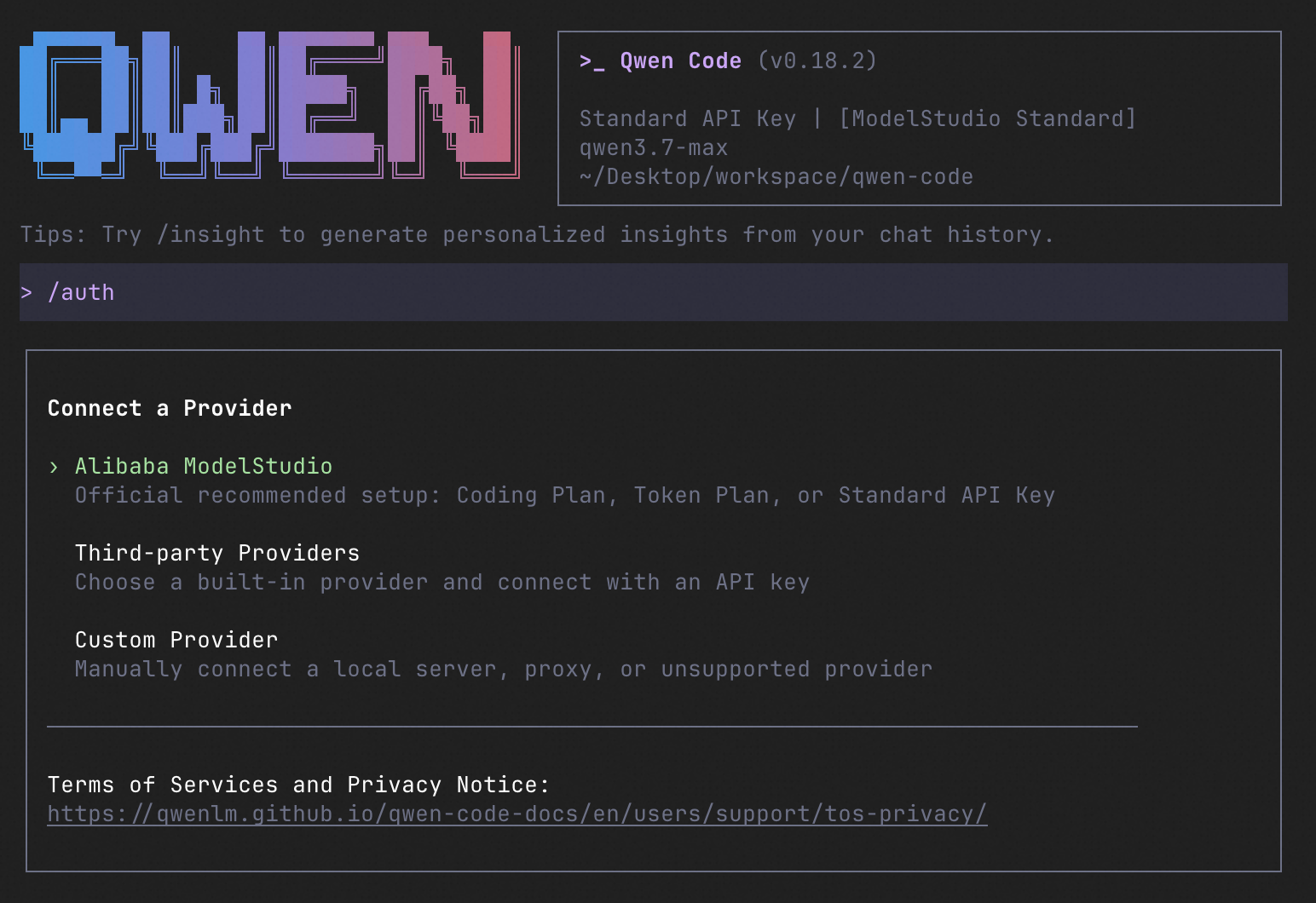
Quick Start
qwen          # Launch interactive terminal UI
# Inside the session:
/auth         # Configure your provider and API key
See the Authentication Guide and Settings Reference for detailed setup.
How to Use Qwen Code
| Mode | Command | Use Case |
|---|---|---|
| Interactive | qwen |
Terminal UI with rich rendering, @file references, slash commands |
| Headless | qwen -p "..." |
Scripts, CI/CD, batch processing — no UI |
| IDE | — | VS Code, Zed, JetBrains |
| Desktop | — | Qwen Code Desktop — GUI for macOS, Windows, Linux |
| Daemon | qwen serve |
Shared agent session over HTTP+SSE (ACP). Multiple clients, one agent. (experimental) Docs |
| SDK | — | TypeScript, Python, Java |
| IM Bot | qwen channel |
Connect to Telegram, DingTalk, WeChat, or Feishu |
SDK example (Python)
import asyncio

from qwen_code_sdk import is_sdk_result_message, query


async def main() -> None:
    result = query(
        "Summarize the repository layout.",
        {
            "cwd": "/path/to/project",
            "path_to_qwen_executable": "qwen",
        },
    )

    async for message in result:
        if is_sdk_result_message(message):
            print(message["result"])


asyncio.run(main())
Capabilities
If you know Claude Code, you already know Qwen Code — and then some. We've put significant effort into bringing Qwen Code to feature parity with Claude Code, improving both breadth and reliability across the board.
| Feature | Qwen Code | Claude Code |
|---|---|---|
| SubAgents, Agent Teams, Dynamic Workflows | ✓ | ✓ |
| Auto-Memory, Auto-Skills, Hooks | ✓ | ✓ |
| Built-in Skills (/review, /batch, /loop, /bugfix…) | ✓ | ✓ |
| MCP, Plan Mode, LSP Integration | ✓ | ✓ |
| Auto Mode, Sandbox, Git Worktrees | ✓ | ✓ |
| Computer Use (desktop automation) | ✓ | ✓ |
| IDE Plugins (VS Code / JetBrains / Zed) | ✓ | ✓ |
| SDK | ✓ | ✓ |
| Headless Mode, Session Management | ✓ | ✓ |
| Open-source — model and framework | ✓ | — |
| Multi-protocol (OpenAI / Anthropic / Gemini / Qwen + any provider) | ✓ | — |
| Agent Arena (multi-model head-to-head on same task) | ✓ | — |
Daemon Mode — qwen serve (multi-client shared agent) |
✓ | — |
| IM Channels (Telegram / DingTalk / WeChat / Feishu) | ✓ | — |
Ecosystem
-
Qwen Code Desktop — Official desktop app for macOS, Windows, and Linux
-
AionUi — A modern GUI for command-line AI tools including Qwen Code
-
Gemini CLI Desktop — A cross-platform desktop/web/mobile UI for Qwen Code
-
🦞 Qwen Code Claw — Let other agents (Claude, Codex, etc.) delegate coding tasks to Qwen Code via ACP. Paste this prompt into your agent:
Use Qwen Code as a coding agent. First, fetch and read this skill reference:
https://raw.githubusercontent.com/QwenLM/qwen-code/refs/heads/main/.qwen/skills/qwen-code-claw/SKILL.md
Then follow the instructions inside to install, authenticate, and use Qwen Code via acpx for all coding tasks.
Contributing
Contributions are welcome! See CONTRIBUTING.md for guidelines.
Acknowledgments
This project was originally based on Google Gemini CLI v0.8.2. We gratefully acknowledge the Gemini CLI team's excellent work. Starting from Qwen Code v0.1, we stopped syncing with upstream and began independent development as a multi-protocol, multi-platform agent framework with deep integrations for Qwen models and beyond.