 a552df8998
* refactor(providers): unify provider config into core, remove CLI re-exports Move all ProviderConfig definitions, registry (ALL_PROVIDERS), and utility functions (buildInstallPlan, resolveBaseUrl, etc.) from packages/cli/src/auth/ into packages/core/src/providers/ so both CLI and VSCode can share the same provider system. - Add core providers module with types, presets, install logic - Rewrite VSCode AuthMessageHandler to dynamically generate provider choices from ALL_PROVIDERS instead of hardcoding 3 providers - Add applyProviderInstallPlanToFile in VSCode settingsWriter using the ProviderSettingsAdapter abstraction - Delete 11 CLI re-export wrapper files, update ~20 import sites - Keep CLI-specific applyProviderInstallPlan (uses LoadedSettings) and openrouterOAuth.ts (CLI-only OAuth runtime) Co-authored-by: Qwen-Coder <qwen-coder@alibabacloud.com> * refactor(cli): drop OpenRouter OAuth + /manage-models, simplify /auth OpenRouter now uses the standard API-key flow under "Third-party Providers" (issue #4108). The whole OpenRouter OAuth implementation (PKCE, callback server, model auto-install) and the /manage-models command (only OpenRouter was wired in; /auth Step 2 already covers model selection) are removed. /auth is renamed around the "Connect a Provider" mental model: - Dialog title is now "Connect a Provider"; the OAuth main entry is gone - handleAuthSelect (mixed close + auth trigger) is split into a single-purpose closeAuthDialog; legacy wrappers (handleSubscriptionPlanSubmit, handleApiKeyProviderSubmit, handleCustomApiKeySubmit, ...) are dropped in favor of the unified handleProviderSubmit Core: openRouterProvider switches to authMethod='input', uiGroup='third-party', ships with two recommended free models, and is reordered to the end of the third-party list to keep DeepSeek as the default highlight. Net diff: 34 files, +124 / -3835. Co-authored-by: Qwen-Coder <qwen-coder@alibabacloud.com> * refactor(auth): unify applyProviderInstallPlan in core, drop cli/auth CLI and vscode now share core's applyProviderInstallPlan instead of keeping two parallel implementations. The CLI-only env rollback (snapshot process.env, restore on error) is folded into the core version so vscode also benefits from it. CLI ships a LoadedSettingsAdapter that maps LoadedSettings to core's ProviderSettingsAdapter contract. Backup/restore is layered: write a .orig file, structuredClone settings + originalSettings, then recomputeMerged() on restore — same guarantees as before, just routed through the adapter. Tests for the install logic are migrated to core and rewritten against the adapter mock (more focused than the previous LoadedSettings/Config mocks). packages/cli/src/auth/ is gone entirely. Co-authored-by: Qwen-Coder <qwen-coder@alibabacloud.com> * refactor(providers): drop unused authMethod field from ProviderConfig Every preset has had authMethod='input' since OpenRouter switched to the standard API-key flow, making the field a dead dimension. Removing it cleans up three never-taken branches and aligns the type with reality: connecting a provider always means entering an API key. - core: remove ProviderConfig.authMethod; shouldShowStep('apiKey') is now unconditionally true; drop authMethod from 9 presets - vscode AuthMessageHandler: drop the OAuth branch in handleAuthInteractive - vscode WebViewProvider: simplify the apiKey-required guard - tests: update provider-config.test and custom-provider.test If a future provider needs a browser-based flow, the field can be re-introduced; for now the smaller surface is worth more. Co-authored-by: Qwen-Coder <qwen-coder@alibabacloud.com> * refactor(providers): prefix Alibaba plan presets with alibaba- Rename coding-plan.{ts,test.ts} → alibaba-coding-plan.{ts,test.ts} and token-plan.{ts,test.ts} → alibaba-token-plan.{ts,test.ts} so the file names line up with the existing alibaba-standard preset and make it obvious at a glance which presets belong to Alibaba ModelStudio. Export names (codingPlanProvider, tokenPlanProvider, TOKEN_PLAN_*, CODING_PLAN_*) are unchanged — only the file paths and the two imports in all-providers.ts / index.ts move. Co-authored-by: Qwen-Coder <qwen-coder@alibabacloud.com> * fix(vscode): guard ProviderSettingsAdapter against prototype pollution The dotted-key writer in createFileSettingsAdapter walked through any segment, including __proto__/constructor/prototype, which would let a malicious or malformed ProviderInstallPlan reach Object.prototype. Refuse to write paths containing reserved segments and use hasOwnProperty when traversing intermediate objects so that inherited properties cannot redirect the walk. Addresses CodeQL alert #226 surfaced on PR #4287. Co-authored-by: Qwen-Coder <qwen-coder@alibabacloud.com> * fix(auth): default Audio modality to off in provider advanced config In the /auth Custom Provider advanced-config step, "Enable modality" should default to Image + Video only. Audio was on by default, which implied the model accepts audio input even though most providers people configure here don't. Co-authored-by: Qwen-Coder <qwen-coder@alibabacloud.com> * fix(auth): show base URL default as placeholder, not prefilled value In Custom Provider Step 2/6 (and on protocol switch), the base URL input started with the protocol's default URL pre-filled. Users who wanted a non-default endpoint had to manually clear the field first. Switch to placeholder semantics: the input starts empty, the default URL is shown as a hint, and submitting blank falls back to that default (then writes it back to baseUrl so downstream steps see a real value). Co-authored-by: Qwen-Coder <qwen-coder@alibabacloud.com> * refactor(cli): rename /auth description to "Connect an LLM provider" The old description ("Configure authentication information for login") implied a Qwen-account login. After the /auth refactor it's really about picking an LLM provider and entering credentials, so the menu entry should say that. Also add 'connect' as an alt-name alongside the existing 'login' so users can type /connect when 'auth' feels wrong. Keep 'login' for muscle-memory compatibility. Co-authored-by: Qwen-Coder <qwen-coder@alibabacloud.com> * i18n(cli): translate "Connect an LLM provider" in all locales Strict-parity locales (zh, zh-TW) require every built-in command description to be translated; the renamed /auth description was falling back to English and breaking the must-translate test. Add translations for zh / zh-TW (required) and refresh the other seven locales (en, ru, de, ja, fr, ca, pt) so the old "Configure authentication information for login" key is removed everywhere rather than left as a dangling dictionary entry. Co-authored-by: Qwen-Coder <qwen-coder@alibabacloud.com> * fix(vscode): await applyProviderInstallPlanToFile and grow test coverage Critical: applyProviderInstallPlanToFile fired the install plan with `void`, so any rejection (EACCES from persist(), prototype-pollution guard throw, etc.) was silently swallowed and WebViewProvider proceeded to disconnect/reconnect the agent as if the write had succeeded. Make the wrapper `async` and `await` it in the only caller. Tests added: - core/install.test: isSameModelIdentity fallback path (prepend-and-remove-owned with no ownsModel) — verifies models are matched on id+baseUrl, not just id. - vscode/AuthMessageHandler.test: happy-path with a fixed-baseUrl third-party provider, validateApiKey error branch, and BaseUrlOption picker presentation. Co-authored-by: Qwen-Coder <qwen-coder@alibabacloud.com> * fix(auth): address PR #4287 review (critical + suggestion) vscode AuthMessageHandler (Critical): - Add the missing protocol-selection step so custom-provider users can pick Anthropic/Gemini instead of being silently locked to OpenAI. - Validate free-form base URL with the same /^https?:\/\// check the CLI uses; reject file:/javascript: schemes. vscode AuthMessageHandler (Suggestion): - Stop filtering separator entries from the provider QuickPick so groups (Alibaba Cloud / Third Party / Custom) actually show as headers instead of a flat list. - Treat a null authInteractiveHandler as an error: surface an authError + cancellation notification instead of silently dropping the user's input. - Call notifyAuthCancelled when validateApiKey rejects so the webview state resets and the user can retry. core/providers/presets/openrouter.ts (Critical): - Replace the substring includes() in ownsModel with a URL-hostname match so paths like https://api.example.com/openrouter.ai/v1 stop being misidentified as OpenRouter models (and getting removed on re-install). vscode/services/settingsWriter.ts (Critical): - stripTrailingCommas() so JSONC files with trailing commas (VSCode's default style) parse instead of silently returning {} and then overwriting the entire settings file. - readSettings() distinguishes ENOENT (return {}) from parse errors (log + rethrow) so a malformed file never gets clobbered. - writeSettings() writes through a temp file + fs.renameSync atomic rename, eliminating the half-written file window on EACCES / disk-full / crash. - setValue() refuses to overwrite a scalar at an intermediate path segment (would have silently destroyed e.g. {"env": "legacy-string"}). core/providers/install.ts (Suggestion): - Move settings.backup?.() inside the try block so a backup failure still triggers the env-rollback path in catch. cli/config/loadedSettingsAdapter.ts (Suggestion): - Add the same UNSAFE_KEY_PARTS guard the vscode adapter has, so __proto__/constructor/prototype segments are rejected before reaching the underlying setNestedPropertySafe walker. Defense in depth: not exploitable today but the utility has no built-in guard. vscode/webview/providers/WebViewProvider.ts (Suggestion): - Hoist buildInstallPlan / applyProviderInstallPlanToFile to static imports (both modules already top-level imported); drops two per-call await import() round-trips. cli/utils/doctorChecks.ts (Suggestion): - Whitespace nit before the comma in the qwen-code-core import. Co-authored-by: Qwen-Coder <qwen-coder@alibabacloud.com> * fix(auth): second round of PR #4287 review fixes Critical: - settingsWriter: stripTrailingCommas now uses a char-by-char scanner so literal ",]" inside a string value is preserved (the previous regex silently corrupted it). - install.ts: wrap settings.restore() in try/catch so a restore failure doesn't mask the original error or skip the env-rollback loop. - install.ts: snapshot the runtime ModelProvidersConfig before applying patches and reload it in the catch path, so an in-flight refreshAuth() failure doesn't leave the live session holding providers that were never successfully installed. - AuthMessageHandler: custom-provider Base URL is now a placeholder instead of a pre-filled value, with the default selected by the user's chosen protocol (openai/anthropic/gemini). Empty input falls back to the protocol-appropriate URL, preventing the pick-Anthropic-but-keep-OpenAI-URL footgun. Suggestion: - AuthDialog: replace the isCurrentlyCodingPlan misnomer with a uiGroup check — resolveMetadataKey returns config.id for *any* provider with a static models[], so the old guard made DeepSeek/MiniMax/OpenRouter users land on the Alibaba tab instead of Third-party Providers. - AuthMessageHandler: guard against modelIds being [] after splitting comma input (matches the CLI's "Model IDs cannot be empty."). - WebViewProvider: restore the explanatory comment for the authState === true success-toast guard that the previous diff accidentally dropped. Tests: - settingsWriter.test: new applyProviderInstallPlanToFile suite covering happy path, prototype-pollution guard (built via Object.defineProperty to bypass __proto__ literal semantics), intermediate-scalar rejection, malformed-file no-clobber, JSONC-with-trailing-commas parsing (including a string containing ",]"), and the atomic-write tmp-file cleanup. - loadedSettingsAdapter.test: new file — forwarding, UNSAFE_KEY_PARTS rejection, getValue against merged settings, backup/restore round-trip, cleanupBackup semantics. - provider-config.test: added findProviderByCredentials and getAllProviderBaseUrls coverage (preset hits, unknown-key misses, BaseUrlOption[] preset expansion). Co-authored-by: Qwen-Coder <qwen-coder@alibabacloud.com> * fix(cli): satisfy strict tsc --build in loadedSettingsAdapter.test CI's `tsc --build` (with emit) enforced two strict checks that `tsc --noEmit` had been letting through: - `noPropertyAccessFromIndexSignature` flagged `file.settings['env']` reads against `Record<string, unknown>`. Switched the test fixture shape to a named `SettingsShape` interface with explicit `env` and `modelProviders` keys (plus an index signature for setValue's arbitrary writes), so dot access on the known keys is no longer "through" the index signature. - Calling optional methods via `adapter.backup?.()` produced TS2722 (`Cannot invoke an object which is possibly 'undefined'`) under the build flags. createLoadedSettingsAdapter always installs backup/restore/cleanupBackup, so the tests now assert `toBeTypeOf('function')` first and then call via non-null assertion, which both documents the invariant and makes the call typesafe. - Dropped the `({} as Record<string, unknown>)['polluted']` sanity check; `expect(setValue).not.toHaveBeenCalled()` already proves the guard short-circuits before any write reaches LoadedSettings. Co-authored-by: Qwen-Coder <qwen-coder@alibabacloud.com> * fix(cli): guard mock setValue against prototype pollution in adapter test CodeQL flagged the mock setValue's recursive property assignment as a prototype-pollution sink. Add UNSAFE_KEY_PARTS check at the top of the mock to align with the real setNestedPropertySafe contract. Co-authored-by: Qwen-Coder <qwen-coder@alibabacloud.com> * fix(cli): use literal === guards for CodeQL prototype-pollution sanitiser CodeQL re-flagged the mock setValue write even after the Set.has guard added in |
||
|---|---|---|
| .github | ||
| .husky | ||
| .qwen | ||
| .vscode | ||
| docs | ||
| docs-site | ||
| eslint-rules | ||
| integration-tests | ||
| packages | ||
| scripts | ||
| .dockerignore | ||
| .editorconfig | ||
| .gitattributes | ||
| .gitignore | ||
| .npmrc | ||
| .nvmrc | ||
| .prettierignore | ||
| .prettierrc.json | ||
| .yamllint.yml | ||
| AGENTS.md | ||
| CONTRIBUTING.md | ||
| Dockerfile | ||
| esbuild.config.js | ||
| eslint.config.js | ||
| LICENSE | ||
| Makefile | ||
| package-lock.json | ||
| package.json | ||
| README.md | ||
| SECURITY.md | ||
| tsconfig.json | ||
| vitest.config.ts | ||




An open-source AI agent that lives in your terminal.
中文 | Deutsch | français | 日本語 | Русский | Português (Brasil)
🎉 News
-
2026-04-15: Qwen OAuth free tier has been discontinued. To continue using Qwen Code, switch to Alibaba Cloud Coding Plan, OpenRouter, Fireworks AI, or bring your own API key. Run
qwen authto configure. -
2026-04-13: Qwen OAuth free tier policy update: daily quota adjusted to 100 requests/day (from 1,000).
-
2026-04-02: Qwen3.6-Plus is now live! Get an API key from Alibaba Cloud ModelStudio to access it through the OpenAI-compatible API.
-
2026-02-16: Qwen3.5-Plus is now live!
Why Qwen Code?
Qwen Code is an open-source AI agent for the terminal, optimized for Qwen series models. It helps you understand large codebases, automate tedious work, and ship faster.
- Multi-protocol, flexible providers: use OpenAI / Anthropic / Gemini-compatible APIs, Alibaba Cloud Coding Plan, OpenRouter, Fireworks AI, or bring your own API key.
- Open-source, co-evolving: both the framework and the Qwen3-Coder model are open-source—and they ship and evolve together.
- Agentic workflow, feature-rich: rich built-in tools (Skills, SubAgents) for a full agentic workflow and a Claude Code-like experience.
- Terminal-first, IDE-friendly: built for developers who live in the command line, with optional integration for VS Code, Zed, and JetBrains IDEs.
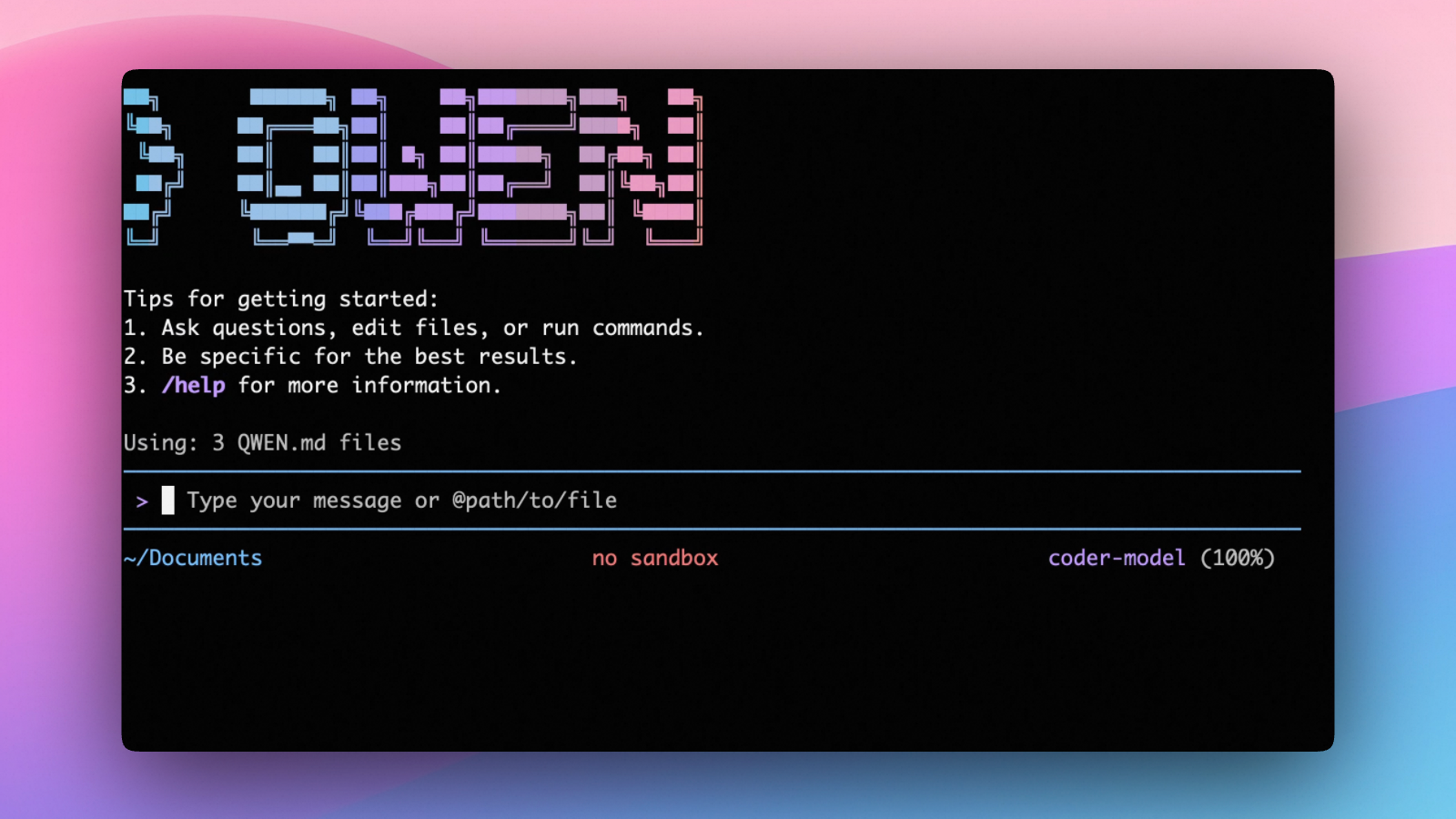
Installation
Quick Install (Recommended)
Linux / macOS
bash -c "$(curl -fsSL https://qwen-code-assets.oss-cn-hangzhou.aliyuncs.com/installation/install-qwen.sh)"
Windows (Run as Administrator)
Works in both Command Prompt and PowerShell:
powershell -Command "Invoke-WebRequest 'https://qwen-code-assets.oss-cn-hangzhou.aliyuncs.com/installation/install-qwen.bat' -OutFile (Join-Path $env:TEMP 'install-qwen.bat'); & (Join-Path $env:TEMP 'install-qwen.bat')"
Note
: It's recommended to restart your terminal after installation to ensure environment variables take effect.
Manual Installation
Prerequisites
Make sure you have Node.js 22 or later installed. Download it from nodejs.org.
NPM
npm install -g @qwen-code/qwen-code@latest
Homebrew (macOS, Linux)
brew install qwen-code
Quick Start
# Start Qwen Code (interactive)
qwen

# Then, in the session:
/help
/auth
On first use, you'll be prompted to sign in. You can run /auth anytime to switch authentication methods.
Example prompts:
What does this project do?
Explain the codebase structure.
Help me refactor this function.
Generate unit tests for this module.
Click to watch a demo video
🦞 Use Qwen Code for Coding Tasks in Claw
Copy the prompt below and paste it into your agent:
Use Qwen Code as a coding agent. First, fetch and read this skill reference:
https://raw.githubusercontent.com/QwenLM/qwen-code/refs/heads/main/.qwen/skills/qwen-code-claw/SKILL.md
Then follow the instructions inside to install, authenticate, and use Qwen Code via acpx for all coding tasks.
Authentication
Qwen Code supports the following authentication methods:
- API Key (recommended): use an API key from Alibaba Cloud Model Studio (Beijing / intl) or any supported provider (OpenAI, Anthropic, Google GenAI, and other compatible endpoints).
- Coding Plan: subscribe to the Alibaba Cloud Coding Plan (Beijing / intl) for a fixed monthly fee with higher quotas.
⚠️ Qwen OAuth was discontinued on April 15, 2026. If you were previously using Qwen OAuth, please switch to one of the methods above. Run
qwenand then/authto reconfigure.
API Key (recommended)
Use an API key to connect to Alibaba Cloud Model Studio or any supported provider. Supports multiple protocols:
- OpenAI-compatible: Alibaba Cloud ModelStudio, ModelScope, OpenAI, OpenRouter, and other OpenAI-compatible providers
- Anthropic: Claude models
- Google GenAI: Gemini models
The recommended way to configure models and providers is by editing ~/.qwen/settings.json (create it if it doesn't exist). This file lets you define all available models, API keys, and default settings in one place.
Quick Setup in 3 Steps
Step 1: Create or edit ~/.qwen/settings.json
Here is a complete example:
{
  "modelProviders": {
    "openai": [
      {
        "id": "qwen3.6-plus",
        "name": "qwen3.6-plus",
        "baseUrl": "https://dashscope.aliyuncs.com/compatible-mode/v1",
        "description": "Qwen3-Coder via Dashscope",
        "envKey": "DASHSCOPE_API_KEY"
      }
    ]
  },
  "env": {
    "DASHSCOPE_API_KEY": "sk-xxxxxxxxxxxxx"
  },
  "security": {
    "auth": {
      "selectedType": "openai"
    }
  },
  "model": {
    "name": "qwen3.6-plus"
  }
}
Step 2: Understand each field
| Field | What it does |
|---|---|
modelProviders |
Declares which models are available and how to connect to them. Keys like openai, anthropic, gemini represent the API protocol. |
modelProviders[].id |
The model ID sent to the API (e.g. qwen3.6-plus, gpt-4o). |
modelProviders[].envKey |
The name of the environment variable that holds your API key. |
modelProviders[].baseUrl |
The API endpoint URL (required for non-default endpoints). |
env |
A fallback place to store API keys (lowest priority; prefer .env files or export for sensitive keys). |
security.auth.selectedType |
The protocol to use on startup (openai, anthropic, gemini, vertex-ai). |
model.name |
The default model to use when Qwen Code starts. |
Step 3: Start Qwen Code — your configuration takes effect automatically:
qwen
Use the /model command at any time to switch between all configured models.
More Examples
Coding Plan (Alibaba Cloud ModelStudio) — fixed monthly fee, higher quotas
{
  "modelProviders": {
    "openai": [
      {
        "id": "qwen3.6-plus",
        "name": "qwen3.6-plus (Coding Plan)",
        "baseUrl": "https://coding.dashscope.aliyuncs.com/v1",
        "description": "qwen3.6-plus from ModelStudio Coding Plan",
        "envKey": "BAILIAN_CODING_PLAN_API_KEY"
      },
      {
        "id": "qwen3.5-plus",
        "name": "qwen3.5-plus (Coding Plan)",
        "baseUrl": "https://coding.dashscope.aliyuncs.com/v1",
        "description": "qwen3.5-plus with thinking enabled from ModelStudio Coding Plan",
        "envKey": "BAILIAN_CODING_PLAN_API_KEY",
        "generationConfig": {
          "extra_body": {
            "enable_thinking": true
          }
        }
      },
      {
        "id": "glm-4.7",
        "name": "glm-4.7 (Coding Plan)",
        "baseUrl": "https://coding.dashscope.aliyuncs.com/v1",
        "description": "glm-4.7 with thinking enabled from ModelStudio Coding Plan",
        "envKey": "BAILIAN_CODING_PLAN_API_KEY",
        "generationConfig": {
          "extra_body": {
            "enable_thinking": true
          }
        }
      },
      {
        "id": "kimi-k2.5",
        "name": "kimi-k2.5 (Coding Plan)",
        "baseUrl": "https://coding.dashscope.aliyuncs.com/v1",
        "description": "kimi-k2.5 with thinking enabled from ModelStudio Coding Plan",
        "envKey": "BAILIAN_CODING_PLAN_API_KEY",
        "generationConfig": {
          "extra_body": {
            "enable_thinking": true
          }
        }
      }
    ]
  },
  "env": {
    "BAILIAN_CODING_PLAN_API_KEY": "sk-xxxxxxxxxxxxx"
  },
  "security": {
    "auth": {
      "selectedType": "openai"
    }
  },
  "model": {
    "name": "qwen3.6-plus"
  }
}
Subscribe to the Coding Plan and get your API key at Alibaba Cloud ModelStudio(Beijing) or Alibaba Cloud ModelStudio(intl).
Multiple providers (OpenAI + Anthropic + Gemini)
{
  "modelProviders": {
    "openai": [
      {
        "id": "gpt-4o",
        "name": "GPT-4o",
        "envKey": "OPENAI_API_KEY",
        "baseUrl": "https://api.openai.com/v1"
      }
    ],
    "anthropic": [
      {
        "id": "claude-sonnet-4-20250514",
        "name": "Claude Sonnet 4",
        "envKey": "ANTHROPIC_API_KEY"
      }
    ],
    "gemini": [
      {
        "id": "gemini-2.5-pro",
        "name": "Gemini 2.5 Pro",
        "envKey": "GEMINI_API_KEY"
      }
    ]
  },
  "env": {
    "OPENAI_API_KEY": "sk-xxxxxxxxxxxxx",
    "ANTHROPIC_API_KEY": "sk-ant-xxxxxxxxxxxxx",
    "GEMINI_API_KEY": "AIzaxxxxxxxxxxxxx"
  },
  "security": {
    "auth": {
      "selectedType": "openai"
    }
  },
  "model": {
    "name": "gpt-4o"
  }
}
Enable thinking mode (for supported models like qwen3.5-plus)
{
  "modelProviders": {
    "openai": [
      {
        "id": "qwen3.5-plus",
        "name": "qwen3.5-plus (thinking)",
        "envKey": "DASHSCOPE_API_KEY",
        "baseUrl": "https://dashscope.aliyuncs.com/compatible-mode/v1",
        "generationConfig": {
          "extra_body": {
            "enable_thinking": true
          }
        }
      }
    ]
  },
  "env": {
    "DASHSCOPE_API_KEY": "sk-xxxxxxxxxxxxx"
  },
  "security": {
    "auth": {
      "selectedType": "openai"
    }
  },
  "model": {
    "name": "qwen3.5-plus"
  }
}
Tip: You can also set API keys via
exportin your shell or.envfiles, which take higher priority thansettings.json→env. See the authentication guide for full details.
Security note: Never commit API keys to version control. The
~/.qwen/settings.jsonfile is in your home directory and should stay private.
Local Model Setup (Ollama / vLLM)
You can also run models locally — no API key or cloud account needed. This is not an authentication method; instead, configure your local model endpoint in ~/.qwen/settings.json using the modelProviders field.
Set generationConfig.contextWindowSize inside the matching provider entry
and adjust it to the context length configured on your local server.
Ollama setup
- Install Ollama from ollama.com
- Pull a model:
ollama pull qwen3:32b - Configure
~/.qwen/settings.json:
{
  "modelProviders": {
    "openai": [
      {
        "id": "qwen3:32b",
        "name": "Qwen3 32B (Ollama)",
        "baseUrl": "http://localhost:11434/v1",
        "description": "Qwen3 32B running locally via Ollama",
        "generationConfig": {
          "contextWindowSize": 131072
        }
      }
    ]
  },
  "security": {
    "auth": {
      "selectedType": "openai"
    }
  },
  "model": {
    "name": "qwen3:32b"
  }
}
vLLM setup
- Install vLLM:
pip install vllm - Start the server:
vllm serve Qwen/Qwen3-32B - Configure
~/.qwen/settings.json:
{
  "modelProviders": {
    "openai": [
      {
        "id": "Qwen/Qwen3-32B",
        "name": "Qwen3 32B (vLLM)",
        "baseUrl": "http://localhost:8000/v1",
        "description": "Qwen3 32B running locally via vLLM",
        "generationConfig": {
          "contextWindowSize": 131072
        }
      }
    ]
  },
  "security": {
    "auth": {
      "selectedType": "openai"
    }
  },
  "model": {
    "name": "Qwen/Qwen3-32B"
  }
}
Usage
As an open-source terminal agent, you can use Qwen Code in five primary ways:
- Interactive mode (terminal UI)
- Headless mode (scripts, CI)
- IDE integration (VS Code, Zed)
- SDKs (TypeScript, Python, Java)
- Daemon mode —
qwen serveexposes ACP over HTTP+SSE so multiple clients share one agent (experimental)
Interactive mode
cd your-project/
qwen
Run qwen in your project folder to launch the interactive terminal UI. Use @ to reference local files (for example @src/main.ts).
Headless mode
cd your-project/
qwen -p "your question"
Use -p to run Qwen Code without the interactive UI—ideal for scripts, automation, and CI/CD. Learn more: Headless mode.
IDE integration
Use Qwen Code inside your editor (VS Code, Zed, and JetBrains IDEs):
Daemon mode (qwen serve, experimental)
cd your-project/
qwen serve
# → qwen serve listening on http://127.0.0.1:4170 (mode=http-bridge)
Run Qwen Code as a local HTTP daemon so IDE plugins, web UIs, CI scripts and custom CLIs all share one agent session over HTTP+SSE — instead of each spawning their own subprocess. Loopback bind has no auth by default (set QWEN_SERVER_TOKEN to enable bearer auth even on loopback); remote binds (--hostname 0.0.0.0) require a token — boot refuses without one. See:
SDKs
Build on top of Qwen Code with the available SDKs:
- TypeScript: Use the Qwen Code SDK
- Python: Use the Python SDK
- Java: Use the Java SDK
Python SDK example:
import asyncio

from qwen_code_sdk import is_sdk_result_message, query


async def main() -> None:
    result = query(
        "Summarize the repository layout.",
        {
            "cwd": "/path/to/project",
            "path_to_qwen_executable": "qwen",
        },
    )

    async for message in result:
        if is_sdk_result_message(message):
            print(message["result"])


asyncio.run(main())
Commands & Shortcuts
Session Commands
/help- Display available commands/clear- Clear conversation history/compress- Compress history to save tokens/stats- Show current session information/bug- Submit a bug report/exitor/quit- Exit Qwen Code
Keyboard Shortcuts
Ctrl+C- Cancel current operationCtrl+D- Exit (on empty line)Up/Down- Navigate command history
Learn more about Commands
Tip: In YOLO mode (
--yolo), vision switching happens automatically without prompts when images are detected. Learn more about Approval Mode
Configuration
Qwen Code can be configured via settings.json, environment variables, and CLI flags.
| File | Scope | Description |
|---|---|---|
~/.qwen/settings.json |
User (global) | Applies to all your Qwen Code sessions. Recommended for modelProviders and env. |
.qwen/settings.json |
Project | Applies only when running Qwen Code in this project. Overrides user settings. |
The most commonly used top-level fields in settings.json:
| Field | Description |
|---|---|
modelProviders |
Define available models per protocol (openai, anthropic, gemini, vertex-ai). |
env |
Fallback environment variables (e.g. API keys). Lower priority than shell export and .env files. |
security.auth.selectedType |
The protocol to use on startup (e.g. openai). |
model.name |
The default model to use when Qwen Code starts. |
See the Authentication section above for complete
settings.jsonexamples, and the settings reference for all available options.
Benchmark Results
Terminal-Bench Performance
| Agent | Model | Accuracy |
|---|---|---|
| Qwen Code | Qwen3-Coder-480A35 | 37.5% |
| Qwen Code | Qwen3-Coder-30BA3B | 31.3% |
Ecosystem
Looking for a graphical interface?
- AionUi A modern GUI for command-line AI tools including Qwen Code
- Gemini CLI Desktop A cross-platform desktop/web/mobile UI for Qwen Code
Troubleshooting
If you encounter issues, check the troubleshooting guide.
Common issues:
Qwen OAuth free tier was discontinued on 2026-04-15: Qwen OAuth is no longer available. Runqwen→/authand switch to API Key or Coding Plan. See the Authentication section above for setup instructions.
To report a bug from within the CLI, run /bug and include a short title and repro steps.
Connect with Us
- Discord: https://discord.gg/RN7tqZCeDK
- Dingtalk: https://qr.dingtalk.com/action/joingroup?code=v1,k1,+FX6Gf/ZDlTahTIRi8AEQhIaBlqykA0j+eBKKdhLeAE=&_dt_no_comment=1&origin=1
Acknowledgments
This project is based on Google Gemini CLI. We acknowledge and appreciate the excellent work of the Gemini CLI team. Our main contribution focuses on parser-level adaptations to better support Qwen-Coder models.