 9a63c03224
* feat(web-shell): add scheduled tasks management page Add a "Scheduled tasks" page to the Web Shell for managing durable cron tasks against the current workspace. - Sidebar entry opens a full-pane page (replaces the chat area, not a modal) listing tasks with enable/disable toggle, delete, run-now, and human-readable schedules. - "New scheduled task" opens a modal with a schedule builder (daily / weekdays / weekly / hourly / every-N-minutes / custom cron) and a live preview. - "Create via chat" returns to the chat and primes the composer so the agent creates the task through its cron_create tool. - Daemon CRUD routes (GET/POST/PATCH/DELETE /scheduled-tasks) read/write the existing per-project scheduled_tasks.json; task firing stays with the session-side scheduler. - Extend DurableCronTask with optional name/enabled (backward compatible); the scheduler skips tasks with enabled:false. - Add /scheduled-tasks to the vite dev-server proxy allowlist so the page works under npm run dev:daemon. * chore(web-shell): address review feedback on scheduled tasks - cron_list: surface name/enabled so the agent can tell a disabled durable task from an active one (a disabled task no longer looks identical to an active one). - core: export only the tasks-file functions the daemon route actually uses (drop unused addCronTask / getCronFilePath / CRON_TASKS_DISPLAY_PATH from the public barrel). - CronScheduler: warn when a durable reload fails and the prior view is kept, since a just-disabled or -deleted task can keep firing until the next successful reload. - Extract the schedule helpers (buildCron / describeCron / parseHhmm / describeLastRun) into a pure module and add unit tests for them. - Add route tests for PATCH cron/prompt/recurring, empty-patch rejection, and POST field-length / boolean-type validation. * chore(web-shell): address second review round on scheduled tasks - Log CRUD errors server-side (writeStderrLine) in each route catch block, matching the other daemon routes. - Share one id generator (generateCronTaskId in cronTasksFile) between the scheduler and the daemon route instead of duplicating it. - describeCron: recognize cron day-of-week 7 as an alternate notation for Sunday. - Reset the builder time to :00 when switching to the hourly frequency (its time picker is hidden, so it no longer silently carries the daily minute). - Tests: cron_list name/disabled output; route Feb-30 impossible-cron and corrupt-file 500 read-failure; describeCron dow=7. * chore(web-shell): address third review round on scheduled tasks - Run now: report sendPrompt rejections via the toast/error path instead of dropping the promise. - Block chat interaction while the full-pane Scheduled Tasks view is open, so the covered composer can't receive keystrokes/Escape. - Guard reload() with a request-sequence id so a slow load can't overwrite a newer list after a mutation. - Re-enabling a task that had genuinely fired resumes from now instead of catching up work paused while it was disabled. - Restrict "every N minutes" to divisors of 60 (a non-divisor */N fires more often than the label claims). - Show a Repeats / Runs once label on each card so tool-created one-shots aren't mistaken for repeating schedules. - Return generic 500 client messages (no internal file path); the detail is logged server-side. - Tests: SDK scheduled-task methods (method/URL/id-encoding/headers/errors); route re-enable behavior both ways. * chore(web-shell): address fourth review round (minor suggestions) - Route error logs interpolate the actual task id instead of the literal ":id". - cron_list returnDisplay includes the task name (matching llmContent) so terminal /cron list shows UI-assigned names. - Truncate the delete-confirm label so an unnamed task's long prompt doesn't blow up the confirm() dialog. - Cap the create-form prompt textarea at MAX_PROMPT_LENGTH and drop the dead typeof-window guard. - Test generateCronTaskId (format + near-uniqueness). * chore(web-shell): address fifth review round on scheduled tasks - Re-enable now resumes any recurring task from now (stamp on every false→true), not only ones that had already fired — a task disabled before its first run no longer catch-up-fires the slot it was paused through. - describeCron applies the same divisor-of-60 check as buildCron, so a hand-edited/persisted */45 falls back to the raw expression instead of a misleading "every 45 minutes". - Strengthen the corrupt-file route test to assert the generic client message and no leaked file path. - Tests: recurring-disabled-before-first-run and one-shot re-enable; describeCron non-divisor fallback. * test(cli): cover legacy scheduled-task normalization on GET Seed a pre-fields task (no name/enabled) directly to disk and assert the GET response normalizes it to name:null / enabled:true, guarding backward compatibility with existing scheduled_tasks.json files. * fix(core): cap durable cron loads against a durable-only budget The daemon route accepts up to MAX_JOBS durable tasks on disk, but the scheduler previously capped durable loads against its combined job map (session-only + durable). A session holding session-only cron jobs could push the map to MAX_JOBS and make loadFileTasks silently skip durable tasks the route had already accepted — a create that returned 201 would then never fire. Cap durable installs against a durable-only count instead, and share one MAX_JOBS constant between the scheduler and the daemon route, so a successful create is always loadable. Adds a scheduler test that 40 session-only jobs no longer crowd out 20 durable loads. |
||
|---|---|---|
| .github | ||
| .husky | ||
| .qwen | ||
| .vscode | ||
| docs | ||
| docs-site | ||
| eslint-rules | ||
| integration-tests | ||
| packages | ||
| patches | ||
| scripts | ||
| .dockerignore | ||
| .editorconfig | ||
| .gitattributes | ||
| .gitignore | ||
| .npmrc | ||
| .nvmrc | ||
| .prettierignore | ||
| .prettierrc.json | ||
| .yamllint.yml | ||
| AGENTS.md | ||
| CHANGELOG.md | ||
| CLAUDE.md | ||
| CONTRIBUTING.md | ||
| Dockerfile | ||
| esbuild.config.js | ||
| eslint.config.js | ||
| eslint.legacy-filenames.mjs | ||
| LICENSE | ||
| Makefile | ||
| package-lock.json | ||
| package.json | ||
| README.md | ||
| SECURITY.md | ||
| tsconfig.json | ||
| vitest.config.ts | ||




The open-source AI coding agent that lives in your terminal.
中文 | Deutsch | français | 日本語 | Русский | Português (Brasil)
Why Qwen Code?
- Agentic out of the box — Auto-Memory, Auto-Skills, SubAgents, Agent Teams, and MCP. Dynamic workflows, zero setup.
- Open-source, inside and out — The framework and the Qwen models are open-source. They evolve together. No vendor lock-in.
- Multi-protocol — Supports OpenAI, Anthropic, Gemini, and Qwen APIs. Any third-party provider or local model (Ollama / vLLM). Switch at runtime.
- Beyond the terminal — IDE plugins, Desktop app, daemon mode, SDKs, and IM bots (Telegram / DingTalk / WeChat / Feishu).
Tip
Qwen Code is actively iterating on itself — using its own agent and models to file issues, submit PRs, review code, and run tests. Powered by the community, driven by AI.
Installation
Linux / macOS:
curl -fsSL https://qwen-code-assets.oss-cn-hangzhou.aliyuncs.com/installation/install-qwen-standalone.sh | bash
Windows:
irm https://qwen-code-assets.oss-cn-hangzhou.aliyuncs.com/installation/install-qwen-standalone.ps1 | iex
Restart your terminal after installation to ensure environment variables take effect.
NPM / Homebrew
NPM (requires Node.js 22+):
npm install -g @qwen-code/qwen-code@latest
Homebrew (macOS / Linux):
brew install qwen-code
Quick Start
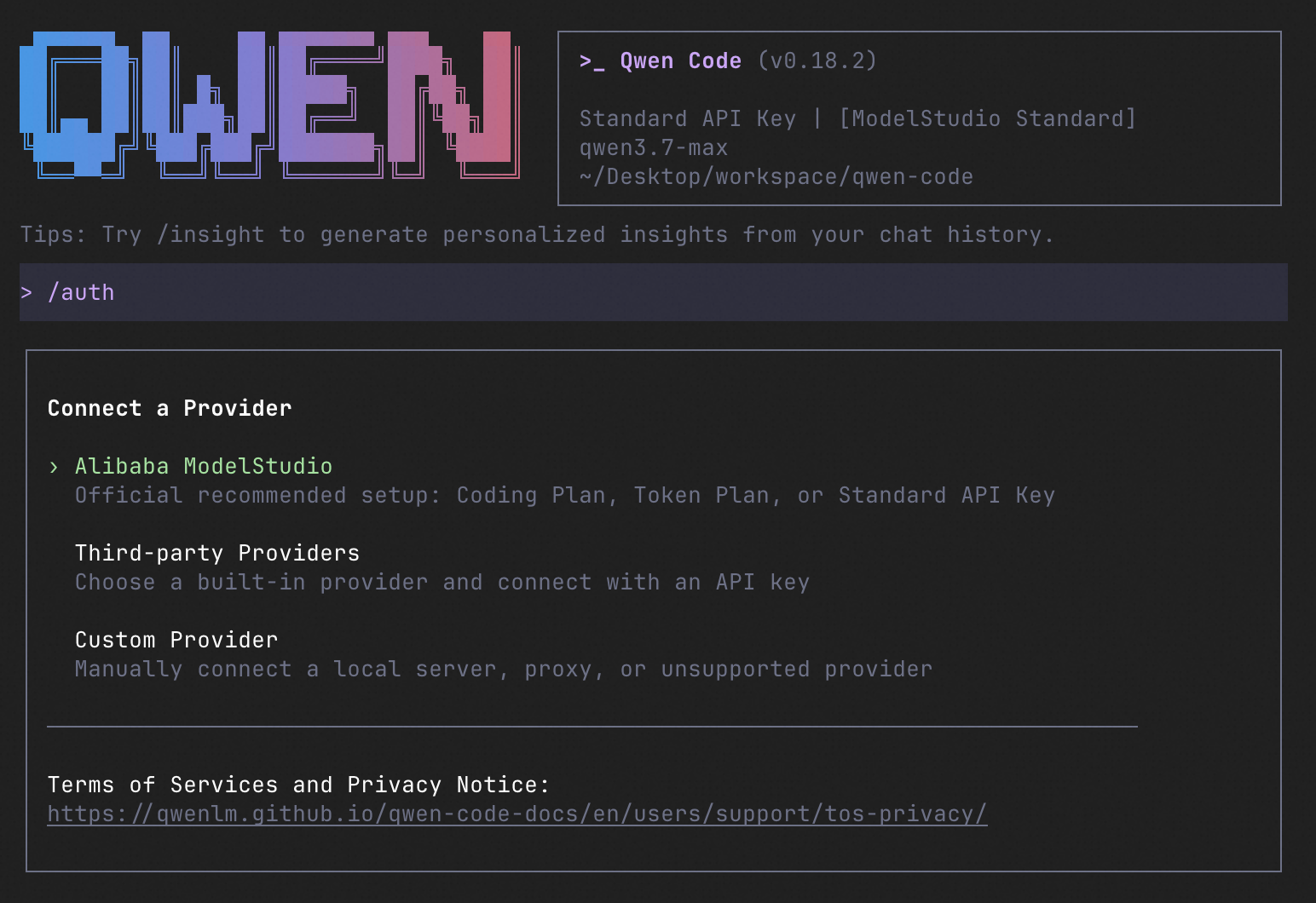
qwen          # Launch interactive terminal UI
# Inside the session:
/auth         # Configure your provider and API key
See the Authentication Guide and Settings Reference for detailed setup.
How to Use Qwen Code
| Mode | Command | Use Case |
|---|---|---|
| Interactive | qwen |
Terminal UI with rich rendering, @file references, slash commands |
| Headless | qwen -p "..." |
Scripts, CI/CD, batch processing — no UI |
| IDE | — | VS Code, Zed, JetBrains |
| Desktop | — | Qwen Code Desktop — GUI for macOS, Windows, Linux |
| Daemon | qwen serve |
Shared agent session over HTTP+SSE (ACP). Multiple clients, one agent. (experimental) Docs |
| SDK | — | TypeScript, Python, Java |
| IM Bot | qwen channel |
Connect to Telegram, DingTalk, WeChat, or Feishu |
SDK example (Python)
import asyncio

from qwen_code_sdk import is_sdk_result_message, query


async def main() -> None:
    result = query(
        "Summarize the repository layout.",
        {
            "cwd": "/path/to/project",
            "path_to_qwen_executable": "qwen",
        },
    )

    async for message in result:
        if is_sdk_result_message(message):
            print(message["result"])


asyncio.run(main())
Capabilities
If you know Claude Code, you already know Qwen Code — and then some. We've put significant effort into bringing Qwen Code to feature parity with Claude Code, improving both breadth and reliability across the board.
| Feature | Qwen Code | Claude Code |
|---|---|---|
| SubAgents, Agent Teams, Dynamic Workflows | ✓ | ✓ |
| Auto-Memory, Auto-Skills, Hooks | ✓ | ✓ |
| Built-in Skills (/review, /batch, /loop, /bugfix…) | ✓ | ✓ |
| MCP, Plan Mode, LSP Integration | ✓ | ✓ |
| Auto Mode, Sandbox, Git Worktrees | ✓ | ✓ |
| Computer Use (desktop automation) | ✓ | ✓ |
| IDE Plugins (VS Code / JetBrains / Zed) | ✓ | ✓ |
| SDK | ✓ | ✓ |
| Headless Mode, Session Management | ✓ | ✓ |
| Open-source — model and framework | ✓ | — |
| Multi-protocol (OpenAI / Anthropic / Gemini / Qwen + any provider) | ✓ | — |
| Agent Arena (multi-model head-to-head on same task) | ✓ | — |
Daemon Mode — qwen serve (multi-client shared agent) |
✓ | — |
| IM Channels (Telegram / DingTalk / WeChat / Feishu) | ✓ | — |
Ecosystem
-
Qwen Code Desktop — Official desktop app for macOS, Windows, and Linux
-
AionUi — A modern GUI for command-line AI tools including Qwen Code
-
Gemini CLI Desktop — A cross-platform desktop/web/mobile UI for Qwen Code
-
🦞 Qwen Code Claw — Let other agents (Claude, Codex, etc.) delegate coding tasks to Qwen Code via ACP. Paste this prompt into your agent:
Use Qwen Code as a coding agent. First, fetch and read this skill reference:
https://raw.githubusercontent.com/QwenLM/qwen-code/refs/heads/main/.qwen/skills/qwen-code-claw/SKILL.md
Then follow the instructions inside to install, authenticate, and use Qwen Code via acpx for all coding tasks.
Contributing
Contributions are welcome! See CONTRIBUTING.md for guidelines.
Acknowledgments
This project was originally based on Google Gemini CLI v0.8.2. We gratefully acknowledge the Gemini CLI team's excellent work. Starting from Qwen Code v0.1, we stopped syncing with upstream and began independent development as a multi-protocol, multi-platform agent framework with deep integrations for Qwen models and beyond.