 997796f532
* fix(cli): refresh static header on model switch
Co-authored-by: Qwen-Coder <qwen-coder@alibabacloud.com>
* feat(cli): simplify api key provider registry
Co-authored-by: Qwen-Coder <qwen-coder@alibabacloud.com>
* refactor(cli): split Alibaba auth providers
Co-authored-by: Qwen-Coder <qwen-coder@alibabacloud.com>
* polish(cli): refine auth provider onboarding
Co-authored-by: Qwen-Coder <qwen-coder@alibabacloud.com>
* fix(cli): update OpenRouter free defaults
Co-authored-by: Qwen-Coder <qwen-coder@alibabacloud.com>
* fix(cli): restrict token plan models
Co-authored-by: Qwen-Coder <qwen-coder@alibabacloud.com>
* chore(cli): remove unused third-party providers
Co-authored-by: Qwen-Coder <qwen-coder@alibabacloud.com>
* feat(cli): add regional third-party providers
Co-authored-by: Qwen-Coder <qwen-coder@alibabacloud.com>
* refactor(cli): simplify api key provider endpoints
Co-authored-by: Qwen-Coder <qwen-coder@alibabacloud.com>
* refactor(cli): split auth dialog flows
Co-authored-by: Qwen-Coder <qwen-coder@alibabacloud.com>
* refactor(cli): unify auth around declarative provider config
Co-authored-by: Qwen-Coder <qwen-coder@alibabacloud.com>
Introduce ProviderConfig abstraction (providerConfig.ts) and a central provider registry (allProviders.ts), replacing the per-flow UI components (AlibabaModelStudioFlow, CustomProviderFlow, OAuthFlow, ThirdPartyProvidersFlow, etc.) with unified ProviderSetupSteps and useProviderSetupFlow.
Key changes:
- Remove setupMethods/apiKey/ directory entirely
- Collapse flow-specific hooks/components into a single generic provider setup flow
- Simplify each provider file to export only a ProviderConfig descriptor
- Add alibabaStandard provider alongside codingPlan/tokenPlan
- Move all baseUrl resolution, install plan building, and settings writing into providerConfig
- Update useAuth, AuthDialog, command handler, and upstream consumers to use the new registry
* refactor(cli): simplify provider setup input flow
Co-authored-by: Qwen-Coder <qwen-coder@alibabacloud.com>
* refactor(cli): remove toLlmProvider and legacy auth wrappers
Co-authored-by: Qwen-Coder <qwen-coder@alibabacloud.com>
* refactor(cli): flatten auth flow files and simplify ProviderSetupSteps props
Co-authored-by: Qwen-Coder <qwen-coder@alibabacloud.com>
* feat(cli): prefill API key from existing env settings in provider setup flow
Co-authored-by: Qwen-Coder <qwen-coder@alibabacloud.com>
* fix(cli): correct third-party provider context windows
Co-authored-by: Qwen-Coder <qwen-coder@alibabacloud.com>
* fix(cli): harden provider auth setup
* feat(cli): support provider modality and context settings
* feat: eable modelsEditable for coding plan
* refactor(cli): auto-derive provider metadata key and state
Move metadataKey and getProviderState from per-provider config to
auto-derived helpers (resolveMetadataKey, resolveProviderState) in
providerConfig.ts. This centralizes version tracking logic and reduces
boilerplate in individual provider definitions.
Add useProviderUpdates hook that detects model template changes across
all version-tracked providers and surfaces update/ignore choices.
Co-authored-by: Qwen-Coder <qwen-coder@alibabacloud.com>
Closes: OSS-1730, OSS-1729
* refactor(cli): namespace provider metadata under providerMetadata key
Introduce PROVIDER_METADATA_NS ('providerMetadata') to avoid top-level
settings key collisions. Provider metadata now lives under
e.g. providerMetadata.coding-plan.version instead of codingPlan.version.
Add migration logic (migrateProviderMetadata) to automatically move
legacy top-level keys (codingPlan, tokenPlan) into the new namespace
on first run.
Update auth handler, useProviderUpdates hook, and all related tests
to use the new namespace structure.
Co-authored-by: Qwen-Coder <qwen-coder@alibabacloud.com>
[skip ci]
Co-authored-by: Qwen-Coder <qwen-coder@alibabacloud.com>
* fix(cli): polish ProviderUpdatePrompt styling and test coverage [skip ci]
Co-authored-by: Qwen-Coder <qwen-coder@alibabacloud.com>
* refactor(auth): simplify auth flows around provider abstraction [skip ci]
- Rewrite motivation.md to document provider-centric architecture
- Remove Alibaba Standard API Key and Coding Plan UI flows from handler
- Update status tests to use providerMetadata instead of codingPlan settings
- Streamline API key auth to show docs link only
Co-authored-by: Qwen-Coder <qwen-coder@alibabacloud.com>
* refactor(auth): update provider models and refine auth infrastructure
- Bump model versions (qwen3.6-plus, glm-5.1) and add deepseek-v4-pro/flash
with modalities to Alibaba Standard provider
- Reorder DeepSeek models, add thinking+image/video modalities to v4-pro,
fix v4-flash context window
- Enhance auth tests with provider metadata setValue assertions
- Switch env key generation from hash-based to URL-based with
trailing-slash normalization
- Remove deprecated codingPlan section from settings schema
Co-authored-by: Qwen-Coder <qwen-coder@alibabacloud.com>
* fix(i18n): add missing zh-TW translations for token plan and subscription providers
Co-authored-by: Qwen-Coder <qwen-coder@alibabacloud.com>
* refactor(auth): improve provider install error recovery and AuthDialog state init
- Restore settings from backup on provider install plan failure
- Fix AuthDialog mainIndex state to null (was 0), preventing stale selection
- Remove ownsModel from customProvider; fall back to id-based filtering
- Change provider migration log from console.error to console.log
- Add sync reminder comments between CLI and VSCode subscription models
- Expand handleApiKeyAuth JSDoc explaining its role as lightweight fallback
Co-authored-by: Qwen-Coder <qwen-coder@alibabacloud.com>
* fix(auth): i18n for step labels, lazy preview JSON, and accurate header label
- Wrap getStepLabel() strings and PROTOCOL_ITEMS in t() for i18n
- Only compute previewJson when on the review step
- Return matched provider's own label in getAuthDisplayType instead
of hardcoding CODING_PLAN for all managed providers
* fix(auth): address round-3 review blockers
- Fix CI: add missing useProviderUpdates mock in AppContainer.test.tsx
that caused TypeError breaking React effects (title/height tests)
- Fix half-rollback: snapshot settings + modelProviders before install,
restore in-memory state (not just disk) on refreshAuth failure
- Fix .orig backup reuse: always create fresh backup (overwrite stale),
cleanup on success, unlink after restore to prevent data loss
- Fix cross-package key consistency: VS Code settingsWriter now writes
to providerMetadata namespace matching CLI's new structure
- Fix validateApiKey: remove baseUrl guard so sk-sp- prefix check
applies to both China and Global Coding Plan endpoints
* fix(cli): stabilize AuthDialog tests for slower CI environments
Increase vi.waitFor timeouts from default 1000ms to 5000ms and replace
unreliable fixed-delay waits with proper render-completion assertions,
preventing flaky failures on Linux/Windows CI runners with Node 22/24.
* fix(core): use id+baseUrl composite key for model identity
Custom provider installs previously used model id alone to determine
ownership, causing the second install to remove the first backend's
model entry when both expose the same model id (e.g. gpt-4o) with
different baseUrls. Use id+baseUrl as the composite identity key
throughout the model registry, ModelDialog, and modelsConfig to
prevent cross-provider model collisions.
* fix(cli): update ModelDialog tests for composite-key model identity
Add missing getModelsConfig and getActiveRuntimeModelSnapshot mocks,
and update switchModel assertion to expect the new { baseUrl } options
object introduced in
|
||
|---|---|---|
| .github | ||
| .husky | ||
| .qwen | ||
| .vscode | ||
| docs | ||
| docs-site | ||
| eslint-rules | ||
| integration-tests | ||
| packages | ||
| scripts | ||
| .dockerignore | ||
| .editorconfig | ||
| .gitattributes | ||
| .gitignore | ||
| .npmrc | ||
| .nvmrc | ||
| .prettierignore | ||
| .prettierrc.json | ||
| .yamllint.yml | ||
| AGENTS.md | ||
| CONTRIBUTING.md | ||
| Dockerfile | ||
| esbuild.config.js | ||
| eslint.config.js | ||
| LICENSE | ||
| Makefile | ||
| package-lock.json | ||
| package.json | ||
| README.md | ||
| SECURITY.md | ||
| tsconfig.json | ||
| vitest.config.ts | ||




An open-source AI agent that lives in your terminal.
中文 | Deutsch | français | 日本語 | Русский | Português (Brasil)
🎉 News
-
2026-04-15: Qwen OAuth free tier has been discontinued. To continue using Qwen Code, switch to Alibaba Cloud Coding Plan, OpenRouter, Fireworks AI, or bring your own API key. Run
qwen authto configure. -
2026-04-13: Qwen OAuth free tier policy update: daily quota adjusted to 100 requests/day (from 1,000).
-
2026-04-02: Qwen3.6-Plus is now live! Get an API key from Alibaba Cloud ModelStudio to access it through the OpenAI-compatible API.
-
2026-02-16: Qwen3.5-Plus is now live!
Why Qwen Code?
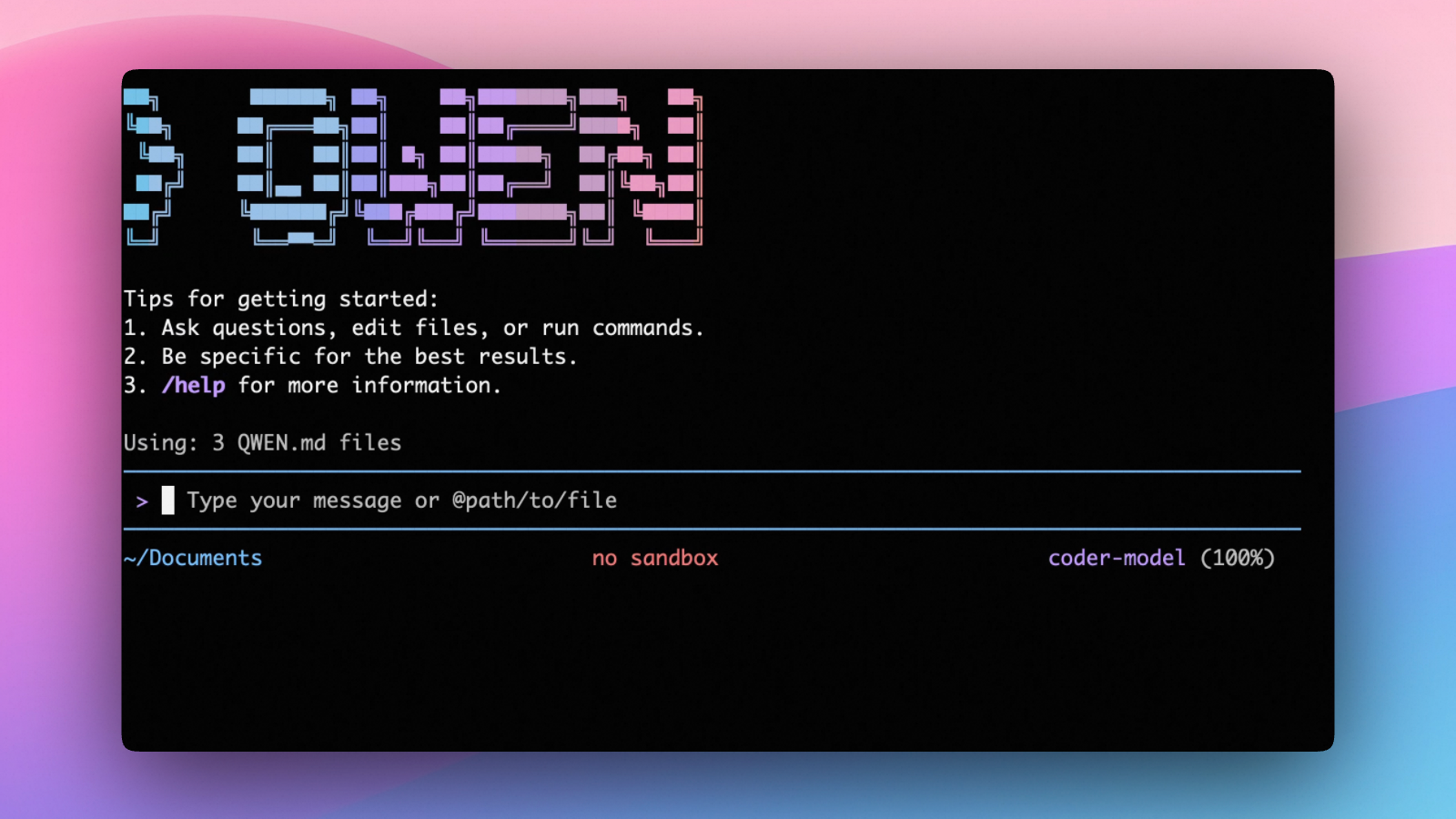
Qwen Code is an open-source AI agent for the terminal, optimized for Qwen series models. It helps you understand large codebases, automate tedious work, and ship faster.
- Multi-protocol, flexible providers: use OpenAI / Anthropic / Gemini-compatible APIs, Alibaba Cloud Coding Plan, OpenRouter, Fireworks AI, or bring your own API key.
- Open-source, co-evolving: both the framework and the Qwen3-Coder model are open-source—and they ship and evolve together.
- Agentic workflow, feature-rich: rich built-in tools (Skills, SubAgents) for a full agentic workflow and a Claude Code-like experience.
- Terminal-first, IDE-friendly: built for developers who live in the command line, with optional integration for VS Code, Zed, and JetBrains IDEs.
Installation
Quick Install (Recommended)
Linux / macOS
bash -c "$(curl -fsSL https://qwen-code-assets.oss-cn-hangzhou.aliyuncs.com/installation/install-qwen.sh)"
Windows (Run as Administrator)
Works in both Command Prompt and PowerShell:
powershell -Command "Invoke-WebRequest 'https://qwen-code-assets.oss-cn-hangzhou.aliyuncs.com/installation/install-qwen.bat' -OutFile (Join-Path $env:TEMP 'install-qwen.bat'); & (Join-Path $env:TEMP 'install-qwen.bat')"
Note
: It's recommended to restart your terminal after installation to ensure environment variables take effect.
Manual Installation
Prerequisites
Make sure you have Node.js 20 or later installed. Download it from nodejs.org.
NPM
npm install -g @qwen-code/qwen-code@latest
Homebrew (macOS, Linux)
brew install qwen-code
Quick Start
# Start Qwen Code (interactive)
qwen

# Then, in the session:
/help
/auth
On first use, you'll be prompted to sign in. You can run /auth anytime to switch authentication methods.
Example prompts:
What does this project do?
Explain the codebase structure.
Help me refactor this function.
Generate unit tests for this module.
Click to watch a demo video
🦞 Use Qwen Code for Coding Tasks in Claw
Copy the prompt below and paste it into your agent:
Use Qwen Code as a coding agent. First, fetch and read this skill reference:
https://raw.githubusercontent.com/QwenLM/qwen-code/refs/heads/main/.qwen/skills/qwen-code-claw/SKILL.md
Then follow the instructions inside to install, authenticate, and use Qwen Code via acpx for all coding tasks.
Authentication
Qwen Code supports the following authentication methods:
- API Key (recommended): use an API key from Alibaba Cloud Model Studio (Beijing / intl) or any supported provider (OpenAI, Anthropic, Google GenAI, and other compatible endpoints).
- Coding Plan: subscribe to the Alibaba Cloud Coding Plan (Beijing / intl) for a fixed monthly fee with higher quotas.
⚠️ Qwen OAuth was discontinued on April 15, 2026. If you were previously using Qwen OAuth, please switch to one of the methods above. Run
qwenand then/authto reconfigure.
API Key (recommended)
Use an API key to connect to Alibaba Cloud Model Studio or any supported provider. Supports multiple protocols:
- OpenAI-compatible: Alibaba Cloud ModelStudio, ModelScope, OpenAI, OpenRouter, and other OpenAI-compatible providers
- Anthropic: Claude models
- Google GenAI: Gemini models
The recommended way to configure models and providers is by editing ~/.qwen/settings.json (create it if it doesn't exist). This file lets you define all available models, API keys, and default settings in one place.
Quick Setup in 3 Steps
Step 1: Create or edit ~/.qwen/settings.json
Here is a complete example:
{
  "modelProviders": {
    "openai": [
      {
        "id": "qwen3.6-plus",
        "name": "qwen3.6-plus",
        "baseUrl": "https://dashscope.aliyuncs.com/compatible-mode/v1",
        "description": "Qwen3-Coder via Dashscope",
        "envKey": "DASHSCOPE_API_KEY"
      }
    ]
  },
  "env": {
    "DASHSCOPE_API_KEY": "sk-xxxxxxxxxxxxx"
  },
  "security": {
    "auth": {
      "selectedType": "openai"
    }
  },
  "model": {
    "name": "qwen3.6-plus"
  }
}
Step 2: Understand each field
| Field | What it does |
|---|---|
modelProviders |
Declares which models are available and how to connect to them. Keys like openai, anthropic, gemini represent the API protocol. |
modelProviders[].id |
The model ID sent to the API (e.g. qwen3.6-plus, gpt-4o). |
modelProviders[].envKey |
The name of the environment variable that holds your API key. |
modelProviders[].baseUrl |
The API endpoint URL (required for non-default endpoints). |
env |
A fallback place to store API keys (lowest priority; prefer .env files or export for sensitive keys). |
security.auth.selectedType |
The protocol to use on startup (openai, anthropic, gemini, vertex-ai). |
model.name |
The default model to use when Qwen Code starts. |
Step 3: Start Qwen Code — your configuration takes effect automatically:
qwen
Use the /model command at any time to switch between all configured models.
More Examples
Coding Plan (Alibaba Cloud ModelStudio) — fixed monthly fee, higher quotas
{
  "modelProviders": {
    "openai": [
      {
        "id": "qwen3.6-plus",
        "name": "qwen3.6-plus (Coding Plan)",
        "baseUrl": "https://coding.dashscope.aliyuncs.com/v1",
        "description": "qwen3.6-plus from ModelStudio Coding Plan",
        "envKey": "BAILIAN_CODING_PLAN_API_KEY"
      },
      {
        "id": "qwen3.5-plus",
        "name": "qwen3.5-plus (Coding Plan)",
        "baseUrl": "https://coding.dashscope.aliyuncs.com/v1",
        "description": "qwen3.5-plus with thinking enabled from ModelStudio Coding Plan",
        "envKey": "BAILIAN_CODING_PLAN_API_KEY",
        "generationConfig": {
          "extra_body": {
            "enable_thinking": true
          }
        }
      },
      {
        "id": "glm-4.7",
        "name": "glm-4.7 (Coding Plan)",
        "baseUrl": "https://coding.dashscope.aliyuncs.com/v1",
        "description": "glm-4.7 with thinking enabled from ModelStudio Coding Plan",
        "envKey": "BAILIAN_CODING_PLAN_API_KEY",
        "generationConfig": {
          "extra_body": {
            "enable_thinking": true
          }
        }
      },
      {
        "id": "kimi-k2.5",
        "name": "kimi-k2.5 (Coding Plan)",
        "baseUrl": "https://coding.dashscope.aliyuncs.com/v1",
        "description": "kimi-k2.5 with thinking enabled from ModelStudio Coding Plan",
        "envKey": "BAILIAN_CODING_PLAN_API_KEY",
        "generationConfig": {
          "extra_body": {
            "enable_thinking": true
          }
        }
      }
    ]
  },
  "env": {
    "BAILIAN_CODING_PLAN_API_KEY": "sk-xxxxxxxxxxxxx"
  },
  "security": {
    "auth": {
      "selectedType": "openai"
    }
  },
  "model": {
    "name": "qwen3.6-plus"
  }
}
Subscribe to the Coding Plan and get your API key at Alibaba Cloud ModelStudio(Beijing) or Alibaba Cloud ModelStudio(intl).
Multiple providers (OpenAI + Anthropic + Gemini)
{
  "modelProviders": {
    "openai": [
      {
        "id": "gpt-4o",
        "name": "GPT-4o",
        "envKey": "OPENAI_API_KEY",
        "baseUrl": "https://api.openai.com/v1"
      }
    ],
    "anthropic": [
      {
        "id": "claude-sonnet-4-20250514",
        "name": "Claude Sonnet 4",
        "envKey": "ANTHROPIC_API_KEY"
      }
    ],
    "gemini": [
      {
        "id": "gemini-2.5-pro",
        "name": "Gemini 2.5 Pro",
        "envKey": "GEMINI_API_KEY"
      }
    ]
  },
  "env": {
    "OPENAI_API_KEY": "sk-xxxxxxxxxxxxx",
    "ANTHROPIC_API_KEY": "sk-ant-xxxxxxxxxxxxx",
    "GEMINI_API_KEY": "AIzaxxxxxxxxxxxxx"
  },
  "security": {
    "auth": {
      "selectedType": "openai"
    }
  },
  "model": {
    "name": "gpt-4o"
  }
}
Enable thinking mode (for supported models like qwen3.5-plus)
{
  "modelProviders": {
    "openai": [
      {
        "id": "qwen3.5-plus",
        "name": "qwen3.5-plus (thinking)",
        "envKey": "DASHSCOPE_API_KEY",
        "baseUrl": "https://dashscope.aliyuncs.com/compatible-mode/v1",
        "generationConfig": {
          "extra_body": {
            "enable_thinking": true
          }
        }
      }
    ]
  },
  "env": {
    "DASHSCOPE_API_KEY": "sk-xxxxxxxxxxxxx"
  },
  "security": {
    "auth": {
      "selectedType": "openai"
    }
  },
  "model": {
    "name": "qwen3.5-plus"
  }
}
Tip: You can also set API keys via
exportin your shell or.envfiles, which take higher priority thansettings.json→env. See the authentication guide for full details.
Security note: Never commit API keys to version control. The
~/.qwen/settings.jsonfile is in your home directory and should stay private.
Local Model Setup (Ollama / vLLM)
You can also run models locally — no API key or cloud account needed. This is not an authentication method; instead, configure your local model endpoint in ~/.qwen/settings.json using the modelProviders field.
Set generationConfig.contextWindowSize inside the matching provider entry
and adjust it to the context length configured on your local server.
Ollama setup
- Install Ollama from ollama.com
- Pull a model:
ollama pull qwen3:32b - Configure
~/.qwen/settings.json:
{
  "modelProviders": {
    "openai": [
      {
        "id": "qwen3:32b",
        "name": "Qwen3 32B (Ollama)",
        "baseUrl": "http://localhost:11434/v1",
        "description": "Qwen3 32B running locally via Ollama",
        "generationConfig": {
          "contextWindowSize": 131072
        }
      }
    ]
  },
  "security": {
    "auth": {
      "selectedType": "openai"
    }
  },
  "model": {
    "name": "qwen3:32b"
  }
}
vLLM setup
- Install vLLM:
pip install vllm - Start the server:
vllm serve Qwen/Qwen3-32B - Configure
~/.qwen/settings.json:
{
  "modelProviders": {
    "openai": [
      {
        "id": "Qwen/Qwen3-32B",
        "name": "Qwen3 32B (vLLM)",
        "baseUrl": "http://localhost:8000/v1",
        "description": "Qwen3 32B running locally via vLLM",
        "generationConfig": {
          "contextWindowSize": 131072
        }
      }
    ]
  },
  "security": {
    "auth": {
      "selectedType": "openai"
    }
  },
  "model": {
    "name": "Qwen/Qwen3-32B"
  }
}
Usage
As an open-source terminal agent, you can use Qwen Code in four primary ways:
- Interactive mode (terminal UI)
- Headless mode (scripts, CI)
- IDE integration (VS Code, Zed)
- SDKs (TypeScript, Python, Java)
Interactive mode
cd your-project/
qwen
Run qwen in your project folder to launch the interactive terminal UI. Use @ to reference local files (for example @src/main.ts).
Headless mode
cd your-project/
qwen -p "your question"
Use -p to run Qwen Code without the interactive UI—ideal for scripts, automation, and CI/CD. Learn more: Headless mode.
IDE integration
Use Qwen Code inside your editor (VS Code, Zed, and JetBrains IDEs):
SDKs
Build on top of Qwen Code with the available SDKs:
- TypeScript: Use the Qwen Code SDK
- Python: Use the Python SDK
- Java: Use the Java SDK
Python SDK example:
import asyncio

from qwen_code_sdk import is_sdk_result_message, query


async def main() -> None:
    result = query(
        "Summarize the repository layout.",
        {
            "cwd": "/path/to/project",
            "path_to_qwen_executable": "qwen",
        },
    )

    async for message in result:
        if is_sdk_result_message(message):
            print(message["result"])


asyncio.run(main())
Commands & Shortcuts
Session Commands
/help- Display available commands/clear- Clear conversation history/compress- Compress history to save tokens/stats- Show current session information/bug- Submit a bug report/exitor/quit- Exit Qwen Code
Keyboard Shortcuts
Ctrl+C- Cancel current operationCtrl+D- Exit (on empty line)Up/Down- Navigate command history
Learn more about Commands
Tip: In YOLO mode (
--yolo), vision switching happens automatically without prompts when images are detected. Learn more about Approval Mode
Configuration
Qwen Code can be configured via settings.json, environment variables, and CLI flags.
| File | Scope | Description |
|---|---|---|
~/.qwen/settings.json |
User (global) | Applies to all your Qwen Code sessions. Recommended for modelProviders and env. |
.qwen/settings.json |
Project | Applies only when running Qwen Code in this project. Overrides user settings. |
The most commonly used top-level fields in settings.json:
| Field | Description |
|---|---|
modelProviders |
Define available models per protocol (openai, anthropic, gemini, vertex-ai). |
env |
Fallback environment variables (e.g. API keys). Lower priority than shell export and .env files. |
security.auth.selectedType |
The protocol to use on startup (e.g. openai). |
model.name |
The default model to use when Qwen Code starts. |
See the Authentication section above for complete
settings.jsonexamples, and the settings reference for all available options.
Benchmark Results
Terminal-Bench Performance
| Agent | Model | Accuracy |
|---|---|---|
| Qwen Code | Qwen3-Coder-480A35 | 37.5% |
| Qwen Code | Qwen3-Coder-30BA3B | 31.3% |
Ecosystem
Looking for a graphical interface?
- AionUi A modern GUI for command-line AI tools including Qwen Code
- Gemini CLI Desktop A cross-platform desktop/web/mobile UI for Qwen Code
Troubleshooting
If you encounter issues, check the troubleshooting guide.
Common issues:
Qwen OAuth free tier was discontinued on 2026-04-15: Qwen OAuth is no longer available. Runqwen→/authand switch to API Key or Coding Plan. See the Authentication section above for setup instructions.
To report a bug from within the CLI, run /bug and include a short title and repro steps.
Connect with Us
- Discord: https://discord.gg/RN7tqZCeDK
- Dingtalk: https://qr.dingtalk.com/action/joingroup?code=v1,k1,+FX6Gf/ZDlTahTIRi8AEQhIaBlqykA0j+eBKKdhLeAE=&_dt_no_comment=1&origin=1
Acknowledgments
This project is based on Google Gemini CLI. We acknowledge and appreciate the excellent work of the Gemini CLI team. Our main contribution focuses on parser-level adaptations to better support Qwen-Coder models.