 95b2cf4cb1
* fix(review): pin the verified git identity across the residue probe (#9557) `worktreeResidue` verified a tree's identity once and then ran five commands that each re-discovered the repository from `cwd`, through the same `.git` file the check had read — a file writable by anything running as this user. Two halves, and they close different windows: - **The gate now requires the gitfile's admin entry to point BACK at this tree.** A repository whose `core.worktree` names this path answers `--show-toplevel` with this path, so the old gate saw itself while every command after it measured the plant's index — which already holds the contamination as committed content, so `status` comes back clean for a tree with a mutant in it. A planted standalone repo has no admin entry to round-trip; `scratch-tree` gates its own reset on exactly this. - **The verified `--git-dir`/`--work-tree` are pinned onto every later spawn**, so a swap that lands AFTER the gate cannot redirect them either. The reason recorded against doing this — that an explicit pin changes what `ls-files` resolves, so it needs its own round — was measured and is wrong. Across a standalone checkout, a linked worktree, a superproject with an initialised submodule, and a worktree reached through a symlinked ancestor, all five commands return **byte-identical** output pinned and unpinned. What was right about it is that it needed measuring, which is what this is. The backpointer half is pinned by a test that goes red without it. The pin half is not: it closes a check-then-use window the suite cannot open deterministically (the swap has to land between two spawns). Its evidence is a shell repro — with the identity captured, then the gitfile swapped, discovery reports a clean tree while the pinned commands still report ` M a.ts` and the untracked probe file. Saying that rather than implying a pin that is not there. * fix(review): refuse symlink redirects and forged admin entries in the residue probe (#9742) * fix(review): fail closed on unanchored clean verdicts and steered boundaries (#9742) The residue probe's identity gate answered CLEAN for shapes it cannot vouch for. Four closes, all fail-closed: - A repository answering for a path it does not contain — the common dir no literal ancestor of the tree path — is refused before the symlink walk. That is the shape a forge uses to steer the walk's own stop boundary so it fires before the planted link is lstat'd, and the walk's bound escaping to the filesystem root misdiagnosed refusals (and reddened the suite on hosts whose tmpdir resolves through a symlink). - A clean measurement no fetched-head record anchored is refused: a forged pair answers clean too, so an unanchored empty status certifies whichever index the gitfile names. Dirty reports still name paths — a forge answers clean, never dirty. - The agent-prompt wiring fails closed when the plan's fetchedSha is absent or malformed instead of degrading to an unpinned probe: every worktree-mode fetch writes the field. - A dangling admin-entry backpointer is "does not point back", not the outer catch's "not a git worktree". Comments now say what the pin actually closes (post-gate identity redirect, pre-planted shapes) and what it does not (in-window state presentation by an active writer — cost-raising, not closure; the structural close is the sandbox boundary, #9556). Witnessed: every guard flips its focused tests when removed (mutation probes), including new ones for the case-fold, the unreadable-HEAD arm, the sha handover seam, and the sha-less production caller. Fixtures realpath their roots so the suite holds under any tmpdir spelling. * fix(review): anchor the scratch-tree residue check and name unmeasured reasons (#9742) Three closes on the round-4 findings, all inside the residue probe's own footprint: - The sha-less production caller flattened the tampering signal the probe exists to protect: the no-record refusal fired on 100% of clean runs, so a note that fires always is a note nobody reads. scratch-tree now takes --fetched-sha, agent-prompt welds the plan's record into the verifier's command, and a healthy shared tree measures clean again — a forged pair is refused at the pin with a distinguishable reason instead. - The unmeasured renderers blamed `git status` for refusals where it never failed (the gates run before it; the no-record tail runs after it answered CLEAN), sending triagers to debug a git environment with nothing wrong. All three renderings now name a reason. - The ancestor-symlink walk had no witness: both sibling shapes refuse at earlier gates, and deleting the arm shipped green (measured). A shape that passes the leaf, the self-equality and the boundary gate leaves only the walk to refuse it. * test(review): pin the fetched-sha CLI contract and the weld continuation (#9742) * test(review): share the forge-territory fixture across the redirect residue tests (#9742) * fix(review): admit healthy trees spelled through links above the root (#9742) * fix(review): canonicalise both spellings the containment gate compares (#9742) * fix(review): admit healthy layouts and refuse unpinned or drifting trees (#9742) --------- Co-authored-by: qwen-code-ci-bot <qwen-code-ci-bot@users.noreply.github.com> Co-authored-by: qwen-code-dev-bot <qwen-code-dev@service.alibaba.com> |
||
|---|---|---|
| .github | ||
| .husky | ||
| .qwen | ||
| .vscode | ||
| docs | ||
| docs-site | ||
| eslint-rules | ||
| integration-tests | ||
| integrations/external-context | ||
| packages | ||
| patches | ||
| scripts | ||
| .dockerignore | ||
| .editorconfig | ||
| .gitattributes | ||
| .gitignore | ||
| .npmrc | ||
| .nvmrc | ||
| .prettierignore | ||
| .prettierrc.json | ||
| .yamllint.yml | ||
| AGENTS.md | ||
| CHANGELOG.md | ||
| CLAUDE.md | ||
| CONTRIBUTING.md | ||
| Dockerfile | ||
| esbuild.config.js | ||
| eslint.config.js | ||
| eslint.legacy-filenames.mjs | ||
| LICENSE | ||
| Makefile | ||
| package-lock.json | ||
| package.json | ||
| README.md | ||
| SECURITY.md | ||
| tsconfig.json | ||
| vitest.config.ts | ||




The open-source AI coding agent that lives in your terminal.
中文 | Deutsch | français | 日本語 | Русский | Português (Brasil) | 한국어
Why Qwen Code?
- Agentic out of the box — Auto-Memory, Auto-Skills, SubAgents, Agent Teams, and MCP. Dynamic workflows, zero setup.
- Open-source, inside and out — The framework and the Qwen models are open-source. They evolve together. No vendor lock-in.
- Multi-protocol — Supports OpenAI, Anthropic, Gemini, and Qwen APIs. Any third-party provider or local model (Ollama / vLLM). Switch at runtime.
- Beyond the terminal — IDE plugins, Desktop app, daemon mode, SDKs, and IM bots (Telegram / DingTalk / WeChat / Feishu).
Tip
Qwen Code is actively iterating on itself — using its own agent and models to file issues, submit PRs, review code, and run tests. Powered by the community, driven by AI.
Installation
Linux / macOS:
curl -fsSL https://qwen-code-assets.oss-cn-hangzhou.aliyuncs.com/installation/install-qwen-standalone.sh | bash
Windows:
irm https://qwen-code-assets.oss-cn-hangzhou.aliyuncs.com/installation/install-qwen-standalone.ps1 | iex
Restart your terminal after installation to ensure environment variables take effect.
NPM / Homebrew
NPM (requires Node.js 22+):
npm install -g @qwen-code/qwen-code@latest
Homebrew (macOS / Linux):
brew install qwen-code
Quick Start
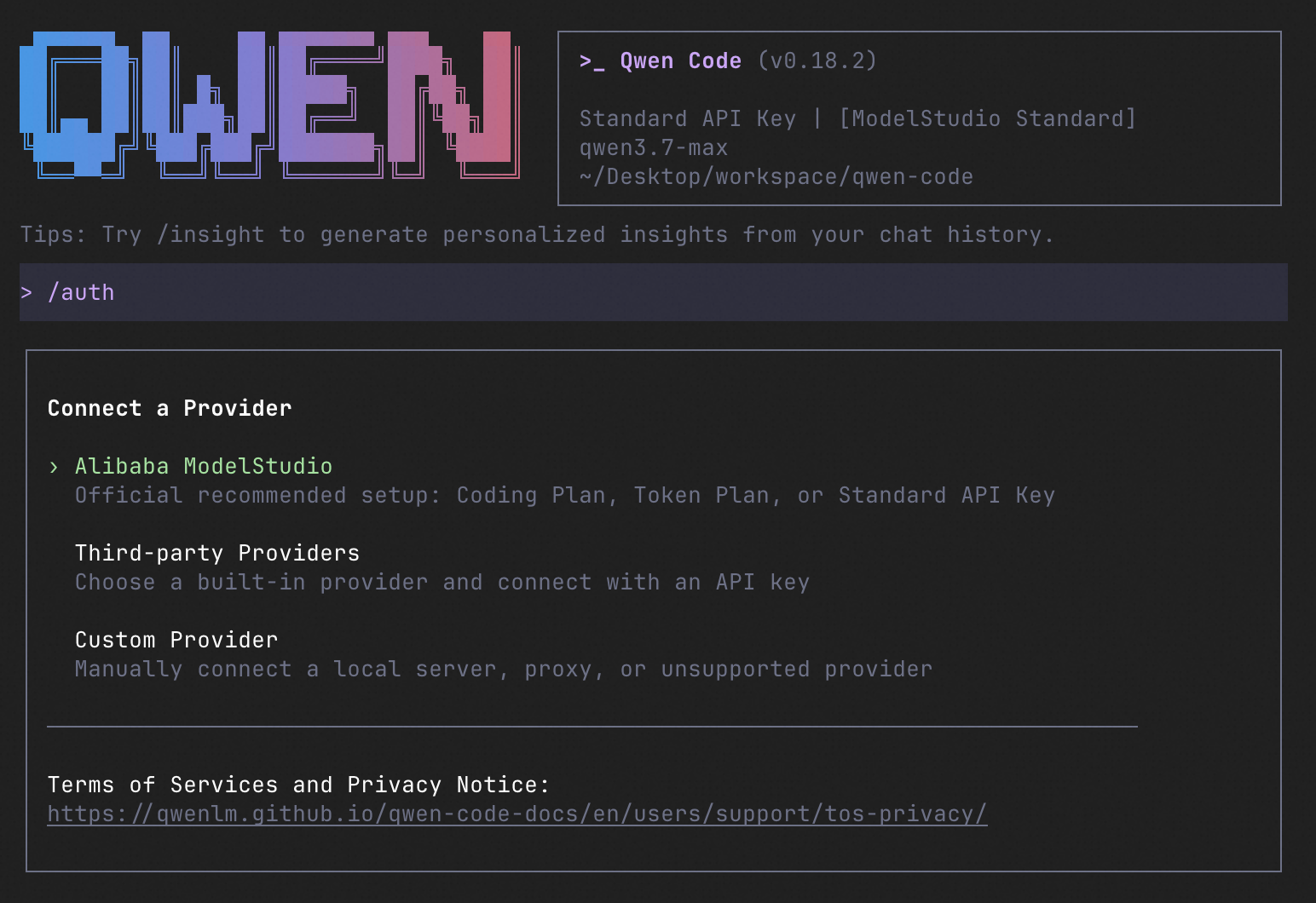
qwen          # Launch interactive terminal UI
# Inside the session:
/auth         # Configure your provider and API key
See the Authentication Guide and Settings Reference for detailed setup.
How to Use Qwen Code
| Mode | Command | Use Case |
|---|---|---|
| Interactive | qwen |
Terminal UI with rich rendering, @file references, slash commands |
| Headless | qwen -p "..." |
Scripts, CI/CD, batch processing — no UI |
| IDE | — | VS Code, Zed, JetBrains |
| Desktop | — | Qwen Code Desktop — GUI for macOS, Windows, Linux |
| Daemon | qwen serve |
Shared agent session over HTTP+SSE (ACP). Multiple clients, one agent. (experimental) Docs |
| SDK | — | TypeScript, Python, Java |
| IM Bot | qwen channel |
Connect to Telegram, DingTalk, WeChat, or Feishu |
SDK example (Python)
import asyncio

from qwen_code_sdk import is_sdk_result_message, query


async def main() -> None:
    result = query(
        "Summarize the repository layout.",
        {
            "cwd": "/path/to/project",
            "path_to_qwen_executable": "qwen",
        },
    )

    async for message in result:
        if is_sdk_result_message(message):
            print(message["result"])


asyncio.run(main())
Capabilities
If you know Claude Code, you already know Qwen Code — and then some. We've put significant effort into bringing Qwen Code to feature parity with Claude Code, improving both breadth and reliability across the board.
| Feature | Qwen Code | Claude Code |
|---|---|---|
| SubAgents, Agent Teams, Dynamic Workflows | ✓ | ✓ |
| Auto-Memory, Auto-Skills, Hooks | ✓ | ✓ |
| Built-in Skills (/review, /batch, /loop, /bugfix…) | ✓ | ✓ |
| MCP, Plan Mode, LSP Integration | ✓ | ✓ |
| Auto Mode, Sandbox, Git Worktrees | ✓ | ✓ |
| Computer Use (desktop automation) | ✓ | ✓ |
| IDE Plugins (VS Code / JetBrains / Zed) | ✓ | ✓ |
| SDK | ✓ | ✓ |
| Headless Mode, Session Management | ✓ | ✓ |
| Open-source — model and framework | ✓ | — |
| Multi-protocol (OpenAI / Anthropic / Gemini / Qwen + any provider) | ✓ | — |
| Agent Arena (multi-model head-to-head on same task) | ✓ | — |
Daemon Mode — qwen serve (multi-client shared agent) |
✓ | — |
| IM Channels (Telegram / DingTalk / WeChat / Feishu) | ✓ | — |
Ecosystem
-
Qwen Code Desktop — Official desktop app for macOS, Windows, and Linux
-
AionUi — A modern GUI for command-line AI tools including Qwen Code
-
Gemini CLI Desktop — A cross-platform desktop/web/mobile UI for Qwen Code
-
🦞 Qwen Code Claw — Let other agents (Claude, Codex, etc.) delegate coding tasks to Qwen Code via ACP. Paste this prompt into your agent:
Use Qwen Code as a coding agent. First, fetch and read this skill reference:
https://raw.githubusercontent.com/QwenLM/qwen-code/refs/heads/main/.qwen/skills/qwen-code-claw/SKILL.md
Then follow the instructions inside to install, authenticate, and use Qwen Code via acpx for all coding tasks.
- Aliyun Model Studio CLI — Official CLI for Aliyun's AI platform (
bailian-cli). Extends Qwen Code with image/video generation, knowledge retrieval, app orchestration, and model deployment
Contributing
Contributions are welcome! See CONTRIBUTING.md for guidelines.
Acknowledgments
This project was originally based on Google Gemini CLI v0.8.2. We gratefully acknowledge the Gemini CLI team's excellent work. Starting from Qwen Code v0.1, we stopped syncing with upstream and began independent development as a multi-protocol, multi-platform agent framework with deep integrations for Qwen models and beyond.