 8fcc43943d
* feat(channel): add QQ Bot channel adapter Add @qwen-code/channel-qqbot package implementing QQ Bot WebSocket Gateway connection via the official QQ Bot API. Supports: - WebSocket Gateway (HELLO/IDENTIFY/HEARTBEAT/DISPATCH/RECONNECT) - C2C single chat (C2C_MESSAGE_CREATE) - Group @mention (GROUP_AT_MESSAGE_CREATE) — code path exists, unverified - Streaming output via msg_id + msg_seq multi-block sending - Auto-reconnect with exponential backoff - Sandbox environment toggle TODO (technical debt acknowledged): - Group chat not verified end-to-end - Single-file architecture (should split into gateway/send/auth modules like weixin channel) - No tests (weixin has send.test.ts + media.test.ts) - No typing indicator (onPromptStart/onPromptEnd not yet implemented) - No channel instructions injection in connect() - No structured error types Closes #5201 * feat(qqbot): add QR login, group chat support with typed events - Add QR code login via @tencent-connect/qqbot-connector with credential persistence - Add Intent constants for C2C (1<<12) and GROUP_AT_MESSAGE (1<<25) - Use QQGroupMessageEvent type in handleGroup instead of cast - Remove resolved TODO comments for group chat verification - Add msg_seq to send error log for debugging * fix(qqbot): address PR review — lint errors, token refresh, security - Use bracket notation for Record<string, unknown> to fix TS4111 lint errors - Add chmodSync(credsFile, 0o600) for credential file permissions - Implement token refresh at 80% TTL with expires_in tracking - Fix RECONNECT opcode: use code 4000 + serverRequestedReconnect flag - Fix connect() Promise: reject on close before READY via connectReject - Log empty-token case in sendMessage, drain response body on error - Clear chatTypeMap/replyMsgId/msgSeqMap in disconnect() - Capture msgId at send-time to avoid race on replyMsgId - Switch channel-registry.ts to Promise.allSettled (isolated channel failures) - Add chatId validation (isValidChatId) to prevent SSRF * fix(qqbot): add qqbot to build order, fix ESLint default-case - Add packages/channels/qqbot to scripts/build.js buildOrder (CLI imports @qwen-code/channel-qqbot but it wasn't being built) - Add default case to handleGatewayMessage switch * feat(qqbot): prepend sender name in group messages for shared context When sessionScope is set to 'thread', all group members share one session. Prepending [senderName] helps the agent distinguish who said what in the shared context. * feat(qqbot): cross-server context continuation via SessionRouter persistence - Persist SessionRouter mappings to disk via sessionsPath, surviving daemon restarts - Persist QQ routing state (chatTypeMap, replyMsgId, msgSeqMap) to {name}-state.json - Backup/restore global sessions.json on disconnect/connect to survive start.ts cleanup - fixRestoredSessions() workaround for ACP LoadSessionResponse missing sessionId - READY handler delays resolve() until restoreSessions() completes, preventing race * feat(qqbot): add Session Resume + reconnect retry resilience - Support WS session resume (RESUME opcode 6) on reconnect, falling back to full IDENTIFY when session is invalid - Add reconnectWithRetry() loop: retries gateway fetch up to 5x with exponential backoff, then schedules 60s fallback retry (fixes silent death after GW HTTP 500) - connect() now retries up to 3 times on initial failure - Bump maxReconnectAttempts from 10 to 20 - Refresh token before each reconnect attempt * fix(qqbot): address review feedback from wenshao - fixRestoredSessions: use entry.target directly instead of tt.get(undefined) (fixes first restored session routing to wrong conversation when 2+ sessions) - scheduleTokenRefresh: retry in 60s on token refresh failure, not just log - sendMessage: move saveQQState() after chunk loop, avoid redundant disk I/O - handleGroup: drop message when group_openid is missing instead of falling back to author.id (which would cause 404 on group message send) * fix(qqbot): address 3rd review from doudouOUC (12 issues) - QWEN_HOME: use getGlobalQwenDir() instead of homedir() - name sanitization: prevent path traversal in file paths - fetch timeouts: AbortSignal.timeout(15s) on all 3 fetch calls - TOCTOU: writeFileSync with {mode: 0o600} instead of chmodSync after - msg_seq gaps: only increment seq on send success, break on failure - message dedup: seenMessages Map with 5min TTL cleanup timer - disconnect: set disposed flag + flushQQState sync + clear timers - heartbeat ACK: track lastHeartbeatAck, force close on 2x interval timeout - reconnect exhaustion: FATAL log when max attempts reached post-connect - debounced saveQQState: 500ms debounce, flush on disconnect - handleGroup: skip [senderName] prefix for slash commands, log for audit - disposed guard: connectGateway checks disposed before creating WS * fix(qqbot): robustness round — RESUMED, token expiry, SSRF, disposed, typing stubs - Handle RESUMED event on RESUME success (start heartbeat, restore sessions) - Check token expiry before sendMessage, refresh if expired - Tighten isValidChatId regex (remove . and /) to close path traversal - Reset disposed flag in connect() for reusability - Add onPromptStart/onPromptEnd stubs (QQ Bot has no typing API) - Add robustness comments for splitText surrogate pairs, restoreQQState corruption, and senderId identity fragmentation across contexts * refactor(qqbot): split into modules — api, accounts, login Extract HTTP calls, credential I/O, and QR login into separate files matching the weixin channel's architecture: - api.ts: fetchAccessToken, fetchGatewayUrl, getApiBase, sendQQMessage - accounts.ts: getCredsFilePath, loadCredentials, saveCredentials - login.ts: qrCodeLogin (qrConnect wrapper) QQChannel.ts drops inline fetch/credential/qrConnect logic and imports from the new modules. Net -41 lines in the adapter. * feat(qqbot): markdown message support (msg_type: 2) Detect markdown syntax in AI responses and send as msg_type=2 with markdown.content field instead of plain-text msg_type=0. Detection covers headers, code blocks, bold, italic, strikethrough, inline code, links, and lists via a single regex. * fix(qqbot): defensive patches from complete review - reconnectWithRetry: guard against disposed channel to prevent infinite loop - handleGroup: broaden @mention regex to match both legacy <@!id> and V2 <@openid> - handleGroup: set isReplyToBot=true (every group msg is an @mention) - fixRestoredSessions: document fragile private-field access - saveCredentials: correct TOCTOU claim in comment - hasMarkdownSyntax: document false-positive trade-off * fix(qqbot): guard against empty content in C2C and group handlers - handleC2C: return early when event.content is null/empty (image/sticker msgs) - handleGroup: return early when cleanText is empty after @mention stripping * fix(qqbot): close remaining review gaps — disposed guard, connectReject, token retry, RESUMED restore * fix(qqbot): address wenshao review — RESUME restore removal, disposed guards, timer tracking, logging, heartbeat floor, requiredConfigFields, channel-registry error labels * fix(qqbot): markdown fallback to plain text on rejection * docs(qqbot): clarify markdown permission — Open Platform has no gate, FAQ is a different platform * feat(qqbot): add Ark (msg_type=3) and Media (msg_type=7) message support - types.ts: ArkKV, ArkPayload, FileType, MediaUploadRequest/Response, MediaPayload - api.ts: uploadQQMedia() — file upload for rich media - QQChannel.ts: sendArk(chatId, templateId, kv) + sendMedia(chatId, fileType, url, text?) - C2C/group upload paths separated (file_info not interchangeable) - file_type=4 (文件) blocked for groups per QQ API - Embed (msg_type=4) skipped — QQ频道专用, not available for Bot Open Platform * feat(qqbot): auto-route !ark / !media commands from LLM text via sendMessage LLM outputs text — the channel now parses structured commands inline: !ark(24, #TITLE#=标题, #META_DESC#=描述) !media(image, https://example.com/photo.jpg, caption text) parseArkCommand / parseMediaCommand extract at sendMessage entry; normal text/markdown flow unchanged. * feat(qqbot): inject channel instructions for ark/media commands Sets config.instructions on connect() so the LLM learns about: !ark(template_id, key=val, ...) — 3 default templates (23/24/37) !media(type, url, [caption]) — image/video/voice/file Fixes known debt: 'No channel instructions'. * feat(qqbot): gate ark/media behind config flags (enableArk/enableMedia) Both features default to false — opt-in via settings.json: channels.my-qq.enableArk = true channels.my-qq.enableMedia = true Instructions injected conditionally; command routing gated per-flag. * refactor(qqbot): extract resolveRoute() to eliminate duplication across sendMessage/sendArk/sendMedia disposed check, token refresh, chatId validation, sandbox path selection now in one place. All three methods call resolveRoute() instead of repeating the same 15-line preamble. * chore(qqbot): remove Ark and Media message support Remove !ark() / !media() text parsing, sendArk/sendMedia methods, uploadQQMedia, and all related types. The text-parsing approach was too fragile against LLM output formatting. Only text/markdown messaging remains. * fix(qqbot): robustness patches for review findings - Add { mode: 0o600 } to all writeFileSync calls (state/session files) - Guard against stale WebSocket close event nuking new connection - Add isReconnecting guard to prevent parallel reconnectWithRetry chains - Reset isReconnecting flag in READY, RESUMED, and exhaustion paths * docs(channel): add QQ Bot user documentation Add user-facing documentation for the QQ Bot channel adapter: - New docs/users/features/channels/qqbot.md covering setup, configuration, QR code login, group chat, Markdown support, token management, connection resilience, and troubleshooting - Update docs/users/features/channels/_meta.ts to include QQ Bot in nav - Update docs/users/features/channels/overview.md to reference QQ Bot across the intro, quick start, type options, slash commands, and the media platform differences table * docs(qqbot): fix prerequisites — QR login needs no developer account QR code login via qrConnect() does not require a developer account or manual app registration. First qwen channel start is all you need. * docs(qqbot): emphasize QR login, keep developer portal as secondary path Both paths work (config → persisted file → QR scan), confirmed against fetchToken() code. Reposition QR code login as the primary setup flow, remove redundant tips/troubleshooting entries. * docs(qqbot): remove Images and Files section — not supported in channel code handleC2C/handleGroup both skip messages with no text content. No media download or upload logic exists in this channel adapter. * test(qqbot): add unit tests for send utilities Add vitest test suite for QQ Bot channel following the weixin channel testing patterns. Extract isValidChatId, hasMarkdownSyntax, and splitText as exported module-level functions to enable direct testing. - 27 tests covering: chatId SSRF validation, Markdown syntax detection, and text chunking for QQ's 2000-char message limit - Add vitest.config.ts and test script to qqbot package - Register qqbot in root vitest workspace projects Refs: #5202 * test(qqbot): add sendMessage flow tests with mocked API Follow the weixin sendImage test pattern: mock sendQQMessage and channel-base dependencies to test sendMessage end-to-end. - C2C/group routing verification - Markdown msg_type=2 vs plain text msg_type=0 - Markdown rejection fallback to plain text - Disposed guard and error-stop behavior - msg_id + msg_seq tracking for multi-chunk streaming 9 new tests, 36 total (all passing) * test(qqbot): fix review issues — add missing edge cases Self-review fixes: - Fix misleading test name: 'returns early when chatId not in chatTypeMap' → 'defaults to C2C path for unknown chatId' (code doesn't return early) - Add SSRF validation test: sendMessage rejects '../traversal' chatId - Add network error test: thrown sendQQMessage caught by try/catch - Add token expiration test: expired token + failed refresh → early return - Hoist mockFetchAccessToken and set default resolved value in beforeEach to prevent silent undefined-access failures in accidental token-refresh paths 39 tests, all passing * test(qqbot): add api and accounts unit tests Add api.test.ts (13 tests) and accounts.test.ts (8 tests) following weixin channel vitest patterns: vi.hoisted() mocks, vi.mock() module replacement, and dynamic import() after mock setup. api.test.ts covers getApiBase, sendQQMessage, fetchAccessToken, and fetchGatewayUrl — including HTTP errors, missing fields, and request body format. accounts.test.ts covers getCredsFilePath, loadCredentials (missing file, corrupt JSON, missing fields, valid data), and saveCredentials (dir creation + 0o600 permissions). All 60 tests pass (39 existing + 21 new). tsc --build and eslint clean. * chore(qqbot): suppress CodeQL ReDoS false positives Add codeql[js/polynomial-redos] suppression comments for two regexes flagged by CodeQL: - hasMarkdownSyntax(): input is LLM-generated reply text, never attacker-controlled in Qwen Code Channel context. - handleGroup(): <@...> prefix is injected by QQ servers; openid is assigned by QQ, not attacker-chosen. Both paths have no practical exploit vector — an adversary would need to either control an LLM's output or register a malicious openid with QQ, neither of which is achievable. * fix(qqbot): allow QR-code-only login and guard qrConnect return - requiredConfigFields: [] — fetchToken() already resolves credentials from config → persisted file → QR fallback chain. Blocking at config validation prevented QR-code-only users from starting the channel. - qrCodeLogin(): add bounds check for empty qrConnect() return value. If the external library returns an empty array, throw descriptive error instead of crashing with TypeError on creds.appId. * chore(qqbot): add comments for requiredConfigFields and qrConnect guard - index.ts: explain why requiredConfigFields is empty — fetchToken() already resolves credentials via config → file → QR fallback chain. Requiring appID/appSecret at config level would block QR-only users from reaching the fallback through the built-in channel path. - login.ts: clarify qrConnect() guard is a defensive robustness patch, not a response to an observed failure. Verified by removing appID from config and running qwen channel start — QR login triggers correctly and returns valid credentials. * fix(qqbot): replace quadratic regexes with linear patterns, remove failed suppress comments * fix(qqbot): split hasMarkdownSyntax into individual tests to pass CodeQL * fix(qqbot): replace markdown link regex with indexOf to eliminate CodeQL ReDoS |
||
|---|---|---|
| .github | ||
| .husky | ||
| .qwen | ||
| .vscode | ||
| docs | ||
| docs-site | ||
| eslint-rules | ||
| integration-tests | ||
| packages | ||
| scripts | ||
| .dockerignore | ||
| .editorconfig | ||
| .gitattributes | ||
| .gitignore | ||
| .npmrc | ||
| .nvmrc | ||
| .prettierignore | ||
| .prettierrc.json | ||
| .yamllint.yml | ||
| AGENTS.md | ||
| CHANGELOG.md | ||
| CLAUDE.md | ||
| CONTRIBUTING.md | ||
| Dockerfile | ||
| esbuild.config.js | ||
| eslint.config.js | ||
| LICENSE | ||
| Makefile | ||
| package-lock.json | ||
| package.json | ||
| README.md | ||
| SECURITY.md | ||
| tsconfig.json | ||
| vitest.config.ts | ||





The open-source AI coding agent that lives in your terminal.
中文 | Deutsch | français | 日本語 | Русский | Português (Brasil)
Why Qwen Code?
- Agentic out of the box — Auto-Memory, Auto-Skills, SubAgents, Agent Teams, and MCP. Dynamic workflows, zero setup.
- Open-source, inside and out — The framework and the Qwen models are open-source. They evolve together. No vendor lock-in.
- Multi-protocol — Supports OpenAI, Anthropic, Gemini, and Qwen APIs. Any third-party provider or local model (Ollama / vLLM). Switch at runtime.
- Beyond the terminal — IDE plugins, Desktop app, daemon mode, SDKs, and IM bots (Telegram / DingTalk / WeChat / Feishu).
Tip
Qwen Code is actively iterating on itself — using its own agent and models to file issues, submit PRs, review code, and run tests. Powered by the community, driven by AI.
Installation
Linux / macOS:
curl -fsSL https://qwen-code-assets.oss-cn-hangzhou.aliyuncs.com/installation/install-qwen-standalone.sh | bash
Windows:
irm https://qwen-code-assets.oss-cn-hangzhou.aliyuncs.com/installation/install-qwen-standalone.ps1 | iex
Restart your terminal after installation to ensure environment variables take effect.
NPM / Homebrew
NPM (requires Node.js 22+):
npm install -g @qwen-code/qwen-code@latest
Homebrew (macOS / Linux):
brew install qwen-code
Quick Start
qwen          # Launch interactive terminal UI
# Inside the session:
/auth         # Configure your provider and API key
See the Authentication Guide and Settings Reference for detailed setup.
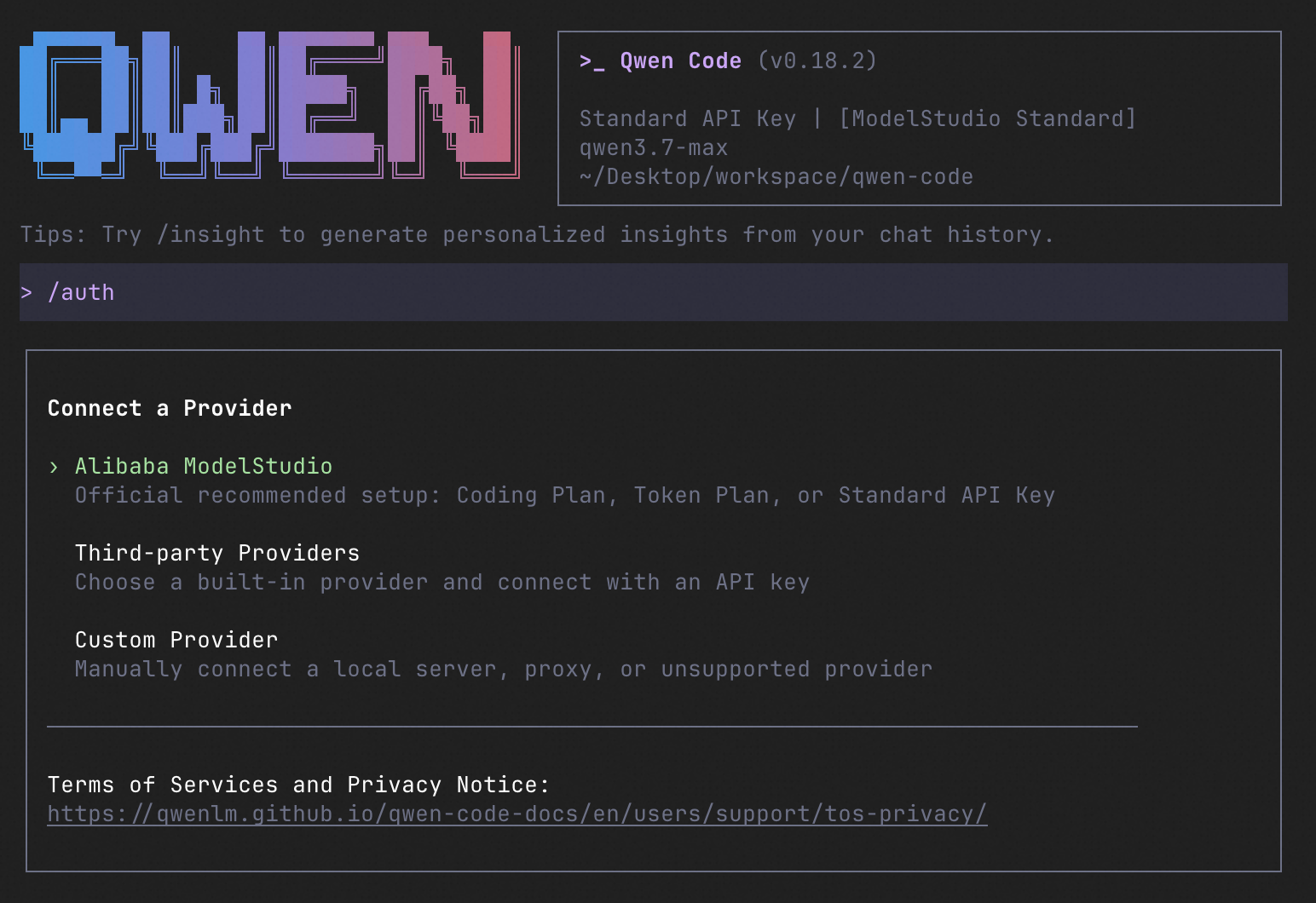
How to Use Qwen Code
| Mode | Command | Use Case |
|---|---|---|
| Interactive | qwen |
Terminal UI with rich rendering, @file references, slash commands |
| Headless | qwen -p "..." |
Scripts, CI/CD, batch processing — no UI |
| IDE | — | VS Code, Zed, JetBrains |
| Desktop | — | Qwen Code Desktop — GUI for macOS, Windows, Linux |
| Daemon | qwen serve |
Shared agent session over HTTP+SSE (ACP). Multiple clients, one agent. (experimental) Docs |
| SDK | — | TypeScript, Python, Java |
| IM Bot | qwen channel |
Connect to Telegram, DingTalk, WeChat, or Feishu |
SDK example (Python)
import asyncio

from qwen_code_sdk import is_sdk_result_message, query


async def main() -> None:
    result = query(
        "Summarize the repository layout.",
        {
            "cwd": "/path/to/project",
            "path_to_qwen_executable": "qwen",
        },
    )

    async for message in result:
        if is_sdk_result_message(message):
            print(message["result"])


asyncio.run(main())
Capabilities
If you know Claude Code, you already know Qwen Code — and then some. We've put significant effort into bringing Qwen Code to feature parity with Claude Code, improving both breadth and reliability across the board.
| Feature | Qwen Code | Claude Code |
|---|---|---|
| SubAgents, Agent Teams, Dynamic Workflows | ✓ | ✓ |
| Auto-Memory, Auto-Skills, Hooks | ✓ | ✓ |
| Built-in Skills (/review, /batch, /loop, /bugfix…) | ✓ | ✓ |
| MCP, Plan Mode, LSP Integration | ✓ | ✓ |
| Auto Mode, Sandbox, Git Worktrees | ✓ | ✓ |
| Computer Use (desktop automation) | ✓ | ✓ |
| IDE Plugins (VS Code / JetBrains / Zed) | ✓ | ✓ |
| SDK | ✓ | ✓ |
| Headless Mode, Session Management | ✓ | ✓ |
| Open-source — model and framework | ✓ | — |
| Multi-protocol (OpenAI / Anthropic / Gemini / Qwen + any provider) | ✓ | — |
| Agent Arena (multi-model head-to-head on same task) | ✓ | — |
Daemon Mode — qwen serve (multi-client shared agent) |
✓ | — |
| IM Channels (Telegram / DingTalk / WeChat / Feishu) | ✓ | — |
Ecosystem
-
Qwen Code Desktop — Official desktop app for macOS, Windows, and Linux
-
AionUi — A modern GUI for command-line AI tools including Qwen Code
-
Gemini CLI Desktop — A cross-platform desktop/web/mobile UI for Qwen Code
-
🦞 Qwen Code Claw — Let other agents (Claude, Codex, etc.) delegate coding tasks to Qwen Code via ACP. Paste this prompt into your agent:
Use Qwen Code as a coding agent. First, fetch and read this skill reference:
https://raw.githubusercontent.com/QwenLM/qwen-code/refs/heads/main/.qwen/skills/qwen-code-claw/SKILL.md
Then follow the instructions inside to install, authenticate, and use Qwen Code via acpx for all coding tasks.
Contributing
Contributions are welcome! See CONTRIBUTING.md for guidelines.
Acknowledgments
This project was originally based on Google Gemini CLI v0.8.2. We gratefully acknowledge the Gemini CLI team's excellent work. Starting from Qwen Code v0.1, we stopped syncing with upstream and began independent development as a multi-protocol, multi-platform agent framework with deep integrations for Qwen models and beyond.