 84ecb5b8a3
* feat(cli): add --json-schema for structured output in headless mode
Registers a synthetic `structured_output` tool whose parameter schema IS the
user-supplied JSON Schema. In headless mode (`qwen -p`), the first successful
call terminates the session and exposes the validated payload via the result
message's `structured_result` field. Invalid schemas are rejected at CLI parse
time via a new strict Ajv compile helper so they can't silently no-op at
runtime.
* fix(cli): honour "first structured_output call ends session" + reject non-object root schemas
Two review fixes for the `--json-schema` feature:
1. `runNonInteractive` now breaks out of the tool-call loop as soon as the
first successful `structured_output` invocation is captured, rather than
continuing to execute any trailing tool calls the model emitted in the
same turn. This restores the documented single-shot contract and prevents
side-effecting tools from running after the final answer has already
been accepted.
2. `resolveJsonSchemaArg` rejects schemas whose root `type` is anything
other than "object" (or a type array including "object"). Function-
calling APIs require tool arguments to be JSON objects, so a schema
like `{"type": "array"}` would have registered an unusable synthetic
tool the model could never satisfy. Absent `type` and `type: "object"`
remain accepted.
Adds tests for both paths and updates the existing Ajv-compile test to
exercise that path without tripping the new root-type guard first.
* fix(cli): also reject root anyOf/oneOf schemas whose branches can't accept objects
Addresses a review follow-up: the previous root-object check only inspected
the top-level `type` keyword, so a schema like
`{"anyOf":[{"type":"array"},{"type":"string"}]}` slipped through even though
none of its branches can ever validate the object-shaped arguments that
function-calling APIs send.
Replace the single `type` check with `schemaRootAcceptsObject`, which
recursively walks root-level anyOf/oneOf branches and requires at least one
to accept objects. Absent `type`, `type: "object"`, `type: ["object", ...]`,
and mixed anyOf branches where one accepts object all still pass. `allOf`
is left to Ajv's runtime behaviour — guessing intent across contradictory
allOf branches at parse time is fragile.
* fix(cli): propagate exitCode from --json-schema failure path + tests
Address two PR-3598 review findings:
1. gemini.tsx unconditionally called process.exit(0) after
runNonInteractive/runNonInteractiveStreamJson, clobbering the
process.exitCode = 1 set by nonInteractiveCli.ts when the model
emits plain text instead of the structured_output tool. Switch
both call sites to process.exit(process.exitCode ?? 0) so CI can
detect the failure via the exit code.
2. nonInteractiveCli.test.ts: strengthen the structured-output
success path to assert registry.abortAll() is called and that the
stdout result envelope carries the JSON-stringified args under
`result` plus the raw object under `structured_result`. Add a
retry-path test that mocks executeToolCall to return an error on
the first structured_output call, then verifies sendMessageStream
is called a second time so the model can retry rather than the
session terminating early.
* fix(cli): suppress non-structured tool calls when structured_output is in the same turn
When --json-schema is active and the model emits a batch like
[write_file(...), structured_output(...)], the previous implementation
ran the leading side-effecting tool before accepting the structured
result, violating the "structured_output is the terminal contract"
guarantee. The trailing-only break also let an invalid first
structured_output fall through to subsequent tools before the retry
turn.
Pre-scan the batch: if a structured_output request is present, execute
ONLY the first one and skip everything else (leading and trailing).
This is consistent with the existing terminal-path semantics — the
suppressed tool_use blocks lack a matching tool_result, the same way
max-turns / cancellation leave the stream.
Adds a test covering the reverse-order [side_effect, structured_output]
case alongside the existing trailing-suppression and retry tests.
* fix(cli): tighten --json-schema root validation per review feedback
Three small holes flagged in the latest pass:
1. `schemaRootAcceptsObject` returned early when a root `type` keyword
was present, ignoring sibling `anyOf`/`oneOf`. JSON Schema applies
keywords at the same level conjunctively, so e.g.
`{type:"object", anyOf:[{type:"string"}]}` is unsatisfiable for any
value but used to pass. Now both `type` AND any sibling
`anyOf`/`oneOf` must independently admit object.
2. The FatalConfigError text said "Every branch of a root anyOf/oneOf
must be satisfiable by an object", but the actual logic only
requires *at least one* branch (and tests still accept
`anyOf:[object, string]`). Reworded to "at least one branch" so the
message matches the behaviour.
3. `compileStrict` used `typeof schema !== 'object'` to gate input,
which lets arrays through (`typeof [] === 'object'`). The contract
says "schema must be a JSON object", so add an `Array.isArray`
check so array input gets the intended error rather than a less
helpful Ajv compile message.
Tests cover the new rejection paths and the array case.
* fix(cli): handle root $ref and allOf in --json-schema accept-object check
`schemaRootAcceptsObject` previously only inspected `type`, `anyOf`,
and `oneOf` at the root, so a couple of unsatisfiable shapes still
slipped through:
1. `{"$ref":"#/$defs/Foo","$defs":{"Foo":{"type":"array"}}}` would be
accepted because we don't follow $refs, but registers a synthetic
tool whose params resolve to "array" — the model can never produce
a valid object. Now reject any root $ref unless the user adds a
sibling `type:"object"` as an explicit anchor.
2. `allOf` was deferred to Ajv runtime, but allOf is conjunctive at
the same level as `type` / `anyOf` / `oneOf`, so an entry like
`{"allOf":[{"type":"object"},{"type":"string"}]}` is unsatisfiable
for any value. Walk it like the others, requiring every branch to
admit object.
Tests cover the new $ref-rejected / $ref+anchor-accepted paths and the
allOf reject/accept paths.
* fix(cli): explicit exit code from runNonInteractive + pair suppressed tool calls
Three review threads on the structured-output flow:
1. The break that ends the for-loop on a successful structured_output
call sat *before* the responseParts.push and modelOverride capture.
SyntheticOutputTool currently returns neither, so it was safe today
— but anyone wiring extra signals into the synthetic tool later
would see them silently dropped. Move the break after both captures
so the contract is explicit, not implicit.
2. The failure path used to set process.exitCode = 1 and return void,
relying on global mutable state across an async boundary. Any
cleanup task between runNonInteractive and process.exit could
silently turn the structured-output failure into exit 0. Switch
runNonInteractive to Promise<number>, return 0 / 1 directly from
each function-level exit, and have gemini.tsx use the captured
return value.
3. The pre-scan from the prior commit suppresses sibling tool calls
when structured_output is in the same turn. On the retry path —
when structured_output fails validation — the next-turn payload
has tool_result for structured_output but no entry for the
suppressed siblings, leaving the prior assistant turn's tool_use
blocks unpaired. Anthropic and OpenAI both reject that batch
shape, so the retry would surface as an opaque provider error.
Synthesize a "skipped" functionResponse for every suppressed call
so every tool_use in the prior assistant message has a matching
tool_result.
Tests cover the new retry-pairing contract and update the existing
plain-text-failure test to assert on the return value rather than
process.exitCode.
* fix: address Copilot follow-up review on --json-schema scaffolding
Five small but real findings flagged on the latest pass:
1. core/src/index.ts re-exported `SyntheticOutputTool` via `export type`,
but it's a runtime class — that erased it from the emitted JS and
would break value imports. Split into a value `export { ... }` and a
`export type { StructuredOutputParams }`.
2. The structured-output success path returned without flushing
`localQueue` notifications or finalising one-shot monitors. If a
background task had already emitted `task_started`, exiting here
could drop its paired `task_notification` and leave SDK consumers
with unpaired lifecycle events. Mirror the regular terminal path's
`flushQueuedNotificationsToSdk` + `finalizeOneShotMonitors` calls
before `emitResult`.
3. `schemaRootAcceptsObject` ignored the `not` keyword, so
`{not:{type:"object"}}` (which forbids every object value) slipped
through. Add a best-effort `not` check that rejects when
`not.type` directly excludes object. Deeper negated patterns still
fall through to Ajv at runtime.
4. `compileStrict`'s JSDoc claimed it errored on "Ajv versions we can't
support", but the function doesn't actually check Ajv versions. Reword
to "malformed or uses unsupported draft/features for our Ajv
configuration" so the contract matches the implementation.
5. The pre-scan suppressed sibling tool calls but only synthesised
tool_result events for them on the retry path — the success path
left those tool_use blocks unpaired in the emitted JSONL/stream-json
event log. Move the synthesis after the for loop so it runs for both
the success break and the validation-failure fall-through; the event
log is now consistent regardless of which path the run takes.
Tests cover the new \`not\`-rejection paths, the success-path tool_result
synthesis, and the existing retry-pairing test still passes against the
restructured emit ordering.
* fix(cli): tighten --json-schema parse-time gate per Copilot review
Two more shapes that used to slip through:
1. `schemaRootAcceptsObject` defaulted to true when no narrowing
keyword was present, so root-value constraints like `{const: 1}`
or `{enum: [1, 2]}` registered an unsatisfiable structured_output
contract — the model could never produce a value matching the
tool's parameter schema, and the run would loop on validation
failures until max-turns. Reject `const` whose literal isn't an
object, and `enum` whose members include no object.
2. The yargs check rejected `--json-schema` with `-i` and with no
prompt, but not with `--input-format stream-json`. Stream-json
keeps the process open waiting for protocol messages, so
"terminate on the first valid structured_output call" silently
drops everything queued after that point. Refuse the combination
at parse time so the contradiction surfaces immediately.
Tests cover the new const/enum reject and accept paths.
* fix(cli): handle empty/boolean subschemas + allow stdin-only prompt
Three more shapes flagged on the latest review pass:
1. `schemaRootAcceptsObject` treated an empty root `anyOf`/`oneOf`
as "no constraint" (skipped when length === 0), but per JSON
Schema an empty union is unsatisfiable — no value can match a
member of the empty set. Reject those at parse time so users
get a clear parse error instead of an opaque runtime
never-validates loop.
2. JSON Schema (draft-06+) allows boolean subschemas anywhere a
schema is accepted: `true` matches every value, `false` matches
nothing. The `anyOf`/`oneOf`/`allOf` walks were rejecting
booleans via the typeof-object guard, which incorrectly
rejected `{anyOf:[true]}` and `{allOf:[true,{type:"object"}]}`
while letting `{anyOf:[false]}` slip through. Replace the
per-branch object guard with a `variantAcceptsObject` helper
that treats `true` as accepting and `false` as rejecting, then
recurses on object subschemas.
3. The yargs `.check` rejected `--json-schema` when no `-p` /
positional prompt was given, but the headless CLI also reads
the prompt from stdin (`cat prompt.txt | qwen --json-schema
'...'`) — a legit usage pattern that was being blocked. Drop
the parse-time no-prompt rejection; the existing runtime "No
input provided via stdin..." error in gemini.tsx still catches
genuinely empty input.
Tests cover the empty-union, all-`false`, mixed-boolean accept,
and `false`-in-allOf reject paths. Live-verified against the
bundled CLI: `echo "..." | qwen --json-schema '...'` now reaches
the model call, and the four schema edge cases all surface the
expected error text or proceed past parse time.
* docs(core): note SyntheticOutputTool as the value-export exception
The block comment above the lazy-load type re-exports said tool classes
"are now lazy-loaded and are not exported as values from the package
root", but `SyntheticOutputTool` was just promoted to a runtime export
in
|
||
|---|---|---|
| .github | ||
| .husky | ||
| .qwen | ||
| .vscode | ||
| docs | ||
| docs-site | ||
| eslint-rules | ||
| integration-tests | ||
| packages | ||
| scripts | ||
| .dockerignore | ||
| .editorconfig | ||
| .gitattributes | ||
| .gitignore | ||
| .npmrc | ||
| .nvmrc | ||
| .prettierignore | ||
| .prettierrc.json | ||
| .yamllint.yml | ||
| AGENTS.md | ||
| CONTRIBUTING.md | ||
| Dockerfile | ||
| esbuild.config.js | ||
| eslint.config.js | ||
| LICENSE | ||
| Makefile | ||
| package-lock.json | ||
| package.json | ||
| README.md | ||
| SECURITY.md | ||
| tsconfig.json | ||
| vitest.config.ts | ||




An open-source AI agent that lives in your terminal.
中文 | Deutsch | français | 日本語 | Русский | Português (Brasil)
🎉 News
-
2026-04-15: Qwen OAuth free tier has been discontinued. To continue using Qwen Code, switch to Alibaba Cloud Coding Plan, OpenRouter, Fireworks AI, or bring your own API key. Run
qwen authto configure. -
2026-04-13: Qwen OAuth free tier policy update: daily quota adjusted to 100 requests/day (from 1,000).
-
2026-04-02: Qwen3.6-Plus is now live! Get an API key from Alibaba Cloud ModelStudio to access it through the OpenAI-compatible API.
-
2026-02-16: Qwen3.5-Plus is now live!
Why Qwen Code?
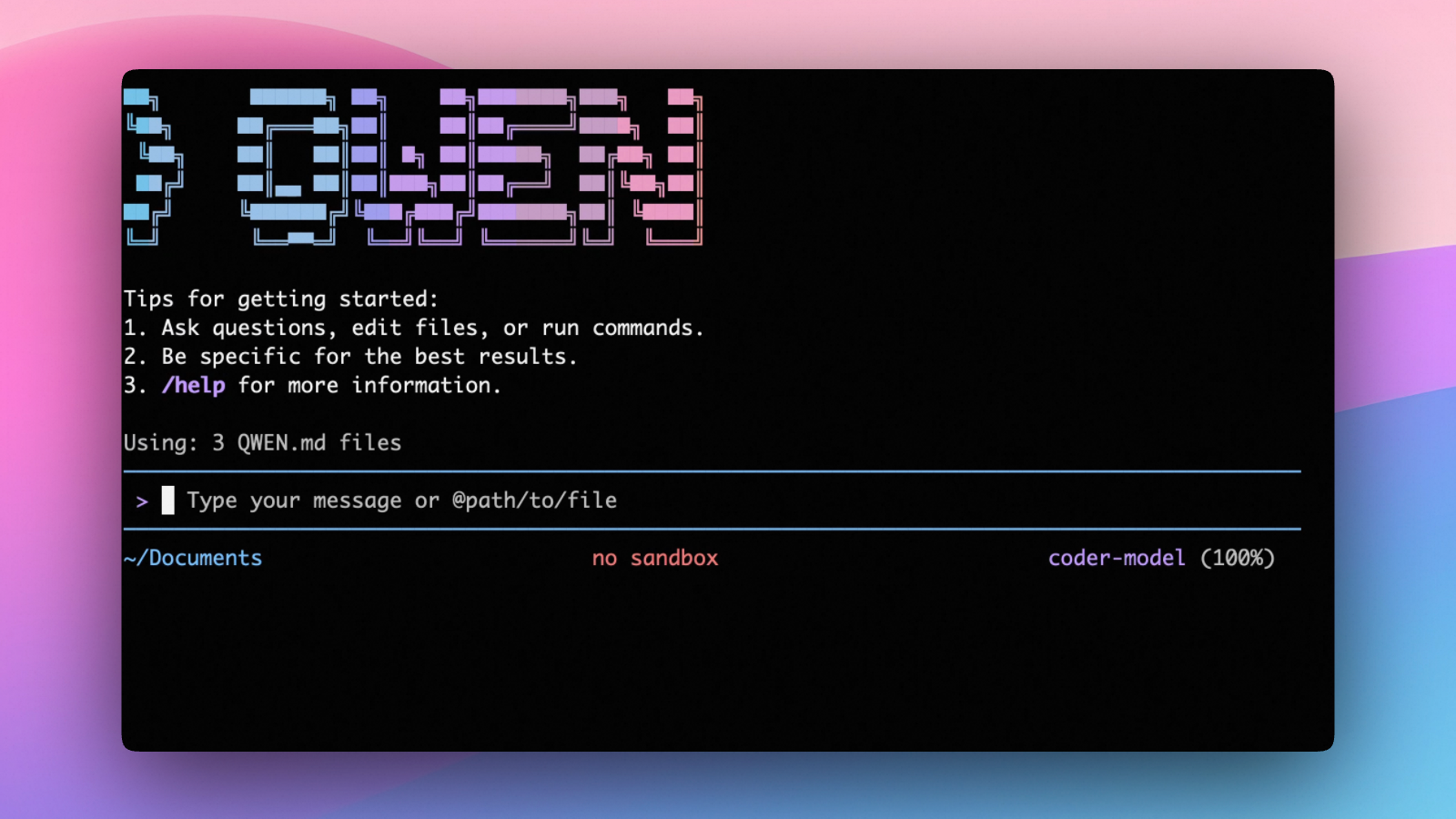
Qwen Code is an open-source AI agent for the terminal, optimized for Qwen series models. It helps you understand large codebases, automate tedious work, and ship faster.
- Multi-protocol, flexible providers: use OpenAI / Anthropic / Gemini-compatible APIs, Alibaba Cloud Coding Plan, OpenRouter, Fireworks AI, or bring your own API key.
- Open-source, co-evolving: both the framework and the Qwen3-Coder model are open-source—and they ship and evolve together.
- Agentic workflow, feature-rich: rich built-in tools (Skills, SubAgents) for a full agentic workflow and a Claude Code-like experience.
- Terminal-first, IDE-friendly: built for developers who live in the command line, with optional integration for VS Code, Zed, and JetBrains IDEs.
Installation
Quick Install (Recommended)
The installer uses a standalone Qwen Code archive when one is available for your platform, so the default path does not require a preinstalled Node.js runtime. If a standalone archive is not available, it falls back to npm and then requires Node.js 20 or later with npm on PATH.
Linux / macOS
bash -c "$(curl -fsSL https://qwen-code-assets.oss-cn-hangzhou.aliyuncs.com/installation/install-qwen.sh)"
Windows
Works in both Command Prompt and PowerShell:
powershell -Command "Invoke-WebRequest 'https://qwen-code-assets.oss-cn-hangzhou.aliyuncs.com/installation/install-qwen.bat' -OutFile (Join-Path $env:TEMP 'install-qwen.bat'); & (Join-Path $env:TEMP 'install-qwen.bat')"
Note
qwenis not immediately available on PATH. For offline installation, download a release archive such asqwen-code-linux-x64.tar.gzorqwen-code-win-x64.zipplusSHA256SUMS, then run the installer with--archive PATH.
Manual Installation
Prerequisites
Manual npm installation requires Node.js 20 or later. Download it from nodejs.org.
NPM
npm install -g @qwen-code/qwen-code@latest
Homebrew (macOS, Linux)
brew install qwen-code
Quick Start
# Start Qwen Code (interactive)
qwen

# Then, in the session:
/help
/auth
On first use, you'll be prompted to sign in. You can run /auth anytime to switch authentication methods.
Example prompts:
What does this project do?
Explain the codebase structure.
Help me refactor this function.
Generate unit tests for this module.
Click to watch a demo video
🦞 Use Qwen Code for Coding Tasks in Claw
Copy the prompt below and paste it into your agent:
Use Qwen Code as a coding agent. First, fetch and read this skill reference:
https://raw.githubusercontent.com/QwenLM/qwen-code/refs/heads/main/.qwen/skills/qwen-code-claw/SKILL.md
Then follow the instructions inside to install, authenticate, and use Qwen Code via acpx for all coding tasks.
Authentication
Qwen Code supports the following authentication methods:
- API Key (recommended): use an API key from Alibaba Cloud Model Studio (Beijing / intl) or any supported provider (OpenAI, Anthropic, Google GenAI, and other compatible endpoints).
- Coding Plan: subscribe to the Alibaba Cloud Coding Plan (Beijing / intl) for a fixed monthly fee with higher quotas.
⚠️ Qwen OAuth was discontinued on April 15, 2026. If you were previously using Qwen OAuth, please switch to one of the methods above. Run
qwenand then/authto reconfigure.
API Key (recommended)
Use an API key to connect to Alibaba Cloud Model Studio or any supported provider. Supports multiple protocols:
- OpenAI-compatible: Alibaba Cloud ModelStudio, ModelScope, OpenAI, OpenRouter, and other OpenAI-compatible providers
- Anthropic: Claude models
- Google GenAI: Gemini models
The recommended way to configure models and providers is by editing ~/.qwen/settings.json (create it if it doesn't exist). This file lets you define all available models, API keys, and default settings in one place.
Quick Setup in 3 Steps
Step 1: Create or edit ~/.qwen/settings.json
Here is a complete example:
{
  "modelProviders": {
    "openai": [
      {
        "id": "qwen3.6-plus",
        "name": "qwen3.6-plus",
        "baseUrl": "https://dashscope.aliyuncs.com/compatible-mode/v1",
        "description": "Qwen3-Coder via Dashscope",
        "envKey": "DASHSCOPE_API_KEY"
      }
    ]
  },
  "env": {
    "DASHSCOPE_API_KEY": "sk-xxxxxxxxxxxxx"
  },
  "security": {
    "auth": {
      "selectedType": "openai"
    }
  },
  "model": {
    "name": "qwen3.6-plus"
  }
}
Step 2: Understand each field
| Field | What it does |
|---|---|
modelProviders |
Declares which models are available and how to connect to them. Keys like openai, anthropic, gemini represent the API protocol. |
modelProviders[].id |
The model ID sent to the API (e.g. qwen3.6-plus, gpt-4o). |
modelProviders[].envKey |
The name of the environment variable that holds your API key. |
modelProviders[].baseUrl |
The API endpoint URL (required for non-default endpoints). |
env |
A fallback place to store API keys (lowest priority; prefer .env files or export for sensitive keys). |
security.auth.selectedType |
The protocol to use on startup (openai, anthropic, gemini, vertex-ai). |
model.name |
The default model to use when Qwen Code starts. |
Step 3: Start Qwen Code — your configuration takes effect automatically:
qwen
Use the /model command at any time to switch between all configured models.
More Examples
Coding Plan (Alibaba Cloud ModelStudio) — fixed monthly fee, higher quotas
{
  "modelProviders": {
    "openai": [
      {
        "id": "qwen3.6-plus",
        "name": "qwen3.6-plus (Coding Plan)",
        "baseUrl": "https://coding.dashscope.aliyuncs.com/v1",
        "description": "qwen3.6-plus from ModelStudio Coding Plan",
        "envKey": "BAILIAN_CODING_PLAN_API_KEY"
      },
      {
        "id": "qwen3.5-plus",
        "name": "qwen3.5-plus (Coding Plan)",
        "baseUrl": "https://coding.dashscope.aliyuncs.com/v1",
        "description": "qwen3.5-plus with thinking enabled from ModelStudio Coding Plan",
        "envKey": "BAILIAN_CODING_PLAN_API_KEY",
        "generationConfig": {
          "extra_body": {
            "enable_thinking": true
          }
        }
      },
      {
        "id": "glm-4.7",
        "name": "glm-4.7 (Coding Plan)",
        "baseUrl": "https://coding.dashscope.aliyuncs.com/v1",
        "description": "glm-4.7 with thinking enabled from ModelStudio Coding Plan",
        "envKey": "BAILIAN_CODING_PLAN_API_KEY",
        "generationConfig": {
          "extra_body": {
            "enable_thinking": true
          }
        }
      },
      {
        "id": "kimi-k2.5",
        "name": "kimi-k2.5 (Coding Plan)",
        "baseUrl": "https://coding.dashscope.aliyuncs.com/v1",
        "description": "kimi-k2.5 with thinking enabled from ModelStudio Coding Plan",
        "envKey": "BAILIAN_CODING_PLAN_API_KEY",
        "generationConfig": {
          "extra_body": {
            "enable_thinking": true
          }
        }
      }
    ]
  },
  "env": {
    "BAILIAN_CODING_PLAN_API_KEY": "sk-xxxxxxxxxxxxx"
  },
  "security": {
    "auth": {
      "selectedType": "openai"
    }
  },
  "model": {
    "name": "qwen3.6-plus"
  }
}
Subscribe to the Coding Plan and get your API key at Alibaba Cloud ModelStudio(Beijing) or Alibaba Cloud ModelStudio(intl).
Multiple providers (OpenAI + Anthropic + Gemini)
{
  "modelProviders": {
    "openai": [
      {
        "id": "gpt-4o",
        "name": "GPT-4o",
        "envKey": "OPENAI_API_KEY",
        "baseUrl": "https://api.openai.com/v1"
      }
    ],
    "anthropic": [
      {
        "id": "claude-sonnet-4-20250514",
        "name": "Claude Sonnet 4",
        "envKey": "ANTHROPIC_API_KEY"
      }
    ],
    "gemini": [
      {
        "id": "gemini-2.5-pro",
        "name": "Gemini 2.5 Pro",
        "envKey": "GEMINI_API_KEY"
      }
    ]
  },
  "env": {
    "OPENAI_API_KEY": "sk-xxxxxxxxxxxxx",
    "ANTHROPIC_API_KEY": "sk-ant-xxxxxxxxxxxxx",
    "GEMINI_API_KEY": "AIzaxxxxxxxxxxxxx"
  },
  "security": {
    "auth": {
      "selectedType": "openai"
    }
  },
  "model": {
    "name": "gpt-4o"
  }
}
Enable thinking mode (for supported models like qwen3.5-plus)
{
  "modelProviders": {
    "openai": [
      {
        "id": "qwen3.5-plus",
        "name": "qwen3.5-plus (thinking)",
        "envKey": "DASHSCOPE_API_KEY",
        "baseUrl": "https://dashscope.aliyuncs.com/compatible-mode/v1",
        "generationConfig": {
          "extra_body": {
            "enable_thinking": true
          }
        }
      }
    ]
  },
  "env": {
    "DASHSCOPE_API_KEY": "sk-xxxxxxxxxxxxx"
  },
  "security": {
    "auth": {
      "selectedType": "openai"
    }
  },
  "model": {
    "name": "qwen3.5-plus"
  }
}
Tip: You can also set API keys via
exportin your shell or.envfiles, which take higher priority thansettings.json→env. See the authentication guide for full details.
Security note: Never commit API keys to version control. The
~/.qwen/settings.jsonfile is in your home directory and should stay private.
Local Model Setup (Ollama / vLLM)
You can also run models locally — no API key or cloud account needed. This is not an authentication method; instead, configure your local model endpoint in ~/.qwen/settings.json using the modelProviders field.
Set generationConfig.contextWindowSize inside the matching provider entry
and adjust it to the context length configured on your local server.
Ollama setup
- Install Ollama from ollama.com
- Pull a model:
ollama pull qwen3:32b - Configure
~/.qwen/settings.json:
{
  "modelProviders": {
    "openai": [
      {
        "id": "qwen3:32b",
        "name": "Qwen3 32B (Ollama)",
        "baseUrl": "http://localhost:11434/v1",
        "description": "Qwen3 32B running locally via Ollama",
        "generationConfig": {
          "contextWindowSize": 131072
        }
      }
    ]
  },
  "security": {
    "auth": {
      "selectedType": "openai"
    }
  },
  "model": {
    "name": "qwen3:32b"
  }
}
vLLM setup
- Install vLLM:
pip install vllm - Start the server:
vllm serve Qwen/Qwen3-32B - Configure
~/.qwen/settings.json:
{
  "modelProviders": {
    "openai": [
      {
        "id": "Qwen/Qwen3-32B",
        "name": "Qwen3 32B (vLLM)",
        "baseUrl": "http://localhost:8000/v1",
        "description": "Qwen3 32B running locally via vLLM",
        "generationConfig": {
          "contextWindowSize": 131072
        }
      }
    ]
  },
  "security": {
    "auth": {
      "selectedType": "openai"
    }
  },
  "model": {
    "name": "Qwen/Qwen3-32B"
  }
}
Usage
As an open-source terminal agent, you can use Qwen Code in four primary ways:
- Interactive mode (terminal UI)
- Headless mode (scripts, CI)
- IDE integration (VS Code, Zed)
- SDKs (TypeScript, Python, Java)
Interactive mode
cd your-project/
qwen
Run qwen in your project folder to launch the interactive terminal UI. Use @ to reference local files (for example @src/main.ts).
Headless mode
cd your-project/
qwen -p "your question"
Use -p to run Qwen Code without the interactive UI—ideal for scripts, automation, and CI/CD. Learn more: Headless mode.
IDE integration
Use Qwen Code inside your editor (VS Code, Zed, and JetBrains IDEs):
SDKs
Build on top of Qwen Code with the available SDKs:
- TypeScript: Use the Qwen Code SDK
- Python: Use the Python SDK
- Java: Use the Java SDK
Python SDK example:
import asyncio

from qwen_code_sdk import is_sdk_result_message, query


async def main() -> None:
    result = query(
        "Summarize the repository layout.",
        {
            "cwd": "/path/to/project",
            "path_to_qwen_executable": "qwen",
        },
    )

    async for message in result:
        if is_sdk_result_message(message):
            print(message["result"])


asyncio.run(main())
Commands & Shortcuts
Session Commands
/help- Display available commands/clear- Clear conversation history/compress- Compress history to save tokens/stats- Show current session information/bug- Submit a bug report/exitor/quit- Exit Qwen Code
Keyboard Shortcuts
Ctrl+C- Cancel current operationCtrl+D- Exit (on empty line)Up/Down- Navigate command history
Learn more about Commands
Tip: In YOLO mode (
--yolo), vision switching happens automatically without prompts when images are detected. Learn more about Approval Mode
Configuration
Qwen Code can be configured via settings.json, environment variables, and CLI flags.
| File | Scope | Description |
|---|---|---|
~/.qwen/settings.json |
User (global) | Applies to all your Qwen Code sessions. Recommended for modelProviders and env. |
.qwen/settings.json |
Project | Applies only when running Qwen Code in this project. Overrides user settings. |
The most commonly used top-level fields in settings.json:
| Field | Description |
|---|---|
modelProviders |
Define available models per protocol (openai, anthropic, gemini, vertex-ai). |
env |
Fallback environment variables (e.g. API keys). Lower priority than shell export and .env files. |
security.auth.selectedType |
The protocol to use on startup (e.g. openai). |
model.name |
The default model to use when Qwen Code starts. |
See the Authentication section above for complete
settings.jsonexamples, and the settings reference for all available options.
Benchmark Results
Terminal-Bench Performance
| Agent | Model | Accuracy |
|---|---|---|
| Qwen Code | Qwen3-Coder-480A35 | 37.5% |
| Qwen Code | Qwen3-Coder-30BA3B | 31.3% |
Ecosystem
Looking for a graphical interface?
- AionUi A modern GUI for command-line AI tools including Qwen Code
- Gemini CLI Desktop A cross-platform desktop/web/mobile UI for Qwen Code
Troubleshooting
If you encounter issues, check the troubleshooting guide.
Common issues:
Qwen OAuth free tier was discontinued on 2026-04-15: Qwen OAuth is no longer available. Runqwen→/authand switch to API Key or Coding Plan. See the Authentication section above for setup instructions.
To report a bug from within the CLI, run /bug and include a short title and repro steps.
Connect with Us
- Discord: https://discord.gg/RN7tqZCeDK
- Dingtalk: https://qr.dingtalk.com/action/joingroup?code=v1,k1,+FX6Gf/ZDlTahTIRi8AEQhIaBlqykA0j+eBKKdhLeAE=&_dt_no_comment=1&origin=1
Acknowledgments
This project is based on Google Gemini CLI. We acknowledge and appreciate the excellent work of the Gemini CLI team. Our main contribution focuses on parser-level adaptations to better support Qwen-Coder models.