 8065355ac3
* feat(autofix): render the managed fleet into the scan's run summary Seeing whether the loop was healthy meant reconstructing it by hand: list the bot's PRs, fetch each one's comments, regex the autofix-eval markers for round and watermark, then cross-check gh pr checks and the fork/takeover state. That is how today's triage of #7246, #7259, #7329, #7333 and #7336 was done, and it is why a stalled PR stayed invisible until somebody went looking for it. The scan already computes every one of those facts while deciding what to process — it just wrote them to a job log nobody reads. Each per-PR terminal decision now also records a row, and the step renders one markdown table into the run summary: | PR | State | Detail | | #7329 | SELECTED | 1 review + 5 inline new (round 0/5) | | #7333 | idle | nothing new since 2026-07-20T13:54:18Z | | #7262 | waiting | active checks in flight | | #7208 | round-capped | round 100/100 - needs a human or @qwen-code /retry | States cover every branch that ends a PR's inspection: busy, skipped, unknown, waiting, round-capped, idle and SELECTED — so a PR cannot drop out of the table by returning early, which is exactly the invisibility this fixes. No new API calls (the data is already in hand), no writes outside the run summary, and the helper is defined at the top of the step so it stays clear of the BUSY_PRS/INSPECTED proximity guard that keeps the free busy-skip from consuming the inspection budget. Tests: the real helper and render block are replayed over fixtures (table structure, one row per state, and an empty fleet still rendering a table), plus each decision branch is pinned to its fleet_row. Mutation-verified: dropping one branch's row turns it red. * fix(autofix): use temp file for fleet test replay; cover fork-head skip (#7355) * test(autofix): assert each skipped fleet_row call site individually (#7355) * fix(autofix): record fleet rows for both budget-break paths (#7355) The candidate-inspection budget break incremented INSPECTED but never called fleet_row, so the PR that tripped the budget was silently absent from the fleet table. The target-budget break left all remaining candidates invisible with no truncation signal. Add a per-PR deferred row before the inspection-budget break and a summary deferred row before the target-budget break so the fleet table stays complete in both cases. * fix(autofix): harden fleet summary render and clean up temp file (#7355) Address review feedback: - Escape '|' in detail values to prevent broken table columns - Render budget summary row (PR '-') as em dash instead of '#-' - Add trap for FLEET_FILE cleanup on early exit paths - Document deferred summary row semantics in test comment * fix(autofix): use summary row for candidate-inspection budget break (#7355) --------- Co-authored-by: wenshao <wenshao@example.com> Co-authored-by: qwen-code-ci-bot <qwen-code-ci-bot@users.noreply.github.com> Co-authored-by: qwen-code-dev-bot <qwen-code-dev-bot@users.noreply.github.com> Co-authored-by: Qwen-Coder <qwen-coder@alibabacloud.com> |
||
|---|---|---|
| .github | ||
| .husky | ||
| .qwen | ||
| .vscode | ||
| docs | ||
| docs-site | ||
| eslint-rules | ||
| integration-tests | ||
| packages | ||
| patches | ||
| scripts | ||
| .dockerignore | ||
| .editorconfig | ||
| .gitattributes | ||
| .gitignore | ||
| .npmrc | ||
| .nvmrc | ||
| .prettierignore | ||
| .prettierrc.json | ||
| .yamllint.yml | ||
| AGENTS.md | ||
| CHANGELOG.md | ||
| CLAUDE.md | ||
| CONTRIBUTING.md | ||
| Dockerfile | ||
| esbuild.config.js | ||
| eslint.config.js | ||
| eslint.legacy-filenames.mjs | ||
| LICENSE | ||
| Makefile | ||
| package-lock.json | ||
| package.json | ||
| README.md | ||
| SECURITY.md | ||
| tsconfig.json | ||
| vitest.config.ts | ||




The open-source AI coding agent that lives in your terminal.
中文 | Deutsch | français | 日本語 | Русский | Português (Brasil)
Why Qwen Code?
- Agentic out of the box — Auto-Memory, Auto-Skills, SubAgents, Agent Teams, and MCP. Dynamic workflows, zero setup.
- Open-source, inside and out — The framework and the Qwen models are open-source. They evolve together. No vendor lock-in.
- Multi-protocol — Supports OpenAI, Anthropic, Gemini, and Qwen APIs. Any third-party provider or local model (Ollama / vLLM). Switch at runtime.
- Beyond the terminal — IDE plugins, Desktop app, daemon mode, SDKs, and IM bots (Telegram / DingTalk / WeChat / Feishu).
Tip
Qwen Code is actively iterating on itself — using its own agent and models to file issues, submit PRs, review code, and run tests. Powered by the community, driven by AI.
Installation
Linux / macOS:
curl -fsSL https://qwen-code-assets.oss-cn-hangzhou.aliyuncs.com/installation/install-qwen-standalone.sh | bash
Windows:
irm https://qwen-code-assets.oss-cn-hangzhou.aliyuncs.com/installation/install-qwen-standalone.ps1 | iex
Restart your terminal after installation to ensure environment variables take effect.
NPM / Homebrew
NPM (requires Node.js 22+):
npm install -g @qwen-code/qwen-code@latest
Homebrew (macOS / Linux):
brew install qwen-code
Quick Start
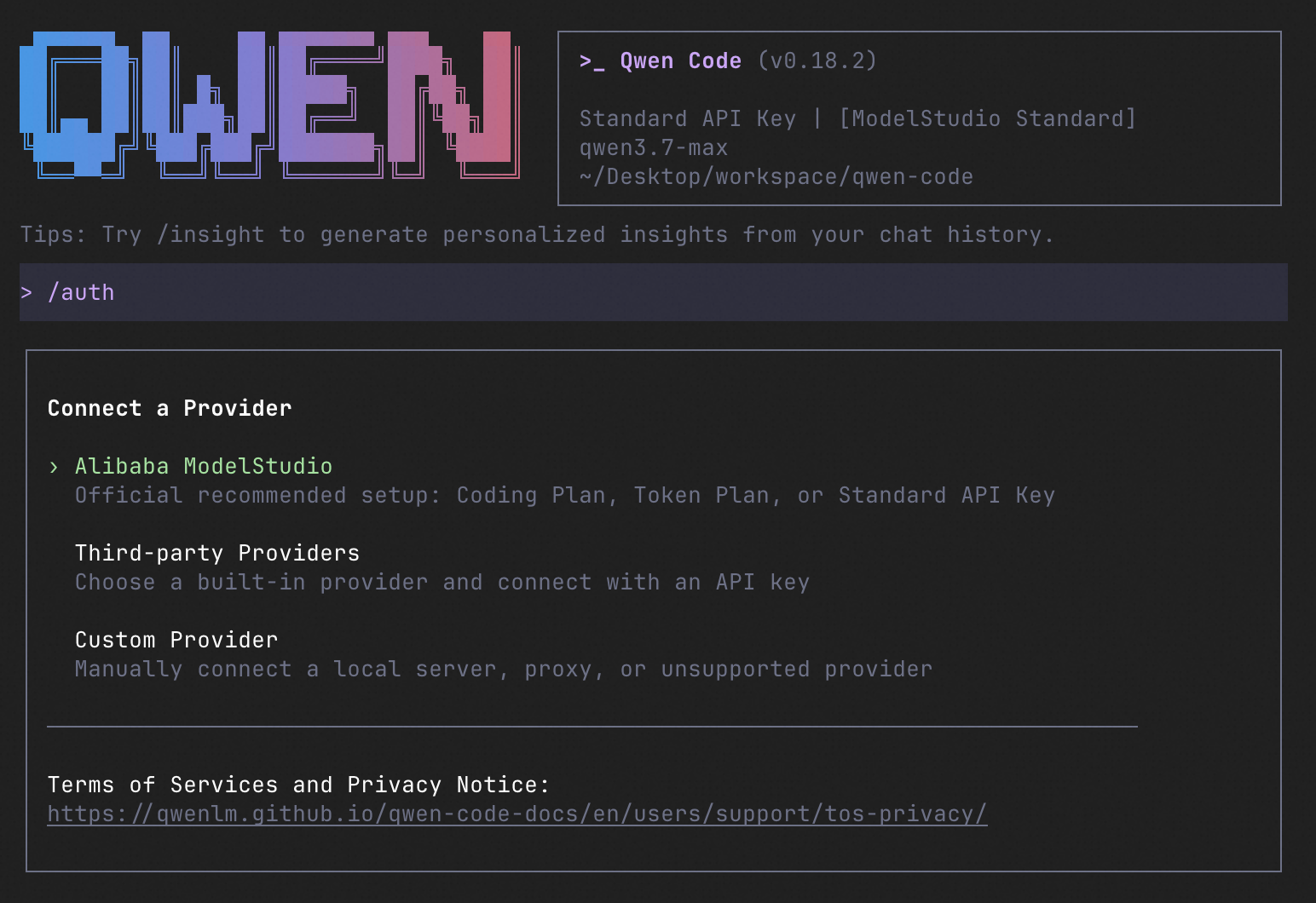
qwen          # Launch interactive terminal UI
# Inside the session:
/auth         # Configure your provider and API key
See the Authentication Guide and Settings Reference for detailed setup.
How to Use Qwen Code
| Mode | Command | Use Case |
|---|---|---|
| Interactive | qwen |
Terminal UI with rich rendering, @file references, slash commands |
| Headless | qwen -p "..." |
Scripts, CI/CD, batch processing — no UI |
| IDE | — | VS Code, Zed, JetBrains |
| Desktop | — | Qwen Code Desktop — GUI for macOS, Windows, Linux |
| Daemon | qwen serve |
Shared agent session over HTTP+SSE (ACP). Multiple clients, one agent. (experimental) Docs |
| SDK | — | TypeScript, Python, Java |
| IM Bot | qwen channel |
Connect to Telegram, DingTalk, WeChat, or Feishu |
SDK example (Python)
import asyncio

from qwen_code_sdk import is_sdk_result_message, query


async def main() -> None:
    result = query(
        "Summarize the repository layout.",
        {
            "cwd": "/path/to/project",
            "path_to_qwen_executable": "qwen",
        },
    )

    async for message in result:
        if is_sdk_result_message(message):
            print(message["result"])


asyncio.run(main())
Capabilities
If you know Claude Code, you already know Qwen Code — and then some. We've put significant effort into bringing Qwen Code to feature parity with Claude Code, improving both breadth and reliability across the board.
| Feature | Qwen Code | Claude Code |
|---|---|---|
| SubAgents, Agent Teams, Dynamic Workflows | ✓ | ✓ |
| Auto-Memory, Auto-Skills, Hooks | ✓ | ✓ |
| Built-in Skills (/review, /batch, /loop, /bugfix…) | ✓ | ✓ |
| MCP, Plan Mode, LSP Integration | ✓ | ✓ |
| Auto Mode, Sandbox, Git Worktrees | ✓ | ✓ |
| Computer Use (desktop automation) | ✓ | ✓ |
| IDE Plugins (VS Code / JetBrains / Zed) | ✓ | ✓ |
| SDK | ✓ | ✓ |
| Headless Mode, Session Management | ✓ | ✓ |
| Open-source — model and framework | ✓ | — |
| Multi-protocol (OpenAI / Anthropic / Gemini / Qwen + any provider) | ✓ | — |
| Agent Arena (multi-model head-to-head on same task) | ✓ | — |
Daemon Mode — qwen serve (multi-client shared agent) |
✓ | — |
| IM Channels (Telegram / DingTalk / WeChat / Feishu) | ✓ | — |
Ecosystem
-
Qwen Code Desktop — Official desktop app for macOS, Windows, and Linux
-
AionUi — A modern GUI for command-line AI tools including Qwen Code
-
Gemini CLI Desktop — A cross-platform desktop/web/mobile UI for Qwen Code
-
🦞 Qwen Code Claw — Let other agents (Claude, Codex, etc.) delegate coding tasks to Qwen Code via ACP. Paste this prompt into your agent:
Use Qwen Code as a coding agent. First, fetch and read this skill reference:
https://raw.githubusercontent.com/QwenLM/qwen-code/refs/heads/main/.qwen/skills/qwen-code-claw/SKILL.md
Then follow the instructions inside to install, authenticate, and use Qwen Code via acpx for all coding tasks.
Contributing
Contributions are welcome! See CONTRIBUTING.md for guidelines.
Acknowledgments
This project was originally based on Google Gemini CLI v0.8.2. We gratefully acknowledge the Gemini CLI team's excellent work. Starting from Qwen Code v0.1, we stopped syncing with upstream and began independent development as a multi-protocol, multi-platform agent framework with deep integrations for Qwen models and beyond.