 7f5b92b076
* feat(core): hint to background long-running foreground bash commands Phase D part (a) of Issue #3634. When a foreground `shell` tool call runs ≥ 60 seconds and completes (succeeds or errors), append an advisory line to the LLM-facing tool result suggesting re-running with `is_background: true` next time. Why: today a foreground bash that takes minutes (build watcher, soak test, slow npm install, polling loop) blocks the agent indefinitely. The user is already paying for the wait; the agent's next turn could have started running in parallel under `is_background: true`. Sleep interception (#3684) handled the egregious `sleep N` case at validate time; this handles the legitimate-but-long case at result time. Trade-offs: - Threshold = 60s. Half the existing 120s foreground timeout. Long enough that normal `npm install` / `pytest` runs don't trigger; short enough that the hint surfaces before the timeout hard-kills. - Advisory only — the command still runs to completion in the foreground for THIS invocation. The advice is for the agent's NEXT decision, not a corrective action on the current one. - Fires on success AND error completions. The advice is the same ("background it next time") in both cases. - Suppressed on aborted (timeout / user-cancel) — those paths already surface their own messaging and don't benefit from a "should have been background" reminder when the user / system already killed it. Implementation: - New constant `LONG_RUNNING_FOREGROUND_THRESHOLD_MS = 60000` in shell.ts, paired with the existing `DEFAULT_FOREGROUND_TIMEOUT_MS`. - Helper `buildLongRunningForegroundHint(elapsedMs)` exported so future surfaces (UI, telemetry) can render the same text without duplicating the threshold logic. - `Date.now()` bracketing around the spawn → `await resultPromise` block — mirrors what the background path already captures via `entry.startTime`. - Append happens inside the existing non-aborted result builder; zero changes to the cancel / timeout arms. Tests: 4 new cases — fires on long success, omits on short success, fires on long error completion, omits on aborted. Uses vi fake timers to drive wall-clock past the threshold without actually sleeping. * fix(core): tighten long-run hint suppression + boundary tests + post-truncation insertion Addresses 8 review threads on PR #3809 — 6 from /review bots, 2 from copilot — covering doc accuracy, code quality, behavioural gaps, and test coverage. **Behavioural fixes (real bugs)**: - **Suppress on external signal kills** (`result.signal != null` with `aborted: false`). `shellExecutionService` only sets `aborted` when the AbortSignal we passed was triggered, so SIGTERM from container shutdown / k8s eviction / OOM killer / sibling process-group reap falls through to the non-aborted branch. The advisory shouldn't fire there — the process didn't run to its conclusion, so "next time, background it" doesn't fit. New test pins this with `signal: 15` (SIGTERM), `aborted: false`. - **Append AFTER `truncateToolOutput`**. Previously the hint was appended inside the non-aborted result builder, which meant for long outputs it got wrapped in the "Truncated part of the output:" envelope — the LLM might read the advisory as part of the command's own output. New post-truncation insertion + test that pins ordering by mocking `truncateToolOutput` directly (real path needs `fs.writeFile` to actually succeed for the replacement branch to fire). - **Hint wording mode-aware**. The dialog mention dropped the unconditional "(footer pill + Enter)" specifics, which would mislead non-TTY users (`-p` headless / ACP / SDK consumers — no dialog or pill exists there). Now qualified as "in interactive mode the Background tasks dialog also has...". `/tasks` and the on-disk output file are mentioned without qualifier (work in any mode). **Code quality**: - **Threshold programmatically coupled to timeout**: `LONG_RUNNING_FOREGROUND_THRESHOLD_MS = Math.floor(DEFAULT_FOREGROUND_TIMEOUT_MS / 2)`. If the timeout is tuned later, the threshold tracks automatically. - **Docstring corrected**: removed the misleading "before it gets killed by the timeout" claim — the hint is on non-aborted path only, so timeout-killed commands never see it. The new docstring enumerates all suppression paths explicitly. - **Removed stale line-number reference**: comment said "mirrors the background path's `entry.startTime` capture (line ~781)" which goes stale on file edits. Now refers conceptually. **Test coverage gaps closed**: - **Off-by-one boundary**: 59_999ms → no hint. Pairs with the existing 60_000ms-exactly test (which fires) to pin the boundary tightly. A regression flipping `>=` to `>` would fail loudly. - **Timeout path explicit**: previous "aborted" test exercised user- cancel only. With `vi.useFakeTimers({ toFake: ['Date'] })`, `AbortSignal.timeout()` doesn't fake (it depends on the real timer subsystem), so `combinedSignal.aborted` stayed false. New test follows the pre-existing `should handle timeout vs user cancellation correctly` pattern: stubs `AbortSignal.timeout` + `.any` to return an already-aborted combined signal, then verifies "Command timed out after Nms" appears AND no advisory. * fix(core): per-invocation long-run threshold + debug-mode + test isolation Six suggestions from /review's third pass on PR #3809: **Real semantic fix**: - Long-run threshold now scales with the EFFECTIVE timeout, not the fixed default. A user who sets `timeout: 600_000` (10 min) gets the advisory at 5 min, not at 60s — respects the explicit timeout intent. Replaced the `LONG_RUNNING_FOREGROUND_THRESHOLD_MS` constant with a per-invocation `longRunThresholdFor(effectiveTimeout)` helper. **Debug-mode visibility**: - Debug mode previously snapshotted `returnDisplayMessage = llmContent` BEFORE the truncation + hint append, so debug-mode users saw the pre-hint content while the agent saw the advisory — agent suddenly suggesting `is_background: true` had no visible trigger in the TUI. Re-sync `returnDisplayMessage` after the hint append (debug-mode branch only) so the TUI mirrors what the agent sees. **Type-safety footgun**: - `if (typeof llmContent === 'string')` would silently drop the hint if `llmContent` ever becomes structured `Part[]`. Added an explicit `else` comment documenting the deliberate omission and the conditions under which to revisit (no string llmContent path exists today). **Style**: - Replaced the JSDoc `/** ... */` block on the (now-defunct) constant with a plain `//` comment block on the helper, matching the `DEFAULT_FOREGROUND_TIMEOUT_MS` / `OUTPUT_UPDATE_INTERVAL_MS` style. **Test hygiene**: - Wrapped both `vi.stubGlobal('AbortSignal', ...)` and `vi.spyOn(truncateToolOutput, ...)` in `try/finally` so failures during the test body don't leak the stub/spy into subsequent tests (would cause confusing cascading failures). - Dropped the internal-roadmap "Phase D part (a)" reference from the test comment — future maintainers don't have the context. **New test**: - `threshold scales with the user-supplied timeout (not the default)`: sets `timeout: 600_000`, advances 100s, verifies no hint. Pins the per-invocation coupling so a regression to a fixed constant would fail loudly here. * fix(core): tighten long-run hint suppression + boundary tests + post-truncation insertion (round 4) Six suggestions from /review's pai/glm-5-fp8 pass on PR #3809: **Behavioural / UX**: - **Hint now visible in non-debug TUI too.** Previously only debug mode mirrored the hint into `returnDisplay`; non-debug users saw the agent suggest `is_background: true` with no visible trigger. Now the hint is appended to `returnDisplayMessage` in both modes (full mirror in debug, terse-append in non-debug to preserve the output-or-status form). **Test coverage**: - **Debug-mode re-sync test added.** All other long-run hint tests run with `getDebugMode → false`; this one flips it to true and asserts the hint appears in `returnDisplay` too. Pins the re-sync so a regression that drops the debug branch would fail loudly. - **Threshold-scaling positive test added.** The negative case (`timeout: 600_000`, advance 100s, no hint) was already pinned; paired now with the positive case (advance 305s, hint fires) so a regression to a fixed 60s threshold is caught at both ends. **Style / consistency**: - **`result.signal === null` (was `== null`).** Strict equality to match the rest of the file. The `signal` field is typed `number | null` so loose equality has identical semantics, but the inconsistency was noise. **Doc clarity (timing semantics)**: - **Comment explains why elapsedMs is computed BEFORE truncation.** Two reviewers disagreed on the timing — one read it as before truncation (correct, slightly under-reports), the other as after (incorrect read). The intent is to report the COMMAND's runtime, not the tool call's total time. Truncation is post-processing, not part of "agent blocking time", so excluding it is the right semantic. Inline comment now spells this out so future readers don't have to infer. * fix(core): error-path hint surfacing + clock-resilient elapsed + threshold floor + observability Round 5 of PR #3809 review — 10 threads, mix of Critical and Suggestion: **Critical fixes**: 1. **Hint survives the error path** (`#OWbA`). When result.error is set, coreToolScheduler builds the model-facing functionResponse from `error.message` ONLY (not llmContent — see convertToFunctionResponse + the toolResult.error branch in scheduler:1648-1724). My hint was being silently dropped on long-command-failed cases. Now the hint is appended to error.message too so the advisory survives whichever branch the scheduler takes. 2. **Hint wording de-ambiguated** (`#OU6o`). "prefer re-running with is_background: true" was ambiguous — model could read it as "re-run THIS command in the background", which on stateful commands (DB migrations, deploys, git push) would cause double side effects. Reworded to "Next time you run a SIMILAR long-running process..." with an explicit parenthetical that warns against re-running the just-completed command. 3. **Debug observability** (`#OU6s`). Added `debugLogger.debug` at the hint decision point with elapsedMs / threshold / aborted / signal — when a user reports "my 65s command didn't get the hint" the suppression branch is now visible in DEBUG output. **Other behaviour fixes**: 4. **Threshold floor of 1000ms** (`#OU6r`). Pathological `timeout: 0` / `timeout: 1` would have given a 0-ms threshold, firing the hint on every invocation showing "ran for 0s". Floor at 1s makes that branch unreachable. 5. **`performance.now()` instead of `Date.now()`** (`#OU6v`). NTP corrections / VM clock drift between capture and read would silently make `elapsedMs` negative and skip the hint with no observable failure. Monotonic clock prevents that. 6. **Debug mode preserves truncation marker** (`#OU6w` / `#OWCq`). Previously `returnDisplayMessage = llmContent` after hint clobbered the "Output too long and was saved to: …" line appended during truncation. Switched to append-style re-sync in BOTH modes so prior content is preserved. **Test coverage gaps closed**: 7. **Non-debug returnDisplay test** (`#OWCo`). Pinned that the user TUI gets the hint in the default (non-debug) mode too. 8. **Test rename** (`#OWCl`). The "debug-mode TUI mirror" test passed in non-debug too after the recent refactor; split into two tests, one per branch. 9. **Error-path hint test**. Added a test that pins `result.error?.message` contains both the original error text AND the hint, covering the scheduler-routing-via-error.message path that was silently broken before fix #1. 10. **Test: faketimers also fakes `performance`**. Since we switched to `performance.now()`, `vi.useFakeTimers({ toFake: ['Date'] })` no longer covered the elapsed measurement; extended to `['Date', 'performance']` so the threshold tests can drive the wall-clock with `advanceTimersByTimeAsync`. #OU6t (else-comment for the type guard) was already addressed in the prior round — the explicit else-with-comment is in place; adding logging there would be noise. * test(core): cover the MIN_LONG_RUN_THRESHOLD_MS floor branch PR #3809 review: the new `Math.max(MIN_LONG_RUN_THRESHOLD_MS, ...)` floor in `longRunThresholdFor` was untested — only default-timeout and large-custom-timeout cases existed. A regression that strips the floor would let `timeout: 1` produce a 0ms threshold and fire a "ran for 0s" advisory on every invocation; the test suite would not catch it. New test: build with `timeout: 1`, advance 500ms (below the 1000ms floor), resolve with `aborted: false` to isolate the threshold logic from the abort path. Asserts no hint appears. A regression that removes the floor flips the assertion to fail. * fix(core): structured delimiter on error.message hint + tighten timeout floor comment Two of three threads from the latest /review pass on PR #3809 (the third — PR description / threshold scaling reconciliation — is fixed in the PR description update, not in code): - **`\n---\n` divider before hint in `error.message`** (`#Pt7C`). Downstream consumers of `error.message` (firePostToolUseFailureHook, telemetry grouping, SIEM alerting, hook-side error parsers) were receiving ~400 chars of advisory text mixed inline with the original error body — pattern-matching on error messages would absorb the advisory into the matched body. Added a `---` separator line so the boundary is unambiguous and split-able. - **Threshold-floor comment narrowed to `timeout: 1`** (`#Pu9o`). The comment said the floor guards `timeout: 0` / `timeout: 1`, but `validateToolParamValues` rejects `timeout <= 0` at validate time, so `timeout: 0` can't reach `longRunThresholdFor`. Updated the comment to mention only the actually-allowed pathological case (`timeout: 1` and any value `< 2` rounds to 0). Test updated to assert the `---` divider format with `toMatch`. * fix(core): capture executionStartTime AFTER spawn so PTY import isn't counted PR #3809 review: copilot caught that `executionStartTime` was captured BEFORE `await ShellExecutionService.execute(...)`, which meant the elapsed measurement included `getPty()` dynamic-import setup (~50-200ms on first call). The hint's "ran for Xs" reading was slightly inflated, and the comment claiming "spawn → settle" wasn't strictly accurate. Moved the capture immediately after the execute() call returns its { result, pid } handle. The pid being set by that point confirms the process has been spawned, so the subtraction is true post-spawn-to- settle. Comment updated to reflect the actual semantics. The displayed accuracy gain is small (50-200ms on a 60s+ threshold is <1%), but the comment claim now matches what the code measures. Tests unaffected — fakeTimers don't drive real dynamic imports, so the threshold tests behave identically. * fix(core): align long-run hint code/tests with ShellExecutionResult.error semantics Four copilot threads on PR #3809 — all rooted in the same observation: `ShellExecutionResult.error` is reserved for spawn/setup failures (per the field's doc comment in shellExecutionService.ts), NOT for non-zero exit codes. My existing code/tests conflated the two, making the error-path coverage less realistic and the inline comments inaccurate. **Test shape fixes**: - `appends the hint when a long-running foreground command exits with error` → `exits non-zero`. Changed `error: new Error('exit 1')` to `error: null` (the realistic shape for a non-zero exit without spawn failure). Added a comment explaining the field contract so future test authors don't repeat the conflation. - `hint survives the error path (appended to error.message)`: reframed the mock from `spawn ENOENT` (which would resolve in <1s in practice, making the long-elapsed scenario unrealistic) to `PTY initialization failed after 75s` — a slow-spawn-failure shape that COULD plausibly take 75s. Test still pins the same CODE PATH; comment now acknowledges the edge-case nature ("rare but real: PTY init dragging, remote-fs exec syscalls, security scanners interposing"). **Comment corrections**: - `returnDisplayMessage` build-order comment was misleading. It said "the hint is appended after both the truncation block and the returnDisplayMessage build" — but `returnDisplayMessage` is built BEFORE truncation. Replaced with a chronological enumeration (1. initial value, 2. truncation marker append, 3. hint append) that matches what the code actually does. - Error-path preservation comment now acknowledges the narrow applicability (spawn failures only, exit codes don't reach this branch). Code is unchanged — the path is still real, just rare. * test(core): pin empty-output success + background-no-hint paths Two defensive tests for the long-running foreground hint: - empty-output success at >=60s — exercises the returnDisplayMessage='' → hint append branch (write-only commands like `tar czf` / `cp -r` produce no stdout). Asserts the user- facing returnDisplay still surfaces the advisory even when the command produced nothing else to show. - background never includes the hint — the foreground hint logic lives in executeForeground only, so today this can't fail; the test guards against a future refactor hoisting the advisory into a shared post-execute path that would tag every background launch with a nonsensical "ran for 0s, consider is_background: true" suggestion. |
||
|---|---|---|
| .github | ||
| .husky | ||
| .qwen | ||
| .vscode | ||
| docs | ||
| docs-site | ||
| eslint-rules | ||
| integration-tests | ||
| packages | ||
| scripts | ||
| .dockerignore | ||
| .editorconfig | ||
| .gitattributes | ||
| .gitignore | ||
| .npmrc | ||
| .nvmrc | ||
| .prettierignore | ||
| .prettierrc.json | ||
| .yamllint.yml | ||
| AGENTS.md | ||
| CONTRIBUTING.md | ||
| Dockerfile | ||
| esbuild.config.js | ||
| eslint.config.js | ||
| LICENSE | ||
| Makefile | ||
| package-lock.json | ||
| package.json | ||
| README.md | ||
| SECURITY.md | ||
| tsconfig.json | ||
| vitest.config.ts | ||




An open-source AI agent that lives in your terminal.
中文 | Deutsch | français | 日本語 | Русский | Português (Brasil)
🎉 News
-
2026-04-15: Qwen OAuth free tier has been discontinued. To continue using Qwen Code, switch to Alibaba Cloud Coding Plan, OpenRouter, Fireworks AI, or bring your own API key. Run
qwen authto configure. -
2026-04-13: Qwen OAuth free tier policy update: daily quota adjusted to 100 requests/day (from 1,000).
-
2026-04-02: Qwen3.6-Plus is now live! Get an API key from Alibaba Cloud ModelStudio to access it through the OpenAI-compatible API.
-
2026-02-16: Qwen3.5-Plus is now live!
Why Qwen Code?
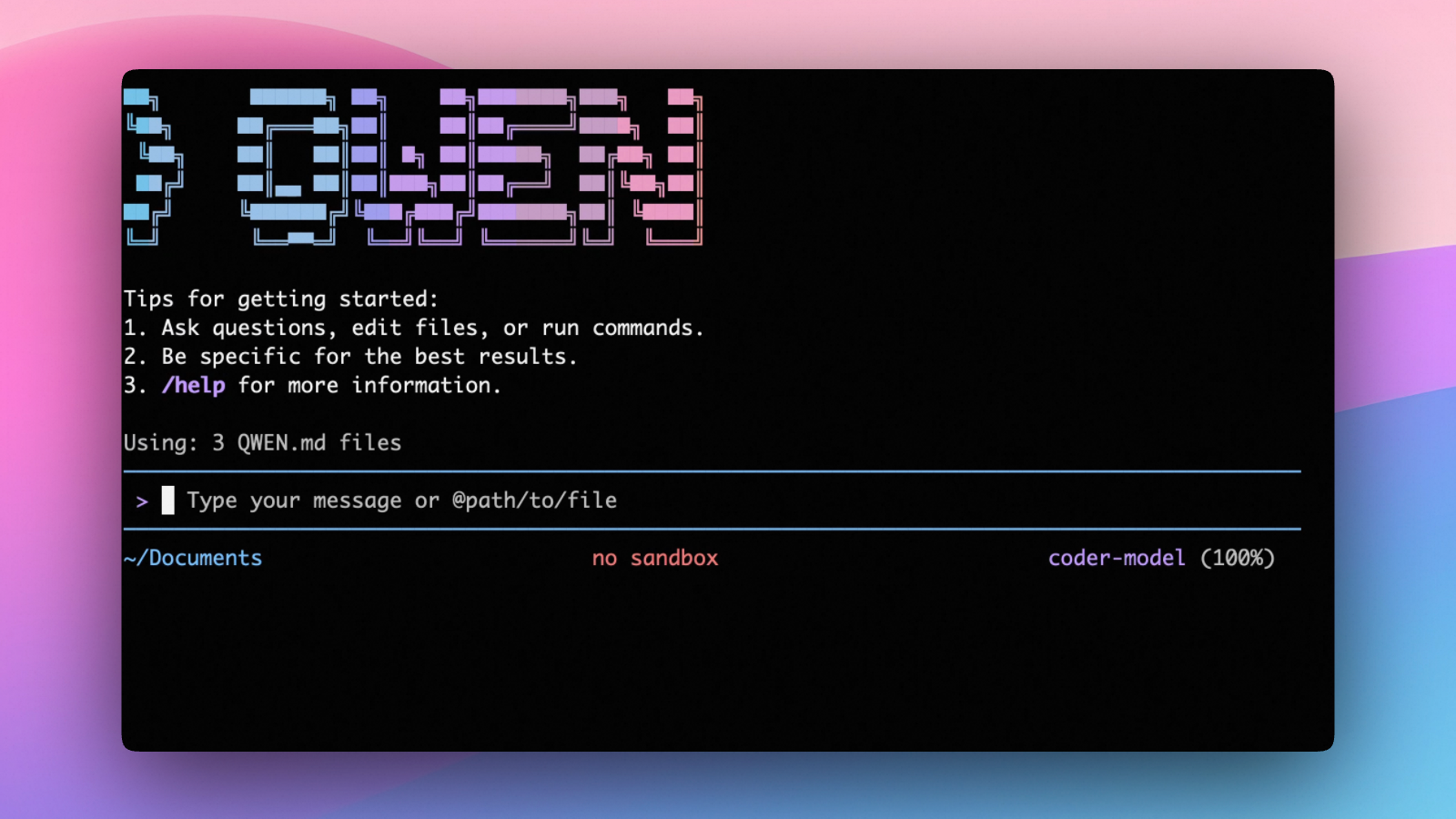
Qwen Code is an open-source AI agent for the terminal, optimized for Qwen series models. It helps you understand large codebases, automate tedious work, and ship faster.
- Multi-protocol, flexible providers: use OpenAI / Anthropic / Gemini-compatible APIs, Alibaba Cloud Coding Plan, OpenRouter, Fireworks AI, or bring your own API key.
- Open-source, co-evolving: both the framework and the Qwen3-Coder model are open-source—and they ship and evolve together.
- Agentic workflow, feature-rich: rich built-in tools (Skills, SubAgents) for a full agentic workflow and a Claude Code-like experience.
- Terminal-first, IDE-friendly: built for developers who live in the command line, with optional integration for VS Code, Zed, and JetBrains IDEs.
Installation
Quick Install (Recommended)
Linux / macOS
bash -c "$(curl -fsSL https://qwen-code-assets.oss-cn-hangzhou.aliyuncs.com/installation/install-qwen.sh)"
Windows (Run as Administrator)
Works in both Command Prompt and PowerShell:
powershell -Command "Invoke-WebRequest 'https://qwen-code-assets.oss-cn-hangzhou.aliyuncs.com/installation/install-qwen.bat' -OutFile (Join-Path $env:TEMP 'install-qwen.bat'); & (Join-Path $env:TEMP 'install-qwen.bat')"
Note
: It's recommended to restart your terminal after installation to ensure environment variables take effect.
Manual Installation
Prerequisites
Make sure you have Node.js 20 or later installed. Download it from nodejs.org.
NPM
npm install -g @qwen-code/qwen-code@latest
Homebrew (macOS, Linux)
brew install qwen-code
Quick Start
# Start Qwen Code (interactive)
qwen

# Then, in the session:
/help
/auth
On first use, you'll be prompted to sign in. You can run /auth anytime to switch authentication methods.
Example prompts:
What does this project do?
Explain the codebase structure.
Help me refactor this function.
Generate unit tests for this module.
Click to watch a demo video
🦞 Use Qwen Code for Coding Tasks in Claw
Copy the prompt below and paste it into your agent:
Use Qwen Code as a coding agent. First, fetch and read this skill reference:
https://raw.githubusercontent.com/QwenLM/qwen-code/refs/heads/main/.qwen/skills/qwen-code-claw/SKILL.md
Then follow the instructions inside to install, authenticate, and use Qwen Code via acpx for all coding tasks.
Authentication
Qwen Code supports the following authentication methods:
- API Key (recommended): use an API key from Alibaba Cloud Model Studio (Beijing / intl) or any supported provider (OpenAI, Anthropic, Google GenAI, and other compatible endpoints).
- Coding Plan: subscribe to the Alibaba Cloud Coding Plan (Beijing / intl) for a fixed monthly fee with higher quotas.
⚠️ Qwen OAuth was discontinued on April 15, 2026. If you were previously using Qwen OAuth, please switch to one of the methods above. Run
qwenand then/authto reconfigure.
API Key (recommended)
Use an API key to connect to Alibaba Cloud Model Studio or any supported provider. Supports multiple protocols:
- OpenAI-compatible: Alibaba Cloud ModelStudio, ModelScope, OpenAI, OpenRouter, and other OpenAI-compatible providers
- Anthropic: Claude models
- Google GenAI: Gemini models
The recommended way to configure models and providers is by editing ~/.qwen/settings.json (create it if it doesn't exist). This file lets you define all available models, API keys, and default settings in one place.
Quick Setup in 3 Steps
Step 1: Create or edit ~/.qwen/settings.json
Here is a complete example:
{
  "modelProviders": {
    "openai": [
      {
        "id": "qwen3.6-plus",
        "name": "qwen3.6-plus",
        "baseUrl": "https://dashscope.aliyuncs.com/compatible-mode/v1",
        "description": "Qwen3-Coder via Dashscope",
        "envKey": "DASHSCOPE_API_KEY"
      }
    ]
  },
  "env": {
    "DASHSCOPE_API_KEY": "sk-xxxxxxxxxxxxx"
  },
  "security": {
    "auth": {
      "selectedType": "openai"
    }
  },
  "model": {
    "name": "qwen3.6-plus"
  }
}
Step 2: Understand each field
| Field | What it does |
|---|---|
modelProviders |
Declares which models are available and how to connect to them. Keys like openai, anthropic, gemini represent the API protocol. |
modelProviders[].id |
The model ID sent to the API (e.g. qwen3.6-plus, gpt-4o). |
modelProviders[].envKey |
The name of the environment variable that holds your API key. |
modelProviders[].baseUrl |
The API endpoint URL (required for non-default endpoints). |
env |
A fallback place to store API keys (lowest priority; prefer .env files or export for sensitive keys). |
security.auth.selectedType |
The protocol to use on startup (openai, anthropic, gemini, vertex-ai). |
model.name |
The default model to use when Qwen Code starts. |
Step 3: Start Qwen Code — your configuration takes effect automatically:
qwen
Use the /model command at any time to switch between all configured models.
More Examples
Coding Plan (Alibaba Cloud ModelStudio) — fixed monthly fee, higher quotas
{
  "modelProviders": {
    "openai": [
      {
        "id": "qwen3.6-plus",
        "name": "qwen3.6-plus (Coding Plan)",
        "baseUrl": "https://coding.dashscope.aliyuncs.com/v1",
        "description": "qwen3.6-plus from ModelStudio Coding Plan",
        "envKey": "BAILIAN_CODING_PLAN_API_KEY"
      },
      {
        "id": "qwen3.5-plus",
        "name": "qwen3.5-plus (Coding Plan)",
        "baseUrl": "https://coding.dashscope.aliyuncs.com/v1",
        "description": "qwen3.5-plus with thinking enabled from ModelStudio Coding Plan",
        "envKey": "BAILIAN_CODING_PLAN_API_KEY",
        "generationConfig": {
          "extra_body": {
            "enable_thinking": true
          }
        }
      },
      {
        "id": "glm-4.7",
        "name": "glm-4.7 (Coding Plan)",
        "baseUrl": "https://coding.dashscope.aliyuncs.com/v1",
        "description": "glm-4.7 with thinking enabled from ModelStudio Coding Plan",
        "envKey": "BAILIAN_CODING_PLAN_API_KEY",
        "generationConfig": {
          "extra_body": {
            "enable_thinking": true
          }
        }
      },
      {
        "id": "kimi-k2.5",
        "name": "kimi-k2.5 (Coding Plan)",
        "baseUrl": "https://coding.dashscope.aliyuncs.com/v1",
        "description": "kimi-k2.5 with thinking enabled from ModelStudio Coding Plan",
        "envKey": "BAILIAN_CODING_PLAN_API_KEY",
        "generationConfig": {
          "extra_body": {
            "enable_thinking": true
          }
        }
      }
    ]
  },
  "env": {
    "BAILIAN_CODING_PLAN_API_KEY": "sk-xxxxxxxxxxxxx"
  },
  "security": {
    "auth": {
      "selectedType": "openai"
    }
  },
  "model": {
    "name": "qwen3.6-plus"
  }
}
Subscribe to the Coding Plan and get your API key at Alibaba Cloud ModelStudio(Beijing) or Alibaba Cloud ModelStudio(intl).
Multiple providers (OpenAI + Anthropic + Gemini)
{
  "modelProviders": {
    "openai": [
      {
        "id": "gpt-4o",
        "name": "GPT-4o",
        "envKey": "OPENAI_API_KEY",
        "baseUrl": "https://api.openai.com/v1"
      }
    ],
    "anthropic": [
      {
        "id": "claude-sonnet-4-20250514",
        "name": "Claude Sonnet 4",
        "envKey": "ANTHROPIC_API_KEY"
      }
    ],
    "gemini": [
      {
        "id": "gemini-2.5-pro",
        "name": "Gemini 2.5 Pro",
        "envKey": "GEMINI_API_KEY"
      }
    ]
  },
  "env": {
    "OPENAI_API_KEY": "sk-xxxxxxxxxxxxx",
    "ANTHROPIC_API_KEY": "sk-ant-xxxxxxxxxxxxx",
    "GEMINI_API_KEY": "AIzaxxxxxxxxxxxxx"
  },
  "security": {
    "auth": {
      "selectedType": "openai"
    }
  },
  "model": {
    "name": "gpt-4o"
  }
}
Enable thinking mode (for supported models like qwen3.5-plus)
{
  "modelProviders": {
    "openai": [
      {
        "id": "qwen3.5-plus",
        "name": "qwen3.5-plus (thinking)",
        "envKey": "DASHSCOPE_API_KEY",
        "baseUrl": "https://dashscope.aliyuncs.com/compatible-mode/v1",
        "generationConfig": {
          "extra_body": {
            "enable_thinking": true
          }
        }
      }
    ]
  },
  "env": {
    "DASHSCOPE_API_KEY": "sk-xxxxxxxxxxxxx"
  },
  "security": {
    "auth": {
      "selectedType": "openai"
    }
  },
  "model": {
    "name": "qwen3.5-plus"
  }
}
Tip: You can also set API keys via
exportin your shell or.envfiles, which take higher priority thansettings.json→env. See the authentication guide for full details.
Security note: Never commit API keys to version control. The
~/.qwen/settings.jsonfile is in your home directory and should stay private.
Local Model Setup (Ollama / vLLM)
You can also run models locally — no API key or cloud account needed. This is not an authentication method; instead, configure your local model endpoint in ~/.qwen/settings.json using the modelProviders field.
Ollama setup
- Install Ollama from ollama.com
- Pull a model:
ollama pull qwen3:32b - Configure
~/.qwen/settings.json:
{
  "modelProviders": {
    "openai": [
      {
        "id": "qwen3:32b",
        "name": "Qwen3 32B (Ollama)",
        "baseUrl": "http://localhost:11434/v1",
        "description": "Qwen3 32B running locally via Ollama"
      }
    ]
  },
  "security": {
    "auth": {
      "selectedType": "openai"
    }
  },
  "model": {
    "name": "qwen3:32b"
  }
}
vLLM setup
- Install vLLM:
pip install vllm - Start the server:
vllm serve Qwen/Qwen3-32B - Configure
~/.qwen/settings.json:
{
  "modelProviders": {
    "openai": [
      {
        "id": "Qwen/Qwen3-32B",
        "name": "Qwen3 32B (vLLM)",
        "baseUrl": "http://localhost:8000/v1",
        "description": "Qwen3 32B running locally via vLLM"
      }
    ]
  },
  "security": {
    "auth": {
      "selectedType": "openai"
    }
  },
  "model": {
    "name": "Qwen/Qwen3-32B"
  }
}
Usage
As an open-source terminal agent, you can use Qwen Code in four primary ways:
- Interactive mode (terminal UI)
- Headless mode (scripts, CI)
- IDE integration (VS Code, Zed)
- SDKs (TypeScript, Python, Java)
Interactive mode
cd your-project/
qwen
Run qwen in your project folder to launch the interactive terminal UI. Use @ to reference local files (for example @src/main.ts).
Headless mode
cd your-project/
qwen -p "your question"
Use -p to run Qwen Code without the interactive UI—ideal for scripts, automation, and CI/CD. Learn more: Headless mode.
IDE integration
Use Qwen Code inside your editor (VS Code, Zed, and JetBrains IDEs):
SDKs
Build on top of Qwen Code with the available SDKs:
- TypeScript: Use the Qwen Code SDK
- Python: Use the Python SDK
- Java: Use the Java SDK
Python SDK example:
import asyncio

from qwen_code_sdk import is_sdk_result_message, query


async def main() -> None:
    result = query(
        "Summarize the repository layout.",
        {
            "cwd": "/path/to/project",
            "path_to_qwen_executable": "qwen",
        },
    )

    async for message in result:
        if is_sdk_result_message(message):
            print(message["result"])


asyncio.run(main())
Commands & Shortcuts
Session Commands
/help- Display available commands/clear- Clear conversation history/compress- Compress history to save tokens/stats- Show current session information/bug- Submit a bug report/exitor/quit- Exit Qwen Code
Keyboard Shortcuts
Ctrl+C- Cancel current operationCtrl+D- Exit (on empty line)Up/Down- Navigate command history
Learn more about Commands
Tip: In YOLO mode (
--yolo), vision switching happens automatically without prompts when images are detected. Learn more about Approval Mode
Configuration
Qwen Code can be configured via settings.json, environment variables, and CLI flags.
| File | Scope | Description |
|---|---|---|
~/.qwen/settings.json |
User (global) | Applies to all your Qwen Code sessions. Recommended for modelProviders and env. |
.qwen/settings.json |
Project | Applies only when running Qwen Code in this project. Overrides user settings. |
The most commonly used top-level fields in settings.json:
| Field | Description |
|---|---|
modelProviders |
Define available models per protocol (openai, anthropic, gemini, vertex-ai). |
env |
Fallback environment variables (e.g. API keys). Lower priority than shell export and .env files. |
security.auth.selectedType |
The protocol to use on startup (e.g. openai). |
model.name |
The default model to use when Qwen Code starts. |
See the Authentication section above for complete
settings.jsonexamples, and the settings reference for all available options.
Benchmark Results
Terminal-Bench Performance
| Agent | Model | Accuracy |
|---|---|---|
| Qwen Code | Qwen3-Coder-480A35 | 37.5% |
| Qwen Code | Qwen3-Coder-30BA3B | 31.3% |
Ecosystem
Looking for a graphical interface?
- AionUi A modern GUI for command-line AI tools including Qwen Code
- Gemini CLI Desktop A cross-platform desktop/web/mobile UI for Qwen Code
Troubleshooting
If you encounter issues, check the troubleshooting guide.
Common issues:
Qwen OAuth free tier was discontinued on 2026-04-15: Qwen OAuth is no longer available. Runqwen→/authand switch to API Key or Coding Plan. See the Authentication section above for setup instructions.
To report a bug from within the CLI, run /bug and include a short title and repro steps.
Connect with Us
- Discord: https://discord.gg/RN7tqZCeDK
- Dingtalk: https://qr.dingtalk.com/action/joingroup?code=v1,k1,+FX6Gf/ZDlTahTIRi8AEQhIaBlqykA0j+eBKKdhLeAE=&_dt_no_comment=1&origin=1
Acknowledgments
This project is based on Google Gemini CLI. We acknowledge and appreciate the excellent work of the Gemini CLI team. Our main contribution focuses on parser-level adaptations to better support Qwen-Coder models.