 784182dfe3
* feat(skills): add /stuck diagnostic skill for frozen sessions Port the /stuck diagnostic capability to qwen-code as a bundled skill. Scans for stuck processes, high CPU/memory, hung subprocesses, and debug logs, then presents a structured diagnostic report. Adapted from claude-code's internal /stuck skill with: - Process identification via command path (node-based CLI, not compiled binary) - Debug log path updated to ~/.qwen/debug/ - Cross-platform stack dump support (macOS sample + Linux /proc/stack) - Direct user-facing output (no Slack dependency) 🤖 Generated with [Qwen Code](https://github.com/QwenLM/qwen-code) * fix(skills): respect QWEN_RUNTIME_DIR/QWEN_HOME for debug log path in /stuck 🤖 Generated with [Qwen Code](https://github.com/QwenLM/qwen-code) * fix(skills): add allowedTools and clarify diagnostic-only boundary in /stuck - Add allowedTools (run_shell_command, read_file) for convention consistency - Rephrase recommended actions as user-facing options, not model-executable commands 🤖 Generated with [Qwen Code](https://github.com/QwenLM/qwen-code) * fix(skills): address review feedback for /stuck — security, accuracy, sidecar - Add explicit PID argument validation (reject shell metacharacters) to prevent the model from substituting injection payloads into shell commands - Mention macOS/BSD `U` state alongside Linux `D` for uninterruptible sleep, so I/O-blocked macOS sessions are not silently missed - Add `-ww` to `ps` to disable column truncation, so long qwen paths don't fall outside the grep window and cause sessions to be missed - Use `~/.qwen/projects/*/chats/*.runtime.json` sidecars as the primary source of (pid, sessionId, workDir) mappings; `ps` is now a supplement for CPU/RSS/state enrichment 🤖 Generated with [Qwen Code](https://github.com/QwenLM/qwen-code) * fix(skills): apply minimal review fixes for /stuck - Filter ps to current UID via -u "$(id -u)" — avoid leaking other users' Qwen processes on shared hosts - Note that ps `rss=` is in KB; divide by 1024 before MB comparison - Replace `pgrep -lP` with `pgrep -P` + `ps -p` so child state shows up - Mention `advanced.runtimeOutputDir` setting alongside QWEN_RUNTIME_DIR / QWEN_HOME in the runtime-base description - Add half-line about PID reuse handling and not quoting secrets from debug logs (without inflating the prompt into a full workflow) 🤖 Generated with [Qwen Code](https://github.com/QwenLM/qwen-code) * fix(skills): round-3 review fixes for /stuck - Resolve RUNTIME_DIR from QWEN_RUNTIME_DIR/QWEN_HOME and use it in the sidecar `ls`, debug log path, and `latest` symlink — the previous round only updated the prose and left the actual commands hardcoded - Add explicit fallthrough: when sidecar enumeration finds nothing, fall through to step 2 instead of getting stuck trying to make sidecar work - Replace metacharacter blacklist with digit-only PID whitelist — safer and shorter; "etc." in a blacklist outsourced completeness to the LLM - Drop `strace -p <pid> -c -f` from the Linux stack-dump branch: `-c` blocks until the target exits, hanging the diagnostic on the very conditions it should diagnose; `ptrace_scope=1` would also misreport permission errors as process symptoms. Keep `cat /proc/<pid>/stack` - Warn that `ps -ww` command lines may include CLI-arg credentials and that `sample` stack frames may include in-memory secrets — redact before quoting in the report - Cover the "no sessions found at all" case so a fresh machine doesn't get reported as "all healthy" when zero data was collected 🤖 Generated with [Qwen Code](https://github.com/QwenLM/qwen-code) * fix(skills): /stuck overview-vs-step3 consistency and self-explanatory state triage - Update "What to look for" overview from `pgrep -lP <pid>` to `pgrep -P <pid>` to match step 3 (overview was left behind in the previous round when step 3 was upgraded to capture child state) - Add a triage sentence to step 3: when the state alone explains the problem (`T` = stopped, `Z` = zombie), skip child/log/stack inspection and go straight to the report 🤖 Generated with [Qwen Code](https://github.com/QwenLM/qwen-code) * fix(skills): correct /stuck runtime base priority order and resolution The actual priority in `Storage.getRuntimeBaseDir()` is `QWEN_RUNTIME_DIR` > `advanced.runtimeOutputDir` setting > `QWEN_HOME` > `~/.qwen`. The previous round merged the `advanced.runtimeOutputDir` mention but listed it after `QWEN_HOME`, and the shell snippet skipped the settings layer entirely — so on a machine where only the setting was configured, the skill would silently look in `~/.qwen` and miss all sessions. - Reorder the prose priority list to match the source - Add a `jq`-based read of `~/.qwen/settings.json` between the env-var and `QWEN_HOME`/default fallbacks. Gracefully degrades if `jq` is absent or the setting is unset. 🤖 Generated with [Qwen Code](https://github.com/QwenLM/qwen-code) * feat(skills): improve /stuck diagnostic flow Functional upgrades found in self-review (no reviewer raised these): - Add network-hang detection bullet to step 3. Hung HTTPS requests to the model API are the most common qwen-code "stuck" mode and showed as healthy under all previous heuristics (low CPU + S state). macOS uses `lsof -i -p`, Linux uses `ss -tnp`. - Add a fast path at the top of "Investigation steps": when the user passes a digit-only PID, skip enumeration and go straight to per-PID ps + step 3. Avoids a full sidecar+ps scan in the targeted case. - Replace per-file sidecar liveness check with a single bash loop that emits only live (pid, sidecar-path) pairs. On machines with many stale sidecars this drops 50+ separate reads. - Promote `~/.qwen/debug/latest` to the primary debug-log entry point (it usually points to the suspicious session). Sidecar-derived path becomes the fallback. - Bound the debug-log read with `tail -n 200` so the model doesn't attempt to load multi-GB log files. - Replace the placeholder `<child_pids>` for `ps -p` with a runnable `pgrep -P <pid> | xargs -I{} ps -p {} -o ...` composition. - Drop the redundant "substitute <pid> only after validation" note in step 3 — the digit-only whitelist in Argument validation already enforces this; PIDs from ps/sidecar are inherently digit-only. End-to-end tmux smoke test confirms the flow runs to completion with a correct structured report. 🤖 Generated with [Qwen Code](https://github.com/QwenLM/qwen-code) * fix(skills): /stuck — RUNTIME_DIR preamble + jq-free sidecar liveness Two issues caught by Codex review: 1. **PID fast path left $RUNTIME_DIR unset.** Step 3 references `"$RUNTIME_DIR"/debug/<session-id>.txt` but the fast path skipped step 1 where it was resolved, so debug-log lookup degraded to `/debug/latest` (broken absolute path). Fix: extract RUNTIME_DIR resolution into a preamble that runs before both paths. Also add a `grep -l "pid": <PID>` lookup in the fast path so it can match the given PID to its sidecar and recover the session ID for log lookup. 2. **Sidecar liveness loop required `jq`.** Default macOS / minimal Linux images don't ship `jq`, so the loop emitted nothing for every sidecar — the "preferred reliable" path silently failed and the skill fell back to the less accurate `ps | grep`. Replace with a single-spawn `node -e` script: node is guaranteed present (qwen-code itself runs on it). The settings.json `jq` lookup stays — that one gracefully degrades to QWEN_HOME/default if `jq` is missing. Both verified by hand: liveness loop correctly emits live PID/sidecar pairs (56219, 33534), `grep -l` lookup correctly finds the sidecar for a given PID and emits empty for non-matches. 🤖 Generated with [Qwen Code](https://github.com/QwenLM/qwen-code) * fix(skills): /stuck — validate fast-path PID is a Qwen Code process Codex review caught that the targeted PID fast path accepted any digit-only PID and dumped its full command line, bypassing the Qwen- process filter that the general scan applies via `grep -E '(qwen|node.*qwen|bun.*qwen)'`. Cross-user PIDs are already filtered (`kill -0` returns EPERM), but **same-user non-Qwen processes** would have their argv (potentially including secret CLI flags) printed into the chat. Fix: add a single-line validation pipeline before the stats dump: `kill -0 <pid> && ps -p <pid> -o command= -ww | grep -qE '(qwen|node.*qwen|bun.*qwen)'`. If it returns non-zero, refuse with "PID is not a current-user Qwen Code session" and stop the diagnostic. Otherwise proceed. Verified by manual test against a real Qwen Code session PID (matches) and PID 1 / launchd (correctly rejected). 🤖 Generated with [Qwen Code](https://github.com/QwenLM/qwen-code) * fix(skills): /stuck — settings path, sidecar grep, ps regex, lsof safety Four issues from PR review: 1. **Settings path honors QWEN_HOME.** The `jq` lookup in the preamble hardcoded `~/.qwen/settings.json`, but `getGlobalSettingsPath()` resolves to `$QWEN_HOME/settings.json` when set. Now uses `"${QWEN_HOME:-$HOME/.qwen}/settings.json"`. 2. **Sidecar grep uses `-El`.** Without `-E`, BSD `grep` on macOS may not treat `\b` as a word boundary in BRE. Also added a note: when PID reuse makes multiple sidecars match, prefer the most recently modified file via `ls -t | head -n 1`. 3. **Process regex tightened to avoid false positives.** The old `(qwen|node.*qwen|bun.*qwen)` matched any path containing "qwen" anywhere — so `qwen-playground/server.js`, `qwen-polyfill.js`, and even unrelated processes that pass a qwen-code path as `--cwd` (e.g., Codex plugin brokers) all matched. Replaced with `(qwen-code/[^ ]*\.(js|ts|mjs|cjs)( |$)|/qwen( |$))` — requires the `qwen-code/` substring to be followed by a script-file path, OR the bin invocation to end in `/qwen`. Verified on the local machine that broker processes are no longer matched while real Qwen sessions (worktree dev, dist/cli.js, qwen serve daemons) all are. 4. **lsof safety.** Added `-nP` to skip reverse-DNS and port lookups which can themselves hang. Mentioned `timeout 10` / `gtimeout 10` as an optional prefix when available — qwen-code's shell tool already has a backstop timeout, so this is belt-and-suspenders. Note: tested `\b` in BSD ERE on macOS — it does work correctly with `-E`, so the `-El` switch alone fully addresses concern #2's portability claim (BRE-without-E remains broken but is no longer used). 🤖 Generated with [Qwen Code](https://github.com/QwenLM/qwen-code) * fix(skills): /stuck — expand ~ and resolve relative paths in RUNTIME_DIR `Storage.resolvePath()` in qwen-code expands `~` and resolves relative paths before using `advanced.runtimeOutputDir`. The shell preamble was reading the raw JSON value via `jq`, so a user with `"runtimeOutputDir": "~/.qwen-runtime"` would pass the literal string to the glob — bash does not expand `~` inside double quotes — and the sidecar scan would silently find nothing and fall back to ps-only mode. Add two bash lines after the jq lookup: - `${RUNTIME_DIR/#\~/$HOME}` to substitute leading tilde - `case ... cd && pwd` to resolve relative paths to absolute (clears RUNTIME_DIR if cd fails so the chain falls through to QWEN_HOME) Smoke tested: tilde paths expand, absolute paths pass through, relative paths resolve, nonexistent dirs clear cleanly, empty stays empty. 🤖 Generated with [Qwen Code](https://github.com/QwenLM/qwen-code) * fix(skills): /stuck — round-N review feedback Adopted 9 of the 16 review suggestions; declined 5; 1 already done. - Anchor process regex to `(^|/)qwen-code[^ /]*/`. Now matches renamed clones (`qwen-code-dev`, `qwen-code-x1`, worktrees) AND rejects prefix false positives (`analyze-qwen-code/`, `my-qwen-code-tool/`). Verified against 10 cases. - Clarify RSS unit conversion: KB ÷ 1024 = MB, KB ÷ 1048576 = GB. The 4GB threshold is `4194304` KB raw, or 4 in GB. Prevents the model from dividing once and comparing to 4, which would over-alert by 1024×. - Add `State S with low CPU` to the Signs list so initial triage flags the most common hang signature (hung HTTPS to model API) instead of only catching it inside step 3. - Split fast path validation into two guards with distinct messages: dead/wrong-user vs. yours-but-not-Qwen. Plus add the same credential-redaction note that step 2 already has. - Replace `pgrep | xargs -I{} ps` with a single `ps -p $CHILDREN` call (avoids forking N times) and add `-ww` so long child cmdlines don't truncate. - Wrap macOS `sample <pid> 3` with optional `timeout 15` (or `gtimeout 15`). Same belt-and-suspenders pattern used for `lsof`. - Note that `ss -tnp -p` requires root/CAP_NET_ADMIN; non-root sees `-` in the PID column. Tell the model to fall back to `lsof` instead of concluding "no connections". Declined: self-PID via `$$` (wrong PID — `$$` is the spawned shell, not qwen), pgrep fallback for distroless (over-engineering), `\b` matches negative numbers (false alarm — `:[[:space:]]*` won't match through `-`), regex DRY abstraction (no value in markdown prompts), project-level settings.json read (already declined; same trade-off). 🤖 Generated with [Qwen Code](https://github.com/QwenLM/qwen-code) * test(skills): add integration test that parses every bundled SKILL.md The bundled skill loader (`SkillManager.parseSkillFileInternal`) silently catches and debug-logs frontmatter parse errors, so a typo in any SKILL.md (missing `description`, broken `---` delimiter, `allowedTools` written as a scalar) merges with green CI and only surfaces when a user invokes the skill — at which point the skill is missing from autocomplete with no indication why. Add a tiny integration test that walks `packages/core/src/skills/bundled/`, runs every `SKILL.md` through the real `parseSkillContent` (no mocks), and asserts: name matches the directory, description is non-empty, body is non-empty, and `allowedTools` (if present) is an array. Lives in its own file because `skill-load.test.ts` mocks `fs/promises` and the YAML parser, which would defeat the purpose of an integration test. New file uses real fs and the real loader. Negative-case verified: deliberately corrupting `stuck/SKILL.md`'s frontmatter delimiter makes only that file's test fail; restoring it returns the suite to all-green. Addresses wenshao's standing [Critical] review (2026-05-15 12:29Z) about the bundled skill system lacking automated tests for SKILL.md parsing. 🤖 Generated with [Qwen Code](https://github.com/QwenLM/qwen-code) |
||
|---|---|---|
| .github | ||
| .husky | ||
| .qwen | ||
| .vscode | ||
| docs | ||
| docs-site | ||
| eslint-rules | ||
| integration-tests | ||
| packages | ||
| scripts | ||
| .dockerignore | ||
| .editorconfig | ||
| .gitattributes | ||
| .gitignore | ||
| .npmrc | ||
| .nvmrc | ||
| .prettierignore | ||
| .prettierrc.json | ||
| .yamllint.yml | ||
| AGENTS.md | ||
| CONTRIBUTING.md | ||
| Dockerfile | ||
| esbuild.config.js | ||
| eslint.config.js | ||
| LICENSE | ||
| Makefile | ||
| package-lock.json | ||
| package.json | ||
| README.md | ||
| SECURITY.md | ||
| tsconfig.json | ||
| vitest.config.ts | ||




An open-source AI agent that lives in your terminal.
中文 | Deutsch | français | 日本語 | Русский | Português (Brasil)
🎉 News
-
2026-04-15: Qwen OAuth free tier has been discontinued. To continue using Qwen Code, switch to Alibaba Cloud Coding Plan, OpenRouter, Fireworks AI, or bring your own API key. Run
qwen authto configure. -
2026-04-13: Qwen OAuth free tier policy update: daily quota adjusted to 100 requests/day (from 1,000).
-
2026-04-02: Qwen3.6-Plus is now live! Get an API key from Alibaba Cloud ModelStudio to access it through the OpenAI-compatible API.
-
2026-02-16: Qwen3.5-Plus is now live!
Why Qwen Code?
Qwen Code is an open-source AI agent for the terminal, optimized for Qwen series models. It helps you understand large codebases, automate tedious work, and ship faster.
- Multi-protocol, flexible providers: use OpenAI / Anthropic / Gemini-compatible APIs, Alibaba Cloud Coding Plan, OpenRouter, Fireworks AI, or bring your own API key.
- Open-source, co-evolving: both the framework and the Qwen3-Coder model are open-source—and they ship and evolve together.
- Agentic workflow, feature-rich: rich built-in tools (Skills, SubAgents) for a full agentic workflow and a Claude Code-like experience.
- Terminal-first, IDE-friendly: built for developers who live in the command line, with optional integration for VS Code, Zed, and JetBrains IDEs.
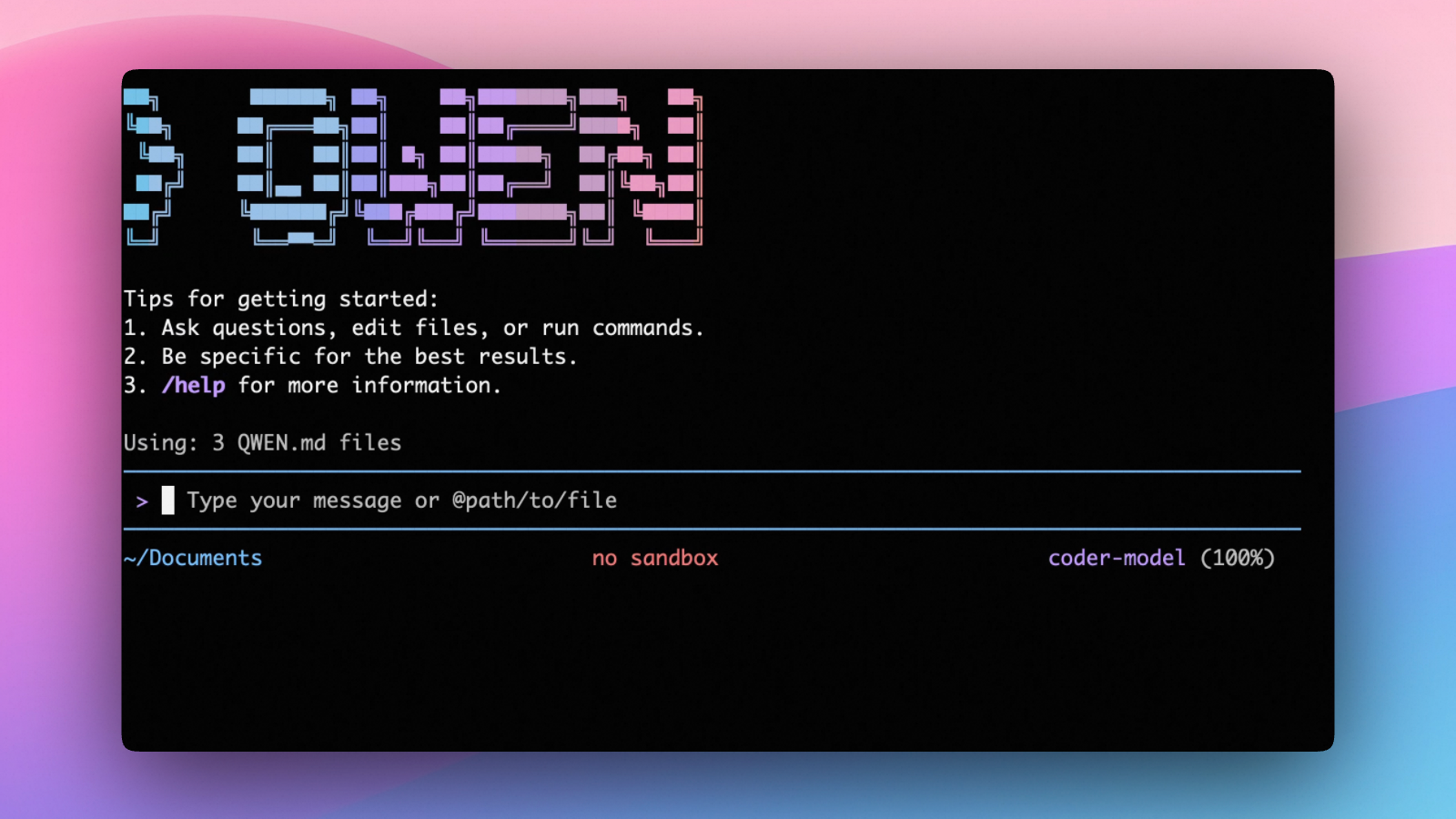
Installation
Quick Install (Recommended)
Linux / macOS
bash -c "$(curl -fsSL https://qwen-code-assets.oss-cn-hangzhou.aliyuncs.com/installation/install-qwen.sh)"
Windows (Run as Administrator)
Works in both Command Prompt and PowerShell:
powershell -Command "Invoke-WebRequest 'https://qwen-code-assets.oss-cn-hangzhou.aliyuncs.com/installation/install-qwen.bat' -OutFile (Join-Path $env:TEMP 'install-qwen.bat'); & (Join-Path $env:TEMP 'install-qwen.bat')"
Note
: It's recommended to restart your terminal after installation to ensure environment variables take effect.
Manual Installation
Prerequisites
Make sure you have Node.js 22 or later installed. Download it from nodejs.org.
NPM
npm install -g @qwen-code/qwen-code@latest
Homebrew (macOS, Linux)
brew install qwen-code
Quick Start
# Start Qwen Code (interactive)
qwen

# Then, in the session:
/help
/auth
On first use, you'll be prompted to sign in. You can run /auth anytime to switch authentication methods.
Example prompts:
What does this project do?
Explain the codebase structure.
Help me refactor this function.
Generate unit tests for this module.
Click to watch a demo video
🦞 Use Qwen Code for Coding Tasks in Claw
Copy the prompt below and paste it into your agent:
Use Qwen Code as a coding agent. First, fetch and read this skill reference:
https://raw.githubusercontent.com/QwenLM/qwen-code/refs/heads/main/.qwen/skills/qwen-code-claw/SKILL.md
Then follow the instructions inside to install, authenticate, and use Qwen Code via acpx for all coding tasks.
Authentication
Qwen Code supports the following authentication methods:
- API Key (recommended): use an API key from Alibaba Cloud Model Studio (Beijing / intl) or any supported provider (OpenAI, Anthropic, Google GenAI, and other compatible endpoints).
- Coding Plan: subscribe to the Alibaba Cloud Coding Plan (Beijing / intl) for a fixed monthly fee with higher quotas.
⚠️ Qwen OAuth was discontinued on April 15, 2026. If you were previously using Qwen OAuth, please switch to one of the methods above. Run
qwenand then/authto reconfigure.
API Key (recommended)
Use an API key to connect to Alibaba Cloud Model Studio or any supported provider. Supports multiple protocols:
- OpenAI-compatible: Alibaba Cloud ModelStudio, ModelScope, OpenAI, OpenRouter, and other OpenAI-compatible providers
- Anthropic: Claude models
- Google GenAI: Gemini models
The recommended way to configure models and providers is by editing ~/.qwen/settings.json (create it if it doesn't exist). This file lets you define all available models, API keys, and default settings in one place.
Quick Setup in 3 Steps
Step 1: Create or edit ~/.qwen/settings.json
Here is a complete example:
{
  "modelProviders": {
    "openai": [
      {
        "id": "qwen3.6-plus",
        "name": "qwen3.6-plus",
        "baseUrl": "https://dashscope.aliyuncs.com/compatible-mode/v1",
        "description": "Qwen3-Coder via Dashscope",
        "envKey": "DASHSCOPE_API_KEY"
      }
    ]
  },
  "env": {
    "DASHSCOPE_API_KEY": "sk-xxxxxxxxxxxxx"
  },
  "security": {
    "auth": {
      "selectedType": "openai"
    }
  },
  "model": {
    "name": "qwen3.6-plus"
  }
}
Step 2: Understand each field
| Field | What it does |
|---|---|
modelProviders |
Declares which models are available and how to connect to them. Keys like openai, anthropic, gemini represent the API protocol. |
modelProviders[].id |
The model ID sent to the API (e.g. qwen3.6-plus, gpt-4o). |
modelProviders[].envKey |
The name of the environment variable that holds your API key. |
modelProviders[].baseUrl |
The API endpoint URL (required for non-default endpoints). |
env |
A fallback place to store API keys (lowest priority; prefer .env files or export for sensitive keys). |
security.auth.selectedType |
The protocol to use on startup (openai, anthropic, gemini, vertex-ai). |
model.name |
The default model to use when Qwen Code starts. |
Step 3: Start Qwen Code — your configuration takes effect automatically:
qwen
Use the /model command at any time to switch between all configured models.
More Examples
Coding Plan (Alibaba Cloud ModelStudio) — fixed monthly fee, higher quotas
{
  "modelProviders": {
    "openai": [
      {
        "id": "qwen3.6-plus",
        "name": "qwen3.6-plus (Coding Plan)",
        "baseUrl": "https://coding.dashscope.aliyuncs.com/v1",
        "description": "qwen3.6-plus from ModelStudio Coding Plan",
        "envKey": "BAILIAN_CODING_PLAN_API_KEY"
      },
      {
        "id": "qwen3.5-plus",
        "name": "qwen3.5-plus (Coding Plan)",
        "baseUrl": "https://coding.dashscope.aliyuncs.com/v1",
        "description": "qwen3.5-plus with thinking enabled from ModelStudio Coding Plan",
        "envKey": "BAILIAN_CODING_PLAN_API_KEY",
        "generationConfig": {
          "extra_body": {
            "enable_thinking": true
          }
        }
      },
      {
        "id": "glm-4.7",
        "name": "glm-4.7 (Coding Plan)",
        "baseUrl": "https://coding.dashscope.aliyuncs.com/v1",
        "description": "glm-4.7 with thinking enabled from ModelStudio Coding Plan",
        "envKey": "BAILIAN_CODING_PLAN_API_KEY",
        "generationConfig": {
          "extra_body": {
            "enable_thinking": true
          }
        }
      },
      {
        "id": "kimi-k2.5",
        "name": "kimi-k2.5 (Coding Plan)",
        "baseUrl": "https://coding.dashscope.aliyuncs.com/v1",
        "description": "kimi-k2.5 with thinking enabled from ModelStudio Coding Plan",
        "envKey": "BAILIAN_CODING_PLAN_API_KEY",
        "generationConfig": {
          "extra_body": {
            "enable_thinking": true
          }
        }
      }
    ]
  },
  "env": {
    "BAILIAN_CODING_PLAN_API_KEY": "sk-xxxxxxxxxxxxx"
  },
  "security": {
    "auth": {
      "selectedType": "openai"
    }
  },
  "model": {
    "name": "qwen3.6-plus"
  }
}
Subscribe to the Coding Plan and get your API key at Alibaba Cloud ModelStudio(Beijing) or Alibaba Cloud ModelStudio(intl).
Multiple providers (OpenAI + Anthropic + Gemini)
{
  "modelProviders": {
    "openai": [
      {
        "id": "gpt-4o",
        "name": "GPT-4o",
        "envKey": "OPENAI_API_KEY",
        "baseUrl": "https://api.openai.com/v1"
      }
    ],
    "anthropic": [
      {
        "id": "claude-sonnet-4-20250514",
        "name": "Claude Sonnet 4",
        "envKey": "ANTHROPIC_API_KEY"
      }
    ],
    "gemini": [
      {
        "id": "gemini-2.5-pro",
        "name": "Gemini 2.5 Pro",
        "envKey": "GEMINI_API_KEY"
      }
    ]
  },
  "env": {
    "OPENAI_API_KEY": "sk-xxxxxxxxxxxxx",
    "ANTHROPIC_API_KEY": "sk-ant-xxxxxxxxxxxxx",
    "GEMINI_API_KEY": "AIzaxxxxxxxxxxxxx"
  },
  "security": {
    "auth": {
      "selectedType": "openai"
    }
  },
  "model": {
    "name": "gpt-4o"
  }
}
Enable thinking mode (for supported models like qwen3.5-plus)
{
  "modelProviders": {
    "openai": [
      {
        "id": "qwen3.5-plus",
        "name": "qwen3.5-plus (thinking)",
        "envKey": "DASHSCOPE_API_KEY",
        "baseUrl": "https://dashscope.aliyuncs.com/compatible-mode/v1",
        "generationConfig": {
          "extra_body": {
            "enable_thinking": true
          }
        }
      }
    ]
  },
  "env": {
    "DASHSCOPE_API_KEY": "sk-xxxxxxxxxxxxx"
  },
  "security": {
    "auth": {
      "selectedType": "openai"
    }
  },
  "model": {
    "name": "qwen3.5-plus"
  }
}
Tip: You can also set API keys via
exportin your shell or.envfiles, which take higher priority thansettings.json→env. See the authentication guide for full details.
Security note: Never commit API keys to version control. The
~/.qwen/settings.jsonfile is in your home directory and should stay private.
Local Model Setup (Ollama / vLLM)
You can also run models locally — no API key or cloud account needed. This is not an authentication method; instead, configure your local model endpoint in ~/.qwen/settings.json using the modelProviders field.
Set generationConfig.contextWindowSize inside the matching provider entry
and adjust it to the context length configured on your local server.
Ollama setup
- Install Ollama from ollama.com
- Pull a model:
ollama pull qwen3:32b - Configure
~/.qwen/settings.json:
{
  "modelProviders": {
    "openai": [
      {
        "id": "qwen3:32b",
        "name": "Qwen3 32B (Ollama)",
        "baseUrl": "http://localhost:11434/v1",
        "description": "Qwen3 32B running locally via Ollama",
        "generationConfig": {
          "contextWindowSize": 131072
        }
      }
    ]
  },
  "security": {
    "auth": {
      "selectedType": "openai"
    }
  },
  "model": {
    "name": "qwen3:32b"
  }
}
vLLM setup
- Install vLLM:
pip install vllm - Start the server:
vllm serve Qwen/Qwen3-32B - Configure
~/.qwen/settings.json:
{
  "modelProviders": {
    "openai": [
      {
        "id": "Qwen/Qwen3-32B",
        "name": "Qwen3 32B (vLLM)",
        "baseUrl": "http://localhost:8000/v1",
        "description": "Qwen3 32B running locally via vLLM",
        "generationConfig": {
          "contextWindowSize": 131072
        }
      }
    ]
  },
  "security": {
    "auth": {
      "selectedType": "openai"
    }
  },
  "model": {
    "name": "Qwen/Qwen3-32B"
  }
}
Usage
As an open-source terminal agent, you can use Qwen Code in five primary ways:
- Interactive mode (terminal UI)
- Headless mode (scripts, CI)
- IDE integration (VS Code, Zed)
- SDKs (TypeScript, Python, Java)
- Daemon mode —
qwen serveexposes ACP over HTTP+SSE so multiple clients share one agent (experimental)
Interactive mode
cd your-project/
qwen
Run qwen in your project folder to launch the interactive terminal UI. Use @ to reference local files (for example @src/main.ts).
Headless mode
cd your-project/
qwen -p "your question"
Use -p to run Qwen Code without the interactive UI—ideal for scripts, automation, and CI/CD. Learn more: Headless mode.
IDE integration
Use Qwen Code inside your editor (VS Code, Zed, and JetBrains IDEs):
Daemon mode (qwen serve, experimental)
cd your-project/
qwen serve
# → qwen serve listening on http://127.0.0.1:4170 (mode=http-bridge)
Run Qwen Code as a local HTTP daemon so IDE plugins, web UIs, CI scripts and custom CLIs all share one agent session over HTTP+SSE — instead of each spawning their own subprocess. Loopback bind has no auth by default (set QWEN_SERVER_TOKEN to enable bearer auth even on loopback); remote binds (--hostname 0.0.0.0) require a token — boot refuses without one. See:
SDKs
Build on top of Qwen Code with the available SDKs:
- TypeScript: Use the Qwen Code SDK
- Python: Use the Python SDK
- Java: Use the Java SDK
Python SDK example:
import asyncio

from qwen_code_sdk import is_sdk_result_message, query


async def main() -> None:
    result = query(
        "Summarize the repository layout.",
        {
            "cwd": "/path/to/project",
            "path_to_qwen_executable": "qwen",
        },
    )

    async for message in result:
        if is_sdk_result_message(message):
            print(message["result"])


asyncio.run(main())
Commands & Shortcuts
Session Commands
/help- Display available commands/clear- Clear conversation history/compress- Compress history to save tokens/stats- Show current session information/bug- Submit a bug report/exitor/quit- Exit Qwen Code
Keyboard Shortcuts
Ctrl+C- Cancel current operationCtrl+D- Exit (on empty line)Up/Down- Navigate command history
Learn more about Commands
Tip: In YOLO mode (
--yolo), vision switching happens automatically without prompts when images are detected. Learn more about Approval Mode
Configuration
Qwen Code can be configured via settings.json, environment variables, and CLI flags.
| File | Scope | Description |
|---|---|---|
~/.qwen/settings.json |
User (global) | Applies to all your Qwen Code sessions. Recommended for modelProviders and env. |
.qwen/settings.json |
Project | Applies only when running Qwen Code in this project. Overrides user settings. |
The most commonly used top-level fields in settings.json:
| Field | Description |
|---|---|
modelProviders |
Define available models per protocol (openai, anthropic, gemini, vertex-ai). |
env |
Fallback environment variables (e.g. API keys). Lower priority than shell export and .env files. |
security.auth.selectedType |
The protocol to use on startup (e.g. openai). |
model.name |
The default model to use when Qwen Code starts. |
See the Authentication section above for complete
settings.jsonexamples, and the settings reference for all available options.
Benchmark Results
Terminal-Bench Performance
| Agent | Model | Accuracy |
|---|---|---|
| Qwen Code | Qwen3-Coder-480A35 | 37.5% |
| Qwen Code | Qwen3-Coder-30BA3B | 31.3% |
Ecosystem
Looking for a graphical interface?
- AionUi A modern GUI for command-line AI tools including Qwen Code
- Gemini CLI Desktop A cross-platform desktop/web/mobile UI for Qwen Code
Troubleshooting
If you encounter issues, check the troubleshooting guide.
Common issues:
Qwen OAuth free tier was discontinued on 2026-04-15: Qwen OAuth is no longer available. Runqwen→/authand switch to API Key or Coding Plan. See the Authentication section above for setup instructions.
To report a bug from within the CLI, run /bug and include a short title and repro steps.
Connect with Us
- Discord: https://discord.gg/RN7tqZCeDK
- Dingtalk: https://qr.dingtalk.com/action/joingroup?code=v1,k1,+FX6Gf/ZDlTahTIRi8AEQhIaBlqykA0j+eBKKdhLeAE=&_dt_no_comment=1&origin=1
Acknowledgments
This project is based on Google Gemini CLI. We acknowledge and appreciate the excellent work of the Gemini CLI team. Our main contribution focuses on parser-level adaptations to better support Qwen-Coder models.