 72d3a845f7
* fix(review): count a fix-induced re-report as first-time work Closes #9674. A carried id has meant two different things since the fix-induced disposition shipped, and the volume trend's first-time count read both as re-posts. One is a re-post: a finding re-asserted under the id it already had. The other is a new defect wearing the id of the entry whose fix produced it, carried deliberately so the author reads one thread per churning site instead of a new one every round. Counting that as a re-post made the trend understate new work exactly where the loop was creating the most of it — measured on the pull request that introduced the disposition, a round that newly identified six defects and re-reported four of them under earlier ids recorded a first-time count of two. Neither count moves. They measure different things and both readings are correct, which is why the two reconciliations the issue rules out stay ruled out: excluding carried-id re-reports from the census would put the attributed count outside it and every such census would be refused as impossible, and counting them as first-time posts wholesale would tell the trend a re-assertion is new work. What was missing is the distinction itself, so the comment now carries it: a fix-induced re-report is marked, and the reader of drafted comments passes that through to the count. The marking sits after the id and its separator, never inside the id grammar. That grammar is shared with the ledger's own carry, so widening it to swallow a parenthetical would put a finding's identity on the same regex as a model-written adjective — a spacing the wider grammar failed to anticipate would stop matching the id and silently renumber the finding. Read after the id, nothing about the token can cost it, and the reading is correspondingly lenient about case and spacing because it governs only whether a comment counts as first-time work. An unrecognised marking leaves the draft counted as a re-post, which is what every round did before this existed; a marking wrongly added to a still-stands is the expensive direction, so the skill restricts the token rather than offering it as a way to flag any carried finding as interesting. The token is stripped from the claim before it reaches the work list. Left in, it would ride into the next round as part of the text Step 6 re-locates the claim by and the status table prints — machine vocabulary about how to count one round, outliving the round it described. Beside no id it is ordinary claim text and survives, because there is no entry there for it to qualify and editing a finding's own words on the strength of a word it opened with is not this token's business. * fix(review): resolve orphaned readback doc and record the fresh-count seam (#9744) Co-authored-by: Qwen-Coder <qwen-coder@alibabacloud.com> * fix(review): name the zero-prev masking round in the fresh-count seam note (#9744) Co-authored-by: Qwen-Coder <qwen-coder@alibabacloud.com> * docs(review): stop the blocker's docblock forbidding what this PR ships Three passages written when a carried id could only mean one thing now forbid the rule this branch adds. The blocker's docblock rules out "counting them as first-time POSTS" as one of two reconciliations that must never be made; the skill's census paragraph says the volume trend is the count "where a carried id is a re-post"; and a test comment restates the same premise. Each was true before a fix-induced re-report could be marked, and each now tells the next reader to undo the code beside it. The distinction the passages were protecting is real and stays. What they ruled out was reading a carried id as first-time work BY INFERENCE, which would count every re-assertion of a standing finding as new work — still wrong, and still what `isFreshDraft` refuses. What this branch added is narrower and is not an inference: the round marks the re-report, and only a marked one counts. An unmarked carried id is a re-post to the trend exactly as before, so the two counts still diverge by design; what is gone is the premise that a carried id can mean only one thing. The census paragraph gains the consequence that follows for whoever writes the comment: a fix-induced finding counted in the census but left unmarked in the body is counted by neither number. Prose only — no logic, no test assertion changes. Reported twice by the review as a deferred finding and left standing under the code-age rule, which is correct as a posting decision and not a reason to leave a contradiction in the file. --------- Co-authored-by: qwen-code-dev-bot <qwen-code-dev-bot@users.noreply.github.com> Co-authored-by: Qwen-Coder <qwen-coder@alibabacloud.com> |
||
|---|---|---|
| .github | ||
| .husky | ||
| .qwen | ||
| .vscode | ||
| docs | ||
| docs-site | ||
| eslint-rules | ||
| integration-tests | ||
| integrations/external-context | ||
| packages | ||
| patches | ||
| scripts | ||
| .dockerignore | ||
| .editorconfig | ||
| .gitattributes | ||
| .gitignore | ||
| .npmrc | ||
| .nvmrc | ||
| .prettierignore | ||
| .prettierrc.json | ||
| .yamllint.yml | ||
| AGENTS.md | ||
| CHANGELOG.md | ||
| CLAUDE.md | ||
| CONTRIBUTING.md | ||
| Dockerfile | ||
| esbuild.config.js | ||
| eslint.config.js | ||
| eslint.legacy-filenames.mjs | ||
| LICENSE | ||
| Makefile | ||
| package-lock.json | ||
| package.json | ||
| README.md | ||
| SECURITY.md | ||
| tsconfig.json | ||
| vitest.config.ts | ||




The open-source AI coding agent that lives in your terminal.
中文 | Deutsch | français | 日本語 | Русский | Português (Brasil) | 한국어
Why Qwen Code?
- Agentic out of the box — Auto-Memory, Auto-Skills, SubAgents, Agent Teams, and MCP. Dynamic workflows, zero setup.
- Open-source, inside and out — The framework and the Qwen models are open-source. They evolve together. No vendor lock-in.
- Multi-protocol — Supports OpenAI, Anthropic, Gemini, and Qwen APIs. Any third-party provider or local model (Ollama / vLLM). Switch at runtime.
- Beyond the terminal — IDE plugins, Desktop app, daemon mode, SDKs, and IM bots (Telegram / DingTalk / WeChat / Feishu).
Tip
Qwen Code is actively iterating on itself — using its own agent and models to file issues, submit PRs, review code, and run tests. Powered by the community, driven by AI.
Installation
Linux / macOS:
curl -fsSL https://qwen-code-assets.oss-cn-hangzhou.aliyuncs.com/installation/install-qwen-standalone.sh | bash
Windows:
irm https://qwen-code-assets.oss-cn-hangzhou.aliyuncs.com/installation/install-qwen-standalone.ps1 | iex
Restart your terminal after installation to ensure environment variables take effect.
NPM / Homebrew
NPM (requires Node.js 22+):
npm install -g @qwen-code/qwen-code@latest
Homebrew (macOS / Linux):
brew install qwen-code
Quick Start
qwen          # Launch interactive terminal UI
# Inside the session:
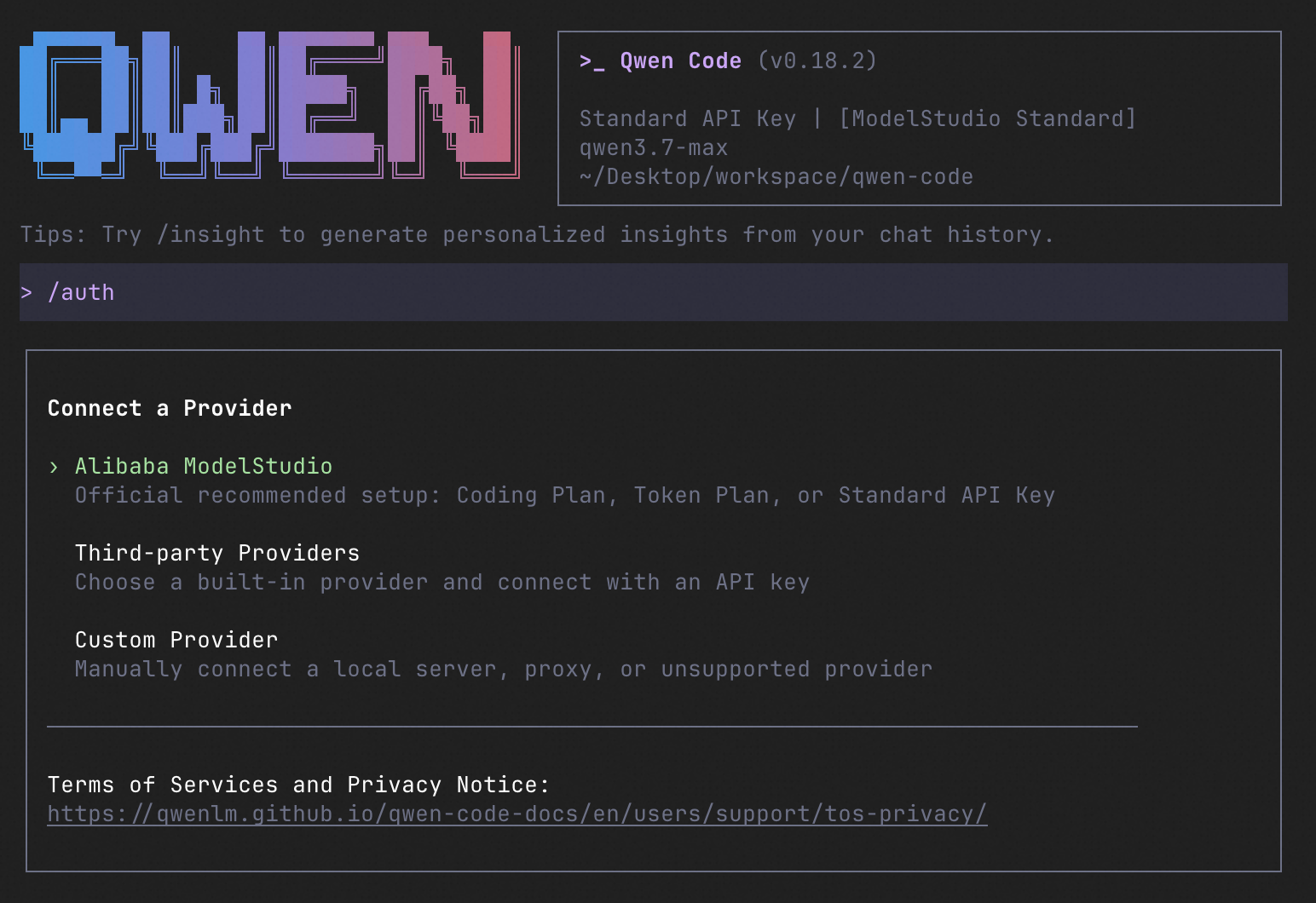
/auth         # Configure your provider and API key
See the Authentication Guide and Settings Reference for detailed setup.
How to Use Qwen Code
| Mode | Command | Use Case |
|---|---|---|
| Interactive | qwen |
Terminal UI with rich rendering, @file references, slash commands |
| Headless | qwen -p "..." |
Scripts, CI/CD, batch processing — no UI |
| IDE | — | VS Code, Zed, JetBrains |
| Desktop | — | Qwen Code Desktop — GUI for macOS, Windows, Linux |
| Daemon | qwen serve |
Shared agent session over HTTP+SSE (ACP). Multiple clients, one agent. (experimental) Docs |
| SDK | — | TypeScript, Python, Java |
| IM Bot | qwen channel |
Connect to Telegram, DingTalk, WeChat, or Feishu |
SDK example (Python)
import asyncio

from qwen_code_sdk import is_sdk_result_message, query


async def main() -> None:
    result = query(
        "Summarize the repository layout.",
        {
            "cwd": "/path/to/project",
            "path_to_qwen_executable": "qwen",
        },
    )

    async for message in result:
        if is_sdk_result_message(message):
            print(message["result"])


asyncio.run(main())
Capabilities
If you know Claude Code, you already know Qwen Code — and then some. We've put significant effort into bringing Qwen Code to feature parity with Claude Code, improving both breadth and reliability across the board.
| Feature | Qwen Code | Claude Code |
|---|---|---|
| SubAgents, Agent Teams, Dynamic Workflows | ✓ | ✓ |
| Auto-Memory, Auto-Skills, Hooks | ✓ | ✓ |
| Built-in Skills (/review, /batch, /loop, /bugfix…) | ✓ | ✓ |
| MCP, Plan Mode, LSP Integration | ✓ | ✓ |
| Auto Mode, Sandbox, Git Worktrees | ✓ | ✓ |
| Computer Use (desktop automation) | ✓ | ✓ |
| IDE Plugins (VS Code / JetBrains / Zed) | ✓ | ✓ |
| SDK | ✓ | ✓ |
| Headless Mode, Session Management | ✓ | ✓ |
| Open-source — model and framework | ✓ | — |
| Multi-protocol (OpenAI / Anthropic / Gemini / Qwen + any provider) | ✓ | — |
| Agent Arena (multi-model head-to-head on same task) | ✓ | — |
Daemon Mode — qwen serve (multi-client shared agent) |
✓ | — |
| IM Channels (Telegram / DingTalk / WeChat / Feishu) | ✓ | — |
Ecosystem
-
Qwen Code Desktop — Official desktop app for macOS, Windows, and Linux
-
AionUi — A modern GUI for command-line AI tools including Qwen Code
-
Gemini CLI Desktop — A cross-platform desktop/web/mobile UI for Qwen Code
-
🦞 Qwen Code Claw — Let other agents (Claude, Codex, etc.) delegate coding tasks to Qwen Code via ACP. Paste this prompt into your agent:
Use Qwen Code as a coding agent. First, fetch and read this skill reference:
https://raw.githubusercontent.com/QwenLM/qwen-code/refs/heads/main/.qwen/skills/qwen-code-claw/SKILL.md
Then follow the instructions inside to install, authenticate, and use Qwen Code via acpx for all coding tasks.
- Aliyun Model Studio CLI — Official CLI for Aliyun's AI platform (
bailian-cli). Extends Qwen Code with image/video generation, knowledge retrieval, app orchestration, and model deployment
Contributing
Contributions are welcome! See CONTRIBUTING.md for guidelines.
Acknowledgments
This project was originally based on Google Gemini CLI v0.8.2. We gratefully acknowledge the Gemini CLI team's excellent work. Starting from Qwen Code v0.1, we stopped syncing with upstream and began independent development as a multi-protocol, multi-platform agent framework with deep integrations for Qwen models and beyond.