 6b0d2bbca0
* feat(triage): make /verify evidence screenshots actually possible
Measured across the 14 real verify reports on this repo: tables appear
in 14/14 (4 to 31 rows), images in 0/14. The hosting machinery has been
complete the whole time — pr-assets branch, PNG magic check, 8 images,
2 MB cap, sanitised names — and it has never once been fed.
Two independent causes, both fixed:
1. The agent physically could not produce a PNG. It runs as `node`
under `env -i` with HOME pointed at a per-run scratch dir, so
`playwright install --with-deps chromium` needs an apt it has no
rights to and would re-download ~170 MB into a directory deleted at
the end of every run. Chromium is now installed by ROOT in the tools
step into a shared, world-readable PLAYWRIGHT_BROWSERS_PATH, and the
agent env carries that path plus QWEN_VERIFY_CHROMIUM=1 — but ONLY
when the install actually succeeded, so the variable's absence is a
real signal rather than a stale promise. The install is best-effort:
a failure warns and the run continues to a text-only report, which
is what every run has produced anyway.
2. The skill discouraged it. Captures were "Optionally … use them when
text cannot carry the oracle", with TUI rendering as the only
example — so an agent verifying a daemon or a CLI correctly
concluded text carried the oracle and skipped. It now says produce
them whenever a harness ran, and says WHY: a table is the agent's
claim about what happened; a capture of the run is a witness that
the numbers came from a real execution, which is the part a reviewer
cannot get any other way. It names the three highest-value shots
(A/B cells side by side, the mutation matrix as printed, raw harness
output behind a headline number) and forbids `playwright install`
explicitly, so the failure mode of cause 1 cannot be rediscovered by
an agent burning budget on it.
Affordable now because #8014 raised the agent budget to 120m; at 20m a
browser download alone was most of the run.
Mutation-verified 4/4: handing the agent the variable unconditionally,
failing the job on a chromium install failure, reverting the skill to
"Optionally", and dropping the do-not-install warning each turn the
test red.
90/90 tests; prettier, eslint, actionlint and shellcheck clean.
* fix(triage): match browser to lockfile and fix pr-assets branch conflict (#8016)
Split the chromium install into system deps (tools step, as root) and
browser binary (new post-checkout step, as node using the checkout's
own Playwright). This eliminates the version pin that produced an
unusable browser tree.
Change evidence hosting from a bare pr-assets leaf branch — which
cannot coexist with the existing pr-assets/* namespace — to per-PR
branches (pr-assets/pr<N>-verify) with orphan-init fallback.
Update terminal-capture skill to warn CI agents away from the
forbidden playwright install command, and close test blind spots
for conditionality (M1b), version matching (M5), and marker
ordering (M6).
* fix(triage): unpin Playwright install-deps so apt list tracks lockfile browser (#8016)
* fix(triage): assert the browser path reaches the agent, not just the flag
Review finding on #8016, verified by mutation before accepting it:
deleting `"PLAYWRIGHT_BROWSERS_PATH=$CHROMIUM_PATH"` from the agent env
left the test green. That is the nastiest arm of this feature — the
agent is TOLD chromium is available via QWEN_VERIFY_CHROMIUM=1, then
Playwright looks in the default ~/.cache/ms-playwright instead of the
shared install and every capture fails, so a successful install still
degrades to a text-only report.
The test now asserts both variables and that BOTH sit behind the
success guard. Mutation-verified 2/2: deleting the path line fails on
the containment assertion, and hoisting it outside the guard fails on
the ordering one (`expected 21928 to be less than 21834`).
Not changed, because the other two findings do not describe this
codebase — replies on the threads carry the evidence.
90/90 tests; prettier and eslint clean.
* fix(triage): cover orphan-init delivery and delete verify asset branches
Two review findings on #8016, both about the per-PR branch scheme the
autofix bot introduced on this branch (
|
||
|---|---|---|
| .github | ||
| .husky | ||
| .qwen | ||
| .vscode | ||
| docs | ||
| docs-site | ||
| eslint-rules | ||
| integration-tests | ||
| integrations/external-context | ||
| packages | ||
| patches | ||
| scripts | ||
| .dockerignore | ||
| .editorconfig | ||
| .gitattributes | ||
| .gitignore | ||
| .npmrc | ||
| .nvmrc | ||
| .prettierignore | ||
| .prettierrc.json | ||
| .yamllint.yml | ||
| AGENTS.md | ||
| CHANGELOG.md | ||
| CLAUDE.md | ||
| CONTRIBUTING.md | ||
| Dockerfile | ||
| esbuild.config.js | ||
| eslint.config.js | ||
| eslint.legacy-filenames.mjs | ||
| LICENSE | ||
| Makefile | ||
| package-lock.json | ||
| package.json | ||
| README.md | ||
| SECURITY.md | ||
| tsconfig.json | ||
| vitest.config.ts | ||




The open-source AI coding agent that lives in your terminal.
中文 | Deutsch | français | 日本語 | Русский | Português (Brasil)
Why Qwen Code?
- Agentic out of the box — Auto-Memory, Auto-Skills, SubAgents, Agent Teams, and MCP. Dynamic workflows, zero setup.
- Open-source, inside and out — The framework and the Qwen models are open-source. They evolve together. No vendor lock-in.
- Multi-protocol — Supports OpenAI, Anthropic, Gemini, and Qwen APIs. Any third-party provider or local model (Ollama / vLLM). Switch at runtime.
- Beyond the terminal — IDE plugins, Desktop app, daemon mode, SDKs, and IM bots (Telegram / DingTalk / WeChat / Feishu).
Tip
Qwen Code is actively iterating on itself — using its own agent and models to file issues, submit PRs, review code, and run tests. Powered by the community, driven by AI.
Installation
Linux / macOS:
curl -fsSL https://qwen-code-assets.oss-cn-hangzhou.aliyuncs.com/installation/install-qwen-standalone.sh | bash
Windows:
irm https://qwen-code-assets.oss-cn-hangzhou.aliyuncs.com/installation/install-qwen-standalone.ps1 | iex
Restart your terminal after installation to ensure environment variables take effect.
NPM / Homebrew
NPM (requires Node.js 22+):
npm install -g @qwen-code/qwen-code@latest
Homebrew (macOS / Linux):
brew install qwen-code
Quick Start
qwen          # Launch interactive terminal UI
# Inside the session:
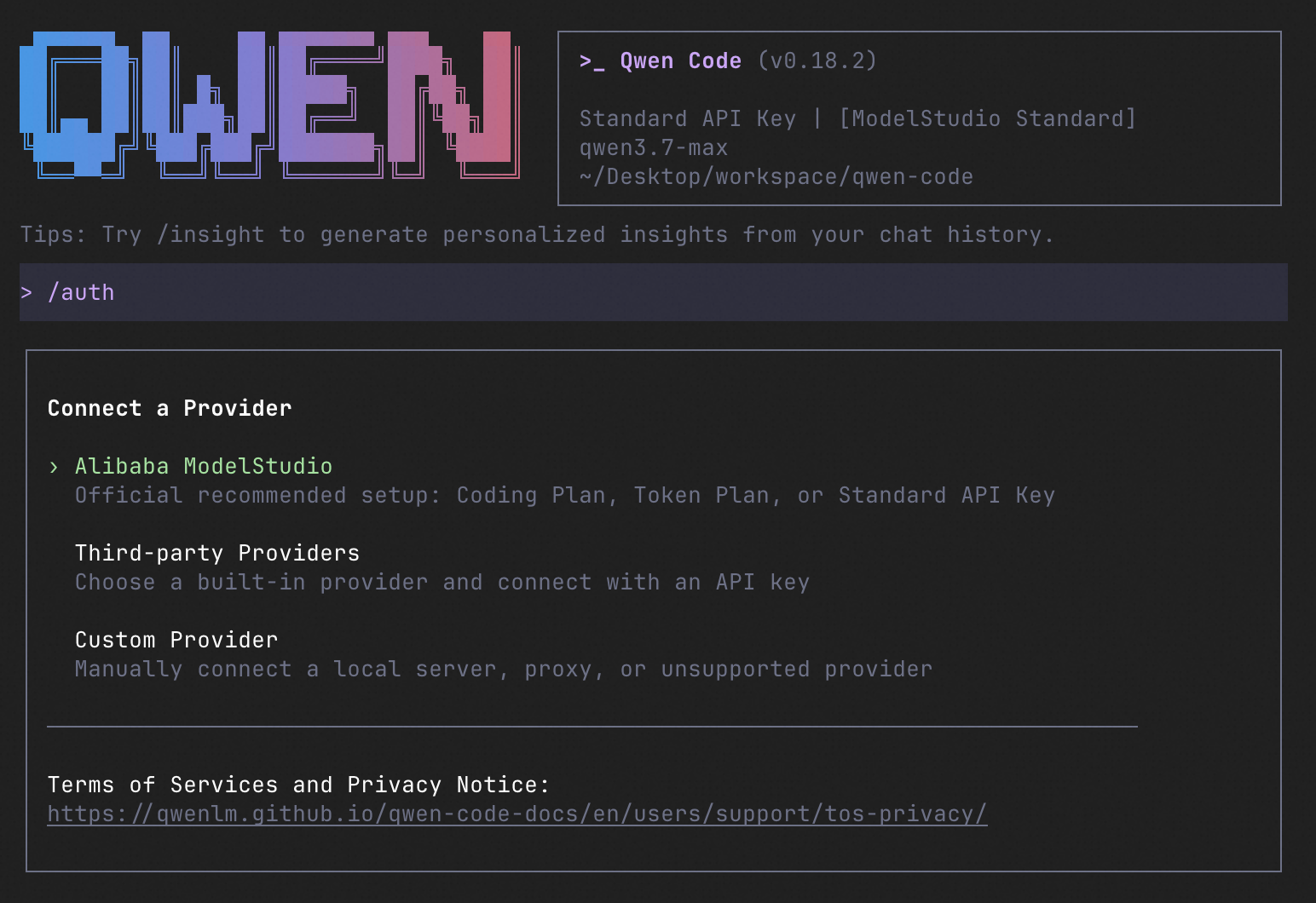
/auth         # Configure your provider and API key
See the Authentication Guide and Settings Reference for detailed setup.
How to Use Qwen Code
| Mode | Command | Use Case |
|---|---|---|
| Interactive | qwen |
Terminal UI with rich rendering, @file references, slash commands |
| Headless | qwen -p "..." |
Scripts, CI/CD, batch processing — no UI |
| IDE | — | VS Code, Zed, JetBrains |
| Desktop | — | Qwen Code Desktop — GUI for macOS, Windows, Linux |
| Daemon | qwen serve |
Shared agent session over HTTP+SSE (ACP). Multiple clients, one agent. (experimental) Docs |
| SDK | — | TypeScript, Python, Java |
| IM Bot | qwen channel |
Connect to Telegram, DingTalk, WeChat, or Feishu |
SDK example (Python)
import asyncio

from qwen_code_sdk import is_sdk_result_message, query


async def main() -> None:
    result = query(
        "Summarize the repository layout.",
        {
            "cwd": "/path/to/project",
            "path_to_qwen_executable": "qwen",
        },
    )

    async for message in result:
        if is_sdk_result_message(message):
            print(message["result"])


asyncio.run(main())
Capabilities
If you know Claude Code, you already know Qwen Code — and then some. We've put significant effort into bringing Qwen Code to feature parity with Claude Code, improving both breadth and reliability across the board.
| Feature | Qwen Code | Claude Code |
|---|---|---|
| SubAgents, Agent Teams, Dynamic Workflows | ✓ | ✓ |
| Auto-Memory, Auto-Skills, Hooks | ✓ | ✓ |
| Built-in Skills (/review, /batch, /loop, /bugfix…) | ✓ | ✓ |
| MCP, Plan Mode, LSP Integration | ✓ | ✓ |
| Auto Mode, Sandbox, Git Worktrees | ✓ | ✓ |
| Computer Use (desktop automation) | ✓ | ✓ |
| IDE Plugins (VS Code / JetBrains / Zed) | ✓ | ✓ |
| SDK | ✓ | ✓ |
| Headless Mode, Session Management | ✓ | ✓ |
| Open-source — model and framework | ✓ | — |
| Multi-protocol (OpenAI / Anthropic / Gemini / Qwen + any provider) | ✓ | — |
| Agent Arena (multi-model head-to-head on same task) | ✓ | — |
Daemon Mode — qwen serve (multi-client shared agent) |
✓ | — |
| IM Channels (Telegram / DingTalk / WeChat / Feishu) | ✓ | — |
Ecosystem
-
Qwen Code Desktop — Official desktop app for macOS, Windows, and Linux
-
AionUi — A modern GUI for command-line AI tools including Qwen Code
-
Gemini CLI Desktop — A cross-platform desktop/web/mobile UI for Qwen Code
-
🦞 Qwen Code Claw — Let other agents (Claude, Codex, etc.) delegate coding tasks to Qwen Code via ACP. Paste this prompt into your agent:
Use Qwen Code as a coding agent. First, fetch and read this skill reference:
https://raw.githubusercontent.com/QwenLM/qwen-code/refs/heads/main/.qwen/skills/qwen-code-claw/SKILL.md
Then follow the instructions inside to install, authenticate, and use Qwen Code via acpx for all coding tasks.
Contributing
Contributions are welcome! See CONTRIBUTING.md for guidelines.
Acknowledgments
This project was originally based on Google Gemini CLI v0.8.2. We gratefully acknowledge the Gemini CLI team's excellent work. Starting from Qwen Code v0.1, we stopped syncing with upstream and began independent development as a multi-protocol, multi-platform agent framework with deep integrations for Qwen models and beyond.