 65c0d36be3
* fix(session): bridge broken parentUuid chains instead of truncating history reconstructHistory walked parentUuid from the newest leaf and stopped at the first missing ancestor, silently dropping every earlier record. A session file with a broken chain (a partial write, or a lost middle segment) therefore lost all history before the break on resume — in both the terminal /resume and the web-shell/ACP replay, which both go through sessionService.loadSession. Add a shared hardened chain walk (buildOrderedUuidChain) that, on a missing parent, bridges onto the newest still-present earlier connected component (union-find; position-based). It treats /rewind gap children as a barrier and matches the tail's sidechain-ness, so it never resurrects abandoned rewind branches or crosses the main/subagent boundary. sessionService and background-agent-resume now share it. loadSession returns historyGaps metadata; the terminal /resume and ACP replay render a localized (i18n) visible divider so the recovered halves are not read as contiguous. The bridged child's parentUuid is rewritten (on the aggregated copy) to the bridged record so rebuildTurnBoundaries/rewind re-root correctly. Read-side only; write-side durability is a separate follow-up. 🤖 Generated with [Qwen Code](https://github.com/QwenLM/qwen-code) * qwen: fix CI failure on PR #6502 * fix(session): use non-recovered copy for history gaps with no bridged island When a missing-parent gap has no earlier island to bridge onto (bridgedToUuid is null), the divider is the first visible item — the previous copy still said "recovered earlier history is shown above" with nothing above it. Emit a distinct notice for the null-bridge case (both terminal /resume and ACP replay go through formatHistoryGapNotice). 🤖 Generated with [Qwen Code](https://github.com/QwenLM/qwen-code) * fix(i18n): add zh-TW translation for the non-recovered history-gap notice zh-TW is a strict-parity locale, so the new null-bridge notice key must be translated there too (pre-empts a CI strict-parity failure). 🤖 Generated with [Qwen Code](https://github.com/QwenLM/qwen-code) * fix(session): address history-gap review nits (accuracy, lazy maps, docs, tests) - conversation-chain: gap duration now uses the target island's last-occurrence timestamp; a uuid can span several streamed records, and the first occurrence overstated the gap. - conversation-chain: build posByUuid/lastByUuid lazily on the first gap (healthy sessions skip them); early-return for a caller-supplied leafUuid not backed by any record. - resumeHistoryUtils: reorder createHistoryGapItem so the convertToHistoryItems JSDoc documents its own function again. - HistoryReplayer: add tests covering the gap-notice replay path (notice emitted before the gap child; none when there are no gaps). 🤖 Generated with [Qwen Code](https://github.com/QwenLM/qwen-code) * fix(acp): thread historyGaps through the qwen/session/loadUpdates replay path collectHistoryReplayUpdates now accepts gaps from both callers; the loadUpdates ACP surface passed only records, so a bridged (recovered) history was rendered contiguous there with no gap divider. Adds a loadUpdates test asserting the gaps reach the replayer. 🤖 Generated with [Qwen Code](https://github.com/QwenLM/qwen-code) * fix(session): detect-and-mark broken history chains instead of stitching Read-side, a record whose parentUuid is physically missing is indistinguishable from a lost /rewind marker — where the "earlier" turns are ones the user deliberately discarded. Speculatively stitching the nearest earlier island back on (the previous approach) could therefore resurrect deleted content (wenshao's [Critical]). This mirrors claude-code, which never guesses: it only reconnects across a gap when durable metadata (snip removedUuids, compact re-root) proves it safe, and otherwise truncates. Replace the connected-component bridging with detect-only: on a missing parent the walk stops (as it always did) and records a HistoryGap, so the terminal /resume and ACP replay surfaces show a visible "earlier history was lost and could not be recovered" marker instead of silently truncating. No earlier records are reconstructed. Renames the option bridgeGaps -> detectGaps, drops the bridgedToUuid/approxLostMs fields and the now-unused "recovered above" i18n copy, and adds a regression test where the rewind marker is missing and the discarded branch must not be restored. True recovery (keeping the earlier island) requires durable write-side metadata and is left as a follow-up. * refactor(session): correct stale gap comments and dedup gap indexing The detect-only rewrite (13c613c9) left doc comments that still described the removed stitching path — claiming the earlier history was "bridged" or "stitched back on". Reword them to match the actual behavior: the break is detected and marked, the lost segment is not recovered. Also extract the duplicated gap-by-child map construction (identical in both HistoryReplayer.replay and resumeHistoryUtils.convertToHistoryItems) into a shared indexGapsByChild helper alongside formatHistoryGapNotice — the one still-applicable item from the review suggestion summary. Comments + one small refactor only; no behavior change. * fix(session): reset pending @-command state at a history-gap divider Belt-and-braces for the resume renderer: when convertToHistoryItems emits a history-gap divider it already flushes the pending tool group; also clear pendingAtCommands so an unconsumed pre-gap at_command can never be shift()- paired with the post-gap user turn (which would attach @file reads to a turn the user never wrote them on). In the current detect-only design reconstructHistory truncates to the tail island — the gap child is always the first replayed record, so the buffer is already empty at the divider and this cannot trigger. The reset keeps the invariant if that ever changes. Adds a regression test at the convertToHistoryItems boundary. * fix(session): don't detect history gaps on the background-agent resume path Addresses wenshao's review: this non-interactive transcript recovery has no surface to render a gap marker on (unlike interactive /resume via sessionService and the ACP replay via HistoryReplayer), so passing detectGaps: true only to emit a debugLogger.warn and then drop the gaps was an inconsistent half-measure ("half-detection is worse than no detection"). Turn detection off here — the walk truncates at a broken parent link either way, matching this path's historical behavior. Gap surfacing stays exactly on the two paths that have a UI for it. --------- Co-authored-by: qwen-code-dev-bot <qwen-code-dev-bot@users.noreply.github.com> |
||
|---|---|---|
| .github | ||
| .husky | ||
| .qwen | ||
| .vscode | ||
| docs | ||
| docs-site | ||
| eslint-rules | ||
| integration-tests | ||
| packages | ||
| patches | ||
| scripts | ||
| .dockerignore | ||
| .editorconfig | ||
| .gitattributes | ||
| .gitignore | ||
| .npmrc | ||
| .nvmrc | ||
| .prettierignore | ||
| .prettierrc.json | ||
| .yamllint.yml | ||
| AGENTS.md | ||
| CHANGELOG.md | ||
| CLAUDE.md | ||
| CONTRIBUTING.md | ||
| Dockerfile | ||
| esbuild.config.js | ||
| eslint.config.js | ||
| eslint.legacy-filenames.mjs | ||
| LICENSE | ||
| Makefile | ||
| package-lock.json | ||
| package.json | ||
| README.md | ||
| SECURITY.md | ||
| tsconfig.json | ||
| vitest.config.ts | ||




The open-source AI coding agent that lives in your terminal.
中文 | Deutsch | français | 日本語 | Русский | Português (Brasil)
Why Qwen Code?
- Agentic out of the box — Auto-Memory, Auto-Skills, SubAgents, Agent Teams, and MCP. Dynamic workflows, zero setup.
- Open-source, inside and out — The framework and the Qwen models are open-source. They evolve together. No vendor lock-in.
- Multi-protocol — Supports OpenAI, Anthropic, Gemini, and Qwen APIs. Any third-party provider or local model (Ollama / vLLM). Switch at runtime.
- Beyond the terminal — IDE plugins, Desktop app, daemon mode, SDKs, and IM bots (Telegram / DingTalk / WeChat / Feishu).
Tip
Qwen Code is actively iterating on itself — using its own agent and models to file issues, submit PRs, review code, and run tests. Powered by the community, driven by AI.
Installation
Linux / macOS:
curl -fsSL https://qwen-code-assets.oss-cn-hangzhou.aliyuncs.com/installation/install-qwen-standalone.sh | bash
Windows:
irm https://qwen-code-assets.oss-cn-hangzhou.aliyuncs.com/installation/install-qwen-standalone.ps1 | iex
Restart your terminal after installation to ensure environment variables take effect.
NPM / Homebrew
NPM (requires Node.js 22+):
npm install -g @qwen-code/qwen-code@latest
Homebrew (macOS / Linux):
brew install qwen-code
Quick Start
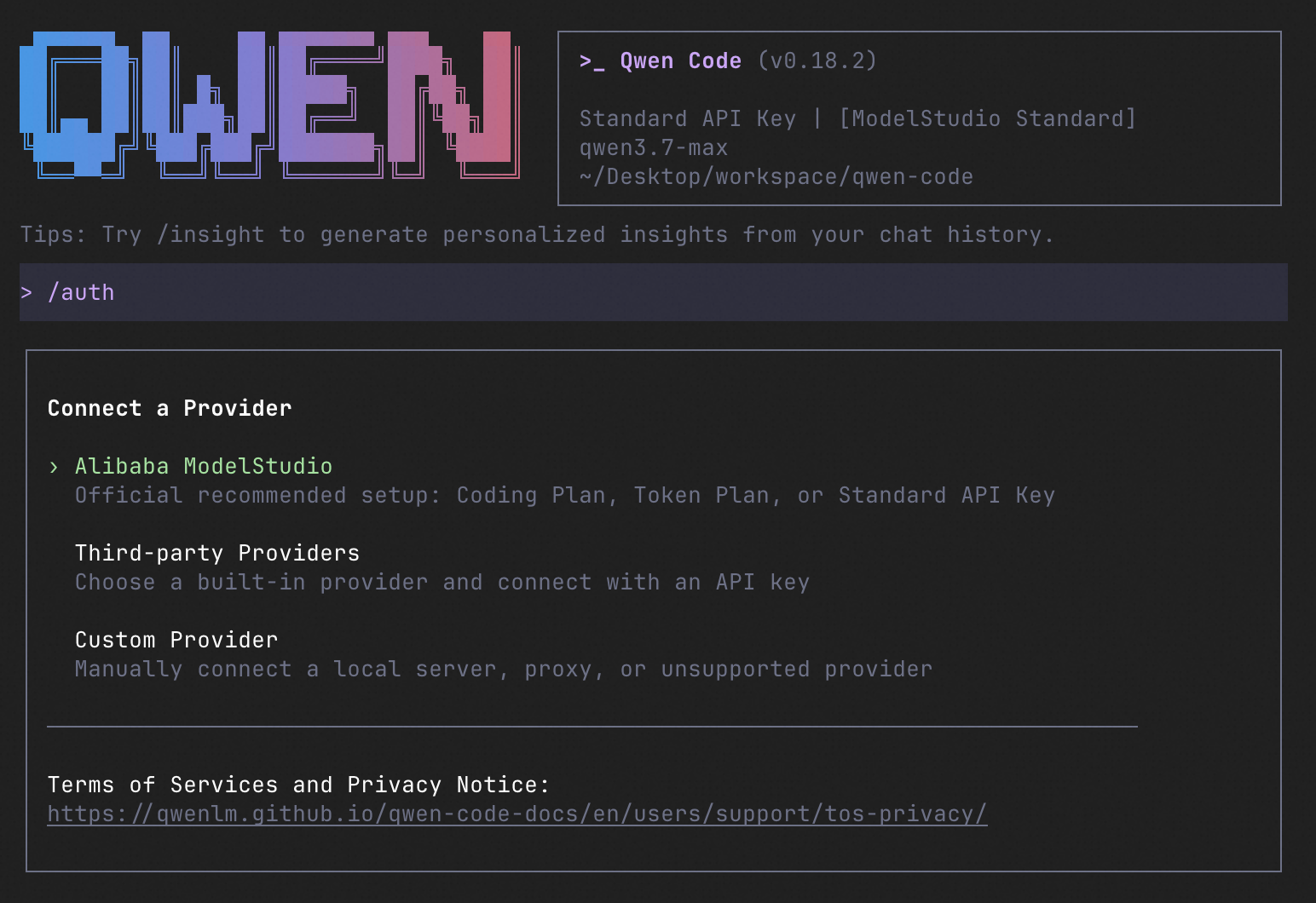
qwen          # Launch interactive terminal UI
# Inside the session:
/auth         # Configure your provider and API key
See the Authentication Guide and Settings Reference for detailed setup.
How to Use Qwen Code
| Mode | Command | Use Case |
|---|---|---|
| Interactive | qwen |
Terminal UI with rich rendering, @file references, slash commands |
| Headless | qwen -p "..." |
Scripts, CI/CD, batch processing — no UI |
| IDE | — | VS Code, Zed, JetBrains |
| Desktop | — | Qwen Code Desktop — GUI for macOS, Windows, Linux |
| Daemon | qwen serve |
Shared agent session over HTTP+SSE (ACP). Multiple clients, one agent. (experimental) Docs |
| SDK | — | TypeScript, Python, Java |
| IM Bot | qwen channel |
Connect to Telegram, DingTalk, WeChat, or Feishu |
SDK example (Python)
import asyncio

from qwen_code_sdk import is_sdk_result_message, query


async def main() -> None:
    result = query(
        "Summarize the repository layout.",
        {
            "cwd": "/path/to/project",
            "path_to_qwen_executable": "qwen",
        },
    )

    async for message in result:
        if is_sdk_result_message(message):
            print(message["result"])


asyncio.run(main())
Capabilities
If you know Claude Code, you already know Qwen Code — and then some. We've put significant effort into bringing Qwen Code to feature parity with Claude Code, improving both breadth and reliability across the board.
| Feature | Qwen Code | Claude Code |
|---|---|---|
| SubAgents, Agent Teams, Dynamic Workflows | ✓ | ✓ |
| Auto-Memory, Auto-Skills, Hooks | ✓ | ✓ |
| Built-in Skills (/review, /batch, /loop, /bugfix…) | ✓ | ✓ |
| MCP, Plan Mode, LSP Integration | ✓ | ✓ |
| Auto Mode, Sandbox, Git Worktrees | ✓ | ✓ |
| Computer Use (desktop automation) | ✓ | ✓ |
| IDE Plugins (VS Code / JetBrains / Zed) | ✓ | ✓ |
| SDK | ✓ | ✓ |
| Headless Mode, Session Management | ✓ | ✓ |
| Open-source — model and framework | ✓ | — |
| Multi-protocol (OpenAI / Anthropic / Gemini / Qwen + any provider) | ✓ | — |
| Agent Arena (multi-model head-to-head on same task) | ✓ | — |
Daemon Mode — qwen serve (multi-client shared agent) |
✓ | — |
| IM Channels (Telegram / DingTalk / WeChat / Feishu) | ✓ | — |
Ecosystem
-
Qwen Code Desktop — Official desktop app for macOS, Windows, and Linux
-
AionUi — A modern GUI for command-line AI tools including Qwen Code
-
Gemini CLI Desktop — A cross-platform desktop/web/mobile UI for Qwen Code
-
🦞 Qwen Code Claw — Let other agents (Claude, Codex, etc.) delegate coding tasks to Qwen Code via ACP. Paste this prompt into your agent:
Use Qwen Code as a coding agent. First, fetch and read this skill reference:
https://raw.githubusercontent.com/QwenLM/qwen-code/refs/heads/main/.qwen/skills/qwen-code-claw/SKILL.md
Then follow the instructions inside to install, authenticate, and use Qwen Code via acpx for all coding tasks.
Contributing
Contributions are welcome! See CONTRIBUTING.md for guidelines.
Acknowledgments
This project was originally based on Google Gemini CLI v0.8.2. We gratefully acknowledge the Gemini CLI team's excellent work. Starting from Qwen Code v0.1, we stopped syncing with upstream and began independent development as a multi-protocol, multi-platform agent framework with deep integrations for Qwen models and beyond.