 6556adcdba
Some checks are pending
Qwen Code CI / Lint (push) Waiting to run
Qwen Code CI / Test (macos-latest, Node 22.x) (push) Waiting to run
Qwen Code CI / Test (ubuntu-latest, Node 22.x) (push) Waiting to run
Qwen Code CI / Test (windows-latest, Node 22.x) (push) Waiting to run
Qwen Code CI / Post Coverage Comment (push) Blocked by required conditions
Qwen Code CI / CodeQL (push) Waiting to run
E2E Tests / E2E Test (Linux) - sandbox:docker (push) Waiting to run
E2E Tests / E2E Test (Linux) - sandbox:none (push) Waiting to run
E2E Tests / E2E Test - macOS (push) Waiting to run
* feat(core): add git diff statistics utility
Port numstat + unified-diff parsing into `packages/core/src/utils/gitDiff.ts`
to surface structured working-tree change summaries (files changed, lines
added/removed, per-file hunks) against HEAD. Caps mirror issue #2997:
50 files, 1MB per file, 400 lines per file, with a 500-file short-circuit
via `git diff --shortstat` to avoid expensive work on massive diffs.
- `fetchGitDiff(cwd)` returns stats + per-file summaries (tracked + untracked).
- `fetchGitDiffHunks(cwd)` returns structured hunks on demand.
- `resolveGitDir(cwd)` follows `.git` file indirection so linked worktrees
and submodules report the correct gitdir.
- Transient-state short-circuit covers merge, cherry-pick, revert, and both
`rebase-merge` / `rebase-apply` layouts.
- `core.quotepath=false` is forced so non-ASCII filenames stay as UTF-8.
Refs #2997
* feat(cli): add /diff slash command
Surface the `fetchGitDiff` utility through an interactive `/diff` command.
Prints a header (`N files changed, +A / -R`) followed by per-file rows with
padded add/remove counts. Untracked files are marked `?`, binary files are
marked `~`. When the change set exceeds the per-file cap, a trailing
`…and N more` note tells the user how many entries are hidden.
Returns a `MessageActionReturn` so it renders the same way in interactive
and non-interactive modes.
* fix(cli): harden /diff command after adversarial audit
- Wrap `fetchGitDiff` in try/catch so permission errors on `.git` surface
as a friendly error message instead of crashing the action.
- Declare `supportedModes: ['interactive', 'non_interactive', 'acp']` so
the command is reachable outside the interactive Ink UI — the default
for `commandType: 'local'` is interactive-only.
- Align `?` (untracked) and `~` (binary) markers with the `+X -Y` stat
column via a padded prefix, so filenames line up regardless of row kind.
- Drop the "…and N more" hint when no rows are shown (shortstat fast-path
with >500 files) — the count alone is sufficient and "showing first 0"
is noise.
- Switch header to full-phrase i18n templates (separate singular/plural
variants) instead of word-by-word `t()` calls that don't survive
non-English locales.
- Extend tests to 12 scenarios: empty cwd, fetch rejection, singular
"file" form, mixed untracked/binary/tracked alignment, 4-digit padding,
shortstat fast-path, and supportedModes declaration. Mocks carry a
`satisfies GitDiffResult` annotation so shape drift in core breaks the
test at compile time.
* fix(cli): clean up /diff feature review issues
- Remove invalid `commandType` field from diffCommand (SlashCommand has
no such property; caused a TS build failure).
- Drop duplicate `NumstatResult` interface in gitDiff.ts — it is
structurally identical to `GitDiffResult`.
- Register the 9 missing `/diff` i18n strings in en.js / zh.js so the
command is translatable (previously only `Configuration not available.`
had entries).
* fix(core): harden git diff stats after multi-round review
- fetchUntrackedPaths now uses `ls-files -z` so filenames containing
newlines, tabs, or non-ASCII bytes round-trip cleanly instead of
being C-style quoted and split into phantom entries.
- fetchGitDiff runs the `--shortstat` probe and the untracked-paths
lookup in parallel, since both are needed regardless of which path
the function takes.
- parseGitDiff measures per-file diff size via Buffer.byteLength so
MAX_DIFF_SIZE_BYTES matches its documented meaning on non-ASCII diffs.
- Adds a regression test for an untracked file whose name contains a
literal newline.
* fix(core): address /diff PR review comments
Addresses the five open review threads on #3491:
- parseShortstat: anchored and bounded the regex (`^...$` with `\d{1,10}`)
so adversarial inputs can no longer drive polynomial backtracking. Closes
CodeQL alert #137.
- fetchGitDiff: only parse the untracked-path list when we actually need
it; the fast path now counts NUL bytes in the raw `ls-files -z` stdout
(wenshao P1).
- fetchGitDiff: base the `MAX_FILES_FOR_DETAILS` short-circuit on
`tracked + untracked`, so repos with few edits but many untracked files
still take the summary-only path (wenshao P2).
- fetchGitDiff: count newlines in each untracked text file (binary sniff +
1 MB read cap) and fold that into both the header `+N` and the per-file
row, so a brand-new file no longer renders as `+0 / -0` (BZ-D P2).
- parseGitNumstat: switch to `git diff --numstat -z`. The parser now uses
index-based slicing and a rename-pair state machine, so tracked
filenames containing tabs/newlines/non-ASCII keep their real bytes
(BZ-D P3). Renames collapse into a single `old => new` entry.
UI: untracked rows render as `+N filename (new)` (or
`~ filename (binary, new)`) instead of the placeholder `?` marker;
`/diff` now shows real additions for fresh files.
* fix(core): surface truncated untracked counts and decouple totals from display
Two issues surfaced during a directionless multi-round audit of the /diff
feature:
1. `countUntrackedLines` reads at most `UNTRACKED_READ_CAP_BYTES` (1 MB)
per file, so a 10 MB new log was silently reported as `+~20k` when the
real count is ~10×. The helper now `fstat`s the file and returns a
`truncated: true` flag when size exceeds the read window; `/diff`
surfaces it as `(new, partial)` so the `+N` isn't read as exact.
2. Line-count aggregation was coupled to the per-file display cap: when
tracked changes filled the `MAX_FILES` slot, untracked line counts
beyond the remaining slots were dropped from `stats.linesAdded`
entirely (header under-reported additions). Decoupled: we now read up
to `MAX_FILES` untracked files for their line counts regardless of
display slots, and only restrict the visible rows to `remainingSlots`.
Added regression tests for both: a 1.5 MB new file asserts `truncated:
true` and a lower-bound line count, and a `MAX_FILES`-saturated tracked
set + 5 untracked files asserts that untracked additions still appear in
the header totals even though none of them get displayed.
* fix(core): parse filenames from +++/--- lines to handle paths with ' b/'
`diff --git a/X b/Y` is ambiguous when X contains ` b/` — a file literally
named `a b/c.txt` produces `diff --git a/a b/c.txt b/a b/c.txt` with no
escape or quoting, and the previous regex `^a\/(.+?) b\/(.+)$` keyed the
hunks under the wrong path. Consumers of the exported `fetchGitDiffHunks`
API would then fail to correlate hunks with stats or editor paths.
Introduces `extractFilePath(lines)` which walks the block for the
unambiguous markers (`rename to` / `copy to` / `+++ b/<path>` with a
`/dev/null` fallback to `--- a/<path>`) and strips the trailing TAB git
appends to paths containing whitespace. Adds unit tests for the
`a b/c.txt`, rename, delete, and new-file cases plus an end-to-end test
that creates a real `a b/c.txt` file and asserts `fetchGitDiffHunks`
keys the hunks correctly.
Addresses wenshao review comment #3136657141 on #3491.
* feat(cli): colorize /diff output via a themed Ink component
The /diff stats used to come back as a plain-text MessageActionReturn.
Pipes and ACP still get that, but in interactive terminals we now dispatch
a structured history item so the numbers can carry theme colors.
- packages/cli/src/ui/types.ts — new DiffRenderRow / DiffRenderModel /
HistoryItemDiffStats, MessageType.DIFF_STATS.
- packages/cli/src/ui/components/messages/DiffStatsDisplay.tsx — renders
+N in theme.status.success (green), -M in theme.status.error (red), and
the (new) / (binary) / (new, partial) markers in theme.text.secondary
(dim). Column alignment matches the plain-text fallback.
- packages/cli/src/ui/components/HistoryItemDisplay.tsx — routes the new
item type.
- packages/cli/src/ui/commands/diffCommand.ts — builds a DiffRenderModel
once and fans out: interactive calls context.ui.addItem; other modes
fall through to renderDiffModelText() for the plain-text path. Error
and "clean tree" branches keep the existing info/error
MessageActionReturn in every mode.
- Tests: existing diffCommand suite moved to an explicit non_interactive
context (it was asserting text content); new interactive suite covers
addItem dispatch and model shape; DiffStatsDisplay component tests
cover the four row variants and the "…and N more" note.
* refactor(cli): factor /diff column widths into a shared helper
Audit of the colorize commit found one real DRY hazard: DiffStatsDisplay
and renderDiffModelText each independently re-derived addWidth /
remWidth / statColumnWidth from the same row list. If anyone later
changed one formula, the interactive Ink output and the non-interactive
plain text would silently fall out of column alignment.
Extract the computation into computeDiffColumnWidths() exported from
diffCommand.ts; both renderers now call it. Adds a focused unit test of
the contract (empty rows, widest non-binary row wins, binary rows are
ignored, untracked text rows count). Drop a redundant
`Omit<HistoryItemDiffStats, 'id'>` annotation since the type already has
no id field.
* fix(core): pin /diff git ops to repo root and lstat untracked entries
Two Critical findings on PR #3491:
1. (line 63) When /diff is invoked from a subdirectory of the worktree,
`git diff` emits repo-root-relative paths but `git ls-files --others`
is scoped to cwd and emits cwd-relative paths. Result: mixed path
bases in `perFileStats` and silent omission of untracked files in
sibling directories. Resolve `findGitRoot(cwd)` once and run every
git invocation (and `path.join(...)` for line counting) from there,
so all keys are repo-root-relative and the listing is repo-wide.
2. (line 455) `countUntrackedLines` opened every untracked path with
`open(absPath, 'r')`. Git's `ls-files --others` can list FIFOs
(whose `open()` blocks indefinitely waiting on a writer) and
symlinks (which `open()` dereferences, potentially reading outside
the worktree). Add an `lstat` gate: only regular files are counted;
symlinks and other special files render as binary `~` rows.
Two new integration tests cover both regressions: one creates a
sibling untracked file at the repo root and invokes fetchGitDiff from
a subdir asserting all three changes (root + sub) come back keyed by
repo-root-relative paths; the other creates a symlink pointing at
content outside the worktree and asserts it lands as a binary row
with no contribution to linesAdded.
* chore: revert stray .npmrc/README.md test edits swept into
|
||
|---|---|---|
| .github | ||
| .husky | ||
| .qwen | ||
| .vscode | ||
| docs | ||
| docs-site | ||
| eslint-rules | ||
| integration-tests | ||
| packages | ||
| scripts | ||
| .dockerignore | ||
| .editorconfig | ||
| .gitattributes | ||
| .gitignore | ||
| .npmrc | ||
| .nvmrc | ||
| .prettierignore | ||
| .prettierrc.json | ||
| .yamllint.yml | ||
| AGENTS.md | ||
| CONTRIBUTING.md | ||
| Dockerfile | ||
| esbuild.config.js | ||
| eslint.config.js | ||
| LICENSE | ||
| Makefile | ||
| package-lock.json | ||
| package.json | ||
| README.md | ||
| SECURITY.md | ||
| tsconfig.json | ||
| vitest.config.ts | ||




An open-source AI agent that lives in your terminal.
中文 | Deutsch | français | 日本語 | Русский | Português (Brasil)
🎉 News
-
2026-04-15: Qwen OAuth free tier has been discontinued. To continue using Qwen Code, switch to Alibaba Cloud Coding Plan, OpenRouter, Fireworks AI, or bring your own API key. Run
qwen authto configure. -
2026-04-13: Qwen OAuth free tier policy update: daily quota adjusted to 100 requests/day (from 1,000).
-
2026-04-02: Qwen3.6-Plus is now live! Get an API key from Alibaba Cloud ModelStudio to access it through the OpenAI-compatible API.
-
2026-02-16: Qwen3.5-Plus is now live!
Why Qwen Code?
Qwen Code is an open-source AI agent for the terminal, optimized for Qwen series models. It helps you understand large codebases, automate tedious work, and ship faster.
- Multi-protocol, flexible providers: use OpenAI / Anthropic / Gemini-compatible APIs, Alibaba Cloud Coding Plan, OpenRouter, Fireworks AI, or bring your own API key.
- Open-source, co-evolving: both the framework and the Qwen3-Coder model are open-source—and they ship and evolve together.
- Agentic workflow, feature-rich: rich built-in tools (Skills, SubAgents) for a full agentic workflow and a Claude Code-like experience.
- Terminal-first, IDE-friendly: built for developers who live in the command line, with optional integration for VS Code, Zed, and JetBrains IDEs.
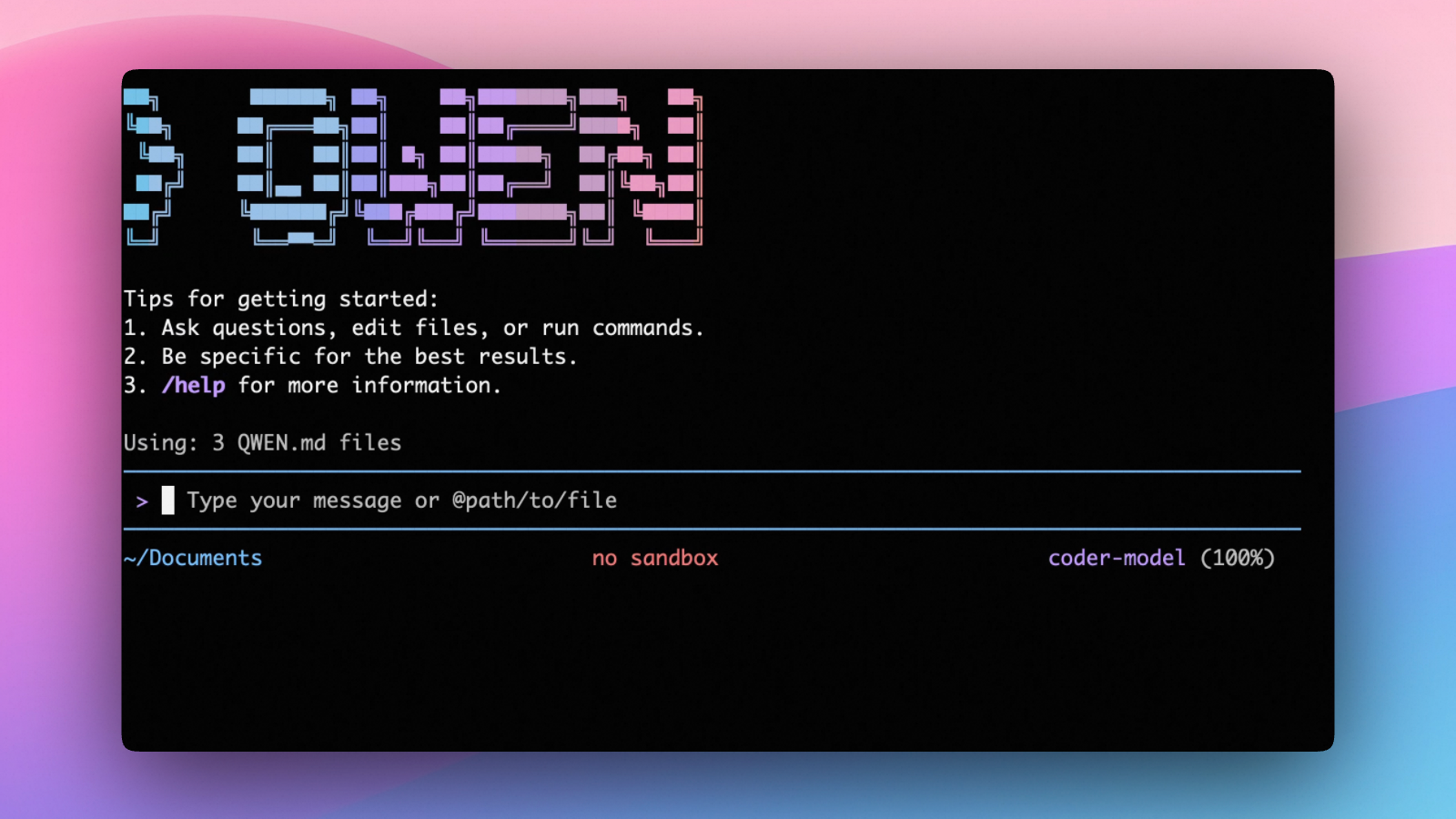
Installation
Quick Install (Recommended)
Linux / macOS
bash -c "$(curl -fsSL https://qwen-code-assets.oss-cn-hangzhou.aliyuncs.com/installation/install-qwen.sh)"
Windows (Run as Administrator)
Works in both Command Prompt and PowerShell:
powershell -Command "Invoke-WebRequest 'https://qwen-code-assets.oss-cn-hangzhou.aliyuncs.com/installation/install-qwen.bat' -OutFile (Join-Path $env:TEMP 'install-qwen.bat'); & (Join-Path $env:TEMP 'install-qwen.bat')"
Note
: It's recommended to restart your terminal after installation to ensure environment variables take effect.
Manual Installation
Prerequisites
Make sure you have Node.js 20 or later installed. Download it from nodejs.org.
NPM
npm install -g @qwen-code/qwen-code@latest
Homebrew (macOS, Linux)
brew install qwen-code
Quick Start
# Start Qwen Code (interactive)
qwen

# Then, in the session:
/help
/auth
On first use, you'll be prompted to sign in. You can run /auth anytime to switch authentication methods.
Example prompts:
What does this project do?
Explain the codebase structure.
Help me refactor this function.
Generate unit tests for this module.
Click to watch a demo video
🦞 Use Qwen Code for Coding Tasks in Claw
Copy the prompt below and paste it into your agent:
Use Qwen Code as a coding agent. First, fetch and read this skill reference:
https://raw.githubusercontent.com/QwenLM/qwen-code/refs/heads/main/.qwen/skills/qwen-code-claw/SKILL.md
Then follow the instructions inside to install, authenticate, and use Qwen Code via acpx for all coding tasks.
Authentication
Qwen Code supports the following authentication methods:
- API Key (recommended): use an API key from Alibaba Cloud Model Studio (Beijing / intl) or any supported provider (OpenAI, Anthropic, Google GenAI, and other compatible endpoints).
- Coding Plan: subscribe to the Alibaba Cloud Coding Plan (Beijing / intl) for a fixed monthly fee with higher quotas.
⚠️ Qwen OAuth was discontinued on April 15, 2026. If you were previously using Qwen OAuth, please switch to one of the methods above. Run
qwenand then/authto reconfigure.
API Key (recommended)
Use an API key to connect to Alibaba Cloud Model Studio or any supported provider. Supports multiple protocols:
- OpenAI-compatible: Alibaba Cloud ModelStudio, ModelScope, OpenAI, OpenRouter, and other OpenAI-compatible providers
- Anthropic: Claude models
- Google GenAI: Gemini models
The recommended way to configure models and providers is by editing ~/.qwen/settings.json (create it if it doesn't exist). This file lets you define all available models, API keys, and default settings in one place.
Quick Setup in 3 Steps
Step 1: Create or edit ~/.qwen/settings.json
Here is a complete example:
{
  "modelProviders": {
    "openai": [
      {
        "id": "qwen3.6-plus",
        "name": "qwen3.6-plus",
        "baseUrl": "https://dashscope.aliyuncs.com/compatible-mode/v1",
        "description": "Qwen3-Coder via Dashscope",
        "envKey": "DASHSCOPE_API_KEY"
      }
    ]
  },
  "env": {
    "DASHSCOPE_API_KEY": "sk-xxxxxxxxxxxxx"
  },
  "security": {
    "auth": {
      "selectedType": "openai"
    }
  },
  "model": {
    "name": "qwen3.6-plus"
  }
}
Step 2: Understand each field
| Field | What it does |
|---|---|
modelProviders |
Declares which models are available and how to connect to them. Keys like openai, anthropic, gemini represent the API protocol. |
modelProviders[].id |
The model ID sent to the API (e.g. qwen3.6-plus, gpt-4o). |
modelProviders[].envKey |
The name of the environment variable that holds your API key. |
modelProviders[].baseUrl |
The API endpoint URL (required for non-default endpoints). |
env |
A fallback place to store API keys (lowest priority; prefer .env files or export for sensitive keys). |
security.auth.selectedType |
The protocol to use on startup (openai, anthropic, gemini, vertex-ai). |
model.name |
The default model to use when Qwen Code starts. |
Step 3: Start Qwen Code — your configuration takes effect automatically:
qwen
Use the /model command at any time to switch between all configured models.
More Examples
Coding Plan (Alibaba Cloud ModelStudio) — fixed monthly fee, higher quotas
{
  "modelProviders": {
    "openai": [
      {
        "id": "qwen3.6-plus",
        "name": "qwen3.6-plus (Coding Plan)",
        "baseUrl": "https://coding.dashscope.aliyuncs.com/v1",
        "description": "qwen3.6-plus from ModelStudio Coding Plan",
        "envKey": "BAILIAN_CODING_PLAN_API_KEY"
      },
      {
        "id": "qwen3.5-plus",
        "name": "qwen3.5-plus (Coding Plan)",
        "baseUrl": "https://coding.dashscope.aliyuncs.com/v1",
        "description": "qwen3.5-plus with thinking enabled from ModelStudio Coding Plan",
        "envKey": "BAILIAN_CODING_PLAN_API_KEY",
        "generationConfig": {
          "extra_body": {
            "enable_thinking": true
          }
        }
      },
      {
        "id": "glm-4.7",
        "name": "glm-4.7 (Coding Plan)",
        "baseUrl": "https://coding.dashscope.aliyuncs.com/v1",
        "description": "glm-4.7 with thinking enabled from ModelStudio Coding Plan",
        "envKey": "BAILIAN_CODING_PLAN_API_KEY",
        "generationConfig": {
          "extra_body": {
            "enable_thinking": true
          }
        }
      },
      {
        "id": "kimi-k2.5",
        "name": "kimi-k2.5 (Coding Plan)",
        "baseUrl": "https://coding.dashscope.aliyuncs.com/v1",
        "description": "kimi-k2.5 with thinking enabled from ModelStudio Coding Plan",
        "envKey": "BAILIAN_CODING_PLAN_API_KEY",
        "generationConfig": {
          "extra_body": {
            "enable_thinking": true
          }
        }
      }
    ]
  },
  "env": {
    "BAILIAN_CODING_PLAN_API_KEY": "sk-xxxxxxxxxxxxx"
  },
  "security": {
    "auth": {
      "selectedType": "openai"
    }
  },
  "model": {
    "name": "qwen3.6-plus"
  }
}
Subscribe to the Coding Plan and get your API key at Alibaba Cloud ModelStudio(Beijing) or Alibaba Cloud ModelStudio(intl).
Multiple providers (OpenAI + Anthropic + Gemini)
{
  "modelProviders": {
    "openai": [
      {
        "id": "gpt-4o",
        "name": "GPT-4o",
        "envKey": "OPENAI_API_KEY",
        "baseUrl": "https://api.openai.com/v1"
      }
    ],
    "anthropic": [
      {
        "id": "claude-sonnet-4-20250514",
        "name": "Claude Sonnet 4",
        "envKey": "ANTHROPIC_API_KEY"
      }
    ],
    "gemini": [
      {
        "id": "gemini-2.5-pro",
        "name": "Gemini 2.5 Pro",
        "envKey": "GEMINI_API_KEY"
      }
    ]
  },
  "env": {
    "OPENAI_API_KEY": "sk-xxxxxxxxxxxxx",
    "ANTHROPIC_API_KEY": "sk-ant-xxxxxxxxxxxxx",
    "GEMINI_API_KEY": "AIzaxxxxxxxxxxxxx"
  },
  "security": {
    "auth": {
      "selectedType": "openai"
    }
  },
  "model": {
    "name": "gpt-4o"
  }
}
Enable thinking mode (for supported models like qwen3.5-plus)
{
  "modelProviders": {
    "openai": [
      {
        "id": "qwen3.5-plus",
        "name": "qwen3.5-plus (thinking)",
        "envKey": "DASHSCOPE_API_KEY",
        "baseUrl": "https://dashscope.aliyuncs.com/compatible-mode/v1",
        "generationConfig": {
          "extra_body": {
            "enable_thinking": true
          }
        }
      }
    ]
  },
  "env": {
    "DASHSCOPE_API_KEY": "sk-xxxxxxxxxxxxx"
  },
  "security": {
    "auth": {
      "selectedType": "openai"
    }
  },
  "model": {
    "name": "qwen3.5-plus"
  }
}
Tip: You can also set API keys via
exportin your shell or.envfiles, which take higher priority thansettings.json→env. See the authentication guide for full details.
Security note: Never commit API keys to version control. The
~/.qwen/settings.jsonfile is in your home directory and should stay private.
Local Model Setup (Ollama / vLLM)
You can also run models locally — no API key or cloud account needed. This is not an authentication method; instead, configure your local model endpoint in ~/.qwen/settings.json using the modelProviders field.
Set generationConfig.contextWindowSize inside the matching provider entry
and adjust it to the context length configured on your local server.
Ollama setup
- Install Ollama from ollama.com
- Pull a model:
ollama pull qwen3:32b - Configure
~/.qwen/settings.json:
{
  "modelProviders": {
    "openai": [
      {
        "id": "qwen3:32b",
        "name": "Qwen3 32B (Ollama)",
        "baseUrl": "http://localhost:11434/v1",
        "description": "Qwen3 32B running locally via Ollama",
        "generationConfig": {
          "contextWindowSize": 131072
        }
      }
    ]
  },
  "security": {
    "auth": {
      "selectedType": "openai"
    }
  },
  "model": {
    "name": "qwen3:32b"
  }
}
vLLM setup
- Install vLLM:
pip install vllm - Start the server:
vllm serve Qwen/Qwen3-32B - Configure
~/.qwen/settings.json:
{
  "modelProviders": {
    "openai": [
      {
        "id": "Qwen/Qwen3-32B",
        "name": "Qwen3 32B (vLLM)",
        "baseUrl": "http://localhost:8000/v1",
        "description": "Qwen3 32B running locally via vLLM",
        "generationConfig": {
          "contextWindowSize": 131072
        }
      }
    ]
  },
  "security": {
    "auth": {
      "selectedType": "openai"
    }
  },
  "model": {
    "name": "Qwen/Qwen3-32B"
  }
}
Usage
As an open-source terminal agent, you can use Qwen Code in four primary ways:
- Interactive mode (terminal UI)
- Headless mode (scripts, CI)
- IDE integration (VS Code, Zed)
- SDKs (TypeScript, Python, Java)
Interactive mode
cd your-project/
qwen
Run qwen in your project folder to launch the interactive terminal UI. Use @ to reference local files (for example @src/main.ts).
Headless mode
cd your-project/
qwen -p "your question"
Use -p to run Qwen Code without the interactive UI—ideal for scripts, automation, and CI/CD. Learn more: Headless mode.
IDE integration
Use Qwen Code inside your editor (VS Code, Zed, and JetBrains IDEs):
SDKs
Build on top of Qwen Code with the available SDKs:
- TypeScript: Use the Qwen Code SDK
- Python: Use the Python SDK
- Java: Use the Java SDK
Python SDK example:
import asyncio

from qwen_code_sdk import is_sdk_result_message, query


async def main() -> None:
    result = query(
        "Summarize the repository layout.",
        {
            "cwd": "/path/to/project",
            "path_to_qwen_executable": "qwen",
        },
    )

    async for message in result:
        if is_sdk_result_message(message):
            print(message["result"])


asyncio.run(main())
Commands & Shortcuts
Session Commands
/help- Display available commands/clear- Clear conversation history/compress- Compress history to save tokens/stats- Show current session information/bug- Submit a bug report/exitor/quit- Exit Qwen Code
Keyboard Shortcuts
Ctrl+C- Cancel current operationCtrl+D- Exit (on empty line)Up/Down- Navigate command history
Learn more about Commands
Tip: In YOLO mode (
--yolo), vision switching happens automatically without prompts when images are detected. Learn more about Approval Mode
Configuration
Qwen Code can be configured via settings.json, environment variables, and CLI flags.
| File | Scope | Description |
|---|---|---|
~/.qwen/settings.json |
User (global) | Applies to all your Qwen Code sessions. Recommended for modelProviders and env. |
.qwen/settings.json |
Project | Applies only when running Qwen Code in this project. Overrides user settings. |
The most commonly used top-level fields in settings.json:
| Field | Description |
|---|---|
modelProviders |
Define available models per protocol (openai, anthropic, gemini, vertex-ai). |
env |
Fallback environment variables (e.g. API keys). Lower priority than shell export and .env files. |
security.auth.selectedType |
The protocol to use on startup (e.g. openai). |
model.name |
The default model to use when Qwen Code starts. |
See the Authentication section above for complete
settings.jsonexamples, and the settings reference for all available options.
Benchmark Results
Terminal-Bench Performance
| Agent | Model | Accuracy |
|---|---|---|
| Qwen Code | Qwen3-Coder-480A35 | 37.5% |
| Qwen Code | Qwen3-Coder-30BA3B | 31.3% |
Ecosystem
Looking for a graphical interface?
- AionUi A modern GUI for command-line AI tools including Qwen Code
- Gemini CLI Desktop A cross-platform desktop/web/mobile UI for Qwen Code
Troubleshooting
If you encounter issues, check the troubleshooting guide.
Common issues:
Qwen OAuth free tier was discontinued on 2026-04-15: Qwen OAuth is no longer available. Runqwen→/authand switch to API Key or Coding Plan. See the Authentication section above for setup instructions.
To report a bug from within the CLI, run /bug and include a short title and repro steps.
Connect with Us
- Discord: https://discord.gg/RN7tqZCeDK
- Dingtalk: https://qr.dingtalk.com/action/joingroup?code=v1,k1,+FX6Gf/ZDlTahTIRi8AEQhIaBlqykA0j+eBKKdhLeAE=&_dt_no_comment=1&origin=1
Acknowledgments
This project is based on Google Gemini CLI. We acknowledge and appreciate the excellent work of the Gemini CLI team. Our main contribution focuses on parser-level adaptations to better support Qwen-Coder models.