 609e05baee
* feat(tools): add generic worktree support (Phase A + B of #4056) Adds first-class git worktree as a general-purpose capability: Phase A — User-facing tools - enter_worktree: creates `<projectRoot>/.qwen/worktrees/<slug>` on a `worktree-<slug>` branch and returns the absolute path. Slug auto-generated when omitted; validated against path traversal and disallowed characters. - exit_worktree: keeps or removes the worktree (and its branch). Refuses to remove a worktree with uncommitted tracked changes or untracked files unless `discard_changes: true` is set. Phase B — Agent isolation - Agent tool gains an `isolation: 'worktree'` parameter that provisions a temporary `agent-<7hex>` worktree, prepends a worktree notice to the task prompt, and on completion either removes the worktree (no changes) or preserves it and reports its path/branch in the result. Background and foreground execution paths both wired up; rejected for fork agents. - worktreeCleanup.cleanupStaleAgentWorktrees: fail-closed sweep for ephemeral `agent-<7hex>` worktrees older than 30 days with no tracked changes and no unpushed commits. User-named worktrees are never swept. - buildWorktreeNotice helper for fork subagents (parity with claude-code). Arena compatibility - The existing Arena worktree implementation (GitWorktreeService.setupWorktrees, ArenaManager, agents.arena.worktreeBaseDir) is untouched. Arena uses its own batch APIs and `~/.qwen/arena` base dir; the new general-purpose APIs live alongside under `<projectRoot>/.qwen/worktrees/`. Subagent safety - enter_worktree / exit_worktree are added to EXCLUDED_TOOLS_FOR_SUBAGENTS so a subagent cannot mutate the parent session's worktree state. Refs #4056 Co-Authored-By: Claude Opus 4.7 <noreply@anthropic.com> * test(worktree): use path.join in expected paths so the test passes on Windows The Windows CI run reported `enter-worktree.test.ts` failing because the expected string was hardcoded with `/` while `getUserWorktreesDir()` uses `path.join`, which returns `\\` on Windows. Build the expected path via `path.join` so the platform-correct separator is compared. Co-Authored-By: Claude Opus 4.7 <noreply@anthropic.com> * fix(enter-worktree): treat empty name as auto-generate Some models pass `{ "name": "" }` when calling EnterWorktree, because the schema marks `name` as optional and they emit an empty placeholder. The previous validation rejected the empty string with "Worktree name must be a non-empty string", which surprised users running the auto-slug path. Now both `validateToolParams` and `execute` treat `name: ""` as equivalent to `name: undefined` and fall back to the auto-generated `{adj}-{noun}-{4hex}` slug. Explicit invalid slugs (`'../etc'`, `'a/b'`, etc.) are still rejected as before. Co-Authored-By: Claude Opus 4.7 <noreply@anthropic.com> * fix(worktree): address review findings 1-6 from PR #4073 Six issues raised on the initial review; each addressed with a verifiable guarantee. 1. Real isolation for `agent isolation: 'worktree'` Before: subagent's Config still resolved `getTargetDir()` to the parent project root, so Edit/Write/Read workspace checks and Shell's default cwd silently operated on the parent tree. The cleanup helper then saw a "clean" worktree and removed it — destroying the evidence. After: the worktree is provisioned BEFORE `createApprovalModeOverride`, and the resulting agent Config has `getTargetDir`/`getCwd`/`getWorkingDir` rebound to the worktree path. Relative paths, unqualified shell commands, and glob/grep roots all confine to the worktree. 2. `exit_worktree action='remove'` now prompts in default/auto-edit modes Added `getDefaultPermission()` on the invocation: `'ask'` when action is `remove`, `'allow'` when `keep`. Brings it in line with edit, write_file, and run_shell_command. 3. Force-delete no longer silently destroys unpushed commits `removeUserWorktree` now uses `git branch -d` (refuses unmerged) by default and surfaces `branchPreserved: true` when git refuses. Added `hasUnmergedWorktreeCommits` (checks if branch tip is reachable from any other local branch or remote ref). Both the agent isolation cleanup and `exit_worktree action='remove'` use this check: if the branch has work not covered elsewhere, the worktree+branch are preserved even when `discard_changes: true` is set (there is no `discard_commits` flag — committed work is rarely what `remove` means to discard). 4. Both new tools are now deferred behind ToolSearch `shouldDefer: true` + `searchHint` on both. Verified via openai-logging: `enter_worktree` and `exit_worktree` no longer appear in the function- declaration list sent on every API request. 5. Stale-worktree cleanup is wired in `Config.initialize()` fires `cleanupStaleAgentWorktrees(targetDir)` as a non-awaited startup sweep (skipped in bare mode). Picks up orphaned `agent-<7hex>` worktrees left by crashed runs. 6. Foreground isolation no longer leaks on uncaught throw The foreground try block tracks whether the cleanup helper ran on the success path; the finally block invokes it as a fallback when the try bailed early. Mirrors the background path's pattern. Verification: - Unit tests: 83 passed (16 worktree + 64 existing agent + 3 cleanup) — no regressions. - E2E #1: agent told to write `hello.txt` via RELATIVE path — file landed at `.qwen/worktrees/agent-XXXXXXX/hello.txt`, NOT at the parent root. - E2E #3: created worktree, committed work inside it, called exit_worktree with `discard_changes=true` — refused with clear message; worktree and branch both preserved. - E2E #4: openai-logging confirms worktree tools absent from API tool list (7 tools sent instead of 9). Co-Authored-By: Claude Opus 4.7 <noreply@anthropic.com> * fix(worktree): address review round 2 findings (1 from tanzhenxin, 7+8 from wenshao) The first round closed the data-loss-class issues. This round addresses follow-ups from a deeper audit: 1. Stale-worktree sweep was inert on common-case repos `cleanupStaleAgentWorktrees` previously ran `git log --branches --not --remotes --oneline` from each worktree's directory — that lists unpushed commits across EVERY local branch, not just the worktree's own branch. On any repo with no remote configured (or with stray unpushed branches), the sweep refused to remove every candidate. Replaced with `service.hasUnmergedWorktreeCommits(slug)` which scopes the check to the worktree branch via `for-each-ref --contains <tip>`. Also added the `branchPreserved` warn log requested in M7 and an `fs.access` shortcut for the empty-worktrees-dir case (M8). 2. `cleanupWorktreeIsolation` and `worktreeIsolation` were inside the inner try (~660 lines from the outer catch). Hoisted both to the top of `execute()` so the outer catch can reap or preserve the worktree when anything between provisioning and the inner try throws (e.g. `createApprovalModeOverride`, agent creation). Closure carries the resolved `repoRoot` so cleanup never has to re-resolve. 3. Background error path discarded the cleanup result. Now captures `formatWorktreeSuffix(...)` and appends it to the registry's failure /cancel message, so users see the preserved path/branch even when the agent crashed before reporting. 4. `cleanupWorktreeIsolation` now treats `result.success === false` as "worktree still on disk" and surfaces it as preserved instead of silently dropping it from the result. 5. Override was incomplete. Several Config methods read `this.targetDir` directly (`getProjectRoot`, `getFileService`, etc.) — own-property getter overrides did not redirect them. Now also shadows `targetDir` and `cwd` as own properties on the agent's Config override, swaps in a `FileDiscoveryService` rooted at the worktree, and rebuilds `WorkspaceContext` to point at the worktree only. Verified end-to-end: shell `pwd > pwd-record.txt` (no directory arg) lands at `.qwen/worktrees/agent-<7hex>/pwd-record.txt`, not the parent root. 6. monorepo subdir issue. Both `enter_worktree` and the agent isolation path now resolve `git rev-parse --show-toplevel` first and anchor `.qwen/worktrees/<slug>` at the repo root. Worktrees created from any subdirectory now end up where the startup sweep can find them. 7. Replaced `git worktree add -B` (silent force-reset of pre-existing branches) with `git worktree add -b` plus an explicit existence check via `git for-each-ref` (NOT `show-ref --quiet`, which simple-git swallows). Pre-existing `worktree-<slug>` branches now trigger a clear error instead of clobbering committed work. 8. First worktree creation in a repo writes `<projectRoot>/.qwen/.gitignore` with `worktrees/` so worktree contents stay out of the parent's `git status`, glob/grep results, and bundle tools. Idempotent: never overwrites an existing file. 9. Logging across the failure paths (`enter_worktree` errors, `agent.ts:failWorktreeProvisioning`, `cleanupWorktreeIsolation`, `hasUnmergedWorktreeCommits` swallowed errors, `cleanupStaleAgentWorktrees`'s `branchPreserved` race). 10. `exit_worktree` no longer suggests `discard_changes: true` when the git status check itself fails — that would be advising the user to bypass a safety check whose precondition is unknown. Now points at the underlying repo problem. 11. `generateAutoSlug` switched from `Math.random()` (4 hex, weak RNG, one-in-65k collision) to `randomBytes` (6 hex, ~16M combinations). Two RNG sources in this file collapsed to one. Pushed back: the TOCTOU swap in `removeUserWorktree` (S6 round 1) is left as-is — `git branch -d` is the real safety, and reordering does not eliminate the window. Windows reserved-name validation (M5 round 2) deferred to a follow-up; the current allowlist already rejects path separators, `..`, leading dot/dash, and the >64-char case. Co-Authored-By: Claude Opus 4.7 <noreply@anthropic.com> * fix(worktree): use randomInt to silence CodeQL biased-modulo finding CodeQL's `js/biased-cryptographic-random` flagged `randomBytes(4)[i] % ARRAY.length` in `generateAutoSlug`. The math is actually exact for the current word-list lengths (256 % 8 == 0), but the lint rule does not know that — and a future contributor changing the list to a non-power-of-two length would silently introduce bias. Switched the index lookups to `crypto.randomInt(0, length)`, which uses rejection sampling and is uniform by construction. Suffix still uses `randomBytes(3).toString('hex')` since hex encoding is unbiased. Co-Authored-By: Claude Opus 4.7 <noreply@anthropic.com> * fix(worktree): address review round 3 findings 1-6 from PR #4073 The previous round added `getRepoTopLevel` for `enter_worktree`'s provisioning, but missed three sibling call sites that still used the raw cwd. The double-cleanup race in the foreground path also leaked stale `[worktree preserved]` suffixes on rejected promises. All six findings from the deeper audit are addressed: 1. exit_worktree now resolves through `getRepoTopLevel()` before building its `GitWorktreeService`, mirroring `enter_worktree`. Without this, launching `qwen` from a monorepo subdirectory created the worktree under the repo root but exit_worktree looked under the subdir's `.qwen/worktrees/` and always returned "Worktree not found". Verified end-to-end: enter + exit from `packages/core/` works. 2. agent.ts cleanup helper now nulls `worktreeIsolation` immediately after capturing the closure value. The previous structure could reach the helper twice — once in the foreground try's success path and once in the foreground finally fallback (or once in the inner try and once in the outer catch on a thrown rejection). The second call would `hasWorktreeChanges()` against a directory the first call already removed, fail-closed, and emit a bogus `[worktree preserved: <missing path>]` suffix. 3. Config.initialize's startup sweep now resolves `getRepoTopLevel()` before invoking `cleanupStaleAgentWorktrees`. Without this, every subdir launch scanned a non-existent `<subdir>/.qwen/worktrees/` and the 30-day expiry sweep was permanently a no-op. 4. agent.ts's `buildWorktreeNotice` now passes `worktreeIsolation.repoRoot` as `parentCwd` instead of `this.config.getTargetDir()`. The notice's path-translation guidance (≈ "translate paths from <parent> to <worktree>") would otherwise misdirect the subagent in a monorepo subdir launch. 5. Removed dead method `GitWorktreeService.listUserWorktrees`. It had no callers anywhere in the codebase and used `execSync` in a loop (would have blocked the event loop if anyone wired it up). 6. `localBranchExists` no longer swallows git failures silently. The defensive `false` default is preserved (so `git worktree add -b` itself surfaces the conflict if the check missed an existing branch), but the catch now logs via `debugLogger.warn` so disk-full / permission / ref-store-corruption cases are visible in debug output instead of being invisible. Co-Authored-By: Claude Opus 4.7 <noreply@anthropic.com> * fix(worktree): address review round 4 findings (data-loss + visibility) Seven actionable findings from a deeper audit, all closed: 1. User worktree slugs could collide with ephemeral-agent shape `validateUserWorktreeSlug` did not reject names starting with `agent-`, so a user-named `agent-1234567` matched the cleanup regex `/^agent-[0-9a-f]{7}$/` and would be silently swept after 30 days along with whatever work was in it. Now reserved — clear error message points users at the cause. 2. Slug producer and consumer were string-coupled across files `agent.ts` hardcoded `agent-${hex(7)}` and `worktreeCleanup.ts` independently hardcoded `/^agent-[0-9a-f]{7}$/`. Future change to hex length on one side would silently break the other. Lifted `AGENT_WORKTREE_PREFIX`, `AGENT_WORKTREE_HEX_LENGTH`, `AGENT_WORKTREE_SLUG_PATTERN`, and `generateAgentWorktreeSlug()` to `gitWorktreeService.ts`; both call sites import them. 3. Startup sweep was invisible at default log level Fire-and-forget sweep used `debug` for errors and discarded the success count. A leak-chasing operator had no log breadcrumb. Errors promoted to `warn`; successful removals (count > 0) logged at `info`. 4. `getRepoTopLevel()` silent catch Returned `null` on any git failure with no log. Combined with `?? cwd` fallback in callers, a flaky git would have made worktree creators and the startup sweep disagree silently about which dir to use. Now logs the underlying error. 5. `hasTrackedChanges()` silent catch Cleanup's fail-closed `return true` had no log. Couldn't tell "has real changes — leave alone" from "git index unreadable — repo may be corrupt". Now logs. 6. `cleanupWorktreeIsolation` claimed `preservedPath` for a removed dir When `removeUserWorktree` returns `{ success: true, branchPreserved: true }` it has already deleted the directory and failed only on `git branch -d`. The helper still reported the (now non-existent) path as preserved. Now returns only `preservedBranch` for that case; `formatWorktreeSuffix` emits a distinct message instructing recovery via `git worktree add <new-path> <branch>`. 7. `removeUserWorktree` swallowed branch-delete failures Both `-d` and `-D` catch blocks were empty. Locked refs, perms, disk full all looked identical to "unmerged commits". Both now `debugLogger.warn` with the underlying error. Co-Authored-By: Claude Opus 4.7 <noreply@anthropic.com> * refactor(worktree): self-review pass — reuse, parallelism, dead code Self-review caught a handful of issues across three categories: Reuse: - `pathExists` in the new code now uses the existing `fileExists` from `utils/fileUtils.ts` instead of duplicating an `fs.access` wrapper. - `worktree-` branch prefix was string-literalled in five places. Added `WORKTREE_BRANCH_PREFIX` and `worktreeBranchForSlug(slug)` exports in `gitWorktreeService.ts`; updated `gitWorktreeService.ts`, `worktreeCleanup.ts`, and `exit-worktree.ts` to use them. Future prefix changes are a single edit. Efficiency: - `Config.initialize` used two `await import(...)` calls inside the startup-sweep IIFE, paying that cost on every CLI start. Switched to static imports at the top of `config.ts` — the modules are tiny and the dynamic indirection bought nothing. - `cleanupWorktreeIsolation` in `agent.ts` ran `hasWorktreeChanges` and `hasUnmergedWorktreeCommits` sequentially. They have no data dependency on each other and each spawns its own `git` invocation; `Promise.all` halves the cleanup wall-clock on the common path. Same fix in `worktreeCleanup.ts`'s per-entry loop. - `ensureWorktreesGitignored` used `fs.access` then `fs.writeFile`, a TOCTOU race when two agent invocations created worktrees concurrently (both could pass the `access` check and the second would clobber the first's `.gitignore`). Now writes with `flag: 'wx'` and treats `EEXIST` as the no-op case — atomic in one syscall. Quality: - Dropped the `worktreeCleanupRan` boolean in the foreground execution path. `cleanupWorktreeIsolation` already nulls its closure variable at the top of every call (see the comment at its definition), so re-entries are no-ops. The boolean and its tracking were dead weight that obscured the real guard. - Trimmed the Phase-2 override comment block to drop the WHAT-stating enumerations (items 3 and 4 just narrated the lines below) and removed a navigation comment about hoisted helpers — the helpers are visible at the top of the same method. 84 unit tests pass; typecheck clean. Co-Authored-By: Claude Opus 4.7 <noreply@anthropic.com> * fix(worktree): address review round 5 — design-doc commitments + correctness Five critical findings + four suggestions, all closed. Critical: 1. Wrong base branch for agent isolation. `createUserWorktree(slug)` with no `baseBranch` arg fell back to `getCurrentBranch()` on the **main** working tree, returning `main` regardless of which branch the user was actually on. A subagent invoked from `feature-x` would silently start from `main` and produce diffs against the wrong baseline. `enter_worktree` had the same bug. Both now resolve the parent's current branch first and pass it explicitly. Verified end-to-end: `git checkout feature-x` → `enter_worktree` → worktree HEAD includes the feature-x commit. 2. `countWorktreeChanges` (used by `exit_worktree`'s dirty-state guard) missed `status.conflicted[]`. In simple-git that array is mutually exclusive with the staged/modified/etc. arrays, so a worktree mid-merge with only conflicts looked `{tracked: 0, untracked: 0}` to the guard and `action='remove'` would proceed without `discard_changes: true`. Added `+ status.conflicted.length`. 3. `exit_worktree` had no session-ownership check, contradicting the design doc's "only operates on worktrees created by THIS session". In yolo mode a prompt injection could enumerate `.qwen/worktrees/` and pass any name to drop another session's work. Now: `enter_worktree` and agent isolation write a `.qwen-session` marker into the worktree at provisioning time; `exit_worktree action='remove'` reads it and refuses if it does not match the current `Config.getSessionId()`. Worktrees from before this guard (no marker file) are treated as "owner unknown" — allowed with a warn log so the change is observable. 4. `enter_worktree` did not refuse nested invocations from inside an existing worktree, contradicting the design doc. Now rejects any cwd containing `.qwen/worktrees/` as a path component, with a clear "Already inside a git worktree…" message. Verified: enter from inside a worktree returns is_error with that text. 6. `hasTrackedChanges` (cleanup sweep) had the same `conflicted[]` gap. Rewrote to use raw `git status --porcelain --untracked-files=no` which lists every tracked change including `UU` conflict markers in a single git call and explicitly skips the untracked walk (the prior comment claimed to skip it, but `status()` always does the scan). Suggestion: 7. `buildWorktreeNotice` now receives the parent agent's actual `getTargetDir()` again (was switched to `repoRoot` in round 3 on a different reviewer's suggestion; round-5 caught that the model's inherited paths reference the parent's cwd, not necessarily the repo root, so the prior behaviour was correct). 8. Startup sweep now does `fs.access(<targetDir>/.qwen/worktrees)` *before* importing GitWorktreeService and spawning `git rev-parse --show-toplevel`. The git probe is reserved for users who actually have a worktrees directory locally — 99% of users pay only one syscall on startup. 9. Tests: - New `exit-worktree.test.ts` covers metadata, validation, `getDefaultPermission` (ask vs allow), and getDescription. - `agent.test.ts` adds three `validateToolParams` cases for the `isolation` parameter (accepted with subagent_type, rejected without, rejected for non-"worktree" values). - `enter-worktree.test.ts` adds round-trip tests for `writeWorktreeSessionMarker` / `readWorktreeSessionMarker` plus a `worktreeBranchForSlug` sanity check. - Total: 101 tests pass (was 86 → +15). Co-Authored-By: Claude Opus 4.7 <noreply@anthropic.com> * fix(test): drop unused @ts-expect-error in exit-worktree.test.ts Empty string `''` is a valid `string` type, so the @ts-expect-error directive on `validateToolParams({ name: '', action: 'keep' })` did nothing — TypeScript correctly accepted the line, and `tsc --build` in CI reported TS2578 ("Unused '@ts-expect-error' directive"). The runtime assertion already covers the case; the directive was leftover from an earlier draft. Co-Authored-By: Claude Opus 4.7 <noreply@anthropic.com> * fix(test): use importActual in ArenaManager mock to preserve new exports The Arena test mocks `gitWorktreeService.js` with a factory that returns only `{ GitWorktreeService }`. PR #4073 added several other exports to that module (`AGENT_WORKTREE_SLUG_PATTERN`, `WORKTREE_BRANCH_PREFIX`, `worktreeBranchForSlug`, `generateAgentWorktreeSlug`, `writeWorktreeSessionMarker`, `readWorktreeSessionMarker`, `WORKTREE_SESSION_FILE`). Other modules in the dep graph reach the mocked surface — most notably `worktreeCleanup.ts` imports `AGENT_WORKTREE_SLUG_PATTERN` and `worktreeBranchForSlug`, and now reaches the mock via the static `config.ts` → `worktreeCleanup.ts` import chain added in the self-review pass. The Arena test failed at module-load with: Caused by: Error: [vitest] No "AGENT_WORKTREE_SLUG_PATTERN" export is defined on the "../../services/gitWorktreeService.js" mock. Did you forget to return it from "vi.mock"? Use `importOriginal` to capture every real export, spread it into the return object, and only replace `GitWorktreeService` (the class the test actually needs to mock). The class-level mock keeps its existing static-method shims. Co-Authored-By: Claude Opus 4.7 <noreply@anthropic.com> * fix(worktree): address review round 6 (5 critical + 6 suggestions) The biggest item — #1 — is a self-inflicted regression from round 5: the new agent- prefix reservation in `validateUserWorktreeSlug` rejected EVERY slug that `generateAgentWorktreeSlug` produces, since that helper emits exactly `agent-<7hex>`. Net effect: every `AgentTool isolation: 'worktree'` invocation failed at validation. The reservation now allows the canonical pattern through (everything the helper can produce) and only rejects user-chosen `agent-*` names that don't match it. Added a round-trip regression guard: 50 `generateAgentWorktreeSlug()` outputs are fed back through `validateUserWorktreeSlug` and must all pass. Other critical fixes: 2. `hasWorktreeChanges` (used by agent isolation cleanup) was the one remaining caller relying solely on `status.isClean()`. Defensive `|| status.conflicted.length > 0` so a future simple-git bookkeeping change can't let a mid-merge worktree appear clean and get auto-deleted. 3. `readWorktreeSessionMarker` swallowed every I/O error as "marker missing", which let a disk error / EACCES silently bypass the session-ownership guard. ENOENT is still treated as missing (legitimate); every other code now logs. 4. `exit_worktree` `fs.stat` catch was the same shape — every error collapsed to "Worktree not found". ENOENT → not found; everything else logs and returns a distinct "cannot access" error. 5. `cleanupStaleAgentWorktrees` `fs.stat` catch was again the same. ENOENT → silently skip (entry vanished between readdir and stat); everything else logs. Suggestions: 6. Startup sweep fast-bail was running BEFORE resolving the repo top-level. For monorepo subdir launches, `targetDir/.qwen/worktrees` never exists and the sweep early-returned — permanently a no-op. Now resolves the root first, then fast-bails against the resolved `<root>/.qwen/worktrees`. Also logs the skip case so operators can tell "skipped" from "ran, found nothing". 7. `.qwen-session` marker was visible to `git add -A` inside the worktree. Now writes a `.git/info/exclude` rule (resolved via `git rev-parse --git-dir`, since worktree `.git` is a file pointing at the parent repo's `.git/worktrees/<name>/`). Best-effort: failure to write the rule does not abort provisioning. 8. Agent isolation now refuses to provision when the parent's cwd is already inside a worktree — same regex guard as `enter_worktree`. 9. `exit_worktree`'s wrapper around `hasUnmergedWorktreeCommits` now logs at the call site so the chain (caller → reason it asked → underlying git error) is complete in operator logs. 10. Sweep now logs unconditionally at `info`. Three distinct messages: "skipped (no worktrees dir)", "ran, nothing to remove", "removed N". Tests: 11. New `execute()` coverage: • exit-worktree: session-ownership refusal, keep happy path, legacy/no-marker fallthrough with warn log, missing-worktree error, unmerged-commits guard with `discard_changes: true`, `writeWorktreeSessionMarker` round-trip. • enter-worktree: nested-guard rejection, non-git-repo error. These spin up real temp git repos (no filesystem mocking) and drive the actual tool invocation pipeline. Total: 135 tests pass (was 101 → +34). Co-Authored-By: Claude Opus 4.7 <noreply@anthropic.com> * refactor(worktree): demote noise startup-sweep logs to debug Self-review pass applying the round-6 review-triage framework (filter #5: "If a log only fires on the happy path, it's noise.") to my own round-6 changes: - "Stale worktree sweep skipped: <dir> does not exist" — fires on every CLI start for ~99% of users who never use worktrees. - "Stale worktree sweep ran under <root>: nothing to remove" — fires on every CLI start for users who have any worktrees but no stale ones at the moment. Both are happy-path noise at `info`. Demoted to `debug` so an operator can opt in via `--debug` when they want to confirm the sweep is wired up, but normal output stays clean. Only the actually-actionable case ("removed N worktrees") stays at `info` — that's the signal someone chasing a worktree leak would grep for. Co-Authored-By: Claude Opus 4.7 <noreply@anthropic.com> * fix(worktree): close AUTO_EDIT bypass + parent-dirty stale-code hazard Round-7 review caught two correctness gaps: 1. exit_worktree action='remove' was still auto-approved in AUTO_EDIT `getDefaultPermission` returning 'ask' is necessary but not sufficient. `permissionFlow.isAutoEditApproved` auto-approves any tool whose `confirmationDetails.type` is 'edit' OR 'info', and `BaseToolInvocation` returns 'info' by default. So a session in AUTO_EDIT could silently destroy a worktree (with branch deletion) without a confirmation prompt — the data-loss path the round-1 `'ask'` switch was meant to close. Now overrides `getConfirmationDetails` to return `type: 'exec'` for action=remove, which keeps the prompt in AUTO_EDIT. The `keep` action still falls through to the base info-type since it is non-destructive. Regression-guard test asserts the type is 'exec' (not 'info') for remove and that the command field describes both the worktree-remove and branch-delete operations. 2. Agent isolation worktrees ran against parent's HEAD, not its working tree `git worktree add -b <branch> <path> <base>` only checks out the base ref's tip — uncommitted edits in the parent's working tree do NOT propagate. The "edit code → ask review/test agent before committing" workflow silently ran the subagent against the pre-edit HEAD and returned results that looked authoritative but reflected stale code. Reviewer offered two options: overlay parent's dirty state à la Arena (~50 LOC, edge cases), or refuse isolation when parent is dirty (~10 LOC, clear UX). Chose the latter for Phase B scope — simpler, decisive, and matches the design-doc's explicit commitment that dirty-state overlay is Arena-specific. Users can commit/stash before re-invoking agent isolation; overlay can be a follow-up if users complain about the friction. Fail-closed on the dirty-check itself (assume dirty rather than silently launch on a possibly-stale tree). Test exercises both "dirty parent → guard fires" and "clean parent → guard passes" against real temp git repos. 139 unit tests pass (was 135, +4 regression guards). Co-Authored-By: Claude Opus 4.7 <noreply@anthropic.com> --------- Co-authored-by: Claude Opus 4.7 <noreply@anthropic.com> |
||
|---|---|---|
| .github | ||
| .husky | ||
| .qwen | ||
| .vscode | ||
| docs | ||
| docs-site | ||
| eslint-rules | ||
| integration-tests | ||
| packages | ||
| scripts | ||
| .dockerignore | ||
| .editorconfig | ||
| .gitattributes | ||
| .gitignore | ||
| .npmrc | ||
| .nvmrc | ||
| .prettierignore | ||
| .prettierrc.json | ||
| .yamllint.yml | ||
| AGENTS.md | ||
| CONTRIBUTING.md | ||
| Dockerfile | ||
| esbuild.config.js | ||
| eslint.config.js | ||
| LICENSE | ||
| Makefile | ||
| package-lock.json | ||
| package.json | ||
| README.md | ||
| SECURITY.md | ||
| tsconfig.json | ||
| vitest.config.ts | ||




An open-source AI agent that lives in your terminal.
中文 | Deutsch | français | 日本語 | Русский | Português (Brasil)
🎉 News
-
2026-04-15: Qwen OAuth free tier has been discontinued. To continue using Qwen Code, switch to Alibaba Cloud Coding Plan, OpenRouter, Fireworks AI, or bring your own API key. Run
qwen authto configure. -
2026-04-13: Qwen OAuth free tier policy update: daily quota adjusted to 100 requests/day (from 1,000).
-
2026-04-02: Qwen3.6-Plus is now live! Get an API key from Alibaba Cloud ModelStudio to access it through the OpenAI-compatible API.
-
2026-02-16: Qwen3.5-Plus is now live!
Why Qwen Code?
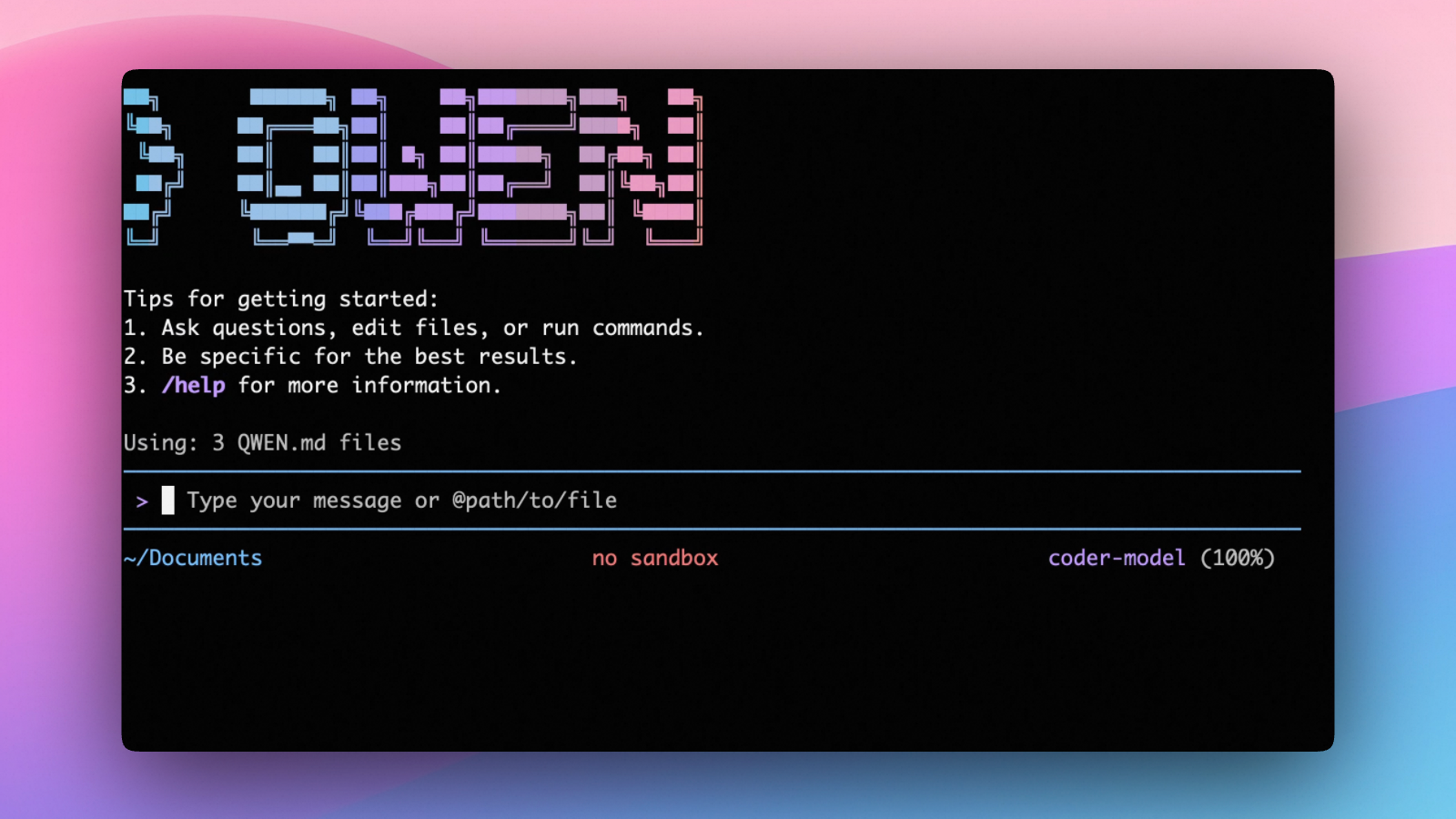
Qwen Code is an open-source AI agent for the terminal, optimized for Qwen series models. It helps you understand large codebases, automate tedious work, and ship faster.
- Multi-protocol, flexible providers: use OpenAI / Anthropic / Gemini-compatible APIs, Alibaba Cloud Coding Plan, OpenRouter, Fireworks AI, or bring your own API key.
- Open-source, co-evolving: both the framework and the Qwen3-Coder model are open-source—and they ship and evolve together.
- Agentic workflow, feature-rich: rich built-in tools (Skills, SubAgents) for a full agentic workflow and a Claude Code-like experience.
- Terminal-first, IDE-friendly: built for developers who live in the command line, with optional integration for VS Code, Zed, and JetBrains IDEs.
Installation
Quick Install (Recommended)
Linux / macOS
bash -c "$(curl -fsSL https://qwen-code-assets.oss-cn-hangzhou.aliyuncs.com/installation/install-qwen.sh)"
Windows (Run as Administrator)
Works in both Command Prompt and PowerShell:
powershell -Command "Invoke-WebRequest 'https://qwen-code-assets.oss-cn-hangzhou.aliyuncs.com/installation/install-qwen.bat' -OutFile (Join-Path $env:TEMP 'install-qwen.bat'); & (Join-Path $env:TEMP 'install-qwen.bat')"
Note
: It's recommended to restart your terminal after installation to ensure environment variables take effect.
Manual Installation
Prerequisites
Make sure you have Node.js 22 or later installed. Download it from nodejs.org.
NPM
npm install -g @qwen-code/qwen-code@latest
Homebrew (macOS, Linux)
brew install qwen-code
Quick Start
# Start Qwen Code (interactive)
qwen

# Then, in the session:
/help
/auth
On first use, you'll be prompted to sign in. You can run /auth anytime to switch authentication methods.
Example prompts:
What does this project do?
Explain the codebase structure.
Help me refactor this function.
Generate unit tests for this module.
Click to watch a demo video
🦞 Use Qwen Code for Coding Tasks in Claw
Copy the prompt below and paste it into your agent:
Use Qwen Code as a coding agent. First, fetch and read this skill reference:
https://raw.githubusercontent.com/QwenLM/qwen-code/refs/heads/main/.qwen/skills/qwen-code-claw/SKILL.md
Then follow the instructions inside to install, authenticate, and use Qwen Code via acpx for all coding tasks.
Authentication
Qwen Code supports the following authentication methods:
- API Key (recommended): use an API key from Alibaba Cloud Model Studio (Beijing / intl) or any supported provider (OpenAI, Anthropic, Google GenAI, and other compatible endpoints).
- Coding Plan: subscribe to the Alibaba Cloud Coding Plan (Beijing / intl) for a fixed monthly fee with higher quotas.
⚠️ Qwen OAuth was discontinued on April 15, 2026. If you were previously using Qwen OAuth, please switch to one of the methods above. Run
qwenand then/authto reconfigure.
API Key (recommended)
Use an API key to connect to Alibaba Cloud Model Studio or any supported provider. Supports multiple protocols:
- OpenAI-compatible: Alibaba Cloud ModelStudio, ModelScope, OpenAI, OpenRouter, and other OpenAI-compatible providers
- Anthropic: Claude models
- Google GenAI: Gemini models
The recommended way to configure models and providers is by editing ~/.qwen/settings.json (create it if it doesn't exist). This file lets you define all available models, API keys, and default settings in one place.
Quick Setup in 3 Steps
Step 1: Create or edit ~/.qwen/settings.json
Here is a complete example:
{
  "modelProviders": {
    "openai": [
      {
        "id": "qwen3.6-plus",
        "name": "qwen3.6-plus",
        "baseUrl": "https://dashscope.aliyuncs.com/compatible-mode/v1",
        "description": "Qwen3-Coder via Dashscope",
        "envKey": "DASHSCOPE_API_KEY"
      }
    ]
  },
  "env": {
    "DASHSCOPE_API_KEY": "sk-xxxxxxxxxxxxx"
  },
  "security": {
    "auth": {
      "selectedType": "openai"
    }
  },
  "model": {
    "name": "qwen3.6-plus"
  }
}
Step 2: Understand each field
| Field | What it does |
|---|---|
modelProviders |
Declares which models are available and how to connect to them. Keys like openai, anthropic, gemini represent the API protocol. |
modelProviders[].id |
The model ID sent to the API (e.g. qwen3.6-plus, gpt-4o). |
modelProviders[].envKey |
The name of the environment variable that holds your API key. |
modelProviders[].baseUrl |
The API endpoint URL (required for non-default endpoints). |
env |
A fallback place to store API keys (lowest priority; prefer .env files or export for sensitive keys). |
security.auth.selectedType |
The protocol to use on startup (openai, anthropic, gemini, vertex-ai). |
model.name |
The default model to use when Qwen Code starts. |
Step 3: Start Qwen Code — your configuration takes effect automatically:
qwen
Use the /model command at any time to switch between all configured models.
More Examples
Coding Plan (Alibaba Cloud ModelStudio) — fixed monthly fee, higher quotas
{
  "modelProviders": {
    "openai": [
      {
        "id": "qwen3.6-plus",
        "name": "qwen3.6-plus (Coding Plan)",
        "baseUrl": "https://coding.dashscope.aliyuncs.com/v1",
        "description": "qwen3.6-plus from ModelStudio Coding Plan",
        "envKey": "BAILIAN_CODING_PLAN_API_KEY"
      },
      {
        "id": "qwen3.5-plus",
        "name": "qwen3.5-plus (Coding Plan)",
        "baseUrl": "https://coding.dashscope.aliyuncs.com/v1",
        "description": "qwen3.5-plus with thinking enabled from ModelStudio Coding Plan",
        "envKey": "BAILIAN_CODING_PLAN_API_KEY",
        "generationConfig": {
          "extra_body": {
            "enable_thinking": true
          }
        }
      },
      {
        "id": "glm-4.7",
        "name": "glm-4.7 (Coding Plan)",
        "baseUrl": "https://coding.dashscope.aliyuncs.com/v1",
        "description": "glm-4.7 with thinking enabled from ModelStudio Coding Plan",
        "envKey": "BAILIAN_CODING_PLAN_API_KEY",
        "generationConfig": {
          "extra_body": {
            "enable_thinking": true
          }
        }
      },
      {
        "id": "kimi-k2.5",
        "name": "kimi-k2.5 (Coding Plan)",
        "baseUrl": "https://coding.dashscope.aliyuncs.com/v1",
        "description": "kimi-k2.5 with thinking enabled from ModelStudio Coding Plan",
        "envKey": "BAILIAN_CODING_PLAN_API_KEY",
        "generationConfig": {
          "extra_body": {
            "enable_thinking": true
          }
        }
      }
    ]
  },
  "env": {
    "BAILIAN_CODING_PLAN_API_KEY": "sk-xxxxxxxxxxxxx"
  },
  "security": {
    "auth": {
      "selectedType": "openai"
    }
  },
  "model": {
    "name": "qwen3.6-plus"
  }
}
Subscribe to the Coding Plan and get your API key at Alibaba Cloud ModelStudio(Beijing) or Alibaba Cloud ModelStudio(intl).
Multiple providers (OpenAI + Anthropic + Gemini)
{
  "modelProviders": {
    "openai": [
      {
        "id": "gpt-4o",
        "name": "GPT-4o",
        "envKey": "OPENAI_API_KEY",
        "baseUrl": "https://api.openai.com/v1"
      }
    ],
    "anthropic": [
      {
        "id": "claude-sonnet-4-20250514",
        "name": "Claude Sonnet 4",
        "envKey": "ANTHROPIC_API_KEY"
      }
    ],
    "gemini": [
      {
        "id": "gemini-2.5-pro",
        "name": "Gemini 2.5 Pro",
        "envKey": "GEMINI_API_KEY"
      }
    ]
  },
  "env": {
    "OPENAI_API_KEY": "sk-xxxxxxxxxxxxx",
    "ANTHROPIC_API_KEY": "sk-ant-xxxxxxxxxxxxx",
    "GEMINI_API_KEY": "AIzaxxxxxxxxxxxxx"
  },
  "security": {
    "auth": {
      "selectedType": "openai"
    }
  },
  "model": {
    "name": "gpt-4o"
  }
}
Enable thinking mode (for supported models like qwen3.5-plus)
{
  "modelProviders": {
    "openai": [
      {
        "id": "qwen3.5-plus",
        "name": "qwen3.5-plus (thinking)",
        "envKey": "DASHSCOPE_API_KEY",
        "baseUrl": "https://dashscope.aliyuncs.com/compatible-mode/v1",
        "generationConfig": {
          "extra_body": {
            "enable_thinking": true
          }
        }
      }
    ]
  },
  "env": {
    "DASHSCOPE_API_KEY": "sk-xxxxxxxxxxxxx"
  },
  "security": {
    "auth": {
      "selectedType": "openai"
    }
  },
  "model": {
    "name": "qwen3.5-plus"
  }
}
Tip: You can also set API keys via
exportin your shell or.envfiles, which take higher priority thansettings.json→env. See the authentication guide for full details.
Security note: Never commit API keys to version control. The
~/.qwen/settings.jsonfile is in your home directory and should stay private.
Local Model Setup (Ollama / vLLM)
You can also run models locally — no API key or cloud account needed. This is not an authentication method; instead, configure your local model endpoint in ~/.qwen/settings.json using the modelProviders field.
Set generationConfig.contextWindowSize inside the matching provider entry
and adjust it to the context length configured on your local server.
Ollama setup
- Install Ollama from ollama.com
- Pull a model:
ollama pull qwen3:32b - Configure
~/.qwen/settings.json:
{
  "modelProviders": {
    "openai": [
      {
        "id": "qwen3:32b",
        "name": "Qwen3 32B (Ollama)",
        "baseUrl": "http://localhost:11434/v1",
        "description": "Qwen3 32B running locally via Ollama",
        "generationConfig": {
          "contextWindowSize": 131072
        }
      }
    ]
  },
  "security": {
    "auth": {
      "selectedType": "openai"
    }
  },
  "model": {
    "name": "qwen3:32b"
  }
}
vLLM setup
- Install vLLM:
pip install vllm - Start the server:
vllm serve Qwen/Qwen3-32B - Configure
~/.qwen/settings.json:
{
  "modelProviders": {
    "openai": [
      {
        "id": "Qwen/Qwen3-32B",
        "name": "Qwen3 32B (vLLM)",
        "baseUrl": "http://localhost:8000/v1",
        "description": "Qwen3 32B running locally via vLLM",
        "generationConfig": {
          "contextWindowSize": 131072
        }
      }
    ]
  },
  "security": {
    "auth": {
      "selectedType": "openai"
    }
  },
  "model": {
    "name": "Qwen/Qwen3-32B"
  }
}
Usage
As an open-source terminal agent, you can use Qwen Code in five primary ways:
- Interactive mode (terminal UI)
- Headless mode (scripts, CI)
- IDE integration (VS Code, Zed)
- SDKs (TypeScript, Python, Java)
- Daemon mode —
qwen serveexposes ACP over HTTP+SSE so multiple clients share one agent (experimental)
Interactive mode
cd your-project/
qwen
Run qwen in your project folder to launch the interactive terminal UI. Use @ to reference local files (for example @src/main.ts).
Headless mode
cd your-project/
qwen -p "your question"
Use -p to run Qwen Code without the interactive UI—ideal for scripts, automation, and CI/CD. Learn more: Headless mode.
IDE integration
Use Qwen Code inside your editor (VS Code, Zed, and JetBrains IDEs):
Daemon mode (qwen serve, experimental)
cd your-project/
qwen serve
# → qwen serve listening on http://127.0.0.1:4170 (mode=http-bridge)
Run Qwen Code as a local HTTP daemon so IDE plugins, web UIs, CI scripts and custom CLIs all share one agent session over HTTP+SSE — instead of each spawning their own subprocess. Loopback bind has no auth by default (set QWEN_SERVER_TOKEN to enable bearer auth even on loopback); remote binds (--hostname 0.0.0.0) require a token — boot refuses without one. See:
SDKs
Build on top of Qwen Code with the available SDKs:
- TypeScript: Use the Qwen Code SDK
- Python: Use the Python SDK
- Java: Use the Java SDK
Python SDK example:
import asyncio

from qwen_code_sdk import is_sdk_result_message, query


async def main() -> None:
    result = query(
        "Summarize the repository layout.",
        {
            "cwd": "/path/to/project",
            "path_to_qwen_executable": "qwen",
        },
    )

    async for message in result:
        if is_sdk_result_message(message):
            print(message["result"])


asyncio.run(main())
Commands & Shortcuts
Session Commands
/help- Display available commands/clear- Clear conversation history/compress- Compress history to save tokens/stats- Show current session information/bug- Submit a bug report/exitor/quit- Exit Qwen Code
Keyboard Shortcuts
Ctrl+C- Cancel current operationCtrl+D- Exit (on empty line)Up/Down- Navigate command history
Learn more about Commands
Tip: In YOLO mode (
--yolo), vision switching happens automatically without prompts when images are detected. Learn more about Approval Mode
Configuration
Qwen Code can be configured via settings.json, environment variables, and CLI flags.
| File | Scope | Description |
|---|---|---|
~/.qwen/settings.json |
User (global) | Applies to all your Qwen Code sessions. Recommended for modelProviders and env. |
.qwen/settings.json |
Project | Applies only when running Qwen Code in this project. Overrides user settings. |
The most commonly used top-level fields in settings.json:
| Field | Description |
|---|---|
modelProviders |
Define available models per protocol (openai, anthropic, gemini, vertex-ai). |
env |
Fallback environment variables (e.g. API keys). Lower priority than shell export and .env files. |
security.auth.selectedType |
The protocol to use on startup (e.g. openai). |
model.name |
The default model to use when Qwen Code starts. |
See the Authentication section above for complete
settings.jsonexamples, and the settings reference for all available options.
Benchmark Results
Terminal-Bench Performance
| Agent | Model | Accuracy |
|---|---|---|
| Qwen Code | Qwen3-Coder-480A35 | 37.5% |
| Qwen Code | Qwen3-Coder-30BA3B | 31.3% |
Ecosystem
Looking for a graphical interface?
- AionUi A modern GUI for command-line AI tools including Qwen Code
- Gemini CLI Desktop A cross-platform desktop/web/mobile UI for Qwen Code
Troubleshooting
If you encounter issues, check the troubleshooting guide.
Common issues:
Qwen OAuth free tier was discontinued on 2026-04-15: Qwen OAuth is no longer available. Runqwen→/authand switch to API Key or Coding Plan. See the Authentication section above for setup instructions.
To report a bug from within the CLI, run /bug and include a short title and repro steps.
Connect with Us
- Discord: https://discord.gg/RN7tqZCeDK
- Dingtalk: https://qr.dingtalk.com/action/joingroup?code=v1,k1,+FX6Gf/ZDlTahTIRi8AEQhIaBlqykA0j+eBKKdhLeAE=&_dt_no_comment=1&origin=1
Acknowledgments
This project is based on Google Gemini CLI. We acknowledge and appreciate the excellent work of the Gemini CLI team. Our main contribution focuses on parser-level adaptations to better support Qwen-Coder models.