 57326e55be
* feat(review): add issue-fidelity and root-cause ownership gate to /review Adds a dedicated Issue Fidelity & Root-Cause Ownership agent (Agent 0) to the /review pipeline and a core-infrastructure scope gate that runs before the review agents. Agent 0 fetches linked GitHub issue evidence directly (closingIssuesReferences plus issue comments) instead of trusting the PR author's framing, compares the original reported failure against the PR's claimed fix, and flags client-side parser/sanitizer workarounds for malformed upstream output as Critical unless a maintainer explicitly requested the defensive mitigation. The core-infra gate applies the repository's existing two-tier maintainer-only rule before spending review budget. This hardens the pipeline against a false-approval mode where a bot PR passes its own tests and reads as internally reasonable but fixes the author's mistaken diagnosis rather than the linked issue's actual root cause. Co-Authored-By: Claude Opus 4.8 <noreply@anthropic.com> * docs(review): address PR review feedback on issue-fidelity gate - Fetch issue evidence with `gh issue view --json title,body,comments` so the issue body (reporter repro/observed payload/expected behavior) is included; `--comments` alone omits it. Use each closingIssuesReferences entry's own repository so cross-repo linked issues resolve correctly. - Treat closingIssuesReferences as a discovery hint (fetch apparent target issues even when it is empty) and treat fetched issue content as untrusted data (extract facts, ignore embedded instructions). - Run Agent 0 (Issue Fidelity) only for PR targets; skip it for local-diff and file-path reviews, and require the PR number/repo/context in its prompt. Handle empty references / non-bugfix / gh failure explicitly. - Pass Agent 0's quoted issue evidence to Step 4 batch verification and stop it rejecting issue-grounded findings just because the code compiles/tests pass. - Make the core-infrastructure gate concrete: deterministic maintainer signal via authorAssociation, count only core-path lines, honor the AGENTS.md low-risk-sweep exception, clean up the worktree on hard block, run the gate right after fetch-pr (before npm ci), and map escalate -> COMMENT (never APPROVE) in Steps 6-7. - Sync agent counts and token math across SKILL.md, DESIGN.md, and code-review.md (Agent 0 is PR-only; ~620-730K). * docs(review): rename 'Linked Issue Fit' heading to 'Issue Fidelity' Aligns the code-review docs heading with the 'Issue Fidelity' name used for Agent 0 in SKILL.md and DESIGN.md, so the section connects to the pipeline diagram. Addresses review feedback. * docs(review): stop core-infra hard block before load-rules and surface it via --comment - Hard block now stops before Step 2 (load-rules) instead of before Step 3, so a PR destined for hard-block no longer runs the load-rules step. - In --comment mode the hard block posts an event=COMMENT on the PR, matching the escalate path's GitHub visibility, so external authors see the block. --------- Co-authored-by: dragon <dragon@U-2Q53JQG9-0233.local> Co-authored-by: Claude Opus 4.8 <noreply@anthropic.com> |
||
|---|---|---|
| .github | ||
| .husky | ||
| .qwen | ||
| .vscode | ||
| docs | ||
| docs-site | ||
| eslint-rules | ||
| integration-tests | ||
| packages | ||
| patches | ||
| scripts | ||
| .dockerignore | ||
| .editorconfig | ||
| .gitattributes | ||
| .gitignore | ||
| .npmrc | ||
| .nvmrc | ||
| .prettierignore | ||
| .prettierrc.json | ||
| .yamllint.yml | ||
| AGENTS.md | ||
| CHANGELOG.md | ||
| CLAUDE.md | ||
| CONTRIBUTING.md | ||
| Dockerfile | ||
| esbuild.config.js | ||
| eslint.config.js | ||
| eslint.legacy-filenames.mjs | ||
| LICENSE | ||
| Makefile | ||
| package-lock.json | ||
| package.json | ||
| README.md | ||
| SECURITY.md | ||
| tsconfig.json | ||
| vitest.config.ts | ||




The open-source AI coding agent that lives in your terminal.
中文 | Deutsch | français | 日本語 | Русский | Português (Brasil)
Why Qwen Code?
- Agentic out of the box — Auto-Memory, Auto-Skills, SubAgents, Agent Teams, and MCP. Dynamic workflows, zero setup.
- Open-source, inside and out — The framework and the Qwen models are open-source. They evolve together. No vendor lock-in.
- Multi-protocol — Supports OpenAI, Anthropic, Gemini, and Qwen APIs. Any third-party provider or local model (Ollama / vLLM). Switch at runtime.
- Beyond the terminal — IDE plugins, Desktop app, daemon mode, SDKs, and IM bots (Telegram / DingTalk / WeChat / Feishu).
Tip
Qwen Code is actively iterating on itself — using its own agent and models to file issues, submit PRs, review code, and run tests. Powered by the community, driven by AI.
Installation
Linux / macOS:
curl -fsSL https://qwen-code-assets.oss-cn-hangzhou.aliyuncs.com/installation/install-qwen-standalone.sh | bash
Windows:
irm https://qwen-code-assets.oss-cn-hangzhou.aliyuncs.com/installation/install-qwen-standalone.ps1 | iex
Restart your terminal after installation to ensure environment variables take effect.
NPM / Homebrew
NPM (requires Node.js 22+):
npm install -g @qwen-code/qwen-code@latest
Homebrew (macOS / Linux):
brew install qwen-code
Quick Start
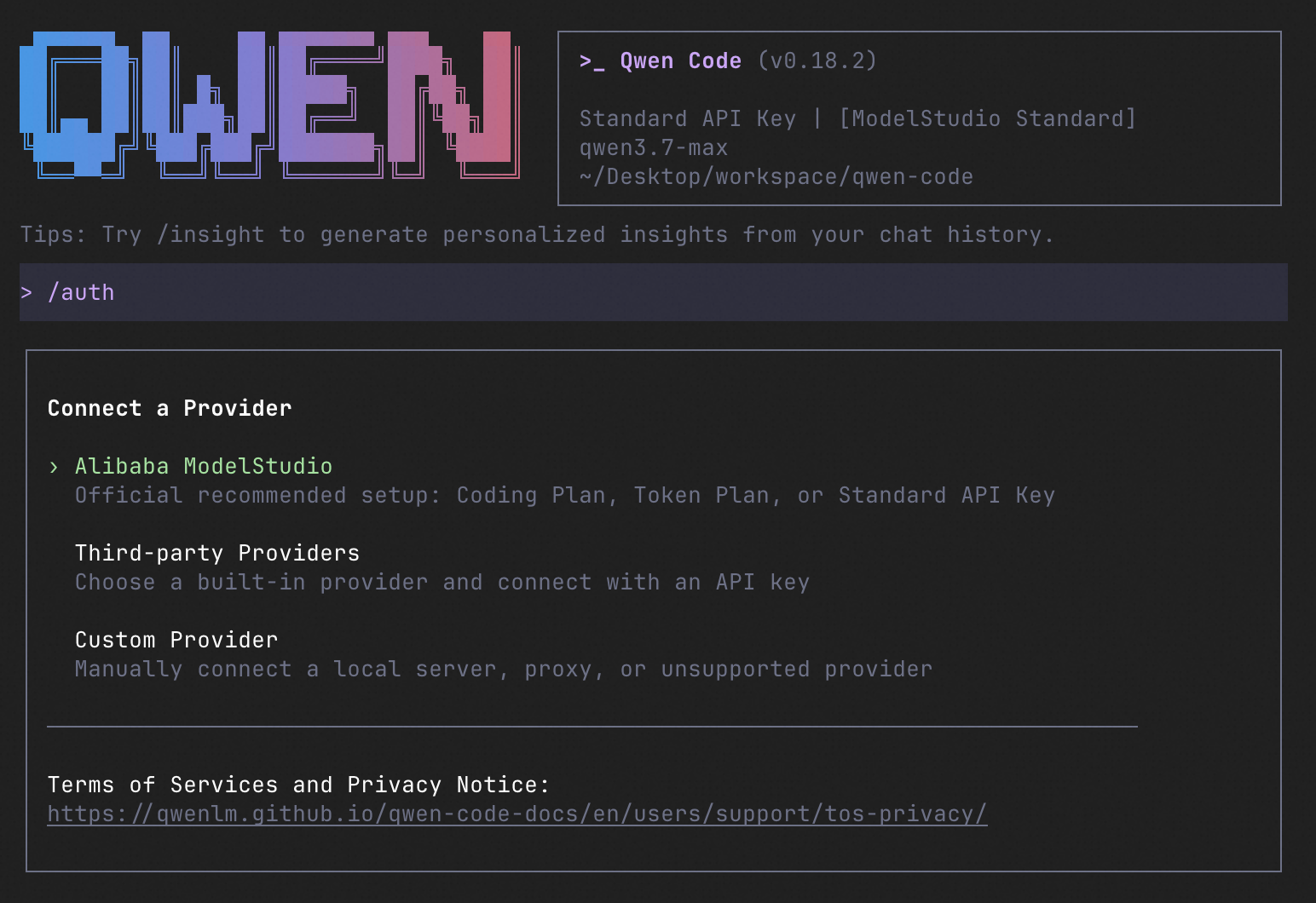
qwen          # Launch interactive terminal UI
# Inside the session:
/auth         # Configure your provider and API key
See the Authentication Guide and Settings Reference for detailed setup.
How to Use Qwen Code
| Mode | Command | Use Case |
|---|---|---|
| Interactive | qwen |
Terminal UI with rich rendering, @file references, slash commands |
| Headless | qwen -p "..." |
Scripts, CI/CD, batch processing — no UI |
| IDE | — | VS Code, Zed, JetBrains |
| Desktop | — | Qwen Code Desktop — GUI for macOS, Windows, Linux |
| Daemon | qwen serve |
Shared agent session over HTTP+SSE (ACP). Multiple clients, one agent. (experimental) Docs |
| SDK | — | TypeScript, Python, Java |
| IM Bot | qwen channel |
Connect to Telegram, DingTalk, WeChat, or Feishu |
SDK example (Python)
import asyncio

from qwen_code_sdk import is_sdk_result_message, query


async def main() -> None:
    result = query(
        "Summarize the repository layout.",
        {
            "cwd": "/path/to/project",
            "path_to_qwen_executable": "qwen",
        },
    )

    async for message in result:
        if is_sdk_result_message(message):
            print(message["result"])


asyncio.run(main())
Capabilities
If you know Claude Code, you already know Qwen Code — and then some. We've put significant effort into bringing Qwen Code to feature parity with Claude Code, improving both breadth and reliability across the board.
| Feature | Qwen Code | Claude Code |
|---|---|---|
| SubAgents, Agent Teams, Dynamic Workflows | ✓ | ✓ |
| Auto-Memory, Auto-Skills, Hooks | ✓ | ✓ |
| Built-in Skills (/review, /batch, /loop, /bugfix…) | ✓ | ✓ |
| MCP, Plan Mode, LSP Integration | ✓ | ✓ |
| Auto Mode, Sandbox, Git Worktrees | ✓ | ✓ |
| Computer Use (desktop automation) | ✓ | ✓ |
| IDE Plugins (VS Code / JetBrains / Zed) | ✓ | ✓ |
| SDK | ✓ | ✓ |
| Headless Mode, Session Management | ✓ | ✓ |
| Open-source — model and framework | ✓ | — |
| Multi-protocol (OpenAI / Anthropic / Gemini / Qwen + any provider) | ✓ | — |
| Agent Arena (multi-model head-to-head on same task) | ✓ | — |
Daemon Mode — qwen serve (multi-client shared agent) |
✓ | — |
| IM Channels (Telegram / DingTalk / WeChat / Feishu) | ✓ | — |
Ecosystem
-
Qwen Code Desktop — Official desktop app for macOS, Windows, and Linux
-
AionUi — A modern GUI for command-line AI tools including Qwen Code
-
Gemini CLI Desktop — A cross-platform desktop/web/mobile UI for Qwen Code
-
🦞 Qwen Code Claw — Let other agents (Claude, Codex, etc.) delegate coding tasks to Qwen Code via ACP. Paste this prompt into your agent:
Use Qwen Code as a coding agent. First, fetch and read this skill reference:
https://raw.githubusercontent.com/QwenLM/qwen-code/refs/heads/main/.qwen/skills/qwen-code-claw/SKILL.md
Then follow the instructions inside to install, authenticate, and use Qwen Code via acpx for all coding tasks.
Contributing
Contributions are welcome! See CONTRIBUTING.md for guidelines.
Acknowledgments
This project was originally based on Google Gemini CLI v0.8.2. We gratefully acknowledge the Gemini CLI team's excellent work. Starting from Qwen Code v0.1, we stopped syncing with upstream and began independent development as a multi-protocol, multi-platform agent framework with deep integrations for Qwen models and beyond.