 560e6103a9
* feat(cli): skill review dialog — inline preview, open-in-editor, turn-off option The auto-skill review dialog now shows the staged SKILL.md inline (sanitized, bounded reads, wrap-aware height cap), opens it in the configured editor without advancing (with watcher-based preview refresh so non-blocking GUI editors work), and offers a visible last option to turn the feature off — effective immediately in-session, persisted at workspace scope, non-destructive to the pending batch. Bulk options render only while at least two skills remain. Re-enabling auto-skill from /memory can resurface a batch put aside by turn-off. * test(integration): render harness + capture scenarios for the skill review dialog Browser-free harness that renders the production dialog from source via an ESM loader hook; its before mode renders the globally installed qwen (no local fixture — the baseline is what actually shipped, or a loud failure). Terminal-capture scenarios produce the PR's before/after screenshots. * fix(cli): address review findings on the skill review dialog - Sanitize the model-generated name and description in the dialog header, same as the preview body — an escape sequence in the frontmatter must not reach the terminal through the header fields. - Clamp the preview width to the dialog container cap (min(columns-4, 100), the same clamp DiffDialog uses) instead of the raw terminal width, which broke the wrapped-row accounting on terminals wider than ~106 columns. - Catch settings persistence failures in the turn-off option: surface the error in the dialog and leave the feature untouched instead of letting the throw escape the keypress handler. - Extract the auto-open gate into shouldAutoOpenSkillReview and cover it with a truth table (turn-off, /memory overlap, re-enable, Esc-dismiss). - Cover the MemoryDialog auto-skill ON->OFF toggle direction. - Release the capture harness temp dir with try/finally. * fix(cli): guard the preview watcher against async errors and event bursts An FSWatcher 'error' event after attach had no listener, so Node raised it as an uncaught exception and the global handler exited the CLI. Consume it and drop the watcher; the blocking-editor reload still works. Also debounce the watch callback (300ms, same as SettingsWatcher): a single editor save fires several raw events, and each one re-read the file and re-attached the watcher. * test(cli): drop white-box watcher tests, keep the end-to-end refresh test The prototype-spy scaffolding tested implementation details (listener registration, synthetic event bursts) and leaned on vite-node interop quirks. The existing on-disk refresh test already exercises the watcher path, debounce included. * fix(cli): sanitize action errors, log preview read failures, cover key guards - Render actionError through sanitizeMultilineForDisplay: error messages can embed the staged path, whose basename derives from the model-generated skill name. - Log the underlying cause when the preview read fails; all failures render the same 'Preview unavailable' otherwise. - Cover Ctrl+O/Cmd+O inertness and Esc dismissal with tests. - Document that getAutoSkillEnabled() also gates on bare/safe mode. --------- Co-authored-by: qwen-code-dev-bot <qwen-code-dev-bot@users.noreply.github.com> Co-authored-by: Qwen-Coder <qwen-coder@alibabacloud.com> |
||
|---|---|---|
| .github | ||
| .husky | ||
| .qwen | ||
| .vscode | ||
| docs | ||
| docs-site | ||
| eslint-rules | ||
| integration-tests | ||
| packages | ||
| patches | ||
| scripts | ||
| .dockerignore | ||
| .editorconfig | ||
| .gitattributes | ||
| .gitignore | ||
| .npmrc | ||
| .nvmrc | ||
| .prettierignore | ||
| .prettierrc.json | ||
| .yamllint.yml | ||
| AGENTS.md | ||
| CHANGELOG.md | ||
| CLAUDE.md | ||
| CONTRIBUTING.md | ||
| Dockerfile | ||
| esbuild.config.js | ||
| eslint.config.js | ||
| eslint.legacy-filenames.mjs | ||
| LICENSE | ||
| Makefile | ||
| package-lock.json | ||
| package.json | ||
| README.md | ||
| SECURITY.md | ||
| tsconfig.json | ||
| vitest.config.ts | ||




The open-source AI coding agent that lives in your terminal.
中文 | Deutsch | français | 日本語 | Русский | Português (Brasil)
Why Qwen Code?
- Agentic out of the box — Auto-Memory, Auto-Skills, SubAgents, Agent Teams, and MCP. Dynamic workflows, zero setup.
- Open-source, inside and out — The framework and the Qwen models are open-source. They evolve together. No vendor lock-in.
- Multi-protocol — Supports OpenAI, Anthropic, Gemini, and Qwen APIs. Any third-party provider or local model (Ollama / vLLM). Switch at runtime.
- Beyond the terminal — IDE plugins, Desktop app, daemon mode, SDKs, and IM bots (Telegram / DingTalk / WeChat / Feishu).
Tip
Qwen Code is actively iterating on itself — using its own agent and models to file issues, submit PRs, review code, and run tests. Powered by the community, driven by AI.
Installation
Linux / macOS:
curl -fsSL https://qwen-code-assets.oss-cn-hangzhou.aliyuncs.com/installation/install-qwen-standalone.sh | bash
Windows:
irm https://qwen-code-assets.oss-cn-hangzhou.aliyuncs.com/installation/install-qwen-standalone.ps1 | iex
Restart your terminal after installation to ensure environment variables take effect.
NPM / Homebrew
NPM (requires Node.js 22+):
npm install -g @qwen-code/qwen-code@latest
Homebrew (macOS / Linux):
brew install qwen-code
Quick Start
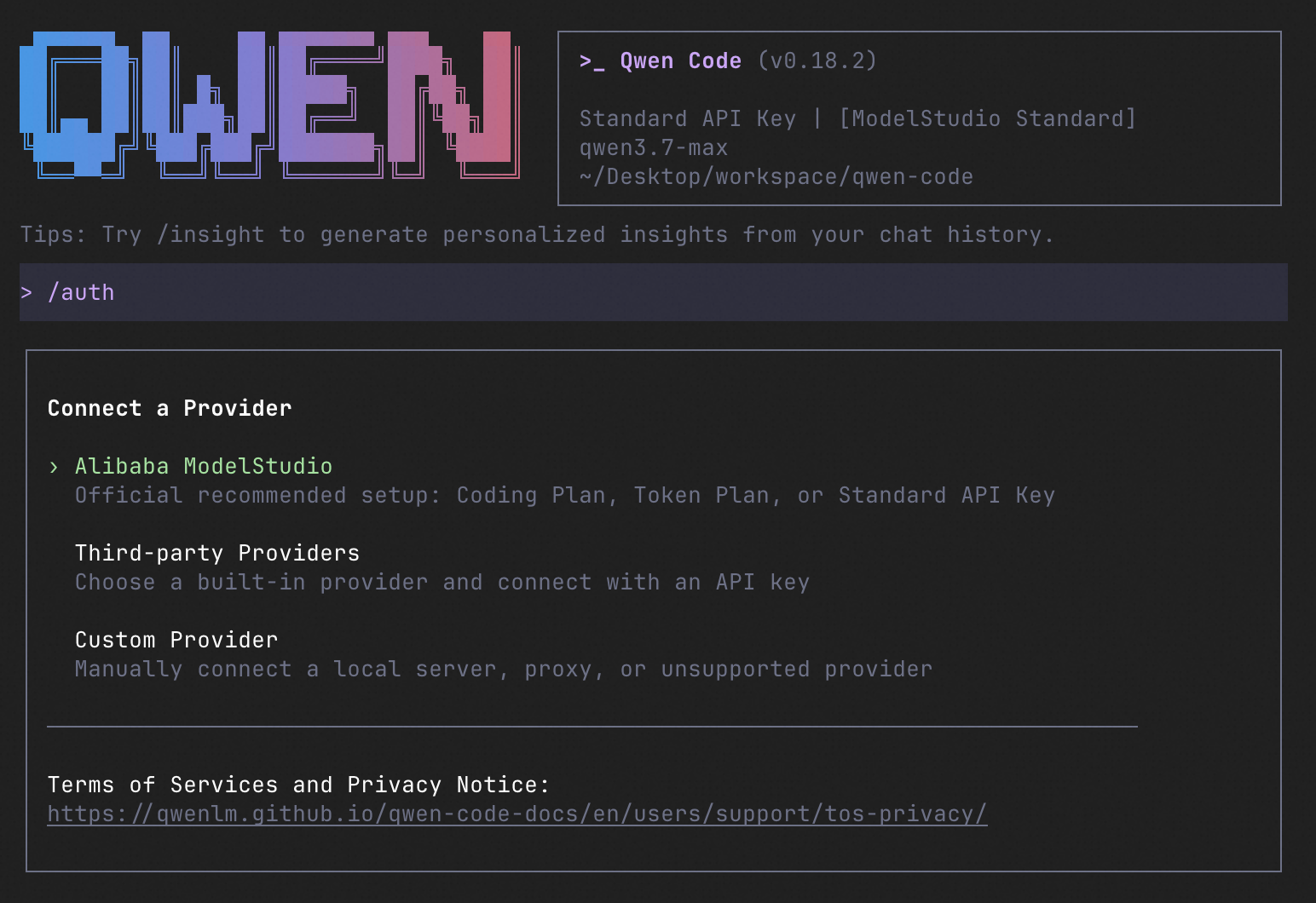
qwen          # Launch interactive terminal UI
# Inside the session:
/auth         # Configure your provider and API key
See the Authentication Guide and Settings Reference for detailed setup.
How to Use Qwen Code
| Mode | Command | Use Case |
|---|---|---|
| Interactive | qwen |
Terminal UI with rich rendering, @file references, slash commands |
| Headless | qwen -p "..." |
Scripts, CI/CD, batch processing — no UI |
| IDE | — | VS Code, Zed, JetBrains |
| Desktop | — | Qwen Code Desktop — GUI for macOS, Windows, Linux |
| Daemon | qwen serve |
Shared agent session over HTTP+SSE (ACP). Multiple clients, one agent. (experimental) Docs |
| SDK | — | TypeScript, Python, Java |
| IM Bot | qwen channel |
Connect to Telegram, DingTalk, WeChat, or Feishu |
SDK example (Python)
import asyncio

from qwen_code_sdk import is_sdk_result_message, query


async def main() -> None:
    result = query(
        "Summarize the repository layout.",
        {
            "cwd": "/path/to/project",
            "path_to_qwen_executable": "qwen",
        },
    )

    async for message in result:
        if is_sdk_result_message(message):
            print(message["result"])


asyncio.run(main())
Capabilities
If you know Claude Code, you already know Qwen Code — and then some. We've put significant effort into bringing Qwen Code to feature parity with Claude Code, improving both breadth and reliability across the board.
| Feature | Qwen Code | Claude Code |
|---|---|---|
| SubAgents, Agent Teams, Dynamic Workflows | ✓ | ✓ |
| Auto-Memory, Auto-Skills, Hooks | ✓ | ✓ |
| Built-in Skills (/review, /batch, /loop, /bugfix…) | ✓ | ✓ |
| MCP, Plan Mode, LSP Integration | ✓ | ✓ |
| Auto Mode, Sandbox, Git Worktrees | ✓ | ✓ |
| Computer Use (desktop automation) | ✓ | ✓ |
| IDE Plugins (VS Code / JetBrains / Zed) | ✓ | ✓ |
| SDK | ✓ | ✓ |
| Headless Mode, Session Management | ✓ | ✓ |
| Open-source — model and framework | ✓ | — |
| Multi-protocol (OpenAI / Anthropic / Gemini / Qwen + any provider) | ✓ | — |
| Agent Arena (multi-model head-to-head on same task) | ✓ | — |
Daemon Mode — qwen serve (multi-client shared agent) |
✓ | — |
| IM Channels (Telegram / DingTalk / WeChat / Feishu) | ✓ | — |
Ecosystem
-
Qwen Code Desktop — Official desktop app for macOS, Windows, and Linux
-
AionUi — A modern GUI for command-line AI tools including Qwen Code
-
Gemini CLI Desktop — A cross-platform desktop/web/mobile UI for Qwen Code
-
🦞 Qwen Code Claw — Let other agents (Claude, Codex, etc.) delegate coding tasks to Qwen Code via ACP. Paste this prompt into your agent:
Use Qwen Code as a coding agent. First, fetch and read this skill reference:
https://raw.githubusercontent.com/QwenLM/qwen-code/refs/heads/main/.qwen/skills/qwen-code-claw/SKILL.md
Then follow the instructions inside to install, authenticate, and use Qwen Code via acpx for all coding tasks.
Contributing
Contributions are welcome! See CONTRIBUTING.md for guidelines.
Acknowledgments
This project was originally based on Google Gemini CLI v0.8.2. We gratefully acknowledge the Gemini CLI team's excellent work. Starting from Qwen Code v0.1, we stopped syncing with upstream and began independent development as a multi-protocol, multi-platform agent framework with deep integrations for Qwen models and beyond.