 4f79036a22
* feat(review): a cost ledger from the records already on disk "0.21.3 was fine, 0.21.4 got slow" was settled only by replaying a whole review under a telemetry exporter and hand-aggregating the output — hours of forensics to find a repair round that had silently doubled a run (measured: a +93/-48 PR at high effort cost 523 model calls and 37.8M input tokens, 9.7M of them redelivering prompts the agents had already acted on). The usage data was on disk the whole time: every chat and subagent transcript event carries usageMetadata. qwen review cost-ledger --plan <plan> aggregates those records — the same files check-coverage trusts for delivery, found via the same environment-exported location, floored at the plan's mtime so a review started an hour into a session does not bill that hour — into per-stream totals: the main loop and each agent, with input / cached / output / thinking counts and wall time. Step 8 pastes the printed block into the saved report, so the next slowness question is a diff of two archives instead of an excavation. Informational by construction: an incomputable ledger prints why and exits 0. Validated against the measured run above — 521 calls, 37.7M input (93% cached), 849k output, 107 min — matching the telemetry-side aggregation, minus the two side-query calls that are not the review's. * test: register cost-ledger in the subcommand registry and its demand message * fix(review): honest cost-ledger output and a safe archive write (#8471) Address the review of the cost ledger: report output tokens once (thinking is a subset of candidates, not a sibling), keep the --out write inside the exit-0 contract and mkdir its parent, name a missing plan as the plan, read each transcript once, compare timestamps as instants, fold relaunched agents into marked rows, and archive the full ledger next to the Step 8 report. * fix(review): cost ledger — honest failures, validated plan, shared records (#8471) Address the second review round: a missing or faulted chat transcript now says "cost-ledger unavailable" instead of rendering agents-only totals as the whole cost (the plan proves the main loop ran), and a subagent dir that fails listing with anything but ENOENT does the same. The --plan file is validated as a plan report before its mtime alone sets the billing window. Output derives from totalTokenCount − promptTokenCount when present, correct under both usage conventions. Chunk agents label "chunk N" via the shared CHUNK_RE instead of the malformed "agent chunk N of M"; the transcript listing is one helper shared with the coverage gate; glued JSONL records are recovered via parseLineTolerant; totals reuse the rows' accumulator; folded (×N) rows rank by combined total; stale agent files are skipped by mtime without being opened. Rendered block gains pluralization, "agent runs: N", and a B tier; SKILL.md states the ledger's bounded window. * fix(review): close the cost-ledger audit — refusals, labels, pinned math Address the remaining review threads on the cost ledger: - Refuse agents-only totals when the chat file exists but holds no above-floor records: a degraded recorder leaves the file present and empty while agents run — the same infrastructure fact as an unreadable transcript, and exactly the output the missing-file refusal exists to prevent. - Read the agent label from the first user record, not a raw 64KB head slice: a fork's agent_bootstrap record precedes the launch prompt, quotes other agents' identity lines, and can outgrow any fixed window. - Distinguish parallel invariant agents by their owned file, so per-file runs stop folding into a phantom (xN) relaunch row. - Coerce negative provider counts to zero: the agent path records usage uncoerced, and summed negatives rendered >100% cached shares. - Accept degraded diff-less Step 1 reports: validate diffLines + chunks, the pair every plan report carries, instead of check-coverage's stricter contract that refused them. - Pin every branch the second round proved unobservable: the exit code on all handler paths, total - prompt under both usage conventions, per-agent fault tolerance, the wall-minutes conversion, array-shaped usage, the mtime pre-filter and the event-level floor, human() rounding, per-condition plan validation, sort order against a lexical readdir, the zero-event skip, the --out per-stream archive contract, error messages naming their paths, truncation membership and folded-run counting, and the assistant-type filter. Every new assertion was mutation-probed: each mutant the review named now turns the suite red. * review: pipeline stages keep their own ledger rows The (×N) fold keyed on the label alone, and three legitimate multi-launch shapes shared one: a reverse-audit chunk auditor is launched with the same 'chunk N of M' identity as the Step 3B territory finder (five audit rounds folded into the finder's row — one agent where six pipeline stages ran), and repeat rounds of the findings roles carry their round OUTSIDE the backticks (every round folded as a phantom relaunch). labelOf now reads the stage from the audit brief's record key in the launch (audit chunk N (round K)) and the round from the identity LINE — never the whole launch, whose folded findings can quote a budget disclosure's own '(round N)' — so rounds are rows and only true relaunches and same-round verify shards fold. The (×N) comment now says what the marker means: N runs under one label. * fix(cli): annotate cost-ledger test helper to restore strict build (#8471) * fix(cli): anchor cost-ledger labels and harden broken-usage defenses (#8471) --------- Co-authored-by: verify <verify@local> Co-authored-by: qwen-code-dev-bot <qwen-code-dev@service.alibaba.com> |
||
|---|---|---|
| .github | ||
| .husky | ||
| .qwen | ||
| .vscode | ||
| docs | ||
| docs-site | ||
| eslint-rules | ||
| integration-tests | ||
| integrations/external-context | ||
| packages | ||
| patches | ||
| scripts | ||
| .dockerignore | ||
| .editorconfig | ||
| .gitattributes | ||
| .gitignore | ||
| .npmrc | ||
| .nvmrc | ||
| .prettierignore | ||
| .prettierrc.json | ||
| .yamllint.yml | ||
| AGENTS.md | ||
| CHANGELOG.md | ||
| CLAUDE.md | ||
| CONTRIBUTING.md | ||
| Dockerfile | ||
| esbuild.config.js | ||
| eslint.config.js | ||
| eslint.legacy-filenames.mjs | ||
| LICENSE | ||
| Makefile | ||
| package-lock.json | ||
| package.json | ||
| README.md | ||
| SECURITY.md | ||
| tsconfig.json | ||
| vitest.config.ts | ||




The open-source AI coding agent that lives in your terminal.
中文 | Deutsch | français | 日本語 | Русский | Português (Brasil)
Why Qwen Code?
- Agentic out of the box — Auto-Memory, Auto-Skills, SubAgents, Agent Teams, and MCP. Dynamic workflows, zero setup.
- Open-source, inside and out — The framework and the Qwen models are open-source. They evolve together. No vendor lock-in.
- Multi-protocol — Supports OpenAI, Anthropic, Gemini, and Qwen APIs. Any third-party provider or local model (Ollama / vLLM). Switch at runtime.
- Beyond the terminal — IDE plugins, Desktop app, daemon mode, SDKs, and IM bots (Telegram / DingTalk / WeChat / Feishu).
Tip
Qwen Code is actively iterating on itself — using its own agent and models to file issues, submit PRs, review code, and run tests. Powered by the community, driven by AI.
Installation
Linux / macOS:
curl -fsSL https://qwen-code-assets.oss-cn-hangzhou.aliyuncs.com/installation/install-qwen-standalone.sh | bash
Windows:
irm https://qwen-code-assets.oss-cn-hangzhou.aliyuncs.com/installation/install-qwen-standalone.ps1 | iex
Restart your terminal after installation to ensure environment variables take effect.
NPM / Homebrew
NPM (requires Node.js 22+):
npm install -g @qwen-code/qwen-code@latest
Homebrew (macOS / Linux):
brew install qwen-code
Quick Start
qwen          # Launch interactive terminal UI
# Inside the session:
/auth         # Configure your provider and API key
See the Authentication Guide and Settings Reference for detailed setup.
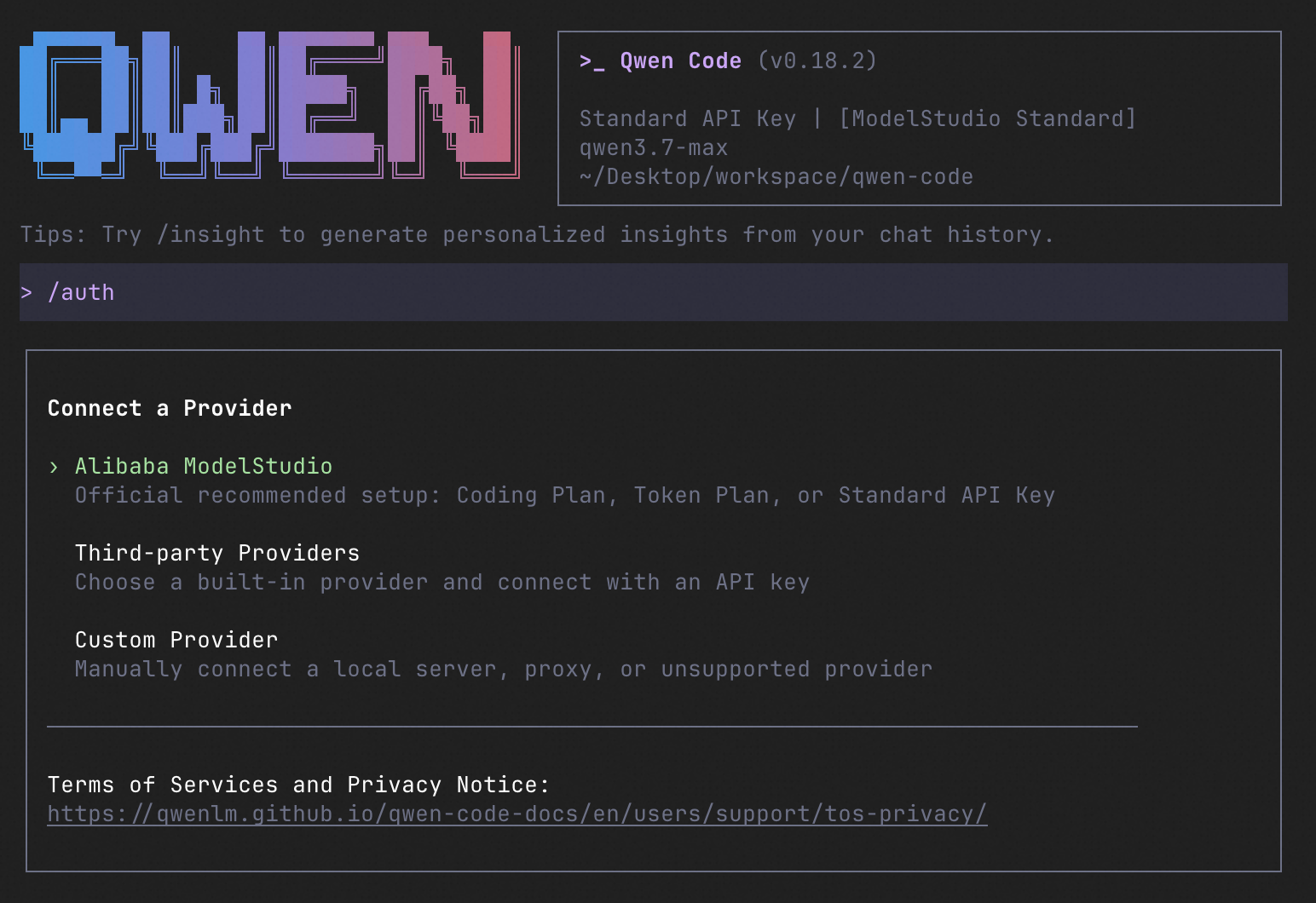
How to Use Qwen Code
| Mode | Command | Use Case |
|---|---|---|
| Interactive | qwen |
Terminal UI with rich rendering, @file references, slash commands |
| Headless | qwen -p "..." |
Scripts, CI/CD, batch processing — no UI |
| IDE | — | VS Code, Zed, JetBrains |
| Desktop | — | Qwen Code Desktop — GUI for macOS, Windows, Linux |
| Daemon | qwen serve |
Shared agent session over HTTP+SSE (ACP). Multiple clients, one agent. (experimental) Docs |
| SDK | — | TypeScript, Python, Java |
| IM Bot | qwen channel |
Connect to Telegram, DingTalk, WeChat, or Feishu |
SDK example (Python)
import asyncio

from qwen_code_sdk import is_sdk_result_message, query


async def main() -> None:
    result = query(
        "Summarize the repository layout.",
        {
            "cwd": "/path/to/project",
            "path_to_qwen_executable": "qwen",
        },
    )

    async for message in result:
        if is_sdk_result_message(message):
            print(message["result"])


asyncio.run(main())
Capabilities
If you know Claude Code, you already know Qwen Code — and then some. We've put significant effort into bringing Qwen Code to feature parity with Claude Code, improving both breadth and reliability across the board.
| Feature | Qwen Code | Claude Code |
|---|---|---|
| SubAgents, Agent Teams, Dynamic Workflows | ✓ | ✓ |
| Auto-Memory, Auto-Skills, Hooks | ✓ | ✓ |
| Built-in Skills (/review, /batch, /loop, /bugfix…) | ✓ | ✓ |
| MCP, Plan Mode, LSP Integration | ✓ | ✓ |
| Auto Mode, Sandbox, Git Worktrees | ✓ | ✓ |
| Computer Use (desktop automation) | ✓ | ✓ |
| IDE Plugins (VS Code / JetBrains / Zed) | ✓ | ✓ |
| SDK | ✓ | ✓ |
| Headless Mode, Session Management | ✓ | ✓ |
| Open-source — model and framework | ✓ | — |
| Multi-protocol (OpenAI / Anthropic / Gemini / Qwen + any provider) | ✓ | — |
| Agent Arena (multi-model head-to-head on same task) | ✓ | — |
Daemon Mode — qwen serve (multi-client shared agent) |
✓ | — |
| IM Channels (Telegram / DingTalk / WeChat / Feishu) | ✓ | — |
Ecosystem
-
Qwen Code Desktop — Official desktop app for macOS, Windows, and Linux
-
AionUi — A modern GUI for command-line AI tools including Qwen Code
-
Gemini CLI Desktop — A cross-platform desktop/web/mobile UI for Qwen Code
-
🦞 Qwen Code Claw — Let other agents (Claude, Codex, etc.) delegate coding tasks to Qwen Code via ACP. Paste this prompt into your agent:
Use Qwen Code as a coding agent. First, fetch and read this skill reference:
https://raw.githubusercontent.com/QwenLM/qwen-code/refs/heads/main/.qwen/skills/qwen-code-claw/SKILL.md
Then follow the instructions inside to install, authenticate, and use Qwen Code via acpx for all coding tasks.
Contributing
Contributions are welcome! See CONTRIBUTING.md for guidelines.
Acknowledgments
This project was originally based on Google Gemini CLI v0.8.2. We gratefully acknowledge the Gemini CLI team's excellent work. Starting from Qwen Code v0.1, we stopped syncing with upstream and began independent development as a multi-protocol, multi-platform agent framework with deep integrations for Qwen models and beyond.