 36760ca63c
* feat(serve): auth device-flow route
Implements issue #4175 Wave 4 PR 21. Brokers OAuth 2.0 Device
Authorization Grant (RFC 8628) through the `qwen serve` daemon so a
remote SDK client can trigger a Qwen-account login whose tokens land
on the **daemon** filesystem, not on the client. The daemon polls the
IdP itself; the client's only job is to display the verification URL +
user code.
Runtime locality (#4175 §11): the daemon NEVER spawns a browser or
calls `open(url)` — even when running locally. Static-source grep
test fails the build on `node:child_process` / `open` / `xdg-open` /
`shell.openExternal` / `execa` / `shelljs` / `process.spawn` and
their dynamic-import / require variants.
- `POST /workspace/auth/device-flow` — strict mutation gate; returns
201 fresh / 200 idempotent take-over with `attached: true`. Per
per-`providerId` singleton: a second POST while pending takes over
rather than allocating a new `device_code`.
- `GET /workspace/auth/device-flow/:id` — public state read. Pending
entries echo `userCode/verificationUri/expiresAt/intervalMs`;
terminal entries (5-min grace) drop them and surface
`status/errorKind/hint`.
- `DELETE /workspace/auth/device-flow/:id` — strict; idempotent
(terminal → 204 no-op; unknown → 404).
- `GET /workspace/auth/status` — pending flows + supported providers
snapshot. v1 stub for `providers: []` (populated in fold-in 1).
`DeviceFlowRegistry` (`packages/cli/src/serve/auth/deviceFlow.ts`)
is the in-memory state holder:
- per-`providerId` singleton with idempotent take-over
- workspace-wide cap of 4 active flows (abuse defense)
- 5-min terminal grace so SDK reconnects can still observe results
- TTL sweeper evicts grace-expired entries every 30s
- in-flight `Promise` map coalesces concurrent `start()` calls so two
parallel POSTs don't double-allocate IdP `device_code`
- `transitionTerminal` returns `boolean` so caller-side emit/audit
guard prevents sweeper × poll-tick double-fire
- `dispose()` wired into `runQwenServe.close()`'s shutdown drain;
cancels `provider.poll()` mid-flight via `cancelController`,
records `lost_success` audit when an IdP-minted token is dropped
by transition
`DeviceFlowProvider` interface accepts `start({signal})` +
`poll(state, {signal})`. `QwenOAuthDeviceFlowProvider` wraps the
existing `QwenOAuth2Client.requestDeviceAuthorization` /
`pollDeviceToken` primitives directly (NOT
`authWithQwenDeviceFlow`, which calls `open(url)`). PKCE is
provider-required by Qwen but optional in the interface for future
non-PKCE providers. `success.persist()` writes to disk FIRST, then
updates the in-process client — a failed disk write no longer
leaves the daemon with a zombie in-memory token. Maps RFC 8628
errors via an anchored regex (`^Device token poll failed:
(expired_token|access_denied|invalid_grant)`) so an
`error_description` containing one of those literals can't
mis-classify an unrelated upstream error.
`BrandedSecret<T extends string>` holds the `device_code` and PKCE
verifier. Earlier draft used `new String()` wrapper which leaked
through `+` / template literals (`Symbol.toPrimitive` →
`valueOf` returned the primitive). Final shape: frozen plain object
+ `WeakMap` indirection + 4-way redaction
(`toString` / `toJSON` / `Symbol.toPrimitive` / numeric coercion →
`'[redacted]'` or `NaN`) + `unique symbol` brand. 6 leak-path
tests: `JSON.stringify` / `String()` / concat / template / `+x` /
reveal-roundtrip.
5 new daemon events (workspace-scoped, fanned out to every active
session bus via `bridge.broadcastWorkspaceEvent`):
- `auth_device_flow_started` — `{deviceFlowId, providerId, expiresAt}`
(no userCode/verificationUri — see PR 21 design §3)
- `auth_device_flow_throttled` — `{deviceFlowId, intervalMs}`,
emitted only on upstream `slow_down` interval bumps
- `auth_device_flow_authorized` — `{deviceFlowId, providerId,
expiresAt?, accountAlias?}`; `accountAlias` is best-effort
non-PII (never email/phone)
- `auth_device_flow_failed` — `{deviceFlowId, errorKind, hint?}`
with `errorKind ∈ {expired_token, access_denied, invalid_grant,
upstream_error, persist_failed}`
- `auth_device_flow_cancelled` — `{deviceFlowId}` (DELETE on pending)
Workspace-scoped reducer `reduceDaemonAuthEvent` produces
`DaemonAuthState { flows: Partial<Record<ProviderId, ...>> }` —
parallel to `reduceDaemonSessionEvent`. Session reducer no-ops on
auth events (workspace-scoped state belongs in its own reducer).
`bridge.broadcastWorkspaceEvent` is intentionally distinct from PR
16's `publishWorkspaceEvent` to avoid merge conflict; collapses to
the shared helper as a fold-in once #4249 lands (~25 LoC).
`@qwen-code/sdk` (`packages/sdk-typescript/`):
- 4 new `DaemonClient` methods: `startDeviceFlow`, `getDeviceFlow`,
`cancelDeviceFlow`, `getAuthStatus` — typed against the wire
shapes, errors mapped through the existing `DaemonHttpError`.
- High-level `client.auth` getter (lazy `DaemonAuthFlow` singleton)
exposes a `start(...).awaitCompletion()` shape mirroring `gh auth
login`'s UX: print code first, let the SDK consumer decide where
to open the browser. `awaitCompletion` polls GET on the
daemon-supplied `intervalMs`, honors `slow_down` bumps, and
fall-back-recovers from 404 (entry evicted post-grace).
POST + DELETE flow through PR 15's `mutate({strict: true})` —
401 `token_required` on token-less loopback defaults. GET routes
use only the global `bearerAuth`. Every state transition
(`started/authorized/failed/cancelled/expired/lost_success`)
records a structured stderr breadcrumb (`[serve] auth.device-flow:
provider=... deviceFlowId=abc12... clientId=... status=...`)
since `mutate()` doesn't carry an audit hook — events alone aren't
enough since SDK can silently drop them; stderr → journald/docker
logs is the unfalsifiable record.
`auth_device_flow` advertised unconditionally on
`/capabilities.features`. Supported providers list lives on
`/workspace/auth/status` to keep the registry descriptor uniform.
- `packages/core/src/qwen/qwenOAuth2.ts`:
- exports `cacheQwenCredentials` (was a private function; needed
by the daemon's device-flow registry)
- `cacheQwenCredentials` now calls `SharedTokenManager.clearCache()`
after writing, folding what was previously a paired call site at
L820+L829. Idempotent change.
- file mode `0o600` on `oauth_creds.json` (was default 0o666 +
umask). Mirrors opencode's `auth/index.ts`.
- `packages/cli/src/serve/runQwenServe.ts`: device-flow registry
`dispose()` wired into the shutdown drain (BEFORE
`bridge.shutdown()`).
- `auth/deviceFlow.test.ts` — 21 tests: BrandedSecret leak paths,
state machine (slow_down / success / error), terminal grace,
concurrent-start coalescing, dispose, cancel idempotency, static-
source grep against browser-spawn primitives.
- `server.test.ts` — 10 device-flow integration tests:
POST 201/200 take-over, strict 401, 400 `unsupported_provider`,
GET / DELETE / `/workspace/auth/status`, 502 `upstream_error`
mapping, sweeper-driven auto-expiry with controlled clock,
capability advertisement.
- `daemonEvents.test.ts` — 5 SDK reducer tests: type guards, per-
provider state projection, `failed` always → `status: 'error'`
(errorKind carries the kind, including new `persist_failed`),
session reducer no-ops on auth events.
369/369 serve + SDK tests pass; typecheck + `eslint
--max-warnings 0` clean across 14 PR 21 files.
- [x] Independently mergeable (depends only on merged PR 4 / PR 7 /
PR 12 / PR 15)
- [x] Backward compatible (4 new routes + 1 capability tag + 5 typed
events + 4 SDK helpers; existing routes/events untouched)
- [x] Default off (capability advertised but no client is forced to
use it; CLI `qwen` OAuth flow unchanged)
- [x] `qwen serve` Stage 1 routes / SDK behavior preserved
- [x] Gradual migration (v1 only `qwen-oauth`; future providers
register through the `DeviceFlowProvider` interface)
- [x] Reversible (revert removes 4 routes + 1 tag + 5 events with no
schema migration)
- [x] Tests-first (28 new tests across 3 layers)
- Inline `bridge.broadcastWorkspaceEvent` → fold-in to PR 16 (#4249)
`publishWorkspaceEvent` once that lands
- `/workspace/auth/status` vs PR 12 `/workspace/providers` boundary
— separate route in v1; merge alternative discussed
- Wave 4 PRs 17/19/20 should adopt the same mutate-strict +
workspace event-fan-out pattern
5 items from pre-PR specialist passes parked for a focused
follow-up: `DeviceFlowEntry` discriminated union, single-source SDK
status / ProviderId unions, `awaitCompletion` memoization,
broadcast-100%-fail stderr elevation, SDK 404 →
`not_found_or_evicted` errorKind.
Refs: #4175
🤖 Generated with [Qwen Code](https://github.com/QwenLM/qwen-code)
* fixup(serve): address PR #4255 round-1 review feedback
Eleven items from copilot-pull-request-reviewer's round-1 pass on
#4255 — 4 inline threads + 7 from the PR-level review summary.
## Adopted (11 items, code/doc changes)
- **`lastSeenAt` → `lastSeenEventId`** (`events.ts`,
`DaemonDeviceFlowReducerState`). The field was set from
`rawEvent.id` (SSE event id) but documented as "epoch ms" — a real
semantic mismatch that would mislead consumers into time-based
logic against a monotonic counter. Rename + tighten the JSDoc to
describe it as an event-id counter; reducer cases updated.
- **`DEVICE_FLOW_EXPIRY_GRACE_MS = 30_000` extracted** in
`DaemonAuthFlow.ts` (was a magic number on `start.expiresAt +
30_000`). `AwaitCompletionOptions.timeoutMs` doc now describes the
actual grace-past-expiry behavior + the rationale (clock skew +
daemon sweeper interval + network latency) instead of the wrong
"defaults to expiresAt - Date.now()" claim.
- **Explicit `chmod 0o600`** in `cacheQwenCredentials` after every
write. `fs.writeFile`'s `mode` only applies on file creation; a
pre-existing `oauth_creds.json` written under a broader umask kept
its old permissions across upgrades. The chmod now tightens it on
every write; chmod failure (Windows / hardened FS) surfaces via
`debugLogger.warn` instead of silently dropping the invariant.
- **`SharedTokenManager.clearCache()` failure now logs**
`debugLogger.warn` (was a silent `try { } catch { }`). In
production a swallowed clearCache means in-process callers serve
stale credentials until the SharedTokenManager mtime watcher
catches up — a recoverable degradation worth a log line.
- **Protocol doc** lists `persist_failed` in the
`auth_device_flow_failed.errorKind` union (was added to the type
but missed in the doc).
- **`pollDeviceToken({signal})`** plumbed through
`IQwenOAuth2Client` interface + `QwenOAuth2Client` impl + the Qwen
device-flow provider. Cancel / dispose during a slow IdP response
now aborts the in-flight HTTP socket immediately instead of
waiting for the upstream timeout. Two new registry tests assert
`cancel()` / `dispose()` propagate abort to the signal observed by
`provider.poll`.
- **`revealSecret` error message** clarified: was "secret has been
GC-evicted" (impossible — WeakMap doesn't evict reachable keys).
Now points at the actual reachable failure modes (forged shape /
serialize+reparse losing the WeakMap binding).
- **`transitionTerminal` JSDoc** clarifies that the PRIMARY guard
against late timer secret leaks is the `entry.status !== 'pending'`
check at the top of `runPollTick`; secret-clearing here is
defense-in-depth.
- **`DeviceFlowErrorKind` JSDoc'd per variant** so consumers can tell
when each fires (RFC 8628 distinctions + `persist_failed` vs
`upstream_error` boundary).
- **Stale "PR 16 / PR 21 §3" temporal references** in
`DaemonAuthFlow.ts:124` rephrased to be timeless ("workspace-scoped
events fan out through whatever session buses happen to be live"
— no PR number references that rot when those PRs merge).
## Not adopted (4 items, replied to in-thread)
- **`authWithQwenDeviceFlow` browser-launch separation** — correct
architectural advice but out of #4255 scope (would refactor a CLI
auth UX module that PR 21 only touched additively). Tracked as a
Wave 5 follow-up.
- **Copyright header year range** — repo-wide convention "2025"; not
introduced by this PR.
- **Spread `...(x ? {x} : {})` → `x: x ?? undefined`** — the two are
not semantically equivalent. The current form omits the key
entirely on falsy `x`; the suggested form always includes the key.
Tests assert object shape and would break under the change.
- **Eager `client.auth` getter** — public API boundary. Lazy
construction matches `DaemonSessionClient` precedent + saves the
module load for SDK consumers that never touch auth.
Refs: #4175 #4255
🤖 Generated with [Qwen Code](https://github.com/QwenLM/qwen-code)
* fixup(serve): address PR #4255 wenshao round-1 review feedback
15 items from @wenshao's review batches on #4255. Catches a handful
of real bugs that the earlier round (commit 3d9f082f5) didn't
surface.
## Critical fixes
- **C1 — `pollUntilTerminal` providerId pass-through**
(`DaemonAuthFlow.ts:185`). The synthetic 404 fallback hardcoded
`providerId: 'qwen-oauth'`; the parent `awaitCompletion` already
receives the real providerId via `start.providerId` but
`pollUntilTerminal`'s parameter type stripped it. Add the field to
the param type, propagate.
- **C2 — open `errorKind` allowlist** (`events.ts`). The closed
5-value union in the type guard silently dropped any `failed`
event whose errorKind the daemon added without mirroring SDK-side
(e.g. a future `rate_limited`). The flow's reducer state would
never transition to terminal, leaving SDK consumers stuck on
`pending` forever. Open the union with `(string & {})` and accept
any non-empty string in the runtime guard. Updated test asserts
forward-compat behavior + still rejects the truly-malformed
empty-string case.
- **C3 — `persist()` timeout + signal**
(`deviceFlow.ts`). A wedged disk I/O (NFS stall, encrypted-volume
contention) without bounds would pin the entry in `pending` until
the upstream `expires_in` elapsed (potentially minutes). The
registry now passes its `cancelController.signal` AND arms a hard
`DEVICE_FLOW_PERSIST_TIMEOUT_MS = 30_000` timer; persist failure
surfaces as `persist_failed` immediately. The
`DeviceFlowPollResult` `success` variant signature changed to
`persist({signal})`.
- **C4 — cancel × success race rollback**
(`deviceFlow.ts` + Qwen provider). Today, if `cancel()`
transitions while `persist()` is in flight, the credentials get
written but the flow's status is `cancelled`. User sees cancelled,
daemon disk has a valid token. `DeviceFlowPollResult.success`
gains an optional `unpersist()` callback the registry calls when
`transitionTerminal(authorized)` fails — the Qwen provider wires
it to `clearQwenCredentials()`. Rollback failure is audited but
not propagated (re-running auth would overwrite anyway).
- **C5 — don't `unref()` the `awaitCompletion` sleep timer**
(`DaemonAuthFlow.ts`). On a standalone Node CLI/script doing just
`client.auth.start().awaitCompletion()`, the unref'd between-poll
timer was the only event-loop handle, so Node could exit before
the user finished authorization. The poll wait is foreground work
the caller explicitly awaits — keep it ref'd.
## Information-leak fixes
- **S1 — sanitize `persist_failed` hint**. `err.message` from
`cacheQwenCredentials` embeds the full `~/.qwen/oauth_creds.json`
path. Broadcast via SSE, that path leaks the daemon's home layout
to every connected session subscriber. Replace user-facing hint
with `"credentials could not be written to the daemon filesystem
— check disk space and permissions"`; full err goes to stderr
audit only.
- **S2 — sanitize upstream `pollDeviceToken` hint**. The class
embedded the entire raw IdP response body (which can be an HTML
error page from a reverse proxy) into the thrown message. Same
broadcast leak path. Replace upstream-error hint with
`"unexpected response from identity provider"`; RFC 8628 errors
use `"Qwen IdP returned ${kind}"`.
## Cleanup / forward-compat
- **D1 — drop duplicate `clearCache()`** at `qwenOAuth2.ts:840`. The
paired call became redundant once `cacheQwenCredentials` folded
the clearCache in (PR #4255 fold-in 1). The fold-in 1 message
said this would be done; the duplicate slipped through.
- **S3 — drop unused `DeviceFlowNotFoundError`** (`deviceFlow.ts`).
Exported but never imported; route handlers do inline 404 JSON.
- **S4 — single-source SDK status / errorKind unions**
(`types.ts`). `DaemonAuthDeviceFlowSdkStatus` /
`DaemonAuthDeviceFlowSdkErrorKind` were parallel literal copies
of the canonical events.ts definitions — drift waiting to happen.
Now imported + aliased as type-only re-exports.
- **S5 — broadcast 100% fail elevates to stderr**
(`httpAcpBridge.ts`). Per-session bus failures stay debug-only,
but a broadcast where EVERY session bus refused is operationally
interesting (clients won't see the event). Track success / fail
counts; `writeStderrLine` when `successCount === 0`.
- **S6 — `this.disposed` check after `await provider.start()`**
(`deviceFlow.ts`). `dispose()` mid-start would orphan the freshly-
inserted entry (`schedulePoll` guards on `disposed` so no poll
fires; the entry never transitions). Throw post-await if disposed.
- **W1 — thread `signal` into `requestDeviceAuthorization`**
(`qwenOAuth2.ts` + Qwen provider). `start()` had the same
cancellation gap that `pollDeviceToken` had — a slow
device-authorization request couldn't be aborted during shutdown.
Now plumbed end-to-end.
- **W2 — split `invalid_request` from `unsupported_provider`**
(`server.ts`). Conflating them surfaced misleading remediation
hints to SDK consumers branching on `code` ("this provider isn't
supported here" when the real cause was a serializer dropping the
field). Bad-shape now returns `code: 'invalid_request'`;
unknown-but-well-formed stays `unsupported_provider`.
- **W3 — drop never-populated `accountAlias`**
(Qwen provider). The field was wired through types / events /
reducer / audit but the Qwen IdP's token response doesn't carry
one (no `name` / `email` / `sub`). Returning only `{expiresAt}`
makes the field type-honestly absent rather than always-undefined.
Future provider with an alias-bearing response can populate it.
- **W4 — `DaemonAuthFlow` JSDoc accuracy**. Doc claimed "first
attempts to consume an SSE event stream … falls back to GET-based
polling"; actual is GET-only with SSE as a real-time hint for
clients already subscribed to a session stream.
- **W5 — clearer unit arithmetic** in interval normalization. The
`(_INTERVAL_MS / 1000) * 1000` cancelation hid the s↔ms boundary;
expanded form makes both branches unit-explicit.
## Test changes
- `daemonEvents.test.ts` updated to match the now-OPEN errorKind
union (forward-compat assertion + empty-string still rejected).
- `deviceFlow.test.ts` `FakeProvider.poll` aligned with the new
`persist({signal})` signature + optional `unpersist`.
## Validation
- `npm run typecheck --workspace packages/cli --workspace
packages/sdk-typescript --workspace packages/core` — clean
- `npx vitest run packages/cli/src/serve/
packages/sdk-typescript/test/unit/daemonEvents.test.ts` — 368/368
- `npx eslint --max-warnings 0` over the 11 PR 21 surface files —
clean
Refs: #4175 #4255
🤖 Generated with [Qwen Code](https://github.com/QwenLM/qwen-code)
* fixup(serve): address PR #4255 wenshao round-2 review feedback
10 new threads from @wenshao's second deep-review pass on #4255.
Verified status: 5 real issues, 1 improvement, 3 stale (already
fixed; comments lagged), 1 false alarm (typecheck demonstrably
clean).
## Critical fixes
- **fold-in 2 C4 REVERSED**: when `provider.poll()` returns success
AND `cancel()` / `dispose()` transitioned the entry mid-`persist()`,
the registry now FORCES the entry to `authorized` and keeps the
on-disk credentials. The earlier rollback (`unpersist()`) wasted
the user's IdP approval because the RFC 8628 `device_code` is
single-use — re-running the flow would force them through the
whole browser-prompt + paste-code dance again for a click whose
intent was likely "stop the wait" rather than "undo my already-
completed approval". Aligns with gh CLI / Auth0 SDK / git-
credential-manager. Audit captures the race via `hint:
'lost_success_kept ...'`. `DeviceFlowPollResult.success.unpersist`
field + Qwen provider's `clearQwenCredentials` rollback removed.
- **#1 GET /workspace/auth/device-flow/:id strict gate**: this GET
surfaces `userCode` / `verificationUri` for pending entries, which
on the loopback no-token default were readable by any local
process. POST + DELETE were already strict; aligning GET closes
the information-disclosure asymmetry. `/workspace/auth/status`
stays bearer-only (its `pendingDeviceFlows` entries intentionally
omit `userCode`).
- **#2 `inFlightStarts` hard timeout**: a hung `provider.start()`
(network partition, unresponsive IdP) used to leave the per-
`providerId` slot in `inFlightStarts` occupied forever, blocking
every subsequent POST until daemon restart. New
`DEVICE_FLOW_START_TIMEOUT_MS = 30_000` arms a timer that
`cancelController.abort()`s the start; the rejected promise
unwinds through the `try/finally` clearing the slot.
- **#10 chain-completing the C3 persist-timeout**: the earlier C3
fix armed a 30s timer that fired `cancelController.abort()` then
`await result.persist({signal})`, but the chain ended at the
registry boundary — `cacheQwenCredentials` didn't take a signal,
so `fs.writeFile` couldn't be aborted. Now `cacheQwenCredentials`
accepts an optional `{signal}` and threads it into
`fs.writeFile(..., {signal})` (Node native). The Qwen provider's
`persist({signal})` forwards the entry's
`cancelController.signal` end-to-end.
## Improvement (#4): 404 fallback errorKind
`pollUntilTerminal`'s 404 catch used to synthesize
`{status: 'expired'}` for ALL evicted entries — conflating "your
flow expired during your disconnect", "the daemon was restarted",
and "your deviceFlowId was wrong". Now returns
`status: 'error'` + `errorKind: 'not_found_or_evicted'` + a `hint`
so SDK consumers branching on errorKind can distinguish.
## Information leak (#9): start() path raw IdP message
S2 (fold-in 2) sanitized `poll()`'s upstream-error hint, but
`start()` still embedded the raw `err.message` (full IdP response,
potentially HTML from a reverse proxy / WAF) into the
`UpstreamDeviceFlowError` that flowed to SDK clients via the 502.
Now uses static messages for the SDK-visible errors; raw detail
goes through `writeStderrLine` for operator audit only. Mirrors
S2's approach.
## Stale comments cleaned (#5, #7)
`qwenDeviceFlowProvider.ts:177` claimed
`cacheQwenCredentials` "doesn't currently take a signal — that's
a follow-up". After #10 above, that's no longer true; the comment
is replaced with the actual end-to-end signal-threading note.
## Not adopted (1 false alarm)
- Thread on `types.ts:330` claimed type-only-import-after-
declarations breaks `tsc` and fails `daemonEvents.test.ts:670`
with TS2345. Demonstrably false: `npx tsc -p
packages/sdk-typescript/tsconfig.json --noEmit` exits 0;
`daemonEvents.test.ts` is the post-fold-in-2 file with the
open-allowlist assertion (test 28/28 passes). The reviewer may
have been looking at a transient state during their analysis.
## Validation
- `npm run typecheck --workspace packages/cli --workspace
packages/sdk-typescript --workspace packages/core` — clean
- `npx vitest run packages/cli/src/serve/
packages/sdk-typescript/test/unit/daemonEvents.test.ts` — 398/398
pass
- `npx eslint --max-warnings 0` over the PR 21 surface — clean
Refs: #4175 #4255
🤖 Generated with [Qwen Code](https://github.com/QwenLM/qwen-code)
* fixup(serve): address PR #4255 wenshao round-3 review feedback
5 new threads from the third deep-review pass on #4255. 3 real
issues fixed; 1 stale (already done in fold-in 3); 1 deferred as
non-blocking design suggestion.
- **A — `expiresIn` / `interval` non-finite guard**
(`deviceFlow.ts`). The provider contract types both as `number`,
but a misbehaving / future provider could hand `undefined` /
`NaN` / `Infinity`. `Math.max(0, NaN) * 1000` is `NaN`, then
`now() + NaN` is `NaN`, then `now >= NaN` is always `false` —
the sweeper would NEVER evict the entry, pinning an upstream
`device_code` slot until daemon restart. Same hazard on
`interval * 1000` (NaN → `setTimeout(NaN)` fires immediately,
Infinity → scheduler clamps to TIMEOUT_MAX). Now both fields go
through `Number.isFinite(x) && x > 0`; missing/bad values fall
back to RFC 8628's recommended ceilings (10 min for expiry, 5s
for interval).
- **D — typed `app.locals` accessor**
(`deviceFlow.ts` + writer/reader call sites). The
`app.locals['deviceFlowRegistry']` string key was shared between
`createServeApp` (writer) and `runQwenServe` (reader); a typo on
either side would compile cleanly and the shutdown dispose call
would silently no-op, leaving polling timers running until the
`unref()` rescue. New `setDeviceFlowRegistry(app, registry)` /
`getDeviceFlowRegistry(app)` pair gives both call sites
type-checked access; the string literal is encapsulated in one
module.
- **E — `UnsupportedDeviceFlowProviderError` docstring**
(`deviceFlow.ts`). After fold-in 2's W2 fix split
`invalid_request` from `unsupported_provider`, the route layer
screens unknown ids against `DEVICE_FLOW_SUPPORTED_PROVIDERS`
before reaching the registry — so this error is now reachable
ONLY on a daemon-internal invariant violation (id is declared
supported but not registered in the runtime provider map).
Docstring + thrown message updated to reflect that this branch
signals a programmer error, not user input.
- **B** claimed `cacheQwenCredentials(credentials)` doesn't forward
signal to `fs.writeFile`. Verified: fold-in 3 (#10) at
`qwenDeviceFlowProvider.ts:204` calls
`cacheQwenCredentials(credentials, { signal: persistOpts.signal })`
and the core helper threads it into `fs.writeFile(..., {mode,
signal})`. The reviewer was looking at the comment block above
(lines 174-181) without scrolling to the actual call site.
- **C — SDK `cancelDeviceFlow` lossy 204/404 collapse**.
Suggested returning `{existed: boolean; alreadyTerminal: boolean}`
instead of resolving void on both 204 and 404. Real signal-loss
but tagged "[非阻塞]" by the reviewer; changing requires a
daemon route shape change (200 + body instead of 204) which is
better as a focused follow-up PR. Acknowledged in-thread;
deferred to a fold-in PR after #4255 lands.
- `npm run typecheck` — clean across `packages/{cli,sdk-typescript,core}`
- `npx vitest run packages/cli/src/serve/
packages/sdk-typescript/test/unit/daemonEvents.test.ts` — 398/398
- `npx eslint --max-warnings 0` over the PR 21 surface — clean
Refs: #4175 #4255
🤖 Generated with [Qwen Code](https://github.com/QwenLM/qwen-code)
* fixup(serve): address PR #4255 wenshao round-4 review feedback
4 threads from the fourth review pass on #4255. 3 adopted + 1
deferred (out-of-scope rename of PR 15's `mutate` helper).
## Adopted
### #1 — `persistInFlight` flag suppresses cancel × persist event-stream UX trap
When `provider.poll()` returns success and we await `persist()`, a
concurrent `cancel()` would synchronously transition the entry to
`cancelled` and emit `auth_device_flow_cancelled` — then `persist()`
resolves and (per fold-in 3 C4) force-overrides to `authorized` +
emits `auth_device_flow_authorized`. The reducer state correctly
last-write-wins on `authorized`, but DIRECT event-stream consumers
(close-dialog handlers, telemetry, UI cleanup) race onto an unmounted
UI when the second event lands.
Now: while persist is in-flight, `cancel()` and the sweeper SKIP the
state transition + event emit. They register intent (set
`cancelRequestedDuringPersist=true` for cancel; sweeper just no-ops)
and let the persist resolution decide:
- persist succeeds → `authorized` (IdP wins per fold-in 3 C4)
- persist fails AND cancel was requested → `cancelled`
- persist fails AND `now >= expiresAt` → `expired` / `expired_token`
- persist fails otherwise → `error` / `persist_failed`
Result: at most one terminal event per flow. Imperative SSE
consumers no longer see oscillating terminal states. Audit captures
the race (`hint: 'lost_success_kept ...'`) for incident-response
correlation.
### #2 — `revealSecret` → `unsafeRevealSecret` rename
The earlier JSDoc claimed "the `unsafeReveal_` naming is intentional:
greppable in code review, easy to allowlist in lint rules, hard to
invoke by accident" — but the actual function was named
`revealSecret`. The promised safety properties didn't exist; a code
reviewer wouldn't single out `revealSecret` as suspicious, and a
`no-restricted-syntax` ESLint rule wouldn't flag it.
Renamed to `unsafeRevealSecret` so the JSDoc-promised "greppable" /
"lintable" property is now actually true. Two call sites in the
Qwen provider + 4 test references updated. Internal symbol; not
exposed through the SDK package.
### #4 — `QwenOAuthPollError` typed class replaces substring regex
The earlier RFC 8628 error mapper used an anchored regex against the
thrown error message text — an implicit cross-file string contract
between `qwenOAuth2.ts` (throws) and `qwenDeviceFlowProvider.ts`
(matches). If `qwenOAuth2.ts` ever changed its message format, ALL
RFC 8628 errors (`expired_token` / `access_denied` / `invalid_grant`)
would silently fall through to `upstream_error` — wrong errorKind
flowing through telemetry with no test or type-system check to catch
the drift.
Now `QwenOAuth2Client.pollDeviceToken` throws a structured
`QwenOAuthPollError extends Error` with `oauthError` / `description`
/ `status` fields. The provider branches on `instanceof
QwenOAuthPollError` and reads `.oauthError` directly via a
dedicated `mapRfc8628OAuthCode(code)` switch. The drift hazard is
gone: a future code change that touches the typed class will
fail tsc until both sides are updated. Message format preserved
for any pre-existing log-parsing / substring matchers.
## Not adopted
### #3 — `mutate({strict:true})` semantic awkwardness on GET
Reviewer correctly noted that `mutate` is named for state-changing
routes, but `GET /workspace/auth/device-flow/:id` uses it for an
information-disclosure defense (only reachable code path is reading
state). Suggested rename: `mutate` → `strictHttpGate`.
Deferred: the rename touches PR 15's helper which has many call
sites in `server.ts` and is shared infrastructure for Wave 4 PRs
17/19/20. PR 21 is the first / only consumer of the strict-on-GET
form so far; widening the rename to a Wave 4 follow-up keeps the
fold-in scope tight. Replied in-thread.
## Validation
- `npm run typecheck` — clean across `packages/{cli,sdk-typescript,core}`
- `npx vitest run packages/cli/src/serve/
packages/sdk-typescript/test/unit/daemonEvents.test.ts` — 544/544
- `npx eslint --max-warnings 0` over the PR 21 surface — clean
Refs: #4175 #4255
🤖 Generated with [Qwen Code](https://github.com/QwenLM/qwen-code)
* fixup(serve): address PR #4255 wenshao round-5 review feedback
Five small adopt items from the round-5 review pass; one stale thread
already addressed in
|
||
|---|---|---|
| .github | ||
| .husky | ||
| .qwen | ||
| .vscode | ||
| docs | ||
| docs-site | ||
| eslint-rules | ||
| integration-tests | ||
| packages | ||
| scripts | ||
| .dockerignore | ||
| .editorconfig | ||
| .gitattributes | ||
| .gitignore | ||
| .npmrc | ||
| .nvmrc | ||
| .prettierignore | ||
| .prettierrc.json | ||
| .yamllint.yml | ||
| AGENTS.md | ||
| CONTRIBUTING.md | ||
| Dockerfile | ||
| esbuild.config.js | ||
| eslint.config.js | ||
| LICENSE | ||
| Makefile | ||
| package-lock.json | ||
| package.json | ||
| README.md | ||
| SECURITY.md | ||
| tsconfig.json | ||
| vitest.config.ts | ||




An open-source AI agent that lives in your terminal.
中文 | Deutsch | français | 日本語 | Русский | Português (Brasil)
🎉 News
-
2026-04-15: Qwen OAuth free tier has been discontinued. To continue using Qwen Code, switch to Alibaba Cloud Coding Plan, OpenRouter, Fireworks AI, or bring your own API key. Run
qwen authto configure. -
2026-04-13: Qwen OAuth free tier policy update: daily quota adjusted to 100 requests/day (from 1,000).
-
2026-04-02: Qwen3.6-Plus is now live! Get an API key from Alibaba Cloud ModelStudio to access it through the OpenAI-compatible API.
-
2026-02-16: Qwen3.5-Plus is now live!
Why Qwen Code?
Qwen Code is an open-source AI agent for the terminal, optimized for Qwen series models. It helps you understand large codebases, automate tedious work, and ship faster.
- Multi-protocol, flexible providers: use OpenAI / Anthropic / Gemini-compatible APIs, Alibaba Cloud Coding Plan, OpenRouter, Fireworks AI, or bring your own API key.
- Open-source, co-evolving: both the framework and the Qwen3-Coder model are open-source—and they ship and evolve together.
- Agentic workflow, feature-rich: rich built-in tools (Skills, SubAgents) for a full agentic workflow and a Claude Code-like experience.
- Terminal-first, IDE-friendly: built for developers who live in the command line, with optional integration for VS Code, Zed, and JetBrains IDEs.
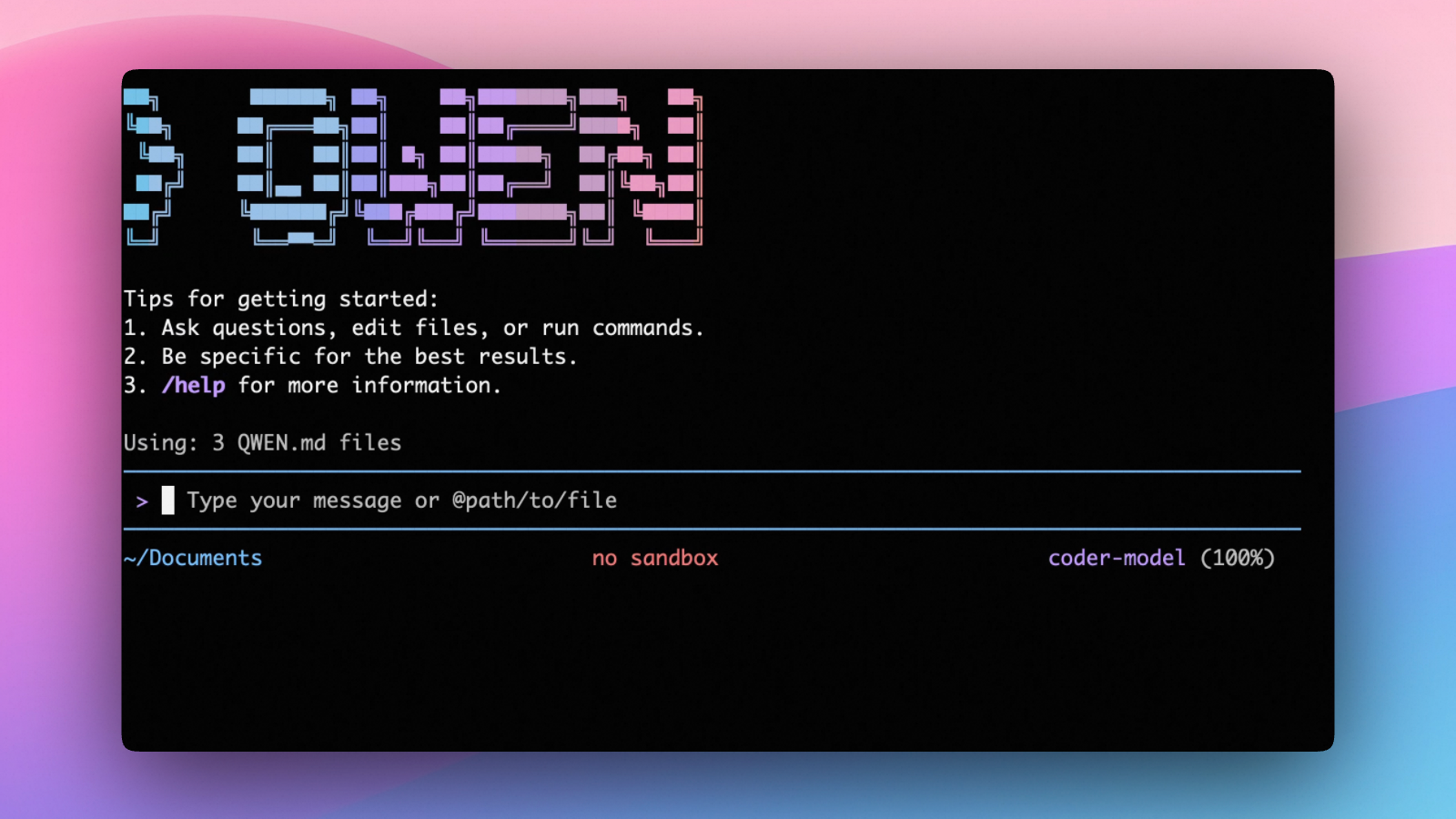
Installation
Quick Install (Recommended)
Linux / macOS
bash -c "$(curl -fsSL https://qwen-code-assets.oss-cn-hangzhou.aliyuncs.com/installation/install-qwen.sh)"
Windows (Run as Administrator)
Works in both Command Prompt and PowerShell:
powershell -Command "Invoke-WebRequest 'https://qwen-code-assets.oss-cn-hangzhou.aliyuncs.com/installation/install-qwen.bat' -OutFile (Join-Path $env:TEMP 'install-qwen.bat'); & (Join-Path $env:TEMP 'install-qwen.bat')"
Note
: It's recommended to restart your terminal after installation to ensure environment variables take effect.
Manual Installation
Prerequisites
Make sure you have Node.js 22 or later installed. Download it from nodejs.org.
NPM
npm install -g @qwen-code/qwen-code@latest
Homebrew (macOS, Linux)
brew install qwen-code
Quick Start
# Start Qwen Code (interactive)
qwen

# Then, in the session:
/help
/auth
On first use, you'll be prompted to sign in. You can run /auth anytime to switch authentication methods.
Example prompts:
What does this project do?
Explain the codebase structure.
Help me refactor this function.
Generate unit tests for this module.
Click to watch a demo video
🦞 Use Qwen Code for Coding Tasks in Claw
Copy the prompt below and paste it into your agent:
Use Qwen Code as a coding agent. First, fetch and read this skill reference:
https://raw.githubusercontent.com/QwenLM/qwen-code/refs/heads/main/.qwen/skills/qwen-code-claw/SKILL.md
Then follow the instructions inside to install, authenticate, and use Qwen Code via acpx for all coding tasks.
Authentication
Qwen Code supports the following authentication methods:
- API Key (recommended): use an API key from Alibaba Cloud Model Studio (Beijing / intl) or any supported provider (OpenAI, Anthropic, Google GenAI, and other compatible endpoints).
- Coding Plan: subscribe to the Alibaba Cloud Coding Plan (Beijing / intl) for a fixed monthly fee with higher quotas.
⚠️ Qwen OAuth was discontinued on April 15, 2026. If you were previously using Qwen OAuth, please switch to one of the methods above. Run
qwenand then/authto reconfigure.
API Key (recommended)
Use an API key to connect to Alibaba Cloud Model Studio or any supported provider. Supports multiple protocols:
- OpenAI-compatible: Alibaba Cloud ModelStudio, ModelScope, OpenAI, OpenRouter, and other OpenAI-compatible providers
- Anthropic: Claude models
- Google GenAI: Gemini models
The recommended way to configure models and providers is by editing ~/.qwen/settings.json (create it if it doesn't exist). This file lets you define all available models, API keys, and default settings in one place.
Quick Setup in 3 Steps
Step 1: Create or edit ~/.qwen/settings.json
Here is a complete example:
{
  "modelProviders": {
    "openai": [
      {
        "id": "qwen3.6-plus",
        "name": "qwen3.6-plus",
        "baseUrl": "https://dashscope.aliyuncs.com/compatible-mode/v1",
        "description": "Qwen3-Coder via Dashscope",
        "envKey": "DASHSCOPE_API_KEY"
      }
    ]
  },
  "env": {
    "DASHSCOPE_API_KEY": "sk-xxxxxxxxxxxxx"
  },
  "security": {
    "auth": {
      "selectedType": "openai"
    }
  },
  "model": {
    "name": "qwen3.6-plus"
  }
}
Step 2: Understand each field
| Field | What it does |
|---|---|
modelProviders |
Declares which models are available and how to connect to them. Keys like openai, anthropic, gemini represent the API protocol. |
modelProviders[].id |
The model ID sent to the API (e.g. qwen3.6-plus, gpt-4o). |
modelProviders[].envKey |
The name of the environment variable that holds your API key. |
modelProviders[].baseUrl |
The API endpoint URL (required for non-default endpoints). |
env |
A fallback place to store API keys (lowest priority; prefer .env files or export for sensitive keys). |
security.auth.selectedType |
The protocol to use on startup (openai, anthropic, gemini, vertex-ai). |
model.name |
The default model to use when Qwen Code starts. |
Step 3: Start Qwen Code — your configuration takes effect automatically:
qwen
Use the /model command at any time to switch between all configured models.
More Examples
Coding Plan (Alibaba Cloud ModelStudio) — fixed monthly fee, higher quotas
{
  "modelProviders": {
    "openai": [
      {
        "id": "qwen3.6-plus",
        "name": "qwen3.6-plus (Coding Plan)",
        "baseUrl": "https://coding.dashscope.aliyuncs.com/v1",
        "description": "qwen3.6-plus from ModelStudio Coding Plan",
        "envKey": "BAILIAN_CODING_PLAN_API_KEY"
      },
      {
        "id": "qwen3.5-plus",
        "name": "qwen3.5-plus (Coding Plan)",
        "baseUrl": "https://coding.dashscope.aliyuncs.com/v1",
        "description": "qwen3.5-plus with thinking enabled from ModelStudio Coding Plan",
        "envKey": "BAILIAN_CODING_PLAN_API_KEY",
        "generationConfig": {
          "extra_body": {
            "enable_thinking": true
          }
        }
      },
      {
        "id": "glm-4.7",
        "name": "glm-4.7 (Coding Plan)",
        "baseUrl": "https://coding.dashscope.aliyuncs.com/v1",
        "description": "glm-4.7 with thinking enabled from ModelStudio Coding Plan",
        "envKey": "BAILIAN_CODING_PLAN_API_KEY",
        "generationConfig": {
          "extra_body": {
            "enable_thinking": true
          }
        }
      },
      {
        "id": "kimi-k2.5",
        "name": "kimi-k2.5 (Coding Plan)",
        "baseUrl": "https://coding.dashscope.aliyuncs.com/v1",
        "description": "kimi-k2.5 with thinking enabled from ModelStudio Coding Plan",
        "envKey": "BAILIAN_CODING_PLAN_API_KEY",
        "generationConfig": {
          "extra_body": {
            "enable_thinking": true
          }
        }
      }
    ]
  },
  "env": {
    "BAILIAN_CODING_PLAN_API_KEY": "sk-xxxxxxxxxxxxx"
  },
  "security": {
    "auth": {
      "selectedType": "openai"
    }
  },
  "model": {
    "name": "qwen3.6-plus"
  }
}
Subscribe to the Coding Plan and get your API key at Alibaba Cloud ModelStudio(Beijing) or Alibaba Cloud ModelStudio(intl).
Multiple providers (OpenAI + Anthropic + Gemini)
{
  "modelProviders": {
    "openai": [
      {
        "id": "gpt-4o",
        "name": "GPT-4o",
        "envKey": "OPENAI_API_KEY",
        "baseUrl": "https://api.openai.com/v1"
      }
    ],
    "anthropic": [
      {
        "id": "claude-sonnet-4-20250514",
        "name": "Claude Sonnet 4",
        "envKey": "ANTHROPIC_API_KEY"
      }
    ],
    "gemini": [
      {
        "id": "gemini-2.5-pro",
        "name": "Gemini 2.5 Pro",
        "envKey": "GEMINI_API_KEY"
      }
    ]
  },
  "env": {
    "OPENAI_API_KEY": "sk-xxxxxxxxxxxxx",
    "ANTHROPIC_API_KEY": "sk-ant-xxxxxxxxxxxxx",
    "GEMINI_API_KEY": "AIzaxxxxxxxxxxxxx"
  },
  "security": {
    "auth": {
      "selectedType": "openai"
    }
  },
  "model": {
    "name": "gpt-4o"
  }
}
Enable thinking mode (for supported models like qwen3.5-plus)
{
  "modelProviders": {
    "openai": [
      {
        "id": "qwen3.5-plus",
        "name": "qwen3.5-plus (thinking)",
        "envKey": "DASHSCOPE_API_KEY",
        "baseUrl": "https://dashscope.aliyuncs.com/compatible-mode/v1",
        "generationConfig": {
          "extra_body": {
            "enable_thinking": true
          }
        }
      }
    ]
  },
  "env": {
    "DASHSCOPE_API_KEY": "sk-xxxxxxxxxxxxx"
  },
  "security": {
    "auth": {
      "selectedType": "openai"
    }
  },
  "model": {
    "name": "qwen3.5-plus"
  }
}
Tip: You can also set API keys via
exportin your shell or.envfiles, which take higher priority thansettings.json→env. See the authentication guide for full details.
Security note: Never commit API keys to version control. The
~/.qwen/settings.jsonfile is in your home directory and should stay private.
Local Model Setup (Ollama / vLLM)
You can also run models locally — no API key or cloud account needed. This is not an authentication method; instead, configure your local model endpoint in ~/.qwen/settings.json using the modelProviders field.
Set generationConfig.contextWindowSize inside the matching provider entry
and adjust it to the context length configured on your local server.
Ollama setup
- Install Ollama from ollama.com
- Pull a model:
ollama pull qwen3:32b - Configure
~/.qwen/settings.json:
{
  "modelProviders": {
    "openai": [
      {
        "id": "qwen3:32b",
        "name": "Qwen3 32B (Ollama)",
        "baseUrl": "http://localhost:11434/v1",
        "description": "Qwen3 32B running locally via Ollama",
        "generationConfig": {
          "contextWindowSize": 131072
        }
      }
    ]
  },
  "security": {
    "auth": {
      "selectedType": "openai"
    }
  },
  "model": {
    "name": "qwen3:32b"
  }
}
vLLM setup
- Install vLLM:
pip install vllm - Start the server:
vllm serve Qwen/Qwen3-32B - Configure
~/.qwen/settings.json:
{
  "modelProviders": {
    "openai": [
      {
        "id": "Qwen/Qwen3-32B",
        "name": "Qwen3 32B (vLLM)",
        "baseUrl": "http://localhost:8000/v1",
        "description": "Qwen3 32B running locally via vLLM",
        "generationConfig": {
          "contextWindowSize": 131072
        }
      }
    ]
  },
  "security": {
    "auth": {
      "selectedType": "openai"
    }
  },
  "model": {
    "name": "Qwen/Qwen3-32B"
  }
}
Usage
As an open-source terminal agent, you can use Qwen Code in five primary ways:
- Interactive mode (terminal UI)
- Headless mode (scripts, CI)
- IDE integration (VS Code, Zed)
- SDKs (TypeScript, Python, Java)
- Daemon mode —
qwen serveexposes ACP over HTTP+SSE so multiple clients share one agent (experimental)
Interactive mode
cd your-project/
qwen
Run qwen in your project folder to launch the interactive terminal UI. Use @ to reference local files (for example @src/main.ts).
Headless mode
cd your-project/
qwen -p "your question"
Use -p to run Qwen Code without the interactive UI—ideal for scripts, automation, and CI/CD. Learn more: Headless mode.
IDE integration
Use Qwen Code inside your editor (VS Code, Zed, and JetBrains IDEs):
Daemon mode (qwen serve, experimental)
cd your-project/
qwen serve
# → qwen serve listening on http://127.0.0.1:4170 (mode=http-bridge)
Run Qwen Code as a local HTTP daemon so IDE plugins, web UIs, CI scripts and custom CLIs all share one agent session over HTTP+SSE — instead of each spawning their own subprocess. Loopback bind has no auth by default (set QWEN_SERVER_TOKEN to enable bearer auth even on loopback); remote binds (--hostname 0.0.0.0) require a token — boot refuses without one. See:
SDKs
Build on top of Qwen Code with the available SDKs:
- TypeScript: Use the Qwen Code SDK
- Python: Use the Python SDK
- Java: Use the Java SDK
Python SDK example:
import asyncio

from qwen_code_sdk import is_sdk_result_message, query


async def main() -> None:
    result = query(
        "Summarize the repository layout.",
        {
            "cwd": "/path/to/project",
            "path_to_qwen_executable": "qwen",
        },
    )

    async for message in result:
        if is_sdk_result_message(message):
            print(message["result"])


asyncio.run(main())
Commands & Shortcuts
Session Commands
/help- Display available commands/clear- Clear conversation history/compress- Compress history to save tokens/stats- Show current session information/bug- Submit a bug report/exitor/quit- Exit Qwen Code
Keyboard Shortcuts
Ctrl+C- Cancel current operationCtrl+D- Exit (on empty line)Up/Down- Navigate command history
Learn more about Commands
Tip: In YOLO mode (
--yolo), vision switching happens automatically without prompts when images are detected. Learn more about Approval Mode
Configuration
Qwen Code can be configured via settings.json, environment variables, and CLI flags.
| File | Scope | Description |
|---|---|---|
~/.qwen/settings.json |
User (global) | Applies to all your Qwen Code sessions. Recommended for modelProviders and env. |
.qwen/settings.json |
Project | Applies only when running Qwen Code in this project. Overrides user settings. |
The most commonly used top-level fields in settings.json:
| Field | Description |
|---|---|
modelProviders |
Define available models per protocol (openai, anthropic, gemini, vertex-ai). |
env |
Fallback environment variables (e.g. API keys). Lower priority than shell export and .env files. |
security.auth.selectedType |
The protocol to use on startup (e.g. openai). |
model.name |
The default model to use when Qwen Code starts. |
See the Authentication section above for complete
settings.jsonexamples, and the settings reference for all available options.
Benchmark Results
Terminal-Bench Performance
| Agent | Model | Accuracy |
|---|---|---|
| Qwen Code | Qwen3-Coder-480A35 | 37.5% |
| Qwen Code | Qwen3-Coder-30BA3B | 31.3% |
Ecosystem
Looking for a graphical interface?
- AionUi A modern GUI for command-line AI tools including Qwen Code
- Gemini CLI Desktop A cross-platform desktop/web/mobile UI for Qwen Code
Troubleshooting
If you encounter issues, check the troubleshooting guide.
Common issues:
Qwen OAuth free tier was discontinued on 2026-04-15: Qwen OAuth is no longer available. Runqwen→/authand switch to API Key or Coding Plan. See the Authentication section above for setup instructions.
To report a bug from within the CLI, run /bug and include a short title and repro steps.
Connect with Us
- Discord: https://discord.gg/RN7tqZCeDK
- Dingtalk: https://qr.dingtalk.com/action/joingroup?code=v1,k1,+FX6Gf/ZDlTahTIRi8AEQhIaBlqykA0j+eBKKdhLeAE=&_dt_no_comment=1&origin=1
Acknowledgments
This project is based on Google Gemini CLI. We acknowledge and appreciate the excellent work of the Gemini CLI team. Our main contribution focuses on parser-level adaptations to better support Qwen-Coder models.