 365409366d
* refactor(core): rewrite compression prompt to 9-section claude-code-style format

Replaces the <state_snapshot> XML template with a numbered 9-section
structure that mandates verbatim preservation of user messages, including
the historical chronological list (section 6). The new format is
designed to pair with post-compact file/image restoration (separate work)
so the agent can resume long single-turn tasks without losing intent.

* refactor(core): align compaction trigger string with new 9-section prompt

The user-turn trigger injected after the system prompt still said
'generate the <state_snapshot>' from the old XML prompt era. Updated to
'produce the 9-section summary' to match Task 1's new prompt format.

Also tightens the prompt test to assert the specific user-message
verbatim mandate (not just the word 'verbatim' anywhere) so a future
regression that drops the mandate won't silently pass.

* feat(core): add postCompactAttachments module with file path extractor

extractRecentFilePaths walks history newest-first and returns the top N
unique file paths touched by read_file/write_file/edit/replace tool calls.
Pure function, no side effects, no state cache — readiness for the next
compaction-rewrite tasks.

* refactor(core): simplify extractRecentFilePaths internals

Three small cleanups from code review:
- Map<string, number> -> Set<string> (the index value was never read)
- Guard against maxFiles <= 0 explicitly (avoids returning 1 result
  when caller passes 0 as a 'disable' sentinel)
- Document 'replace' as a legacy alias for 'edit' so a future cleanup
  pass does not delete it as apparent dead code

Adds one test covering the maxFiles=0 path.

* feat(core): add image extractor with source-tool metadata

extractRecentImages walks history newest-first, collects up to N image
inlineData parts, and attributes each one to the model+functionCall that
preceded it (when one exists). Returns chronological order so callers
can render a meaningful 'last visual state ends here' strip.

* feat(core): add size-adaptive file reader for post-compact restore

readFileSizeAdaptive reads a file and returns one of: embed (full content
for files ≤ maxTokens × 4 chars), reference (path-only for large files),
missing (deleted since last touch), or binary (non-text content). The
embed/reference distinction mirrors claude-code's compact_file_reference
vs file attachment behavior, but without introducing new message types.

* refactor(core): harden readFileSizeAdaptive size accounting

Three corrections from code review:
- Import CHARS_PER_TOKEN from tokenEstimation.ts (canonical) instead of
  redeclaring locally, preventing silent drift between modules.
- Compare decoded character length, not raw byte length, against the
  cap. Otherwise a 10k-char Chinese file would be ~30k bytes and would
  be mis-classified as 'reference' despite fitting the budget.
- Rename FileReadResult -> FileEmbedResult to avoid a name collision
  with the unrelated FileReadResult interface in fileUtils.ts.

Adds a CJK-text test that catches the byte/char regression.

* feat(core): add file restoration block composer

buildFileRestorationBlocks reads each candidate file, classifies it as
embed/reference/missing/binary, and emits one consolidated reference
block (path-only list) plus one user message per embedded small file.
Total embed size is capped at POST_COMPACT_TOKEN_BUDGET; over-budget
files downgrade to reference.

* test(core): make budget test actually exercise the downgrade path

The previous version of this test wrote 3 files totalling 9k chars
against a 200k char budget. The assertions trivially passed regardless
of whether the budget check existed in the implementation.

The new version writes 11 files of 20k chars (each at the per-file cap)
so the budget is exhausted by the 10th and the 11th must downgrade
from embed to reference. Asserts both: file 11 appears in the reference
block, and file 11's content does NOT appear in any embed block.

* feat(core): add image restoration block composer

buildImageRestorationBlock emits a single user message whose first part
is a metadata header (turn index + source tool name + args per image),
followed by the inlineData parts themselves. Handles user-paste images
(no source tool) by labeling them as 'user-provided'.

* feat(core): add composePostCompactHistory orchestrator

Assembles the full post-compact history in order:
  summary → model ack → file references → file embeds → image block.

Each section is built by the per-concern extractors and builders added
in previous tasks. This is the single integration point that
chatCompressionService.compress() will call once the wire-up task lands.

* feat(core)!: rewrite compress() to claude-code-style full-history model

Replaces the split-point + tail-preservation model with full-history
compression + composePostCompactHistory. The entire curated history is
sent to the summary side-query, and the post-compact history is
assembled by the new composer (summary + ack + file restores + image
restore).

BREAKING: the previously-exported findCompressSplitPoint,
splitPointRetainingTrailingPairs, COMPRESSION_PRESERVE_THRESHOLD, and
TOOL_ROUND_RETAIN_COUNT will be removed in the next commit. Tests that
exercise them remain failing temporarily.

* chore(core): remove obsolete split-point compression infrastructure

Deletes findCompressSplitPoint, splitPointRetainingTrailingPairs,
COMPRESSION_PRESERVE_THRESHOLD, MIN_COMPRESSION_FRACTION, and
TOOL_ROUND_RETAIN_COUNT, plus the tests that exercised them. The new
behavior is covered by composePostCompactHistory and its unit tests.

Also cleans up:
- Stale orphan-strip comment in compress() that described the deleted
  manual-trigger orphan-funcCall handling.
- TEST_ONLY.COMPRESSION_PRESERVE_THRESHOLD hatch in client.ts.
- Docstring references in config.ts and compactionInputSlimming.ts.

* test(core): add single-turn computer-use compaction regression

Reproduces the scenario the rewrite targets: one user prompt kicks off
many screenshot tool calls. Asserts that (a) the user prompt is carried
into the summary verbatim and (b) the 3 most recent screenshots are
restored as an image block with source-tool metadata. This is the canary
test for the computer-use UX claim made in the design discussion.

* docs(core): remove stale "split point" references in tokenEstimation comments

Aligns the docstrings with the new compose-based compression flow. The
"split point" and "splitter" concepts no longer exist after the rewrite.

* fix(core): iterate parts reverse so parallel tool calls keep the last N

Real-session E2E surfaced a bug: a model that issues N parallel ReadFile
calls puts all N functionCall parts in ONE model+fc content. The
extractor's outer history walk is newest-first, but the inner parts
walk was forward — so for a 6-parallel batch hitting the cap of 5,
the FIRST 5 parts won and the actually-most-recent (last-listed) file
was dropped.

Fix: walk parts in reverse within each content. Applied symmetrically
to extractRecentImages (same shape, even rarer trigger).

Adds a regression test that hits a 6-parallel batch.

* fix(core): code-review fixes — fence escape, path sanitize, alias removal

- CommonMark-safe fence in file embed blocks. The old 3-backtick fence
  closed prematurely when a file's content contained a triple-backtick
  run (Markdown, CLAUDE.md, JSDoc with code examples) — leaking the
  remainder as unfenced text. Now uses a fence one longer than the
  longest backtick run in the content.

- Strip control characters (\r, \n, \t) from file paths before
  rendering into attachment markdown. Paths come from model-controlled
  history; a \n could inject markdown structure. The actual path stays
  intact for tool calls — only the displayed string is sanitized.

- Remove the historyForCompression alias for curatedHistory in
  compress(). The alias was added as a comment anchor during the
  rewrite but didn't carry semantic information.

* refactor(core): rewrite compression prompt to <state_snapshot> XML with 9 claude-aligned sections

Replaces the 9-section numbered-text prompt with qwen-code's original
<state_snapshot> XML envelope, but with the 9 inner section tags
content-aligned to claude-code:
  <primary_request_and_intent>
  <key_technical_concepts>
  <files_and_code_sections>
  <errors_and_fixes>
  <problem_solving>
  <all_user_messages>
  <pending_tasks>
  <current_work>
  <next_step>

Also:
- <scratchpad> -> <analysis>, stripped by postProcessSummary (saves
  ~600-800 tokens of CoT noise per compaction).
- "Resume directly..." trailer moved out of the prompt body and into
  postProcessSummary (no longer re-generated by the model every
  compaction; lives once in code with our own wording).
- Section 6 verbatim-policed mandate relaxed to "chronological, include
  short messages like 'ok' / 'continue'" — matches claude-code intent
  without forcing the model to literally copy long user messages.

E2E (qwen3.6-plus, 6 substantial .ts files + thorough analysis):
  raw history 6508 -> summary 1513 (after strip ~947), 38% history
  compression. Overall context 24642 -> 20647 reported (-16%), with
  another ~664 tokens actually saved by the post-strip but not
  reflected in the conservative token-math heuristic.

* docs(core): code-review polish on XML prompt rewrite

Four small follow-ups from review of 641a0eadd:

- prompts.ts: rewrite getCompressionPrompt's stale JSDoc — it still
  described the deleted 9-section numbered-text format and the
  verbatim mandate that was relaxed.
- chatCompressionService.ts: clarify the token-math comment so it's
  obvious the ~1000 token deduction covers the full compression
  system prompt + kick-off user turn (not any single instruction)
  and that newTokenCount slightly over-counts because <analysis>
  gets stripped by postProcessSummary downstream.
- postCompactAttachments.ts: add a NOTE comment on the <analysis>
  strip regex covering its strict-tag-match assumption and
  multi-block / non-greedy semantics.
- postCompactAttachments.test.ts: replace the four lazy
  `await import('./postCompactAttachments.js')` calls inside the
  postProcessSummary describe block with one top-level static import
  — consistent with how every other describe in the file imports.

* docs(core): drop stale duplicate sentence left in token-math comment

* fix(core): address wenshao review on PR #4599 (correctness + security + ergonomics)

Seven follow-ups from wenshao's review of the compaction rewrite.

Critical:
- newTokenCount now includes restoration-block tokens via
  estimateContentChars over extraHistory[2..]. Previously the formula
  only counted side-query output, so up to 5 × 5K (files) + 3 × image
  tokens were missing — letting the inflation guard miss and the
  cheap-gate under-estimate the next prompt size (Finding 1).
- composePostCompactHistory now merges every file restoration block
  and the image block into a single user Content following the model
  ack. The previous output had consecutive user roles, which
  geminiChat.test.ts:6289 enforces against and Gemini providers
  reject with 400 "consecutive same-role content" (Finding 2).
- Preserve a trailing model+functionCall through compaction so a
  pending functionResponse (sitting in sendMessageStream's
  pendingUserMessage) has a matching call. Without this, hard-rescue
  auto-compaction mid tool-use loop produces a user+functionResponse
  with no preceding model+functionCall → API 400. This restores the
  protection the split-point in-flight fallback used to provide.
  When the funcCall lands without attachments it folds into the
  ack's own model Content to avoid model→model adjacency (Finding 3).
- composePostCompactHistory now takes an optional workspaceRoot and
  silently skips file paths that resolve outside it.
  extractRecentFilePaths picks up paths from model functionCall args
  regardless of whether the tool execution succeeded; without a
  boundary check, an adversarial model that issued
  read_file('/etc/passwd') — denied by the permission system —
  would still have its path extracted and re-read into the next
  prompt. compress() passes config.getTargetDir() as the boundary
  (Finding 4).

Suggestions:
- composePostCompactHistory + buildFileRestorationBlocks +
  readFileSizeAdaptive all take optional AbortSignal and short-
  circuit / pass it to readFile's { signal } option. Cancelled
  compactions stop on the next file read (Finding 5).
- postProcessSummary fallback no longer re-injects the raw
  <analysis> block when the strip leaves nothing. The new
  stripAnalysisBlock helper runs the closed-tag strip AND an
  unclosed-tag strip (handles 'model ran out of output tokens
  before closing'). If both leave nothing, postProcessSummary
  emits '[Summary unavailable]' rather than leaking scratchpad
  (Finding 6).
- firePostCompactEvent now receives stripAnalysisBlock(summary) so
  hook consumers see the same text that lands in history. The
  resume trailer stays out of the hook payload — that's wrapper
  decoration for the next agent turn, not state for consumers
  (Finding 8a).

Docs:
- Update the geminiChat.ts comment around `trigger: 'auto'` to
  describe what the trigger actually does post-refactor (hook event
  categorization) rather than the deleted manual-only orphan-strip
  it used to guard against (Finding 8b).

Regression tests cover all six fixable code-path changes
(role alternation, trailing funcCall preservation, workspace
boundary, abort propagation, closed-tag fallback strip, unclosed-tag
fallback strip).

* fix(core): add getTargetDir to geminiChat auto-compression test mock

The R3.4 end-to-end auto-compression test drives the real
ChatCompressionService, which reads config.getTargetDir() for the
post-compact file-restoration workspace boundary. The geminiChat mock
config lacked getTargetDir, so the test threw "config.getTargetDir is
not a function" on CI. Add the mock to unblock the failing Test jobs.

* feat(core): configurable compaction retention + computer-use screenshot trigger

Add four env-overridable chatCompression settings (priority env >
settings > default):
- maxRecentFilesToRetain    (QWEN_COMPACT_MAX_RECENT_FILES,     default 5)
- maxRecentImagesToRetain   (QWEN_COMPACT_MAX_RECENT_IMAGES,    default 3)
- enableScreenshotTrigger   (QWEN_COMPACT_SCREENSHOT_TRIGGER,   default true)
- screenshotTriggerThreshold(QWEN_COMPACT_SCREENSHOT_THRESHOLD, default 50)

The screenshot trigger fires auto-compaction once tool-returned images
accumulate to the threshold even when token usage is below the auto tier,
so computer-use sessions don't drown the model in stale screenshots. It
counts only images nested in functionResponse.parts (tool results), not
user pastes, and runs only in the would-be-NOOP path when enabled.

Fix a latent bug surfaced while wiring the trigger: extractRecentImages
only inspected top-level inlineData parts, but convertToFunctionResponse
nests tool media under functionResponse.parts — so post-compact
restoration recovered ZERO tool screenshots in real sessions, while unit
tests stayed green against a fabricated top-level shape. It now walks both
shapes; the image counter and tests use the real nested shape.

Remove the now-defunct contextPercentageThreshold deprecation warning (the
field was already dropped from ChatCompressionSettings) and its tests, and
document the four new settings.

* test(core): assert screenshot trigger can't re-fire post-compaction; fix misleading docs

Code-review follow-up. The screenshot trigger counts only images nested in
functionResponse.parts. Compaction replaces those with the summary and
re-embeds survivors as TOP-LEVEL parts in the restoration block, which the
counter ignores — so the tool-image count always resets to ~0 and the
trigger cannot immediately re-fire, independent of maxRecentImages.

The resolveCompactionTuning JSDoc and the settings.md note previously warned
of a non-existent "maxRecentImages near threshold => compact every turn"
loop. Correct both, and add a regression test asserting
countToolResponseImages() is 0 on composePostCompactHistory output.

* fix(core): guard readFileSizeAdaptive against multi-GB reads; cover composer 4-entry branch

wenshao review round 2 on PR #4599.

- readFileSizeAdaptive now stats the file first and short-circuits to a
  reference when its byte size exceeds maxChars*4 (the safe UTF-8 upper
  bound — a file larger than that cannot fit within maxChars chars). This
  stops a multi-GB file the agent previously touched from being slurped
  into a Buffer and exhausting the heap mid-compaction, exactly when we're
  trying to reduce memory. A large binary file now references rather than
  reading to binary-detect.

- Add a test for composePostCompactHistory's 4-entry branch (attachments +
  trailing model+functionCall) producing [user(summary), model(ack),
  user(attachments), model(fc)]. This is the common mid-tool-loop
  compaction case; a model->model adjacency here is a provider 400. Prior
  tests only covered the 2-entry fold (no attachments) and 3-entry (no
  trailing fc) shapes.

* fix(core): resolve symlinks in workspace boundary; guard compose against throws

wenshao review round 3 on PR #4599 (two Criticals).

- isInsideWorkspace now resolves symlinks via realpathSync (safeRealpath,
  with a lexical fallback for non-existent paths). A symlink living inside
  the workspace but pointing outside (e.g. workspace/.env -> ~/.ssh/id_rsa)
  previously passed the lexical boundary check and had its target read and
  embedded into the post-compact history sent to the provider. Added a
  RED-verified security regression test (secret embedded under the old
  lexical check; rejected under realpath).

- Wrap composePostCompactHistory in try/catch inside compress(). The
  summary side-query has already succeeded at that point, so a
  restoration-assembly throw (disk I/O / malformed history) previously
  escaped to sendMessageStream, crashing the active turn AND bypassing the
  COMPRESSION_FAILED breaker. It now degrades to summary + ack.

* fix(core): close 4 compaction Criticals from review round 4

wenshao review round 4 on PR #4599.

- isSummaryEmpty now checks the STRIPPED summary: a response that is only an
  <analysis> block (no <state_snapshot>) strips to empty, so it takes the
  COMPRESSION_FAILED_EMPTY_SUMMARY path instead of "succeeding" with
  `[Summary unavailable]` as the agent's only context (silent amnesia).
- Manual /compress strips a trailing ORPHANED model+functionCall before
  composing — it has no pending functionResponse, so preserving it would
  emit model[fc] then the next user text turn -> API 400. Auto-compaction
  still keeps it (the pending response pairs with it).
- The restoration-failure catch fallback now folds a trailing
  model+functionCall into the ack turn, so a pending functionResponse
  (auto mid-tool-loop) keeps its matching call even on the degraded path.
- extractRecentFilePaths skips file paths whose tool call FAILED (an error
  functionResponse), so a denied read_file is never re-read off disk during
  compaction — closing a permission-bypass side channel.

RED-verified regression tests for the empty-summary, orphan-strip, and
permission-bypass fixes. Corrected the postProcessSummary comment.

* test(core): cover composePostCompactHistory catch-fallback; document fold text drop

wenshao review round 5 on PR #4599.

- Regression test for the restoration-failure catch fallback: mock
  composePostCompactHistory to reject and assert compaction still returns
  COMPRESSED (no escape to sendMessageStream / breaker bypass) with the
  trailing functionCall folded into the ack and the trailing text dropped.
- Document that the fold branch intentionally keeps only functionCall parts
  (the trailing turn's text is already captured in the summary); the
  asymmetry with the with-attachments branch is deliberate.
|
||
|---|---|---|
| .github | ||
| .husky | ||
| .qwen | ||
| .vscode | ||
| docs | ||
| docs-site | ||
| eslint-rules | ||
| integration-tests | ||
| packages | ||
| scripts | ||
| .dockerignore | ||
| .editorconfig | ||
| .gitattributes | ||
| .gitignore | ||
| .npmrc | ||
| .nvmrc | ||
| .prettierignore | ||
| .prettierrc.json | ||
| .yamllint.yml | ||
| AGENTS.md | ||
| CONTRIBUTING.md | ||
| Dockerfile | ||
| esbuild.config.js | ||
| eslint.config.js | ||
| LICENSE | ||
| Makefile | ||
| package-lock.json | ||
| package.json | ||
| README.md | ||
| SECURITY.md | ||
| tsconfig.json | ||
| vitest.config.ts | ||




An open-source AI agent that lives in your terminal.
中文 | Deutsch | français | 日本語 | Русский | Português (Brasil)
🎉 News
-
2026-04-15: Qwen OAuth free tier has been discontinued. To continue using Qwen Code, switch to Alibaba Cloud Coding Plan, OpenRouter, Fireworks AI, or bring your own API key. Run
qwen authto configure. -
2026-04-13: Qwen OAuth free tier policy update: daily quota adjusted to 100 requests/day (from 1,000).
-
2026-04-02: Qwen3.6-Plus is now live! Get an API key from Alibaba Cloud ModelStudio to access it through the OpenAI-compatible API.
-
2026-02-16: Qwen3.5-Plus is now live!
Why Qwen Code?
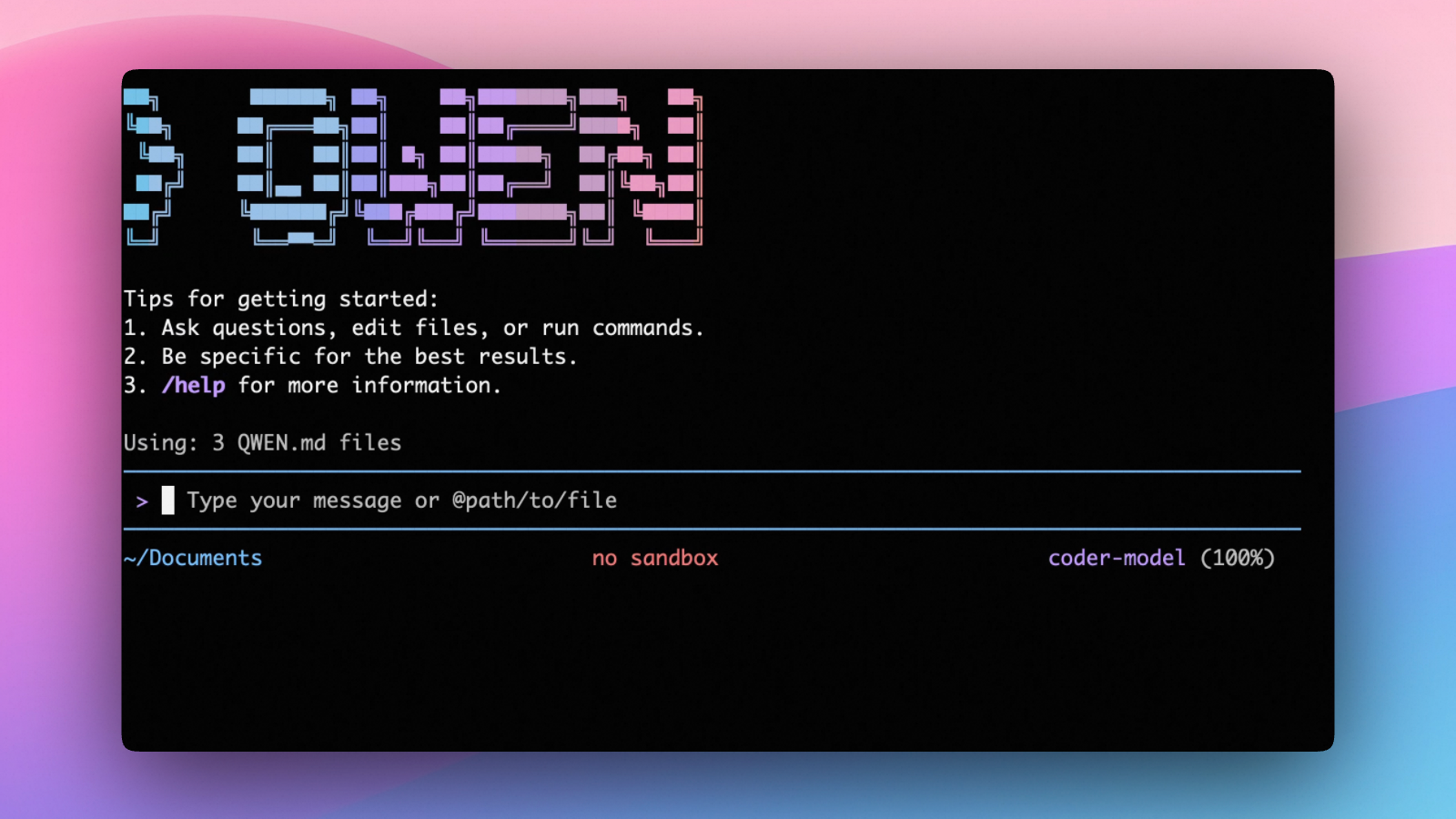
Qwen Code is an open-source AI agent for the terminal, optimized for Qwen series models. It helps you understand large codebases, automate tedious work, and ship faster.
- Multi-protocol, flexible providers: use OpenAI / Anthropic / Gemini-compatible APIs, Alibaba Cloud Coding Plan, OpenRouter, Fireworks AI, or bring your own API key.
- Open-source, co-evolving: both the framework and the Qwen3-Coder model are open-source—and they ship and evolve together.
- Agentic workflow, feature-rich: rich built-in tools (Skills, SubAgents) for a full agentic workflow and a Claude Code-like experience.
- Terminal-first, IDE-friendly: built for developers who live in the command line, with optional integration for VS Code, Zed, and JetBrains IDEs.
Installation
Quick Install (Recommended)
Linux / macOS
bash -c "$(curl -fsSL https://qwen-code-assets.oss-cn-hangzhou.aliyuncs.com/installation/install-qwen.sh)"
Windows (Run as Administrator)
Works in both Command Prompt and PowerShell:
powershell -Command "Invoke-WebRequest 'https://qwen-code-assets.oss-cn-hangzhou.aliyuncs.com/installation/install-qwen.bat' -OutFile (Join-Path $env:TEMP 'install-qwen.bat'); & (Join-Path $env:TEMP 'install-qwen.bat')"
Note
: It's recommended to restart your terminal after installation to ensure environment variables take effect.
Manual Installation
Prerequisites
Make sure you have Node.js 22 or later installed. Download it from nodejs.org.
NPM
npm install -g @qwen-code/qwen-code@latest
Homebrew (macOS, Linux)
brew install qwen-code
Quick Start
# Start Qwen Code (interactive)
qwen

# Then, in the session:
/help
/auth
On first use, you'll be prompted to sign in. You can run /auth anytime to switch authentication methods.
Example prompts:
What does this project do?
Explain the codebase structure.
Help me refactor this function.
Generate unit tests for this module.
Click to watch a demo video
🦞 Use Qwen Code for Coding Tasks in Claw
Copy the prompt below and paste it into your agent:
Use Qwen Code as a coding agent. First, fetch and read this skill reference:
https://raw.githubusercontent.com/QwenLM/qwen-code/refs/heads/main/.qwen/skills/qwen-code-claw/SKILL.md
Then follow the instructions inside to install, authenticate, and use Qwen Code via acpx for all coding tasks.
Authentication
Qwen Code supports the following authentication methods:
- API Key (recommended): use an API key from Alibaba Cloud Model Studio (Beijing / intl) or any supported provider (OpenAI, Anthropic, Google GenAI, and other compatible endpoints).
- Coding Plan: subscribe to the Alibaba Cloud Coding Plan (Beijing / intl) for a fixed monthly fee with higher quotas.
⚠️ Qwen OAuth was discontinued on April 15, 2026. If you were previously using Qwen OAuth, please switch to one of the methods above. Run
qwenand then/authto reconfigure.
API Key (recommended)
Use an API key to connect to Alibaba Cloud Model Studio or any supported provider. Supports multiple protocols:
- OpenAI-compatible: Alibaba Cloud ModelStudio, ModelScope, OpenAI, OpenRouter, and other OpenAI-compatible providers
- Anthropic: Claude models
- Google GenAI: Gemini models
The recommended way to configure models and providers is by editing ~/.qwen/settings.json (create it if it doesn't exist). This file lets you define all available models, API keys, and default settings in one place.
Quick Setup in 3 Steps
Step 1: Create or edit ~/.qwen/settings.json
Here is a complete example:
{
  "modelProviders": {
    "openai": [
      {
        "id": "qwen3.6-plus",
        "name": "qwen3.6-plus",
        "baseUrl": "https://dashscope.aliyuncs.com/compatible-mode/v1",
        "description": "Qwen3-Coder via Dashscope",
        "envKey": "DASHSCOPE_API_KEY"
      }
    ]
  },
  "env": {
    "DASHSCOPE_API_KEY": "sk-xxxxxxxxxxxxx"
  },
  "security": {
    "auth": {
      "selectedType": "openai"
    }
  },
  "model": {
    "name": "qwen3.6-plus"
  }
}
Step 2: Understand each field
| Field | What it does |
|---|---|
modelProviders |
Declares which models are available and how to connect to them. Keys like openai, anthropic, gemini represent the API protocol. |
modelProviders[].id |
The model ID sent to the API (e.g. qwen3.6-plus, gpt-4o). |
modelProviders[].envKey |
The name of the environment variable that holds your API key. |
modelProviders[].baseUrl |
The API endpoint URL (required for non-default endpoints). |
env |
A fallback place to store API keys (lowest priority; prefer .env files or export for sensitive keys). |
security.auth.selectedType |
The protocol to use on startup (openai, anthropic, gemini, vertex-ai). |
model.name |
The default model to use when Qwen Code starts. |
Step 3: Start Qwen Code — your configuration takes effect automatically:
qwen
Use the /model command at any time to switch between all configured models.
More Examples
Coding Plan (Alibaba Cloud ModelStudio) — fixed monthly fee, higher quotas
{
  "modelProviders": {
    "openai": [
      {
        "id": "qwen3.6-plus",
        "name": "qwen3.6-plus (Coding Plan)",
        "baseUrl": "https://coding.dashscope.aliyuncs.com/v1",
        "description": "qwen3.6-plus from ModelStudio Coding Plan",
        "envKey": "BAILIAN_CODING_PLAN_API_KEY"
      },
      {
        "id": "qwen3.5-plus",
        "name": "qwen3.5-plus (Coding Plan)",
        "baseUrl": "https://coding.dashscope.aliyuncs.com/v1",
        "description": "qwen3.5-plus with thinking enabled from ModelStudio Coding Plan",
        "envKey": "BAILIAN_CODING_PLAN_API_KEY",
        "generationConfig": {
          "extra_body": {
            "enable_thinking": true
          }
        }
      },
      {
        "id": "glm-4.7",
        "name": "glm-4.7 (Coding Plan)",
        "baseUrl": "https://coding.dashscope.aliyuncs.com/v1",
        "description": "glm-4.7 with thinking enabled from ModelStudio Coding Plan",
        "envKey": "BAILIAN_CODING_PLAN_API_KEY",
        "generationConfig": {
          "extra_body": {
            "enable_thinking": true
          }
        }
      },
      {
        "id": "kimi-k2.5",
        "name": "kimi-k2.5 (Coding Plan)",
        "baseUrl": "https://coding.dashscope.aliyuncs.com/v1",
        "description": "kimi-k2.5 with thinking enabled from ModelStudio Coding Plan",
        "envKey": "BAILIAN_CODING_PLAN_API_KEY",
        "generationConfig": {
          "extra_body": {
            "enable_thinking": true
          }
        }
      }
    ]
  },
  "env": {
    "BAILIAN_CODING_PLAN_API_KEY": "sk-xxxxxxxxxxxxx"
  },
  "security": {
    "auth": {
      "selectedType": "openai"
    }
  },
  "model": {
    "name": "qwen3.6-plus"
  }
}
Subscribe to the Coding Plan and get your API key at Alibaba Cloud ModelStudio(Beijing) or Alibaba Cloud ModelStudio(intl).
Multiple providers (OpenAI + Anthropic + Gemini)
{
  "modelProviders": {
    "openai": [
      {
        "id": "gpt-4o",
        "name": "GPT-4o",
        "envKey": "OPENAI_API_KEY",
        "baseUrl": "https://api.openai.com/v1"
      }
    ],
    "anthropic": [
      {
        "id": "claude-sonnet-4-20250514",
        "name": "Claude Sonnet 4",
        "envKey": "ANTHROPIC_API_KEY"
      }
    ],
    "gemini": [
      {
        "id": "gemini-2.5-pro",
        "name": "Gemini 2.5 Pro",
        "envKey": "GEMINI_API_KEY"
      }
    ]
  },
  "env": {
    "OPENAI_API_KEY": "sk-xxxxxxxxxxxxx",
    "ANTHROPIC_API_KEY": "sk-ant-xxxxxxxxxxxxx",
    "GEMINI_API_KEY": "AIzaxxxxxxxxxxxxx"
  },
  "security": {
    "auth": {
      "selectedType": "openai"
    }
  },
  "model": {
    "name": "gpt-4o"
  }
}
Enable thinking mode (for supported models like qwen3.5-plus)
{
  "modelProviders": {
    "openai": [
      {
        "id": "qwen3.5-plus",
        "name": "qwen3.5-plus (thinking)",
        "envKey": "DASHSCOPE_API_KEY",
        "baseUrl": "https://dashscope.aliyuncs.com/compatible-mode/v1",
        "generationConfig": {
          "extra_body": {
            "enable_thinking": true
          }
        }
      }
    ]
  },
  "env": {
    "DASHSCOPE_API_KEY": "sk-xxxxxxxxxxxxx"
  },
  "security": {
    "auth": {
      "selectedType": "openai"
    }
  },
  "model": {
    "name": "qwen3.5-plus"
  }
}
Tip: You can also set API keys via
exportin your shell or.envfiles, which take higher priority thansettings.json→env. See the authentication guide for full details.
Security note: Never commit API keys to version control. The
~/.qwen/settings.jsonfile is in your home directory and should stay private.
Local Model Setup (Ollama / vLLM)
You can also run models locally — no API key or cloud account needed. This is not an authentication method; instead, configure your local model endpoint in ~/.qwen/settings.json using the modelProviders field.
Set generationConfig.contextWindowSize inside the matching provider entry
and adjust it to the context length configured on your local server.
Ollama setup
- Install Ollama from ollama.com
- Pull a model:
ollama pull qwen3:32b - Configure
~/.qwen/settings.json:
{
  "modelProviders": {
    "openai": [
      {
        "id": "qwen3:32b",
        "name": "Qwen3 32B (Ollama)",
        "baseUrl": "http://localhost:11434/v1",
        "description": "Qwen3 32B running locally via Ollama",
        "generationConfig": {
          "contextWindowSize": 131072
        }
      }
    ]
  },
  "security": {
    "auth": {
      "selectedType": "openai"
    }
  },
  "model": {
    "name": "qwen3:32b"
  }
}
vLLM setup
- Install vLLM:
pip install vllm - Start the server:
vllm serve Qwen/Qwen3-32B - Configure
~/.qwen/settings.json:
{
  "modelProviders": {
    "openai": [
      {
        "id": "Qwen/Qwen3-32B",
        "name": "Qwen3 32B (vLLM)",
        "baseUrl": "http://localhost:8000/v1",
        "description": "Qwen3 32B running locally via vLLM",
        "generationConfig": {
          "contextWindowSize": 131072
        }
      }
    ]
  },
  "security": {
    "auth": {
      "selectedType": "openai"
    }
  },
  "model": {
    "name": "Qwen/Qwen3-32B"
  }
}
Usage
As an open-source terminal agent, you can use Qwen Code in five primary ways:
- Interactive mode (terminal UI)
- Headless mode (scripts, CI)
- IDE integration (VS Code, Zed)
- SDKs (TypeScript, Python, Java)
- Daemon mode —
qwen serveexposes ACP over HTTP+SSE so multiple clients share one agent (experimental)
Interactive mode
cd your-project/
qwen
Run qwen in your project folder to launch the interactive terminal UI. Use @ to reference local files (for example @src/main.ts).
Headless mode
cd your-project/
qwen -p "your question"
Use -p to run Qwen Code without the interactive UI—ideal for scripts, automation, and CI/CD. Learn more: Headless mode.
IDE integration
Use Qwen Code inside your editor (VS Code, Zed, and JetBrains IDEs):
Daemon mode (qwen serve, experimental)
cd your-project/
qwen serve
# → qwen serve listening on http://127.0.0.1:4170 (mode=http-bridge)
Run Qwen Code as a local HTTP daemon so IDE plugins, web UIs, CI scripts and custom CLIs all share one agent session over HTTP+SSE — instead of each spawning their own subprocess. Loopback bind has no auth by default (set QWEN_SERVER_TOKEN to enable bearer auth even on loopback); remote binds (--hostname 0.0.0.0) require a token — boot refuses without one. See:
SDKs
Build on top of Qwen Code with the available SDKs:
- TypeScript: Use the Qwen Code SDK
- Python: Use the Python SDK
- Java: Use the Java SDK
Python SDK example:
import asyncio

from qwen_code_sdk import is_sdk_result_message, query


async def main() -> None:
    result = query(
        "Summarize the repository layout.",
        {
            "cwd": "/path/to/project",
            "path_to_qwen_executable": "qwen",
        },
    )

    async for message in result:
        if is_sdk_result_message(message):
            print(message["result"])


asyncio.run(main())
Commands & Shortcuts
Session Commands
/help- Display available commands/clear- Clear conversation history/compress- Compress history to save tokens/stats- Show current session information/bug- Submit a bug report/exitor/quit- Exit Qwen Code
Keyboard Shortcuts
Ctrl+C- Cancel current operationCtrl+D- Exit (on empty line)Up/Down- Navigate command history
Learn more about Commands
Tip: In YOLO mode (
--yolo), vision switching happens automatically without prompts when images are detected. Learn more about Approval Mode
Configuration
Qwen Code can be configured via settings.json, environment variables, and CLI flags.
| File | Scope | Description |
|---|---|---|
~/.qwen/settings.json |
User (global) | Applies to all your Qwen Code sessions. Recommended for modelProviders and env. |
.qwen/settings.json |
Project | Applies only when running Qwen Code in this project. Overrides user settings. |
The most commonly used top-level fields in settings.json:
| Field | Description |
|---|---|
modelProviders |
Define available models per protocol (openai, anthropic, gemini, vertex-ai). |
env |
Fallback environment variables (e.g. API keys). Lower priority than shell export and .env files. |
security.auth.selectedType |
The protocol to use on startup (e.g. openai). |
model.name |
The default model to use when Qwen Code starts. |
See the Authentication section above for complete
settings.jsonexamples, and the settings reference for all available options.
Benchmark Results
Terminal-Bench Performance
| Agent | Model | Accuracy |
|---|---|---|
| Qwen Code | Qwen3-Coder-480A35 | 37.5% |
| Qwen Code | Qwen3-Coder-30BA3B | 31.3% |
Ecosystem
Looking for a graphical interface?
- AionUi A modern GUI for command-line AI tools including Qwen Code
- Gemini CLI Desktop A cross-platform desktop/web/mobile UI for Qwen Code
Troubleshooting
If you encounter issues, check the troubleshooting guide.
Common issues:
Qwen OAuth free tier was discontinued on 2026-04-15: Qwen OAuth is no longer available. Runqwen→/authand switch to API Key or Coding Plan. See the Authentication section above for setup instructions.
To report a bug from within the CLI, run /bug and include a short title and repro steps.
Connect with Us
- Discord: https://discord.gg/RN7tqZCeDK
- Dingtalk: https://qr.dingtalk.com/action/joingroup?code=v1,k1,+FX6Gf/ZDlTahTIRi8AEQhIaBlqykA0j+eBKKdhLeAE=&_dt_no_comment=1&origin=1
Acknowledgments
This project is based on Google Gemini CLI. We acknowledge and appreciate the excellent work of the Gemini CLI team. Our main contribution focuses on parser-level adaptations to better support Qwen-Coder models.