 30c35781b3
* ci(autofix): loosen issue candidate filters so the agent finds work

The scheduled issue phase had been finding 0 candidates on every run. Tier-1
requires the rarely-applied status/ready-for-agent label, and tier-2's
"unattended = no human comment at all" rule fought its ">2 days old" age
gate: on a busy repo every aged bug already has a community reply, so the
funnel collapsed (128 aged bugs -> 0 survivors) purely on the comment rule.

- Unattended now keys off maintainer engagement (OWNER/MEMBER/COLLABORATOR
  comments, excluding our own bots), not any human comment. Community
  "+1"/"me too" no longer disqualifies an issue.
- Tier-1 and tier-2 are always both gathered (tier-1 prioritized, then
  de-duped by number) so a single weak ready-for-agent issue can't starve
  the run.
- Tier-2 scans a bounded age window via MIN_ISSUE_AGE_DAYS..MAX_ISSUE_AGE_DAYS
  (1..15) to focus on fresh, settled bugs instead of an unbounded set.

Co-authored-by: Qwen-Coder <qwen-coder@alibabacloud.com>

* fix(ci): preserve autofix issue tier priority

* fix(ci): keep ready autofix issues in tier one

* fix(ci): reserve autofix tier two slots

* fix(ci): tolerate tier two autofix scan failures

* fix(ci): tolerate tier one autofix scan failures

* fix(ci): harden autofix candidate merging

* fix(ci): harden autofix issue scanning

* fix(ci): harden autofix diagnostics

* fix(ci): skip unsafe autofix comment fallbacks

* fix(ci): drop unused autofix comments payload

* test(ci): strengthen autofix comment refresh guard

* test(ci): satisfy autofix workflow lint

* test(ci): tighten autofix tier two assertion

* test(ci): cover autofix tier merge guards

* test(ci): cover autofix unattended filter

* fix(ci): summarize autofix comment refresh drops

* fix(ci): bound autofix tier-2 comment-refresh API calls

Cap the tier-2 issues fed into the comment-refresh loop to 15 (a margin
above the ~10 ever selected, since filter_unattended_candidates drops
attended issues afterward) and request full pages with per_page=100, to
avoid GitHub secondary rate limits. Add workflow tests asserting the
forced-issue skip/in-progress exclusion and the tier-2 ready-for-agent
label exclusion stay in place.

Co-Authored-By: Qwen-Coder <noreply@qwen.ai>

* fix(ci): refresh all scanned tier-2 autofix issues, not just first 15

The previous change capped comment-refresh to the first 15 tier-2 issues
before filter_unattended_candidates runs. The scan still fetches 30, so
valid unattended bugs at positions 16-30 were never refreshed nor
filterable: if the first 15 were all maintainer-attended/dropped, the run
could end with zero candidates again — the failure this PR set out to fix.

Drop the .[0:15] refresh cap and refresh the full scanned set (already
bounded by --limit 30 on the scan). per_page=100 stays as the
pages-per-issue rate-limit mitigation, and the drop summary total/counters
reflect the full refreshed set again. Top-N selection after filtering is
unchanged.

Co-Authored-By: Qwen-Coder <noreply@qwen.ai>

* fix(ci): order tier priority before recency in autofix assess prompt

The assess prompt gave two conflicting selection rules: the tier note says not to pick a tier-2 issue over a comparably actionable tier-1 one, while the recency tiebreaker says to prefer the most recently reported. Since tier-1 has no age bound and tier-2 is the recent (1-15 day) tier, these point in opposite directions for comparable confidence. Make recency apply only after the tier preference and only within the same tier, removing the contradiction. Prompt text only; no shell/jq change.

Co-Authored-By: Qwen-Coder <noreply@qwen.ai>

* fix(ci): guard forced-issue jq and derive autofix comment scratch path

Address two review suggestions on the autofix candidate scan step.

- Wrap the forced-issue candidate jq in the same error guard the other
  jq calls use (tier-1/tier-2 stamp, tier merge): on malformed
  forced-issue JSON it now emits a :⚠️: and falls back to an empty
  candidate list instead of silently producing an empty candidates.json
  with no diagnostic.
- Make refresh_issue_comments reuse-safe by deriving its NDJSON scratch
  path from the output_file parameter (${output_file%.json}.ndjson)
  instead of hardcoding tier2-with-comments.ndjson, so a second call or a
  different tier can't clobber a shared scratch file. Behavior for the
  current single call is unchanged.

Co-Authored-By: Qwen-Coder <noreply@qwen.ai>

---------

Co-authored-by: Qwen-Coder <qwen-coder@alibabacloud.com>
Co-authored-by: Qwen-Coder <noreply@qwen.ai>
|
||
|---|---|---|
| .github | ||
| .husky | ||
| .qwen | ||
| .vscode | ||
| docs | ||
| docs-site | ||
| eslint-rules | ||
| integration-tests | ||
| packages | ||
| patches | ||
| scripts | ||
| .dockerignore | ||
| .editorconfig | ||
| .gitattributes | ||
| .gitignore | ||
| .npmrc | ||
| .nvmrc | ||
| .prettierignore | ||
| .prettierrc.json | ||
| .yamllint.yml | ||
| AGENTS.md | ||
| CHANGELOG.md | ||
| CLAUDE.md | ||
| CONTRIBUTING.md | ||
| Dockerfile | ||
| esbuild.config.js | ||
| eslint.config.js | ||
| eslint.legacy-filenames.mjs | ||
| LICENSE | ||
| Makefile | ||
| package-lock.json | ||
| package.json | ||
| README.md | ||
| SECURITY.md | ||
| tsconfig.json | ||
| vitest.config.ts | ||




The open-source AI coding agent that lives in your terminal.
中文 | Deutsch | français | 日本語 | Русский | Português (Brasil)
Why Qwen Code?
- Agentic out of the box — Auto-Memory, Auto-Skills, SubAgents, Agent Teams, and MCP. Dynamic workflows, zero setup.
- Open-source, inside and out — The framework and the Qwen models are open-source. They evolve together. No vendor lock-in.
- Multi-protocol — Supports OpenAI, Anthropic, Gemini, and Qwen APIs. Any third-party provider or local model (Ollama / vLLM). Switch at runtime.
- Beyond the terminal — IDE plugins, Desktop app, daemon mode, SDKs, and IM bots (Telegram / DingTalk / WeChat / Feishu).
Tip
Qwen Code is actively iterating on itself — using its own agent and models to file issues, submit PRs, review code, and run tests. Powered by the community, driven by AI.
Installation
Linux / macOS:
curl -fsSL https://qwen-code-assets.oss-cn-hangzhou.aliyuncs.com/installation/install-qwen-standalone.sh | bash
Windows:
irm https://qwen-code-assets.oss-cn-hangzhou.aliyuncs.com/installation/install-qwen-standalone.ps1 | iex
Restart your terminal after installation to ensure environment variables take effect.
NPM / Homebrew
NPM (requires Node.js 22+):
npm install -g @qwen-code/qwen-code@latest
Homebrew (macOS / Linux):
brew install qwen-code
Quick Start
qwen          # Launch interactive terminal UI
# Inside the session:
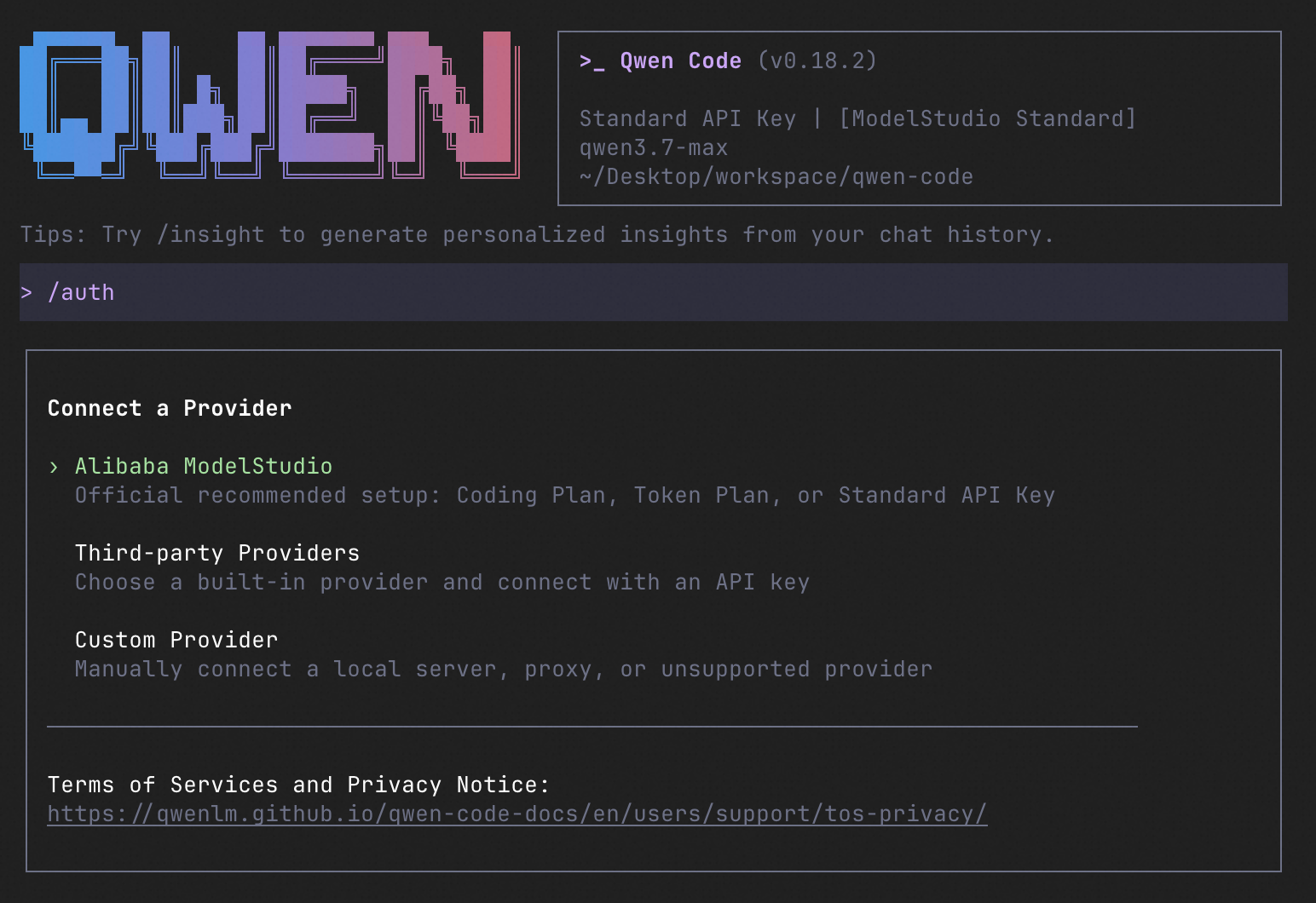
/auth         # Configure your provider and API key
See the Authentication Guide and Settings Reference for detailed setup.
How to Use Qwen Code
| Mode | Command | Use Case |
|---|---|---|
| Interactive | qwen |
Terminal UI with rich rendering, @file references, slash commands |
| Headless | qwen -p "..." |
Scripts, CI/CD, batch processing — no UI |
| IDE | — | VS Code, Zed, JetBrains |
| Desktop | — | Qwen Code Desktop — GUI for macOS, Windows, Linux |
| Daemon | qwen serve |
Shared agent session over HTTP+SSE (ACP). Multiple clients, one agent. (experimental) Docs |
| SDK | — | TypeScript, Python, Java |
| IM Bot | qwen channel |
Connect to Telegram, DingTalk, WeChat, or Feishu |
SDK example (Python)
import asyncio

from qwen_code_sdk import is_sdk_result_message, query


async def main() -> None:
    result = query(
        "Summarize the repository layout.",
        {
            "cwd": "/path/to/project",
            "path_to_qwen_executable": "qwen",
        },
    )

    async for message in result:
        if is_sdk_result_message(message):
            print(message["result"])


asyncio.run(main())
Capabilities
If you know Claude Code, you already know Qwen Code — and then some. We've put significant effort into bringing Qwen Code to feature parity with Claude Code, improving both breadth and reliability across the board.
| Feature | Qwen Code | Claude Code |
|---|---|---|
| SubAgents, Agent Teams, Dynamic Workflows | ✓ | ✓ |
| Auto-Memory, Auto-Skills, Hooks | ✓ | ✓ |
| Built-in Skills (/review, /batch, /loop, /bugfix…) | ✓ | ✓ |
| MCP, Plan Mode, LSP Integration | ✓ | ✓ |
| Auto Mode, Sandbox, Git Worktrees | ✓ | ✓ |
| Computer Use (desktop automation) | ✓ | ✓ |
| IDE Plugins (VS Code / JetBrains / Zed) | ✓ | ✓ |
| SDK | ✓ | ✓ |
| Headless Mode, Session Management | ✓ | ✓ |
| Open-source — model and framework | ✓ | — |
| Multi-protocol (OpenAI / Anthropic / Gemini / Qwen + any provider) | ✓ | — |
| Agent Arena (multi-model head-to-head on same task) | ✓ | — |
Daemon Mode — qwen serve (multi-client shared agent) |
✓ | — |
| IM Channels (Telegram / DingTalk / WeChat / Feishu) | ✓ | — |
Ecosystem
-
Qwen Code Desktop — Official desktop app for macOS, Windows, and Linux
-
AionUi — A modern GUI for command-line AI tools including Qwen Code
-
Gemini CLI Desktop — A cross-platform desktop/web/mobile UI for Qwen Code
-
🦞 Qwen Code Claw — Let other agents (Claude, Codex, etc.) delegate coding tasks to Qwen Code via ACP. Paste this prompt into your agent:
Use Qwen Code as a coding agent. First, fetch and read this skill reference:
https://raw.githubusercontent.com/QwenLM/qwen-code/refs/heads/main/.qwen/skills/qwen-code-claw/SKILL.md
Then follow the instructions inside to install, authenticate, and use Qwen Code via acpx for all coding tasks.
Contributing
Contributions are welcome! See CONTRIBUTING.md for guidelines.
Acknowledgments
This project was originally based on Google Gemini CLI v0.8.2. We gratefully acknowledge the Gemini CLI team's excellent work. Starting from Qwen Code v0.1, we stopped syncing with upstream and began independent development as a multi-protocol, multi-platform agent framework with deep integrations for Qwen models and beyond.