 2deefbf9c7
* test(web-shell): add a mermaid diagram visual scenario Add a `mermaid diagram` scenario to the visuals suite so the preview covers the Mermaid rendering surface — an assistant message with a mermaid fenced flowchart. It renders the real MermaidBlock (async mermaid import, injected <svg>) in light and dark, waiting on the rendered SVG so the capture is never the "rendering…" placeholder. This is the surface the diagram zoom/pan work (#6881) enriches, so once the before/after preview lands it gives that PR a real before/after target instead of an unrelated canned screenshot. * test(web-shell): add a split-view (+ maximize) visual scenario Add a `split view` scenario: enter the two-pane split via the `?split=a,b` deep link, then maximize one pane (#6951). Captures the tiled state (both panes, with the maximize controls) and the maximized state (one pane filling, restore control) in light and dark, driving the real SplitView against the mock daemon serving two sessions. * test(web-shell): add a sidebar attention-badge visual scenario Add a `sidebar attention` scenario: four sessions in distinct states — waiting-on-permission, waiting-on-user-question, running, idle — so the sidebar renders #6956's "Waiting for approval" / "User input needed" attention pills. Renders in light and dark; asserts on session names (present with or without the pills) so the frame is the same shape on main and the PR, letting the before/after preview surface the pills. * test(web-shell): derive the split view's second session from the scenario list Addresses a review suggestion: the split view test hardcoded the 'previous-session' id, which only worked because it is in createWebShellDaemonScenario's default sessions list. Derive the second pane's session from the scenario's own list instead (and throw a clear error if absent), so a future rename/removal of that default surfaces as a self-explaining failure rather than a confusing SSE connection timeout. * test(web-shell): tidy split copy and mermaid width in visual scenarios Address review nits on the visual scenarios: - Split scenario: the mock replays the same events into both panes, so "Here is the first pane of the split." read wrong in the second pane. Use pane-neutral copy ("Here are the two sessions, side by side."). - Mermaid scenario: the flowchart's rightmost node clipped at the code-block edge at the 1280px capture viewport. Shorten the node labels (same nodes and flow) so the whole diagram fits with margin. Re-ran both scenarios (light + dark) locally: 4/4 pass, and confirmed in the captures that the diagram no longer clips and the neutral copy reads correctly in both panes. * test(web-shell): capture split-view restore and assert all sidebar sessions Address review nits on the visual scenarios: - Split view: after maximize, click "Restore pane" and capture the restored tiled layout, asserting the maximize control returns on both panes — so a regression in the restore path is caught, not just the tiled and maximized states. - Sidebar attention: assert all four session names render (not just the two waiting ones). The running session is also the loaded one, so its name also shows in the main view — scope the running/idle checks to the sidebar landmark so the match stays unambiguous. --------- Co-authored-by: wenshao <wenshao@example.com> |
||
|---|---|---|
| .github | ||
| .husky | ||
| .qwen | ||
| .vscode | ||
| docs | ||
| docs-site | ||
| eslint-rules | ||
| integration-tests | ||
| packages | ||
| patches | ||
| scripts | ||
| .dockerignore | ||
| .editorconfig | ||
| .gitattributes | ||
| .gitignore | ||
| .npmrc | ||
| .nvmrc | ||
| .prettierignore | ||
| .prettierrc.json | ||
| .yamllint.yml | ||
| AGENTS.md | ||
| CHANGELOG.md | ||
| CLAUDE.md | ||
| CONTRIBUTING.md | ||
| Dockerfile | ||
| esbuild.config.js | ||
| eslint.config.js | ||
| eslint.legacy-filenames.mjs | ||
| LICENSE | ||
| Makefile | ||
| package-lock.json | ||
| package.json | ||
| README.md | ||
| SECURITY.md | ||
| tsconfig.json | ||
| vitest.config.ts | ||




The open-source AI coding agent that lives in your terminal.
中文 | Deutsch | français | 日本語 | Русский | Português (Brasil)
Why Qwen Code?
- Agentic out of the box — Auto-Memory, Auto-Skills, SubAgents, Agent Teams, and MCP. Dynamic workflows, zero setup.
- Open-source, inside and out — The framework and the Qwen models are open-source. They evolve together. No vendor lock-in.
- Multi-protocol — Supports OpenAI, Anthropic, Gemini, and Qwen APIs. Any third-party provider or local model (Ollama / vLLM). Switch at runtime.
- Beyond the terminal — IDE plugins, Desktop app, daemon mode, SDKs, and IM bots (Telegram / DingTalk / WeChat / Feishu).
Tip
Qwen Code is actively iterating on itself — using its own agent and models to file issues, submit PRs, review code, and run tests. Powered by the community, driven by AI.
Installation
Linux / macOS:
curl -fsSL https://qwen-code-assets.oss-cn-hangzhou.aliyuncs.com/installation/install-qwen-standalone.sh | bash
Windows:
irm https://qwen-code-assets.oss-cn-hangzhou.aliyuncs.com/installation/install-qwen-standalone.ps1 | iex
Restart your terminal after installation to ensure environment variables take effect.
NPM / Homebrew
NPM (requires Node.js 22+):
npm install -g @qwen-code/qwen-code@latest
Homebrew (macOS / Linux):
brew install qwen-code
Quick Start
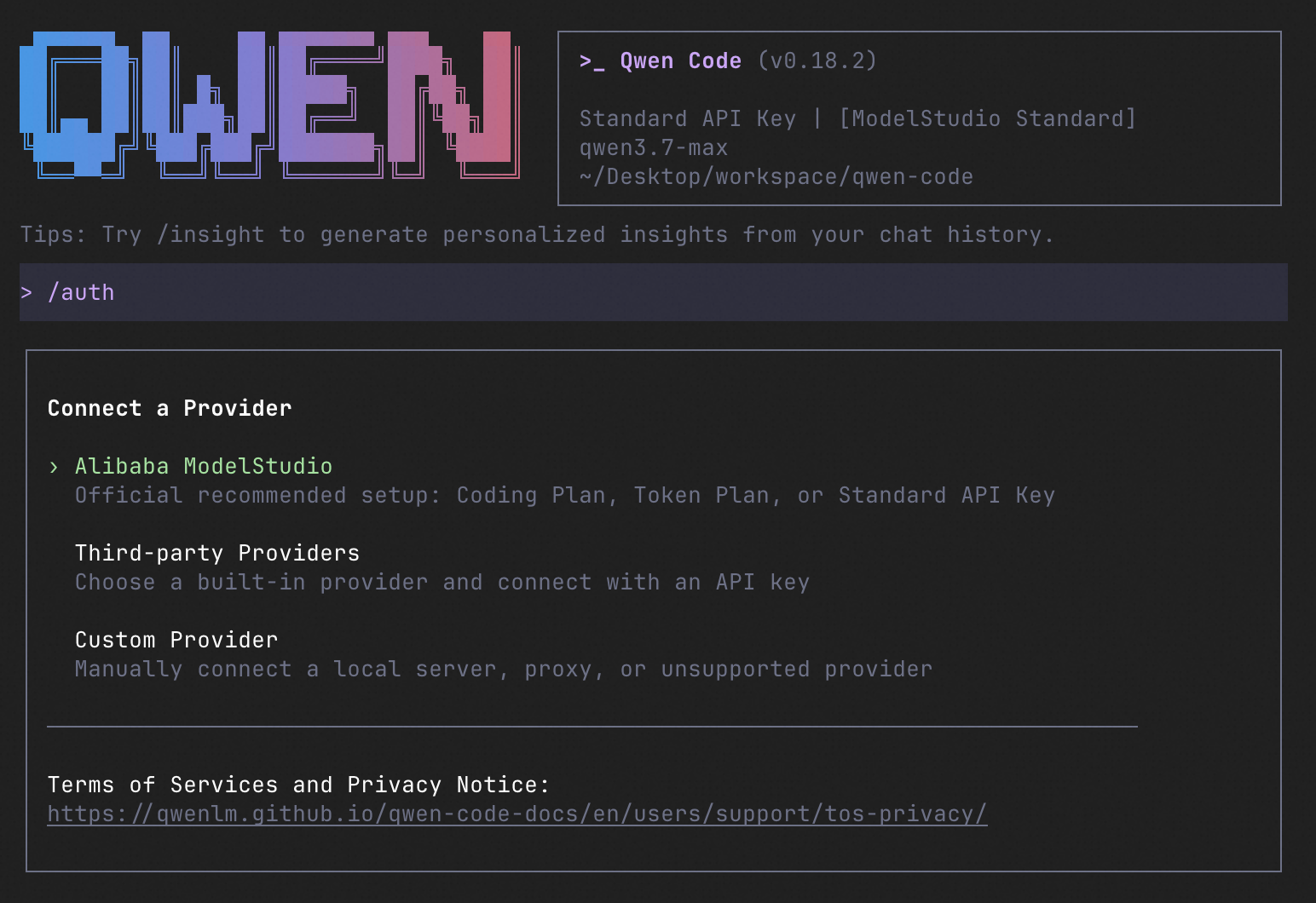
qwen          # Launch interactive terminal UI
# Inside the session:
/auth         # Configure your provider and API key
See the Authentication Guide and Settings Reference for detailed setup.
How to Use Qwen Code
| Mode | Command | Use Case |
|---|---|---|
| Interactive | qwen |
Terminal UI with rich rendering, @file references, slash commands |
| Headless | qwen -p "..." |
Scripts, CI/CD, batch processing — no UI |
| IDE | — | VS Code, Zed, JetBrains |
| Desktop | — | Qwen Code Desktop — GUI for macOS, Windows, Linux |
| Daemon | qwen serve |
Shared agent session over HTTP+SSE (ACP). Multiple clients, one agent. (experimental) Docs |
| SDK | — | TypeScript, Python, Java |
| IM Bot | qwen channel |
Connect to Telegram, DingTalk, WeChat, or Feishu |
SDK example (Python)
import asyncio

from qwen_code_sdk import is_sdk_result_message, query


async def main() -> None:
    result = query(
        "Summarize the repository layout.",
        {
            "cwd": "/path/to/project",
            "path_to_qwen_executable": "qwen",
        },
    )

    async for message in result:
        if is_sdk_result_message(message):
            print(message["result"])


asyncio.run(main())
Capabilities
If you know Claude Code, you already know Qwen Code — and then some. We've put significant effort into bringing Qwen Code to feature parity with Claude Code, improving both breadth and reliability across the board.
| Feature | Qwen Code | Claude Code |
|---|---|---|
| SubAgents, Agent Teams, Dynamic Workflows | ✓ | ✓ |
| Auto-Memory, Auto-Skills, Hooks | ✓ | ✓ |
| Built-in Skills (/review, /batch, /loop, /bugfix…) | ✓ | ✓ |
| MCP, Plan Mode, LSP Integration | ✓ | ✓ |
| Auto Mode, Sandbox, Git Worktrees | ✓ | ✓ |
| Computer Use (desktop automation) | ✓ | ✓ |
| IDE Plugins (VS Code / JetBrains / Zed) | ✓ | ✓ |
| SDK | ✓ | ✓ |
| Headless Mode, Session Management | ✓ | ✓ |
| Open-source — model and framework | ✓ | — |
| Multi-protocol (OpenAI / Anthropic / Gemini / Qwen + any provider) | ✓ | — |
| Agent Arena (multi-model head-to-head on same task) | ✓ | — |
Daemon Mode — qwen serve (multi-client shared agent) |
✓ | — |
| IM Channels (Telegram / DingTalk / WeChat / Feishu) | ✓ | — |
Ecosystem
-
Qwen Code Desktop — Official desktop app for macOS, Windows, and Linux
-
AionUi — A modern GUI for command-line AI tools including Qwen Code
-
Gemini CLI Desktop — A cross-platform desktop/web/mobile UI for Qwen Code
-
🦞 Qwen Code Claw — Let other agents (Claude, Codex, etc.) delegate coding tasks to Qwen Code via ACP. Paste this prompt into your agent:
Use Qwen Code as a coding agent. First, fetch and read this skill reference:
https://raw.githubusercontent.com/QwenLM/qwen-code/refs/heads/main/.qwen/skills/qwen-code-claw/SKILL.md
Then follow the instructions inside to install, authenticate, and use Qwen Code via acpx for all coding tasks.
Contributing
Contributions are welcome! See CONTRIBUTING.md for guidelines.
Acknowledgments
This project was originally based on Google Gemini CLI v0.8.2. We gratefully acknowledge the Gemini CLI team's excellent work. Starting from Qwen Code v0.1, we stopped syncing with upstream and began independent development as a multi-protocol, multi-platform agent framework with deep integrations for Qwen models and beyond.