 2855149d47
* fix(core): detect long verbatim repetition loops in content and reasoning streams The chunk-hash content loop rule only treats repeated 50-char chunks as a loop when their occurrences cluster within 1.5 chunk lengths (75 chars), so a verbatim-repeated unit longer than that (the ~300-char analysis block chanted in issue #1775) never fires. Add a long-period rule: five equally spaced occurrences of an identical chunk mark a candidate period, and the spanned region is verified to be exactly periodic with that stride before halting. Raise the content history window so long units stay observable. Also route thought text into the content-repetition detectors when the structured thought check does not fire: OpenAI-compatible providers stream reasoning as thought parts that getResponseText filters out of Content events, so chants in the thinking stage never reached the chunk-hash rules. * fix(core): isolate reasoning deltas from the content channel's markdown state Route thought-sourced text through an append-and-analyze-only entry point instead of checkContentLoop. Reasoning text is raw chain-of-thought, never rendered markdown: an unbalanced code fence in a thought used to flip the shared inCodeBlock parity — which nothing clears mid-turn — silently disabling visible-content chant detection for the rest of the turn, and list/heading-shaped thought deltas reset the shared history, erasing already-accumulated content evidence when a provider interleaves thought and content parts. * fix(core): grow the periodic-rule verified region with the repetition count The long-period rule only inspected the last five occurrences, pinning the verified region at 4 x stride + 50 chars: units of ~76-237 chars fell in a gap between the clustered rule's 75-char bound and the 1000-char region floor at any repetition count, and units of ~1 KB or more could never fit five occurrences into the 4000-char history window at all. Extend the candidate run backwards over the longest equally-spaced suffix of occurrences so the verified region grows with the repetition count, and once the history saturates accept a shorter run (>= 3 occurrences) when the entire retained region is verified periodic back to the history start, so earlier occurrences truncated out of the window cannot hide a chant. Also correct the constants' comments describing the rule's domains. * test(core): cover post-truncation chant detection after a long varied turn Add the realistic #1775 shape that had no positive coverage: a long varied turn filling the history window, then a ~700-char chant streamed as misaligned deltas. Asserts detection at exactly the fifth in-window occurrence, pinning MAX_HISTORY_LENGTH, truncateAndUpdate's index adjustment, and the long-unit case together — a shrunken window would fire early via the truncated-run path once the filler flushes, and a broken index adjustment would never fire. * fix(cli): widen chanting halt label to cover reasoning-stream repetitions Reasoning-stream chants fire CHANTING_IDENTICAL_SENTENCES via checkReasoningContentLoop, but getResponseText filters reasoning out of visible output, so the headless label 'repeated the same sentence in its output' sends users looking for a repetition that is never rendered. Widen the label to 'output or reasoning' and add a headless-path regression test asserting the wording. * refactor(core): share the append/truncate/analyze tail across loop channels checkReasoningContentLoop duplicated the streamContentHistory append, truncateAndUpdate, analyzeContentChunksForLoop tail of checkContentLoop, leaving the history contract in two copies that a future fix could let drift. Extract the tail into appendToContentHistoryAndAnalyze and call it from both entry points. * perf(core): compare periodic regions in place instead of slicing history isRegionPeriodicWithStride sliced up to ~4 KB of history per invocation. Near-periodic chants fail verification repeatedly while their occurrence runs persist, so once a run reaches length 5 the check fires on up to every streamed character -- a probe measured ~136 MB of transient copies over one 49k-char stream. Index the existing string directly instead; comparison semantics are unchanged. * fix(core): reset stream-content loop state on retry replays and model fallback A replay (non-continuation) retry re-streams the failed attempt's content and reasoning through the chunk detectors — the #7832 transport-replay gate admits thought-only cuts, and with deterministic decoding the re-stream is verbatim. The Retry case in addAndCheckHeuristicLoops cleared only the tool-call counters, so the accumulated identical copies could fire CHANTING_IDENTICAL_SENTENCES mid-way through an otherwise healthy attempt. Continuation retries (isContinuation) keep the delivered text and append new output, so their state stays. ModelFallback had no case at all: the fallback model restarts from scratch, so mirror the replay resets for it. A genuine chant simply re-accumulates after the restart. * perf(core): defer content-history truncation with a hysteresis slack Once streamContentHistory saturates, truncateAndUpdate walked the whole contentStats map on every streamed event — Θ(window) entries in steady state, since the stride-1 sliding window hashes every position (~385 µs/event at window 4000 vs ~12 µs pre-saturation). With high-frequency small reasoning deltas now routed through the path, healthy long-thinking turns paid thousands of events of synchronous CPU. Trim only when the length exceeds MAX_HISTORY_LENGTH by a TRUNCATION_SLACK margin (1000 chars), slicing back to exactly MAX_HISTORY_LENGTH, so the index-rebase walk is amortized over appended chars. The change is behavior-neutral: the detection rules now always operate on the logical window of the last MAX_HISTORY_LENGTH chars — occurrences the window has passed are dropped at lookup (the exact set a per-event trim would have removed) and the periodic rule's escape valve verifies from the window start, i.e. exactly the content a fully-trimmed history retains. Tests pin pre-change fire offsets across saturation and multiple trims, plus the deferred-trim mechanics. * feat(core): log a chanting-region excerpt on loop halt for debug A reasoning-channel halt exits headless runs with empty stdout and only the loop-type label on stderr; neither the LoopDetected event (loop_type + prompt_id only), telemetry, nor any log carried an excerpt of what repeated, leaving no way to tell a true repetition from a detector misfire without instrumenting a repro. Capture one period of the matched region (the span between the last two occurrences, capped at 80 chars) when the chanting detector fires and emit it through the config debug logger at the firing site. The LoopDetected event contract is deliberately unchanged. * fix(core): preserve subagent continuation retries * test(core): cover plain subagent retry forwarding * fix(core): omit plain retry continuation flag |
||
|---|---|---|
| .github | ||
| .husky | ||
| .qwen | ||
| .vscode | ||
| docs | ||
| docs-site | ||
| eslint-rules | ||
| integration-tests | ||
| integrations/external-context | ||
| packages | ||
| patches | ||
| scripts | ||
| .dockerignore | ||
| .editorconfig | ||
| .gitattributes | ||
| .gitignore | ||
| .npmrc | ||
| .nvmrc | ||
| .prettierignore | ||
| .prettierrc.json | ||
| .yamllint.yml | ||
| AGENTS.md | ||
| CHANGELOG.md | ||
| CLAUDE.md | ||
| CONTRIBUTING.md | ||
| Dockerfile | ||
| esbuild.config.js | ||
| eslint.config.js | ||
| eslint.legacy-filenames.mjs | ||
| LICENSE | ||
| Makefile | ||
| package-lock.json | ||
| package.json | ||
| README.md | ||
| SECURITY.md | ||
| tsconfig.json | ||
| vitest.config.ts | ||




The open-source AI coding agent that lives in your terminal.
中文 | Deutsch | français | 日本語 | Русский | Português (Brasil) | 한국어
Why Qwen Code?
- Agentic out of the box — Auto-Memory, Auto-Skills, SubAgents, Agent Teams, and MCP. Dynamic workflows, zero setup.
- Open-source, inside and out — The framework and the Qwen models are open-source. They evolve together. No vendor lock-in.
- Multi-protocol — Supports OpenAI, Anthropic, Gemini, and Qwen APIs. Any third-party provider or local model (Ollama / vLLM). Switch at runtime.
- Beyond the terminal — IDE plugins, Desktop app, daemon mode, SDKs, and IM bots (Telegram / DingTalk / WeChat / Feishu).
Tip
Qwen Code is actively iterating on itself — using its own agent and models to file issues, submit PRs, review code, and run tests. Powered by the community, driven by AI.
Installation
Linux / macOS:
curl -fsSL https://qwen-code-assets.oss-cn-hangzhou.aliyuncs.com/installation/install-qwen-standalone.sh | bash
Windows:
irm https://qwen-code-assets.oss-cn-hangzhou.aliyuncs.com/installation/install-qwen-standalone.ps1 | iex
Restart your terminal after installation to ensure environment variables take effect.
NPM / Homebrew
NPM (requires Node.js 22+):
npm install -g @qwen-code/qwen-code@latest
Homebrew (macOS / Linux):
brew install qwen-code
Quick Start
qwen          # Launch interactive terminal UI
# Inside the session:
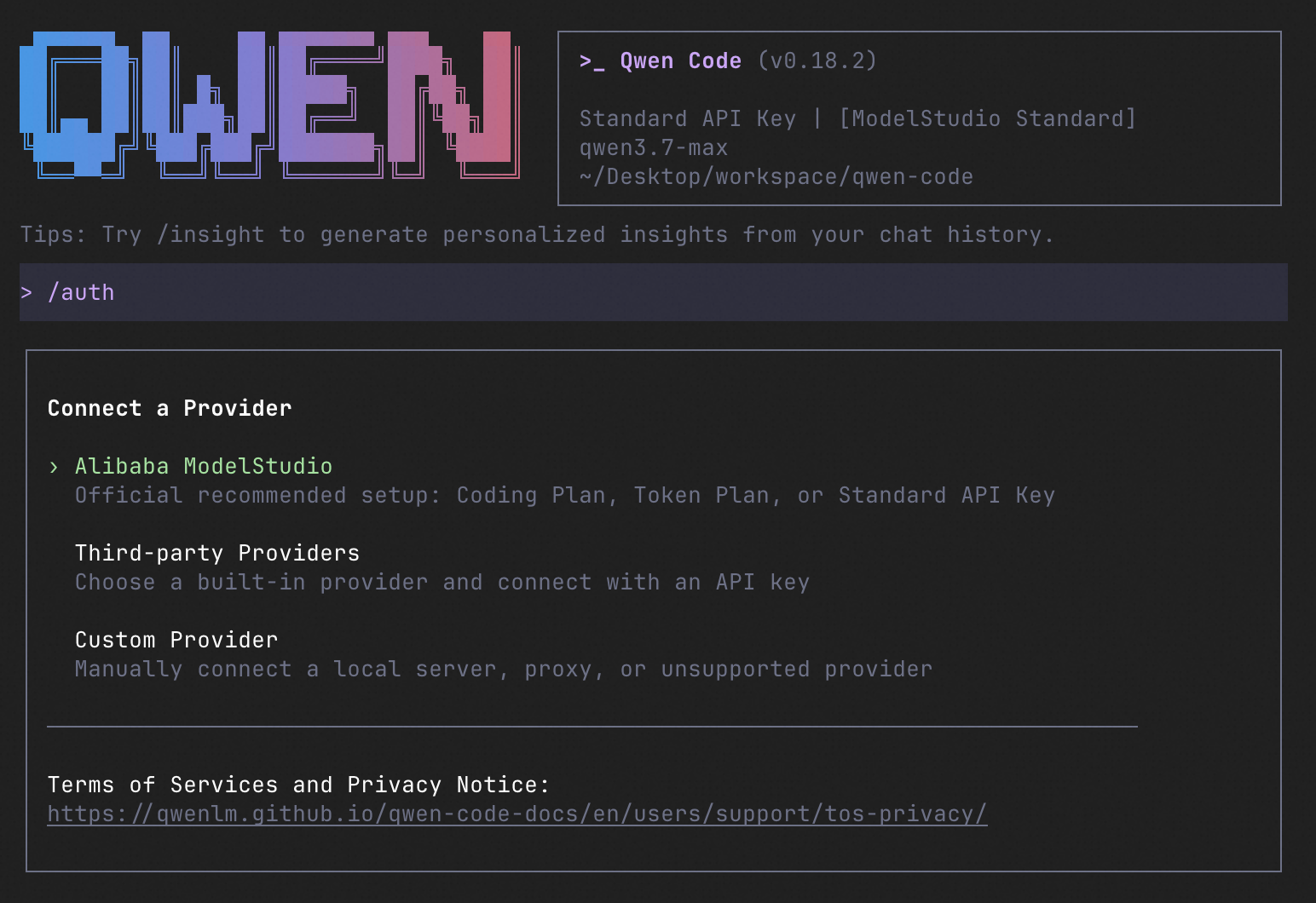
/auth         # Configure your provider and API key
See the Authentication Guide and Settings Reference for detailed setup.
How to Use Qwen Code
| Mode | Command | Use Case |
|---|---|---|
| Interactive | qwen |
Terminal UI with rich rendering, @file references, slash commands |
| Headless | qwen -p "..." |
Scripts, CI/CD, batch processing — no UI |
| IDE | — | VS Code, Zed, JetBrains |
| Desktop | — | Qwen Code Desktop — GUI for macOS, Windows, Linux |
| Daemon | qwen serve |
Shared agent session over HTTP+SSE (ACP). Multiple clients, one agent. (experimental) Docs |
| SDK | — | TypeScript, Python, Java |
| IM Bot | qwen channel |
Connect to Telegram, DingTalk, WeChat, or Feishu |
SDK example (Python)
import asyncio

from qwen_code_sdk import is_sdk_result_message, query


async def main() -> None:
    result = query(
        "Summarize the repository layout.",
        {
            "cwd": "/path/to/project",
            "path_to_qwen_executable": "qwen",
        },
    )

    async for message in result:
        if is_sdk_result_message(message):
            print(message["result"])


asyncio.run(main())
Capabilities
If you know Claude Code, you already know Qwen Code — and then some. We've put significant effort into bringing Qwen Code to feature parity with Claude Code, improving both breadth and reliability across the board.
| Feature | Qwen Code | Claude Code |
|---|---|---|
| SubAgents, Agent Teams, Dynamic Workflows | ✓ | ✓ |
| Auto-Memory, Auto-Skills, Hooks | ✓ | ✓ |
| Built-in Skills (/review, /batch, /loop, /bugfix…) | ✓ | ✓ |
| MCP, Plan Mode, LSP Integration | ✓ | ✓ |
| Auto Mode, Sandbox, Git Worktrees | ✓ | ✓ |
| Computer Use (desktop automation) | ✓ | ✓ |
| IDE Plugins (VS Code / JetBrains / Zed) | ✓ | ✓ |
| SDK | ✓ | ✓ |
| Headless Mode, Session Management | ✓ | ✓ |
| Open-source — model and framework | ✓ | — |
| Multi-protocol (OpenAI / Anthropic / Gemini / Qwen + any provider) | ✓ | — |
| Agent Arena (multi-model head-to-head on same task) | ✓ | — |
Daemon Mode — qwen serve (multi-client shared agent) |
✓ | — |
| IM Channels (Telegram / DingTalk / WeChat / Feishu) | ✓ | — |
Ecosystem
-
Qwen Code Desktop — Official desktop app for macOS, Windows, and Linux
-
AionUi — A modern GUI for command-line AI tools including Qwen Code
-
Gemini CLI Desktop — A cross-platform desktop/web/mobile UI for Qwen Code
-
🦞 Qwen Code Claw — Let other agents (Claude, Codex, etc.) delegate coding tasks to Qwen Code via ACP. Paste this prompt into your agent:
Use Qwen Code as a coding agent. First, fetch and read this skill reference:
https://raw.githubusercontent.com/QwenLM/qwen-code/refs/heads/main/.qwen/skills/qwen-code-claw/SKILL.md
Then follow the instructions inside to install, authenticate, and use Qwen Code via acpx for all coding tasks.
- Aliyun Model Studio CLI — Official CLI for Aliyun's AI platform (
bailian-cli). Extends Qwen Code with image/video generation, knowledge retrieval, app orchestration, and model deployment
Contributing
Contributions are welcome! See CONTRIBUTING.md for guidelines.
Acknowledgments
This project was originally based on Google Gemini CLI v0.8.2. We gratefully acknowledge the Gemini CLI team's excellent work. Starting from Qwen Code v0.1, we stopped syncing with upstream and began independent development as a multi-protocol, multi-platform agent framework with deep integrations for Qwen models and beyond.