 2710bdec0d
* refactor(cli): replace slash command whitelist with capability-based filtering (Phase 1)

## Summary

Replace the hardcoded ALLOWED_BUILTIN_COMMANDS_NON_INTERACTIVE whitelist with a
unified, capability-based command metadata model. This is Phase 1 of the slash
command architecture refactor described in docs/design/slash-command/.

## Key changes

### New types (types.ts)
- Add ExecutionMode ('interactive' | 'non_interactive' | 'acp')
- Add CommandSource ('builtin-command' | 'bundled-skill' | 'skill-dir-command' |
  'plugin-command' | 'mcp-prompt')
- Add CommandType ('prompt' | 'local' | 'local-jsx')
- Extend SlashCommand interface with: source, sourceLabel, commandType,
  supportedModes, userInvocable, modelInvocable, argumentHint, whenToUse,
  examples (all optional, backward-compatible)

### New module (commandUtils.ts + commandUtils.test.ts)
- getEffectiveSupportedModes(): 3-priority inference
  (explicit supportedModes > commandType > CommandKind fallback)
- filterCommandsForMode(): replaces filterCommandsForNonInteractive()
- 18 unit tests

### Whitelist removal (nonInteractiveCliCommands.ts)
- Remove ALLOWED_BUILTIN_COMMANDS_NON_INTERACTIVE constant
- Remove filterCommandsForNonInteractive() function
- Replace with CommandService.getCommandsForMode(mode)

### CommandService enhancements (CommandService.ts)
- Add getCommandsForMode(mode: ExecutionMode): filters by mode, excludes hidden
- Add getModelInvocableCommands(): reserved for Phase 3 model tool-call use

### Built-in command annotations (41 files)
Annotate every built-in command with commandType:
- commandType='local' + supportedModes all-modes: btw, bug, compress, context,
  init, summary (replaces the 6-command whitelist)
- commandType='local' interactive-only: export, memory, plan, insight
- commandType='local-jsx' interactive-only: all remaining ~31 commands

### Loader metadata injection (4 files)
Each loader stamps source/sourceLabel/commandType/modelInvocable on every
command it emits:
- BuiltinCommandLoader: source='builtin-command', modelInvocable=false
- BundledSkillLoader: source='bundled-skill', commandType='prompt',
  modelInvocable=true
- command-factory (FileCommandLoader): source per extension/user origin,
  commandType='prompt', modelInvocable=!extensionName
- McpPromptLoader: source='mcp-prompt', commandType='prompt', modelInvocable=true

### Bug fix
MCP_PROMPT commands were incorrectly excluded from non-interactive/ACP modes by
the old whitelist logic. commandType='prompt' now correctly allows them in all
modes.

### Session.ts / nonInteractiveHelpers.ts
- ACP session calls getAvailableCommands with explicit 'acp' mode
- Remove allowedBuiltinCommandNames parameter from buildSystemMessage() —
  capability filtering is now self-contained in CommandService

* fix test ci

* feat(cli): Phase 2 slash command expansion + ACP fixes + UX improvements

Phase 2.1 - Command mode expansion:
- Extend 13 built-in commands to support non_interactive/acp modes
- A class: export, plan, statusline - supportedModes only
- A+ class: language, copy, restore - add non-interactive branches
- A' class: model, approvalMode - handle dialog paths in non-interactive
- B class: about, stats, insight, docs, clear - full non-interactive branches
- context: format output as readable Markdown instead of raw JSON
- export: use HTML as default format when no subcommand given

Phase 2.2 - SkillTool integration:
- SkillTool now consumes CommandService.getModelInvocableCommands()

Phase 2.3 - Mid-input slash ghost text:
- Replace mid-input dropdown completion with inline ghost text
- Match Claude Code behavior: gray dimmed completion hint in input box
- Tab accepts the ghost text completion
- Add findMidInputSlashCommand() and getBestSlashCommandMatch() utilities

ACP session bug fixes:
- Fix executionMode undefined in interactive mode (slashCommandProcessor)
- Fix slash command output not visible in Zed (use emitAgentMessage)
- Fix newline rendering in Zed (Markdown hard line-break)
- Fix history replay merging consecutive user messages (recordSlashCommand)
- Fix /clear not clearing model context (dynamic chat reference)

* feat: inline complete only for modelInvocable

* fix memory command

* fix: pass 'non_interactive' mode explicitly to getAvailableCommands

- Fix critical bug in nonInteractiveHelpers.ts: loadSlashCommandNames was
  calling getAvailableCommands without specifying mode, causing it to default
  to 'acp' instead of 'non_interactive'. Commands with supportedModes that
  include 'non_interactive' but not 'acp' would be silently excluded.
- Apply the same fix in systemController.ts for the same reason.
- Update test mock to delegate filtering to production filterCommandsForMode()
  instead of duplicating the logic inline, preventing divergence.

Fixes review comments by wenshao and tanzhenxin on PR #3283.

* fix: resolve TypeScript type error in nonInteractiveHelpers.test.ts

* fix test ci

* fix mcp prompt in skill manager

* revert pr#3345

* fix test ci

* feat(cli): adapt /insight for non_interactive mode with message return

- non_interactive: run generateStaticInsight() synchronously with no-op
  progress callback, return { type: 'message' } with output path
- acp: keep existing stream_messages path with progress streaming
- interactive: unchanged

Add tests for non_interactive success and error paths.

Update phase2-technical-design.md and roadmap.md to reflect the
three-way mode split and clarify that MCP prompts do not need
modelInvocable (they are called via native MCP tool call mechanism).

* fix(cli): ghost text only shown when cursor is at end of slash token

Use strict equality (!==) instead of > in findMidInputSlashCommand so that
ghost text is only computed and Tab-accepted when the cursor sits exactly at
the trailing edge of the partial command token.

Previously, with the cursor inside an already-typed token (e.g. /re|view),
the ghost text suffix would still be shown and pressing Tab would insert it
at the cursor position, producing a duplicated tail. Using strict equality
makes ghost text disappear as soon as the cursor moves inside the token.

Add unit tests for findMidInputSlashCommand covering cursor-at-end,
cursor-inside-token, cursor-past-token, start-of-line, and
no-space-before-slash cases.

* fix(cli): support /model <model-id> in non-interactive and ACP modes

Previously, /model <model-id> (without --fast) fell through to the
non-interactive branch that only returned the current model info and
incorrectly told users to use --fast. Now:

- /model <model-id>  → sets the main model via settings + config.setModel()
- /model             → shows current model with correct usage hint
- /model --fast <id> → unchanged (sets fast model)

Fixes the inconsistency flagged in PR review: the help text said to use
'/model <model-id>' but the command returned a dialog action which is
unsupported in non-interactive mode.

* fix(cli): declare supportedModes on doctorCommand to enable non-interactive and ACP

The command's action already had non-interactive handling (returns a JSON
message with check results), but without supportedModes declared the
BUILT_IN fallback restricted it to interactive-only so it was never
registered in non_interactive or acp sessions.

* feat(skills): add SkillCommandLoader for user/project/extension skills as slash commands

- New SkillCommandLoader loads user, project, and extension level SKILL.md
  files as slash commands (previously only bundled skills were slash-invocable)
- Extension skills follow plugin-command rules: modelInvocable only when
  description or whenToUse is present
- User/project skills are always modelInvocable (matching bundled behavior)
- skill-manager now injects extensionName when loading extension-level skills
- Add when_to_use and disable-model-invocation frontmatter support to SKILL.md
  and .md command files (SkillConfig, markdown-command-parser, command-factory,
  BundledSkillLoader, FileCommandLoader)
- SkillTool filters out skills with disableModelInvocation and includes
  whenToUse in the skill description shown to the model
- 16 unit tests for SkillCommandLoader covering all cases

* docs: update phase2 design doc to reflect final decisions on plan/statusline/copy/restore

These four commands are intentionally kept as interactive-only by design:
- /plan and /statusline: tightly coupled with interactive multi-turn UI
- /copy and /restore: clipboard and snapshot restore are inherently interactive

Update design doc classification table, section 4.2, 4.3, 5.2, 5.3,
file change summary, test requirements, behavior analysis table,
and implementation batch descriptions to reflect this decision.

* feat(cli): re-implement slashCommands.disabled denylist based on current refactored code

Adapts the feature originally introduced in pr#3445 to the current
CommandService / Phase-2 refactored code.

Sources (merged, de-duplicated, case-insensitive):
  - settings key slashCommands.disabled (string[], UNION merge)
  - --disabled-slash-commands CLI flag (comma-separated or repeated)
  - QWEN_DISABLED_SLASH_COMMANDS environment variable

Enforcement points:
  - CommandService.create() accepts optional disabledNames: ReadonlySet<string>
    and removes matching commands post-rename, so disabled commands never appear
    in autocomplete, mid-input ghost text, or model-invocable commands list.
  - slashCommandProcessor (interactive TUI) passes the denylist to
    CommandService.create so disabled commands are absent from dropdown/ghost text.
  - nonInteractiveCliCommands.handleSlashCommand() keeps allCommands unfiltered
    to distinguish disabled vs unknown; disabled commands return unsupported with
    a "disabled by the current configuration" reason (not no_command).
  - getAvailableCommands() (ACP) passes the denylist to CommandService.create.

Config plumbing:
  - core/Config: ConfigParameters.disabledSlashCommands + getDisabledSlashCommands()
  - cli/config: CliArgs.disabledSlashCommands + yargs option + loadCliConfig merge
  - settingsSchema: slashCommands.disabled (MergeStrategy.UNION)
  - settings.schema.json: regenerated

Tests: 28 pass (CommandService x4, nonInteractiveCliCommands x3 new cases)

* feat(cli): complete slashCommands.disabled coverage from pr#3445

Fill in the three items that were missing from the initial re-implementation:

- packages/cli/src/config/settings.test.ts: add UNION-merge test for
  slashCommands.disabled across user and workspace scopes
- packages/cli/src/nonInteractiveCli.test.ts: add getDisabledSlashCommands
  mock to the shared mockConfig fixture
- docs/users/configuration/settings.md: add slashCommands section (table +
  example + note) and --disabled-slash-commands row in the CLI args table

* fix(cli): match disabled slash commands by alias as well as primary name

The denylist previously only checked cmd.name (the primary/canonical name),
so disabling a command by its alias (e.g. 'about' for the 'status' command)
had no effect. Fix both CommandService.create() and the isDisabled() helper
in nonInteractiveCliCommands.ts to also check altNames.

Also improve the user-facing error message to show the token the user actually
typed (e.g. /about) instead of always showing the primary name (/status).
|
||
|---|---|---|
| .github | ||
| .husky | ||
| .qwen | ||
| .vscode | ||
| docs | ||
| docs-site | ||
| eslint-rules | ||
| integration-tests | ||
| packages | ||
| scripts | ||
| .dockerignore | ||
| .editorconfig | ||
| .gitattributes | ||
| .gitignore | ||
| .npmrc | ||
| .nvmrc | ||
| .prettierignore | ||
| .prettierrc.json | ||
| .yamllint.yml | ||
| AGENTS.md | ||
| CONTRIBUTING.md | ||
| Dockerfile | ||
| esbuild.config.js | ||
| eslint.config.js | ||
| LICENSE | ||
| Makefile | ||
| package-lock.json | ||
| package.json | ||
| README.md | ||
| SECURITY.md | ||
| tsconfig.json | ||
| vitest.config.ts | ||




An open-source AI agent that lives in your terminal.
中文 | Deutsch | français | 日本語 | Русский | Português (Brasil)
🎉 News
-
2026-04-15: Qwen OAuth free tier has been discontinued. To continue using Qwen Code, switch to Alibaba Cloud Coding Plan, OpenRouter, Fireworks AI, or bring your own API key. Run
qwen authto configure. -
2026-04-13: Qwen OAuth free tier policy update: daily quota adjusted to 100 requests/day (from 1,000).
-
2026-04-02: Qwen3.6-Plus is now live! Get an API key from Alibaba Cloud ModelStudio to access it through the OpenAI-compatible API.
-
2026-02-16: Qwen3.5-Plus is now live!
Why Qwen Code?
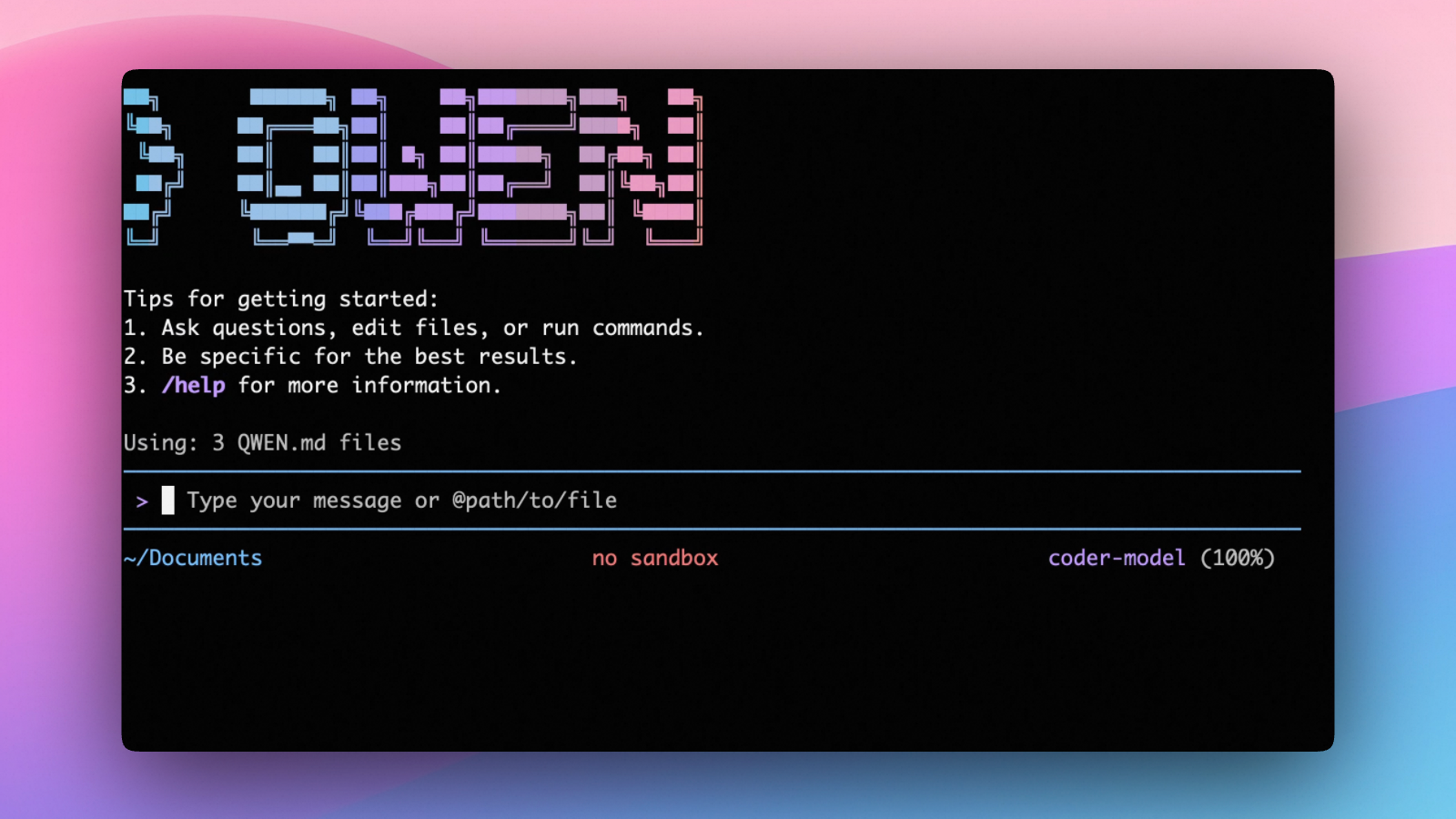
Qwen Code is an open-source AI agent for the terminal, optimized for Qwen series models. It helps you understand large codebases, automate tedious work, and ship faster.
- Multi-protocol, flexible providers: use OpenAI / Anthropic / Gemini-compatible APIs, Alibaba Cloud Coding Plan, OpenRouter, Fireworks AI, or bring your own API key.
- Open-source, co-evolving: both the framework and the Qwen3-Coder model are open-source—and they ship and evolve together.
- Agentic workflow, feature-rich: rich built-in tools (Skills, SubAgents) for a full agentic workflow and a Claude Code-like experience.
- Terminal-first, IDE-friendly: built for developers who live in the command line, with optional integration for VS Code, Zed, and JetBrains IDEs.
Installation
Quick Install (Recommended)
Linux / macOS
bash -c "$(curl -fsSL https://qwen-code-assets.oss-cn-hangzhou.aliyuncs.com/installation/install-qwen.sh)"
Windows (Run as Administrator)
Works in both Command Prompt and PowerShell:
powershell -Command "Invoke-WebRequest 'https://qwen-code-assets.oss-cn-hangzhou.aliyuncs.com/installation/install-qwen.bat' -OutFile (Join-Path $env:TEMP 'install-qwen.bat'); & (Join-Path $env:TEMP 'install-qwen.bat')"
Note
: It's recommended to restart your terminal after installation to ensure environment variables take effect.
Manual Installation
Prerequisites
Make sure you have Node.js 20 or later installed. Download it from nodejs.org.
NPM
npm install -g @qwen-code/qwen-code@latest
Homebrew (macOS, Linux)
brew install qwen-code
Quick Start
# Start Qwen Code (interactive)
qwen

# Then, in the session:
/help
/auth
On first use, you'll be prompted to sign in. You can run /auth anytime to switch authentication methods.
Example prompts:
What does this project do?
Explain the codebase structure.
Help me refactor this function.
Generate unit tests for this module.
Click to watch a demo video
🦞 Use Qwen Code for Coding Tasks in Claw
Copy the prompt below and paste it into your agent:
Use Qwen Code as a coding agent. First, fetch and read this skill reference:
https://raw.githubusercontent.com/QwenLM/qwen-code/refs/heads/main/.qwen/skills/qwen-code-claw/SKILL.md
Then follow the instructions inside to install, authenticate, and use Qwen Code via acpx for all coding tasks.
Authentication
Qwen Code supports the following authentication methods:
- API Key (recommended): use an API key from Alibaba Cloud Model Studio (Beijing / intl) or any supported provider (OpenAI, Anthropic, Google GenAI, and other compatible endpoints).
- Coding Plan: subscribe to the Alibaba Cloud Coding Plan (Beijing / intl) for a fixed monthly fee with higher quotas.
⚠️ Qwen OAuth was discontinued on April 15, 2026. If you were previously using Qwen OAuth, please switch to one of the methods above. Run
qwenand then/authto reconfigure.
API Key (recommended)
Use an API key to connect to Alibaba Cloud Model Studio or any supported provider. Supports multiple protocols:
- OpenAI-compatible: Alibaba Cloud ModelStudio, ModelScope, OpenAI, OpenRouter, and other OpenAI-compatible providers
- Anthropic: Claude models
- Google GenAI: Gemini models
The recommended way to configure models and providers is by editing ~/.qwen/settings.json (create it if it doesn't exist). This file lets you define all available models, API keys, and default settings in one place.
Quick Setup in 3 Steps
Step 1: Create or edit ~/.qwen/settings.json
Here is a complete example:
{
  "modelProviders": {
    "openai": [
      {
        "id": "qwen3.6-plus",
        "name": "qwen3.6-plus",
        "baseUrl": "https://dashscope.aliyuncs.com/compatible-mode/v1",
        "description": "Qwen3-Coder via Dashscope",
        "envKey": "DASHSCOPE_API_KEY"
      }
    ]
  },
  "env": {
    "DASHSCOPE_API_KEY": "sk-xxxxxxxxxxxxx"
  },
  "security": {
    "auth": {
      "selectedType": "openai"
    }
  },
  "model": {
    "name": "qwen3.6-plus"
  }
}
Step 2: Understand each field
| Field | What it does |
|---|---|
modelProviders |
Declares which models are available and how to connect to them. Keys like openai, anthropic, gemini represent the API protocol. |
modelProviders[].id |
The model ID sent to the API (e.g. qwen3.6-plus, gpt-4o). |
modelProviders[].envKey |
The name of the environment variable that holds your API key. |
modelProviders[].baseUrl |
The API endpoint URL (required for non-default endpoints). |
env |
A fallback place to store API keys (lowest priority; prefer .env files or export for sensitive keys). |
security.auth.selectedType |
The protocol to use on startup (openai, anthropic, gemini, vertex-ai). |
model.name |
The default model to use when Qwen Code starts. |
Step 3: Start Qwen Code — your configuration takes effect automatically:
qwen
Use the /model command at any time to switch between all configured models.
More Examples
Coding Plan (Alibaba Cloud ModelStudio) — fixed monthly fee, higher quotas
{
  "modelProviders": {
    "openai": [
      {
        "id": "qwen3.6-plus",
        "name": "qwen3.6-plus (Coding Plan)",
        "baseUrl": "https://coding.dashscope.aliyuncs.com/v1",
        "description": "qwen3.6-plus from ModelStudio Coding Plan",
        "envKey": "BAILIAN_CODING_PLAN_API_KEY"
      },
      {
        "id": "qwen3.5-plus",
        "name": "qwen3.5-plus (Coding Plan)",
        "baseUrl": "https://coding.dashscope.aliyuncs.com/v1",
        "description": "qwen3.5-plus with thinking enabled from ModelStudio Coding Plan",
        "envKey": "BAILIAN_CODING_PLAN_API_KEY",
        "generationConfig": {
          "extra_body": {
            "enable_thinking": true
          }
        }
      },
      {
        "id": "glm-4.7",
        "name": "glm-4.7 (Coding Plan)",
        "baseUrl": "https://coding.dashscope.aliyuncs.com/v1",
        "description": "glm-4.7 with thinking enabled from ModelStudio Coding Plan",
        "envKey": "BAILIAN_CODING_PLAN_API_KEY",
        "generationConfig": {
          "extra_body": {
            "enable_thinking": true
          }
        }
      },
      {
        "id": "kimi-k2.5",
        "name": "kimi-k2.5 (Coding Plan)",
        "baseUrl": "https://coding.dashscope.aliyuncs.com/v1",
        "description": "kimi-k2.5 with thinking enabled from ModelStudio Coding Plan",
        "envKey": "BAILIAN_CODING_PLAN_API_KEY",
        "generationConfig": {
          "extra_body": {
            "enable_thinking": true
          }
        }
      }
    ]
  },
  "env": {
    "BAILIAN_CODING_PLAN_API_KEY": "sk-xxxxxxxxxxxxx"
  },
  "security": {
    "auth": {
      "selectedType": "openai"
    }
  },
  "model": {
    "name": "qwen3.6-plus"
  }
}
Subscribe to the Coding Plan and get your API key at Alibaba Cloud ModelStudio(Beijing) or Alibaba Cloud ModelStudio(intl).
Multiple providers (OpenAI + Anthropic + Gemini)
{
  "modelProviders": {
    "openai": [
      {
        "id": "gpt-4o",
        "name": "GPT-4o",
        "envKey": "OPENAI_API_KEY",
        "baseUrl": "https://api.openai.com/v1"
      }
    ],
    "anthropic": [
      {
        "id": "claude-sonnet-4-20250514",
        "name": "Claude Sonnet 4",
        "envKey": "ANTHROPIC_API_KEY"
      }
    ],
    "gemini": [
      {
        "id": "gemini-2.5-pro",
        "name": "Gemini 2.5 Pro",
        "envKey": "GEMINI_API_KEY"
      }
    ]
  },
  "env": {
    "OPENAI_API_KEY": "sk-xxxxxxxxxxxxx",
    "ANTHROPIC_API_KEY": "sk-ant-xxxxxxxxxxxxx",
    "GEMINI_API_KEY": "AIzaxxxxxxxxxxxxx"
  },
  "security": {
    "auth": {
      "selectedType": "openai"
    }
  },
  "model": {
    "name": "gpt-4o"
  }
}
Enable thinking mode (for supported models like qwen3.5-plus)
{
  "modelProviders": {
    "openai": [
      {
        "id": "qwen3.5-plus",
        "name": "qwen3.5-plus (thinking)",
        "envKey": "DASHSCOPE_API_KEY",
        "baseUrl": "https://dashscope.aliyuncs.com/compatible-mode/v1",
        "generationConfig": {
          "extra_body": {
            "enable_thinking": true
          }
        }
      }
    ]
  },
  "env": {
    "DASHSCOPE_API_KEY": "sk-xxxxxxxxxxxxx"
  },
  "security": {
    "auth": {
      "selectedType": "openai"
    }
  },
  "model": {
    "name": "qwen3.5-plus"
  }
}
Tip: You can also set API keys via
exportin your shell or.envfiles, which take higher priority thansettings.json→env. See the authentication guide for full details.
Security note: Never commit API keys to version control. The
~/.qwen/settings.jsonfile is in your home directory and should stay private.
Local Model Setup (Ollama / vLLM)
You can also run models locally — no API key or cloud account needed. This is not an authentication method; instead, configure your local model endpoint in ~/.qwen/settings.json using the modelProviders field.
Ollama setup
- Install Ollama from ollama.com
- Pull a model:
ollama pull qwen3:32b - Configure
~/.qwen/settings.json:
{
  "modelProviders": {
    "openai": [
      {
        "id": "qwen3:32b",
        "name": "Qwen3 32B (Ollama)",
        "baseUrl": "http://localhost:11434/v1",
        "description": "Qwen3 32B running locally via Ollama"
      }
    ]
  },
  "security": {
    "auth": {
      "selectedType": "openai"
    }
  },
  "model": {
    "name": "qwen3:32b"
  }
}
vLLM setup
- Install vLLM:
pip install vllm - Start the server:
vllm serve Qwen/Qwen3-32B - Configure
~/.qwen/settings.json:
{
  "modelProviders": {
    "openai": [
      {
        "id": "Qwen/Qwen3-32B",
        "name": "Qwen3 32B (vLLM)",
        "baseUrl": "http://localhost:8000/v1",
        "description": "Qwen3 32B running locally via vLLM"
      }
    ]
  },
  "security": {
    "auth": {
      "selectedType": "openai"
    }
  },
  "model": {
    "name": "Qwen/Qwen3-32B"
  }
}
Usage
As an open-source terminal agent, you can use Qwen Code in four primary ways:
- Interactive mode (terminal UI)
- Headless mode (scripts, CI)
- IDE integration (VS Code, Zed)
- TypeScript SDK
Interactive mode
cd your-project/
qwen
Run qwen in your project folder to launch the interactive terminal UI. Use @ to reference local files (for example @src/main.ts).
Headless mode
cd your-project/
qwen -p "your question"
Use -p to run Qwen Code without the interactive UI—ideal for scripts, automation, and CI/CD. Learn more: Headless mode.
IDE integration
Use Qwen Code inside your editor (VS Code, Zed, and JetBrains IDEs):
TypeScript SDK
Build on top of Qwen Code with the TypeScript SDK:
Commands & Shortcuts
Session Commands
/help- Display available commands/clear- Clear conversation history/compress- Compress history to save tokens/stats- Show current session information/bug- Submit a bug report/exitor/quit- Exit Qwen Code
Keyboard Shortcuts
Ctrl+C- Cancel current operationCtrl+D- Exit (on empty line)Up/Down- Navigate command history
Learn more about Commands
Tip: In YOLO mode (
--yolo), vision switching happens automatically without prompts when images are detected. Learn more about Approval Mode
Configuration
Qwen Code can be configured via settings.json, environment variables, and CLI flags.
| File | Scope | Description |
|---|---|---|
~/.qwen/settings.json |
User (global) | Applies to all your Qwen Code sessions. Recommended for modelProviders and env. |
.qwen/settings.json |
Project | Applies only when running Qwen Code in this project. Overrides user settings. |
The most commonly used top-level fields in settings.json:
| Field | Description |
|---|---|
modelProviders |
Define available models per protocol (openai, anthropic, gemini, vertex-ai). |
env |
Fallback environment variables (e.g. API keys). Lower priority than shell export and .env files. |
security.auth.selectedType |
The protocol to use on startup (e.g. openai). |
model.name |
The default model to use when Qwen Code starts. |
See the Authentication section above for complete
settings.jsonexamples, and the settings reference for all available options.
Benchmark Results
Terminal-Bench Performance
| Agent | Model | Accuracy |
|---|---|---|
| Qwen Code | Qwen3-Coder-480A35 | 37.5% |
| Qwen Code | Qwen3-Coder-30BA3B | 31.3% |
Ecosystem
Looking for a graphical interface?
- AionUi A modern GUI for command-line AI tools including Qwen Code
- Gemini CLI Desktop A cross-platform desktop/web/mobile UI for Qwen Code
Troubleshooting
If you encounter issues, check the troubleshooting guide.
Common issues:
Qwen OAuth free tier was discontinued on 2026-04-15: Qwen OAuth is no longer available. Runqwen→/authand switch to API Key or Coding Plan. See the Authentication section above for setup instructions.
To report a bug from within the CLI, run /bug and include a short title and repro steps.
Connect with Us
- Discord: https://discord.gg/RN7tqZCeDK
- Dingtalk: https://qr.dingtalk.com/action/joingroup?code=v1,k1,+FX6Gf/ZDlTahTIRi8AEQhIaBlqykA0j+eBKKdhLeAE=&_dt_no_comment=1&origin=1
Acknowledgments
This project is based on Google Gemini CLI. We acknowledge and appreciate the excellent work of the Gemini CLI team. Our main contribution focuses on parser-level adaptations to better support Qwen-Coder models.