 22bb5e8b9f
Some checks are pending
E2E Tests / E2E Test (Linux) - sandbox:docker - shard 1/3 (push) Waiting to run
E2E Tests / E2E Test (Linux) - sandbox:docker - shard 2/3 (push) Waiting to run
E2E Tests / E2E Test (Linux) - sandbox:docker - shard 3/3 (push) Waiting to run
E2E Tests / E2E Test (Linux) - sandbox:none - shard 1/3 (push) Waiting to run
E2E Tests / E2E Test (Linux) - sandbox:none - shard 2/3 (push) Waiting to run
E2E Tests / E2E Test (Linux) - sandbox:none - shard 3/3 (push) Waiting to run
E2E Tests / E2E Test - macOS - shard 1/2 (push) Waiting to run
E2E Tests / E2E Test - macOS - shard 2/2 (push) Waiting to run
E2E Tests / channel-plugin E2E (nightly) (push) Waiting to run
E2E Tests / cron-interactive E2E (nightly) (push) Waiting to run
E2E Tests / web-shell Browser Regression (push) Waiting to run
SDK Java / ubuntu-latest / Java 11 (push) Waiting to run
SDK Java / ubuntu-latest / Java 17 (push) Waiting to run
SDK Java / macos-latest / Java 21 (push) Waiting to run
SDK Java / ubuntu-latest / Java 21 (push) Waiting to run
SDK Java / windows-latest / Java 21 (push) Waiting to run
SDK Java / Real daemon E2E / Java 11 (push) Waiting to run
Security Checks / Dependency CVE audit (push) Waiting to run
Security Checks / Secret scan (TruffleHog) (push) Waiting to run
* feat(core): require an explicit user opt-in before the model launches a workflow

The Workflow tool description carried judgement heuristics for orchestrating
well, but no rule about when not to orchestrate at all. Read on its own the
prose is encouragement, and a run that can dispatch up to the per-run agent
cap is a large spend to enter on inference rather than on a request.

Prepend a gate above the existing guidance: do not call the tool unless the
user asked for multi-agent orchestration, with the five forms that count as
asking under this project's own triggers -- the `workflow` keyword, the
user's own words, a skill or slash command, a named saved workflow reached
through `workflow('<name>')` or `scriptPath`, and a resume. Upstream's
`ultracode` marker is deliberately not among them: it does not exist here,
and naming it would enumerate a trigger no user can pull.

The fallback path is the load-bearing half. Without an offer-and-ask route
the model reads a refusal rule as "refuse", and a user who would have said
yes never gets asked, so the text ends by telling it to say what a workflow
would fan out over and let the user decide.

The agent cap is interpolated from `DEFAULT_MAX_AGENTS_PER_RUN` rather than
pasted, matching the rest of the description.

Co-Authored-By: Claude Opus 5 (1M context) <noreply@anthropic.com>
Claude-Session: https://claude.ai/code/session_01MDuRWMhKbqEYZXbbLhn3en

* chore: keep agent-core.ts as it is on main

The merge commit's pre-commit hook ran prettier over every file the merge
staged, not just the ones this branch changes, and reformatted a type union
in agent-core.ts. main's copy does not satisfy the repo's pinned prettier
3.6.1, so the hook produced a real diff in a file this PR has no business
touching. Restore main's bytes to keep the PR scoped.

Co-Authored-By: Claude Opus 5 (1M context) <noreply@anthropic.com>
Claude-Session: https://claude.ai/code/session_01MDuRWMhKbqEYZXbbLhn3en

* test(core): pin workflow opt-in contract

---------

Co-authored-by: Claude Opus 5 (1M context) <noreply@anthropic.com>
Co-authored-by: Shaojin Wen <shaojin.wensj@alibaba-inc.com>
Co-authored-by: qqqys <266654365+qqqys@users.noreply.github.com>
|
||
|---|---|---|
| .github | ||
| .husky | ||
| .qwen | ||
| .vscode | ||
| docs | ||
| docs-site | ||
| eslint-rules | ||
| integration-tests | ||
| integrations/external-context | ||
| packages | ||
| patches | ||
| scripts | ||
| .dockerignore | ||
| .editorconfig | ||
| .gitattributes | ||
| .gitignore | ||
| .npmrc | ||
| .nvmrc | ||
| .prettierignore | ||
| .prettierrc.json | ||
| .yamllint.yml | ||
| AGENTS.md | ||
| CHANGELOG.md | ||
| CLAUDE.md | ||
| CONTRIBUTING.md | ||
| Dockerfile | ||
| esbuild.config.js | ||
| eslint.config.js | ||
| eslint.legacy-filenames.mjs | ||
| LICENSE | ||
| Makefile | ||
| package-lock.json | ||
| package.json | ||
| README.md | ||
| SECURITY.md | ||
| tsconfig.json | ||
| vitest.config.ts | ||




The open-source AI coding agent that lives in your terminal.
中文 | Deutsch | français | 日本語 | Русский | Português (Brasil) | 한국어
Why Qwen Code?
- Agentic out of the box — Auto-Memory, Auto-Skills, SubAgents, Agent Teams, and MCP. Dynamic workflows, zero setup.
- Open-source, inside and out — The framework and the Qwen models are open-source. They evolve together. No vendor lock-in.
- Multi-protocol — Supports OpenAI, Anthropic, Gemini, and Qwen APIs. Any third-party provider or local model (Ollama / vLLM). Switch at runtime.
- Beyond the terminal — IDE plugins, Desktop app, daemon mode, SDKs, and IM bots (Telegram / DingTalk / WeChat / Feishu).
Tip
Qwen Code is actively iterating on itself — using its own agent and models to file issues, submit PRs, review code, and run tests. Powered by the community, driven by AI.
Installation
Linux / macOS:
curl -fsSL https://qwen-code-assets.oss-cn-hangzhou.aliyuncs.com/installation/install-qwen-standalone.sh | bash
Windows:
irm https://qwen-code-assets.oss-cn-hangzhou.aliyuncs.com/installation/install-qwen-standalone.ps1 | iex
Restart your terminal after installation to ensure environment variables take effect.
NPM / Homebrew
NPM (requires Node.js 22+):
npm install -g @qwen-code/qwen-code@latest
Homebrew (macOS / Linux):
brew install qwen-code
Quick Start
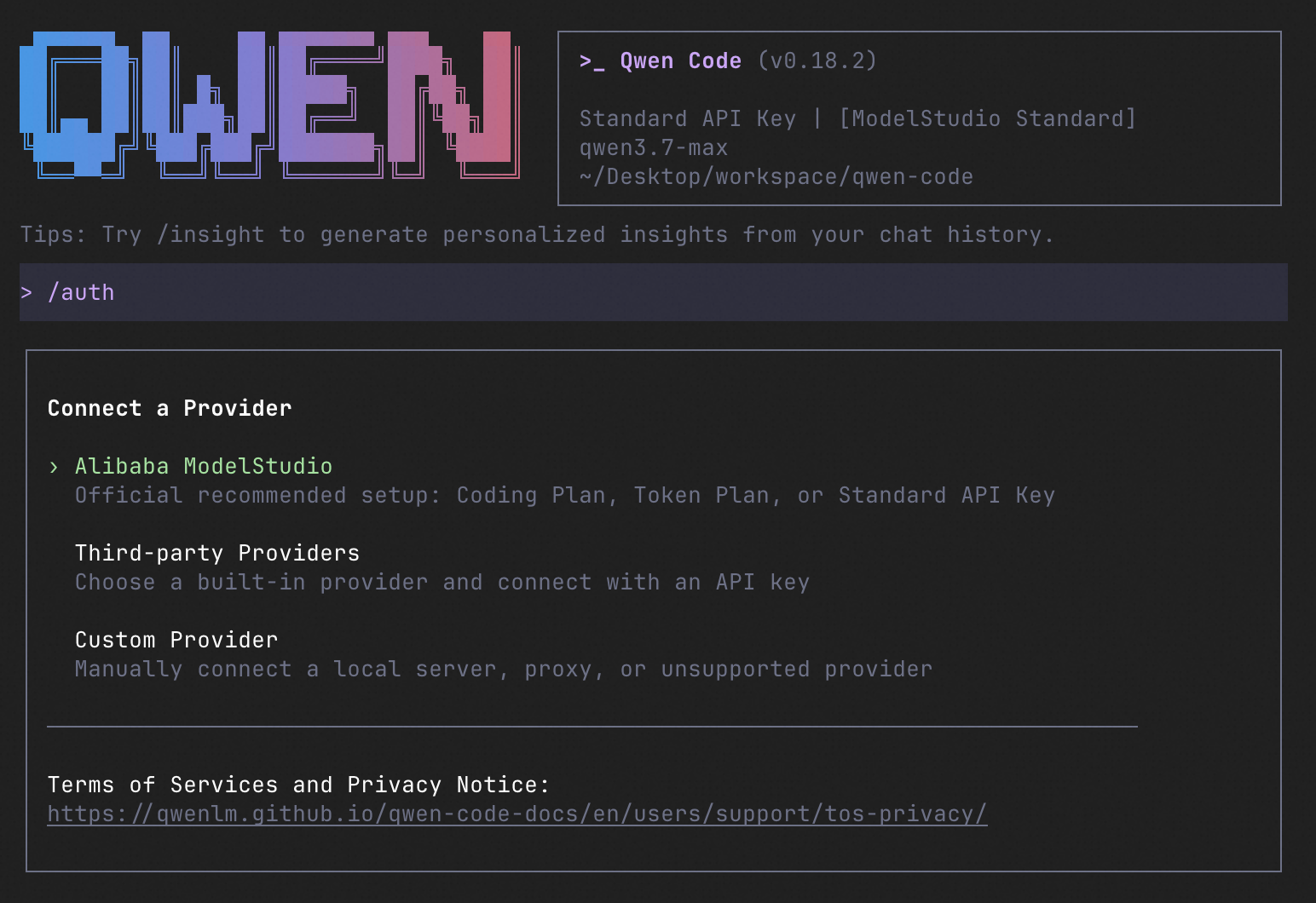
qwen          # Launch interactive terminal UI
# Inside the session:
/auth         # Configure your provider and API key
See the Authentication Guide and Settings Reference for detailed setup.
How to Use Qwen Code
| Mode | Command | Use Case |
|---|---|---|
| Interactive | qwen |
Terminal UI with rich rendering, @file references, slash commands |
| Headless | qwen -p "..." |
Scripts, CI/CD, batch processing — no UI |
| IDE | — | VS Code, Zed, JetBrains |
| Desktop | — | Qwen Code Desktop — GUI for macOS, Windows, Linux |
| Daemon | qwen serve |
Shared agent session over HTTP+SSE (ACP). Multiple clients, one agent. (experimental) Docs |
| SDK | — | TypeScript, Python, Java |
| IM Bot | qwen channel |
Connect to Telegram, DingTalk, WeChat, or Feishu |
SDK example (Python)
import asyncio

from qwen_code_sdk import is_sdk_result_message, query


async def main() -> None:
    result = query(
        "Summarize the repository layout.",
        {
            "cwd": "/path/to/project",
            "path_to_qwen_executable": "qwen",
        },
    )

    async for message in result:
        if is_sdk_result_message(message):
            print(message["result"])


asyncio.run(main())
Capabilities
If you know Claude Code, you already know Qwen Code — and then some. We've put significant effort into bringing Qwen Code to feature parity with Claude Code, improving both breadth and reliability across the board.
| Feature | Qwen Code | Claude Code |
|---|---|---|
| SubAgents, Agent Teams, Dynamic Workflows | ✓ | ✓ |
| Auto-Memory, Auto-Skills, Hooks | ✓ | ✓ |
| Built-in Skills (/review, /batch, /loop, /bugfix…) | ✓ | ✓ |
| MCP, Plan Mode, LSP Integration | ✓ | ✓ |
| Auto Mode, Sandbox, Git Worktrees | ✓ | ✓ |
| Computer Use (desktop automation) | ✓ | ✓ |
| IDE Plugins (VS Code / JetBrains / Zed) | ✓ | ✓ |
| SDK | ✓ | ✓ |
| Headless Mode, Session Management | ✓ | ✓ |
| Open-source — model and framework | ✓ | — |
| Multi-protocol (OpenAI / Anthropic / Gemini / Qwen + any provider) | ✓ | — |
| Agent Arena (multi-model head-to-head on same task) | ✓ | — |
Daemon Mode — qwen serve (multi-client shared agent) |
✓ | — |
| IM Channels (Telegram / DingTalk / WeChat / Feishu) | ✓ | — |
Ecosystem
-
Qwen Code Desktop — Official desktop app for macOS, Windows, and Linux
-
AionUi — A modern GUI for command-line AI tools including Qwen Code
-
Gemini CLI Desktop — A cross-platform desktop/web/mobile UI for Qwen Code
-
🦞 Qwen Code Claw — Let other agents (Claude, Codex, etc.) delegate coding tasks to Qwen Code via ACP. Paste this prompt into your agent:
Use Qwen Code as a coding agent. First, fetch and read this skill reference:
https://raw.githubusercontent.com/QwenLM/qwen-code/refs/heads/main/.qwen/skills/qwen-code-claw/SKILL.md
Then follow the instructions inside to install, authenticate, and use Qwen Code via acpx for all coding tasks.
- Aliyun Model Studio CLI — Official CLI for Aliyun's AI platform (
bailian-cli). Extends Qwen Code with image/video generation, knowledge retrieval, app orchestration, and model deployment
Contributing
Contributions are welcome! See CONTRIBUTING.md for guidelines.
Acknowledgments
This project was originally based on Google Gemini CLI v0.8.2. We gratefully acknowledge the Gemini CLI team's excellent work. Starting from Qwen Code v0.1, we stopped syncing with upstream and began independent development as a multi-protocol, multi-platform agent framework with deep integrations for Qwen models and beyond.