 218dec6a6f
* feat(hooks): add MessageDisplay hook for mid-turn streaming Fires repeatedly as the assistant reply streams, before Stop (which only fires once at the end of the turn). Fire-and-forget, cumulative text payload, debounced (~200ms) except for the unconditional final firing. Fires from the single streaming loop in client.ts shared by the terminal UI and ACP paths. Fixes #6488 * fix(hooks): address MessageDisplay review feedback - Chain fire-and-forget MessageDisplay requests per message_id instead of firing them fully unbounded, so a slow hook command can't pile up concurrent processes. - Gate the final flush on non-empty displayed_text and !signal.aborted, matching the adjacent Stop hook's guard. - Document why the final flush intentionally re-sends the last debounced text (is_final itself is new information). - Simplify the debounce constant's JSDoc to drop the competitor comparison. - Add tests for the mid-stream debounced flush and the rejected-request warn path. * test(hooks): drain microtasks before asserting on chained MessageDisplay calls fireMessageDisplayHook now chains per-message_id through a promise (see previous commit), so the final flush's actual messageBus.request() call lands a few microtask ticks after the generator itself finishes — the mid-stream-flush test needs to let that chain settle before asserting. * fix(hooks): flush MessageDisplay is_final on every for-await exit path The three early `return turn` paths inside the streaming loop (always-on loop-detection safety, heuristic loop detection, and the stream Error event) exited before the final MessageDisplay flush, which only sat after the loop ended normally. Hook scripts relying on is_final: true to know when to flush never received it when a turn ended via loop detection or an API error. Extracts the flush into a shared closure and calls it from all four exits (the three early returns plus the normal fall-through), instead of only the one at the bottom of the loop. Adds regression tests for all three previously missed exits, plus the two guard-coverage tests requested in review (abort suppresses the flush, a tool-call-only turn with no Content events does not fire a vacuous empty-text event). Addresses the outstanding critical review comment and the follow-up test coverage suggestion on PR #6489. * fix(hooks): fire MessageDisplay on the ACP surface, coalesce delivery, drain is_final before turn end Addresses the three findings from the local verification report on #6489: - ACP/qwen serve (Finding 1): the delivery logic now lives in a shared MessageDisplayDispatcher (packages/core), and Session.ts wires it into all four raw-stream loops (main prompt, Stop-hook continuation, cron tick, background notification) — these surfaces consume GeminiChat's stream directly and never enter GeminiClient.sendMessageStream, so they need their own fire sites. The daemon no longer advertises an event it never emits. - Slow-hook backlog (Finding 2): the per-message promise chain is replaced by coalescing delivery — at most one in-flight request plus one pending payload per message; newer flushes overwrite the pending slot, which is lossless because displayed_text is cumulative, and is_final is sticky. A slow hook now sees fewer, newer payloads instead of an ever-growing queue of stale ones. - Headless is_final drop (Finding 3): finish() resolves only once every enqueued payload has actually been delivered, and every exit out of the streaming loops awaits it (early returns, normal fall-through, and the enclosing finally for uncaught exceptions), so a short-lived -p process can no longer exit with the final payload still queued. As a consequence, is_final delivery now strictly precedes the Stop hook rather than racing it. Also: the failure log line carries the message_id, finish() is idempotent, the review-requested tests are added (mid-stream and final firings share one message_id; isFinal as the sole flush reason), and hooks.md gains a delivery-semantics contract covering coalescing, the drain guarantee, no is_final on cancellation, provisional displayed_text, and multiple messages per tool-using turn. Co-Authored-By: Claude Fable 5 <noreply@anthropic.com> * fix(hooks): bound MessageDisplay drain wait, fix test gaps flagged in review finish() now gives up waiting on drain after 5s (MESSAGE_DISPLAY_DRAIN_TIMEOUT_MS) instead of blocking turn teardown for up to the full 60s hook timeout, per the re-verification's S1 finding. Delivery keeps running in the background past the timeout; only the caller's wait is bounded. Also: add the config.ts bridge test for MessageDisplay field extraction (S5), and add the missing MessageDisplay/InstructionsLoaded entries to acpAgent.test.ts's HookEventName mock (S6). Co-Authored-By: Claude Sonnet 5 <noreply@anthropic.com> * fix(hooks): dispatch MessageDisplay is_final alongside stale deliveries, share one drain budget Round-3 review findings on #6489: - finish() no longer queues the is_final payload behind an in-flight mid-stream delivery: the pending slot's supersession argument applies to the in-flight slot too, so the final payload is dispatched immediately, alongside the stale delivery if one is still running. is_final is handed to the hook the moment the message ends — before Stop — on every surface, and can no longer be dropped by a short-lived process exiting with it still queued (Finding 1). - The bounded drain wait is memoized: every finish() call (explicit, finally, or concurrent) shares one promise and one timer, so the teardown ceiling is MESSAGE_DISPLAY_DRAIN_TIMEOUT_MS itself, not a multiple of it (Finding 2). - hooks.md delivery semantics rewritten to match the shipped behavior, including the headless orphaned-hook caveat and the unspecified completion order between an overlapped stale execution and the final one (Finding 3). - The dispatcher mirrors its warnings to console.warn itself (stderr on headless/ACP, ink patchConsole in the TUI) in addition to the injected debug-file sink, so hitting the drain timeout is visible by default (Finding 4). - A superseded mid-stream delivery that fails after the final was dispatched no longer warns; failures during streaming still do. - New tests: finish() twice while delivery is in flight (the exact client.ts sequence), concurrent finish() calls sharing one budget, is_final overtaking a held mid-stream delivery, and drain resolving on the final delivery alone. * refactor(core): consolidate MessageDisplay finish() calls, dedupe test spy setup client.ts: wrap the turn.run() streaming loop in try/finally so messageDisplay.finish() fires once instead of at each of the three early-return sites plus the post-loop path -- matching the pattern the four raw-stream loops in Session.ts already use for the same dispatcher. message-display-dispatcher.test.ts: centralize the console.warn spy setup/teardown in beforeEach/afterEach instead of five repeated per-test try/finally blocks. No behavior change: full client.test.ts (246/246) and the message-display-buffer/dispatcher suites (24/24) pass unchanged. * docs(hooks): clarify MessageDisplay cancellation timing (round-4 nit) * test(hooks): cover the 3 untested MessageDisplay dispatch sites, fix cancellation doc wording Adds MessageDisplay is_final coverage for the Stop-hook continuation loop, the in-session cron fire, and the background-notification loop, each with a normal-completion and an abort case. Adds three MessageDisplayDispatcher edge-case tests: a delivery settling just before the drain timeout, an abort arriving after a drain wait has already started, and addChunk called after abort but before finish(). Rewords the cancellation-timing doc bullet to state the actual criterion (abort signal state when finish() runs) rather than an approximation of it. --------- Co-authored-by: Claude Fable 5 <noreply@anthropic.com> Co-authored-by: Shaojin Wen <shaojin.wensj@alibaba-inc.com> |
||
|---|---|---|
| .github | ||
| .husky | ||
| .qwen | ||
| .vscode | ||
| docs | ||
| docs-site | ||
| eslint-rules | ||
| integration-tests | ||
| packages | ||
| patches | ||
| scripts | ||
| .dockerignore | ||
| .editorconfig | ||
| .gitattributes | ||
| .gitignore | ||
| .npmrc | ||
| .nvmrc | ||
| .prettierignore | ||
| .prettierrc.json | ||
| .yamllint.yml | ||
| AGENTS.md | ||
| CHANGELOG.md | ||
| CLAUDE.md | ||
| CONTRIBUTING.md | ||
| Dockerfile | ||
| esbuild.config.js | ||
| eslint.config.js | ||
| eslint.legacy-filenames.mjs | ||
| LICENSE | ||
| Makefile | ||
| package-lock.json | ||
| package.json | ||
| README.md | ||
| SECURITY.md | ||
| tsconfig.json | ||
| vitest.config.ts | ||




The open-source AI coding agent that lives in your terminal.
中文 | Deutsch | français | 日本語 | Русский | Português (Brasil)
Why Qwen Code?
- Agentic out of the box — Auto-Memory, Auto-Skills, SubAgents, Agent Teams, and MCP. Dynamic workflows, zero setup.
- Open-source, inside and out — The framework and the Qwen models are open-source. They evolve together. No vendor lock-in.
- Multi-protocol — Supports OpenAI, Anthropic, Gemini, and Qwen APIs. Any third-party provider or local model (Ollama / vLLM). Switch at runtime.
- Beyond the terminal — IDE plugins, Desktop app, daemon mode, SDKs, and IM bots (Telegram / DingTalk / WeChat / Feishu).
Tip
Qwen Code is actively iterating on itself — using its own agent and models to file issues, submit PRs, review code, and run tests. Powered by the community, driven by AI.
Installation
Linux / macOS:
curl -fsSL https://qwen-code-assets.oss-cn-hangzhou.aliyuncs.com/installation/install-qwen-standalone.sh | bash
Windows:
irm https://qwen-code-assets.oss-cn-hangzhou.aliyuncs.com/installation/install-qwen-standalone.ps1 | iex
Restart your terminal after installation to ensure environment variables take effect.
NPM / Homebrew
NPM (requires Node.js 22+):
npm install -g @qwen-code/qwen-code@latest
Homebrew (macOS / Linux):
brew install qwen-code
Quick Start
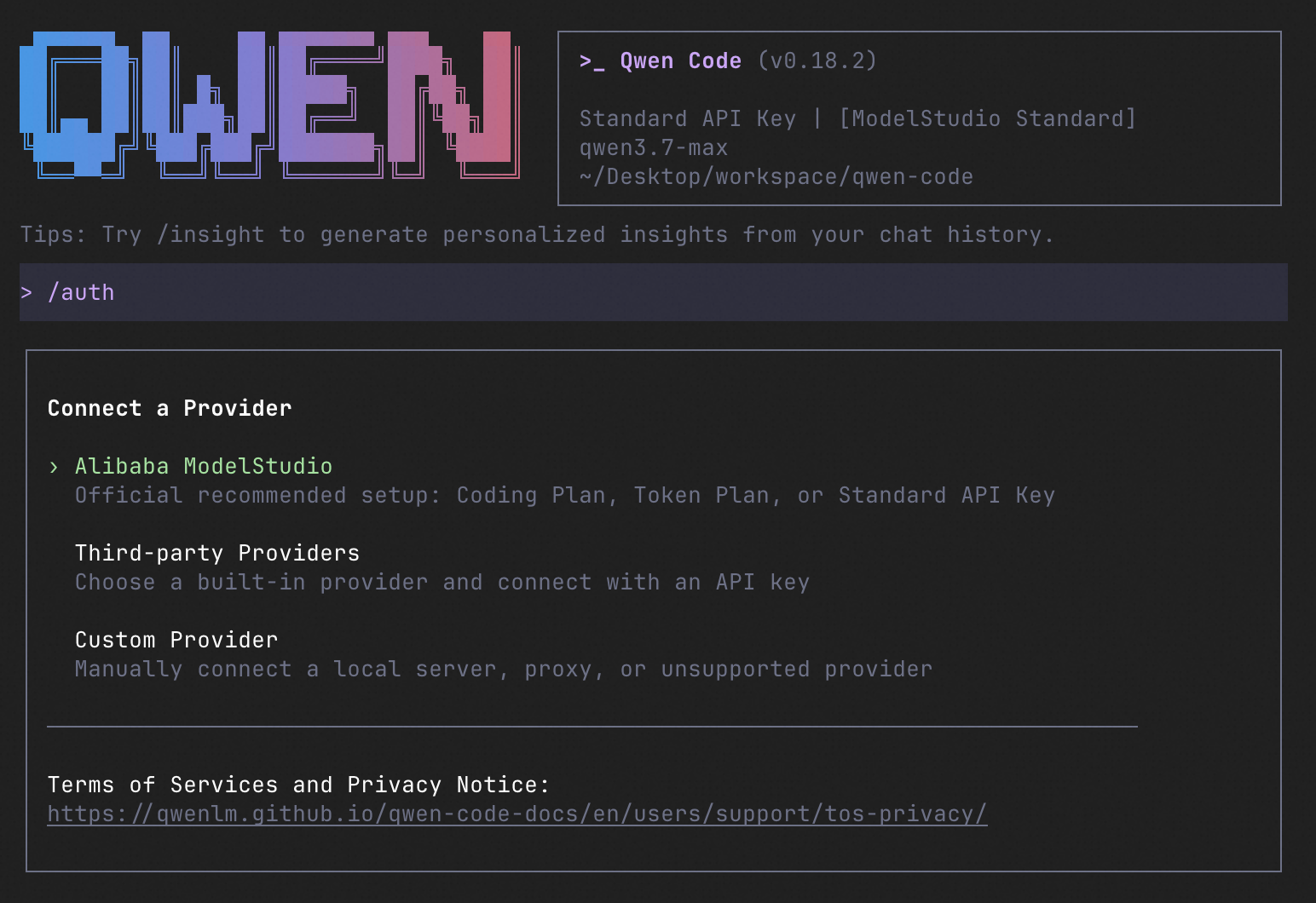
qwen          # Launch interactive terminal UI
# Inside the session:
/auth         # Configure your provider and API key
See the Authentication Guide and Settings Reference for detailed setup.
How to Use Qwen Code
| Mode | Command | Use Case |
|---|---|---|
| Interactive | qwen |
Terminal UI with rich rendering, @file references, slash commands |
| Headless | qwen -p "..." |
Scripts, CI/CD, batch processing — no UI |
| IDE | — | VS Code, Zed, JetBrains |
| Desktop | — | Qwen Code Desktop — GUI for macOS, Windows, Linux |
| Daemon | qwen serve |
Shared agent session over HTTP+SSE (ACP). Multiple clients, one agent. (experimental) Docs |
| SDK | — | TypeScript, Python, Java |
| IM Bot | qwen channel |
Connect to Telegram, DingTalk, WeChat, or Feishu |
SDK example (Python)
import asyncio

from qwen_code_sdk import is_sdk_result_message, query


async def main() -> None:
    result = query(
        "Summarize the repository layout.",
        {
            "cwd": "/path/to/project",
            "path_to_qwen_executable": "qwen",
        },
    )

    async for message in result:
        if is_sdk_result_message(message):
            print(message["result"])


asyncio.run(main())
Capabilities
If you know Claude Code, you already know Qwen Code — and then some. We've put significant effort into bringing Qwen Code to feature parity with Claude Code, improving both breadth and reliability across the board.
| Feature | Qwen Code | Claude Code |
|---|---|---|
| SubAgents, Agent Teams, Dynamic Workflows | ✓ | ✓ |
| Auto-Memory, Auto-Skills, Hooks | ✓ | ✓ |
| Built-in Skills (/review, /batch, /loop, /bugfix…) | ✓ | ✓ |
| MCP, Plan Mode, LSP Integration | ✓ | ✓ |
| Auto Mode, Sandbox, Git Worktrees | ✓ | ✓ |
| Computer Use (desktop automation) | ✓ | ✓ |
| IDE Plugins (VS Code / JetBrains / Zed) | ✓ | ✓ |
| SDK | ✓ | ✓ |
| Headless Mode, Session Management | ✓ | ✓ |
| Open-source — model and framework | ✓ | — |
| Multi-protocol (OpenAI / Anthropic / Gemini / Qwen + any provider) | ✓ | — |
| Agent Arena (multi-model head-to-head on same task) | ✓ | — |
Daemon Mode — qwen serve (multi-client shared agent) |
✓ | — |
| IM Channels (Telegram / DingTalk / WeChat / Feishu) | ✓ | — |
Ecosystem
-
Qwen Code Desktop — Official desktop app for macOS, Windows, and Linux
-
AionUi — A modern GUI for command-line AI tools including Qwen Code
-
Gemini CLI Desktop — A cross-platform desktop/web/mobile UI for Qwen Code
-
🦞 Qwen Code Claw — Let other agents (Claude, Codex, etc.) delegate coding tasks to Qwen Code via ACP. Paste this prompt into your agent:
Use Qwen Code as a coding agent. First, fetch and read this skill reference:
https://raw.githubusercontent.com/QwenLM/qwen-code/refs/heads/main/.qwen/skills/qwen-code-claw/SKILL.md
Then follow the instructions inside to install, authenticate, and use Qwen Code via acpx for all coding tasks.
Contributing
Contributions are welcome! See CONTRIBUTING.md for guidelines.
Acknowledgments
This project was originally based on Google Gemini CLI v0.8.2. We gratefully acknowledge the Gemini CLI team's excellent work. Starting from Qwen Code v0.1, we stopped syncing with upstream and began independent development as a multi-protocol, multi-platform agent framework with deep integrations for Qwen models and beyond.