 1777b20e93
Some checks are pending
Qwen Code CI / Lint (push) Waiting to run
Qwen Code CI / Test (macos-latest, Node 22.x) (push) Waiting to run
Qwen Code CI / Test (ubuntu-latest, Node 22.x) (push) Waiting to run
Qwen Code CI / Test (windows-latest, Node 22.x) (push) Waiting to run
Qwen Code CI / Post Coverage Comment (push) Blocked by required conditions
Qwen Code CI / CodeQL (push) Waiting to run
E2E Tests / E2E Test (Linux) - sandbox:docker (push) Waiting to run
E2E Tests / E2E Test (Linux) - sandbox:none (push) Waiting to run
E2E Tests / E2E Test - macOS (push) Waiting to run
SDK Python / SDK Python (3.10) (push) Waiting to run
SDK Python / SDK Python (3.11) (push) Waiting to run
SDK Python / SDK Python (3.12) (push) Waiting to run
* perf(core): drop full-file readline + pool tail buffer in listSessions

`listSessions` previously called `countSessionMessages` per file, which
streamed the entire JSONL through `readline` to count unique
user/assistant UUIDs. For a project with N sessions averaging M bytes
each, every /resume open paid O(N · M) wall time before showing the
picker — by far the dominant cost once a project accumulated many
multi-MB sessions.

This change:

- Drops the per-file count from listSessions / findSessionsByTitle.
  `SessionListItem.messageCount` is now optional. Callers that need
  a count call the new public `SessionService.countSessionMessages
  (sessionId)` lazily — typically only when a SessionPreview panel is
  about to display the badge.
- Pools a single 64KB tail-read buffer across the per-file metadata
  reads in listSessions / findSessionsByTitle, mirroring the pattern
  in claude-code's `enrichLogs`. The two helpers in
  `sessionStorageUtils` (`readLastJsonStringFieldSync` and
  `readLastJsonStringFieldsSync`) accept an optional caller-owned
  scratch buffer; one-off callers (rename, single-session lookup) pass
  nothing and keep the original alloc behaviour.
- Updates SessionPicker's row metadata to omit the "N messages"
  segment when `messageCount` isn't available, keeping the visual
  layout intact.

Tests:
- Pin that listSessions does not populate messageCount (regression
  guard against silently re-introducing the per-file scan).
- Smoke test the buffer-pool plumbing — same caller-owned buffer
  handed to two reads of different file sizes returns both correct
  values without state bleed.

Co-authored-by: Qwen-Coder <qwen-coder@alibabacloud.com>

* perf(core): re-anchor custom_title; drop Phase-2 full-file scan

Tightens the title-write / title-read invariant so the picker's
metadata read is bounded to a fixed 2 × 64KB per file, regardless
of session length, with no fallback that scales with file size.

Writer (`ChatRecordingService`):
  - New `bytesSinceTitleAnchor` counter and `TITLE_REANCHOR_BYTES`
    threshold (32 KB, half of LITE_READ_BUF_SIZE).
  - `appendRecord` now updates the counter and, once it crosses the
    threshold while a title is set, re-appends a fresh `custom_title`
    record to EOF (`reanchorTitle`). The recursive append routes
    back through the same tracking path, which sees the title
    record and resets the counter to zero.
  - Sessions that never set a title pay zero overhead — the early
    return in `updateTitleAnchorTracking` short-circuits.

Reader (`sessionStorageUtils`):
  - `readLastJsonStringFieldSync` / `readLastJsonStringFieldsSync`
    now read the file's last 64 KB, fall back to the first 64 KB
    on miss, and return `undefined` if neither contains the field.
    The previous Phase-2 streaming full-file scan (capped at 64 MB)
    is removed entirely.
  - The pooled scratch buffer (already optional) now backs both the
    tail and head reads — only one allocation per `listSessions`
    page even with the head fallback firing.
  - `MAX_FULL_SCAN_BYTES` constant deleted (unused).

The two changes are coupled: the reader's tighter bound only works
because the writer guarantees the title stays in tail. A title
buried mid-file is now intentionally `undefined` (the picker
falls back to `firstPrompt` for display) rather than triggering a
full-file scan that would freeze the UI on long agent transcripts.

Tests:
  - `chatRecordingService.customTitle.test.ts` — three scenarios
    pinning the re-anchor invariant: threshold trigger, no-spurious
    on no-title sessions, no-trigger on small write bursts.
  - `sessionStorageUtils.test.ts` — replaces Phase-2 tests with
    head-window fallback tests; pins the new "buried beyond both
    windows returns undefined" contract; updates buffer-pool reuse
    test to cover both tail and head reads with the same scratch.

E2E coverage (35/35 scenarios on a separate harness against real
fs): R1–R10 reader contract, M1–M4 multi-field, W1–W7 writer
re-anchor, L1–L6 listing latency + regression pins, S1 stress
(200 × 3 MB), C1 concurrency, I1–I5 writer/reader integration.
Measured 2.6× speedup on listSessions(50) over 50 × 4 MB
sessions vs the legacy `countSessionMessages` baseline; speedup
scales linearly with average file size.

Co-authored-by: Qwen-Coder <qwen-coder@alibabacloud.com>

* test(core): cover CR review gaps for session-list perf path

- countSessionMessages: valid id counts unique user/assistant uuids and
  ignores other types/malformed lines; invalid id short-circuits without
  filesystem access; ENOENT degrades to 0 instead of bubbling.
- readLastJsonStringFieldsSync: mirror the single-field variant's
  scratch-buffer reuse test across a tail-hit then head-fallback to
  catch any decode that ignores bytesRead.
- ChatRecordingService re-anchor: legacy resumed session (source
  undefined) must omit titleSource on threshold-triggered re-anchor,
  not silently reclassify as 'manual'.

Co-authored-by: Qwen-Coder <noreply@alibabacloud.com>

* fix(core): count title-anchor bytes as utf-8 + reset on reanchor failure

`String.length` undercounts the on-disk size of multi-byte payloads
(CJK, emoji are 1 UTF-16 unit but 3 UTF-8 bytes), so a session full
of CJK content could push >96KB of writes past the last anchor before
the 32KB threshold thinks it has — silently drifting the title past
the 64KB tail window the picker scans. Switch the byte counter to
`Buffer.byteLength(..., 'utf8')` for parity with `jsonl.writeLine`.

Also reset `bytesSinceTitleAnchor` to 0 in the reanchor catch:
without it, a failing reanchor pins the counter at the threshold
and turns a single transient I/O fault into a per-record retry
storm. One missed anchor is the right tradeoff — finalize() will
re-emit on the next lifecycle event.

Co-authored-by: Qwen-Coder <noreply@alibabacloud.com>

* fix(core): trim head-window to whole lines in lite metadata reads

The 64KB head-window fallback in `readLastJsonStringFieldSync` /
`readLastJsonStringFieldsSync` reads a fixed slice and hands it
straight to the extractor — its trailing bytes can fall mid-record.
A partial line whose `customTitle` value happens to close inside
the buffer but whose body extends past 64KB would otherwise win
the latest-match race and surface as the picker's title.

Drop everything past the last `\n` before extracting (only when the
buffer is shorter than the file — a small file is necessarily whole-
line). Honors the original Phase-2 contract that only complete lines
get a vote, without paying for the deleted full-file scan.

Co-authored-by: Qwen-Coder <noreply@alibabacloud.com>

* fix(core,cli): preview lazy count, project-scope countSessionMessages, pin perf contract

Address #3897 follow-up review findings:

- SessionPreview footer no longer drops the message count when listSessions
  omits it. The prop is the override path; default falls back to a unique
  user/assistant uuid count derived from the already-loaded conversation,
  matching countSessionMessages semantics with zero extra disk I/O.
- countSessionMessages now scopes to the current project, mirroring the
  first-record cwd check in deleteSession/renameSession/loadSession. A
  valid sessionId from another project sharing the chats dir no longer
  bypasses project boundaries on lazy count.
- New regression tests:
  - SessionPicker row renders cleanly with messageCount === undefined
    (no "messages"/"undefined"/dangling separator)
  - findSessionsByTitle perf contract: matches have messageCount
    undefined and fs.createReadStream is never called
  - countSessionMessages: cross-project sessions return 0 without
    streaming, empty file returns 0
- Update corruption-recovery tests to call private countSessionMessagesFromPath
  (the streaming entry point) instead of the public sessionId-shaped API the
  merge from main pointed them at.

Co-Authored-By: Qwen-Coder <noreply@qwen.com>

* docs(core): correct stale 'full-file fallback' comments to head-window

The session metadata reader uses two bounded 64KB windows (tail + head)
since the perf rework on this branch — never a full-file scan. Two
comments still described the prior behavior. Reported in MR review.

Co-authored-by: Qwen-Coder <qwen-coder@alibabacloud.com>

* fix(cli): route ACP renameSession through live ChatRecordingService

ACP renameSession constructed a fresh SessionService and wrote the
custom_title record straight to disk. When the same session was live
in this process, ChatRecordingService.currentCustomTitle stayed at
the old value, so the next title re-anchor (every 32KB) or finalize()
re-emitted the stale title at EOF and silently reverted the rename.

Now we look up the live ChatRecordingService first and route through
recordCustomTitle, which keeps the in-memory cache and the on-disk
record in sync. The SessionService path remains for the non-live case
(e.g., another client renaming a backgrounded session). Reported in
MR review.

Co-authored-by: Qwen-Coder <qwen-coder@alibabacloud.com>

* fix(core): harden session title re-anchor invariants

* docs(core): clarify bounded metadata race recovery cost

* test(core): cover bounded multi-field title reads

---------

Co-authored-by: Qwen-Coder <qwen-coder@alibabacloud.com>
Co-authored-by: Qwen-Coder <noreply@alibabacloud.com>
Co-authored-by: Qwen-Coder <noreply@qwen.com>
Co-authored-by: qqqys <266654365+qqqys@users.noreply.github.com>
|
||
|---|---|---|
| .github | ||
| .husky | ||
| .qwen | ||
| .vscode | ||
| docs | ||
| docs-site | ||
| eslint-rules | ||
| integration-tests | ||
| packages | ||
| scripts | ||
| .dockerignore | ||
| .editorconfig | ||
| .gitattributes | ||
| .gitignore | ||
| .npmrc | ||
| .nvmrc | ||
| .prettierignore | ||
| .prettierrc.json | ||
| .yamllint.yml | ||
| AGENTS.md | ||
| CONTRIBUTING.md | ||
| Dockerfile | ||
| esbuild.config.js | ||
| eslint.config.js | ||
| LICENSE | ||
| Makefile | ||
| package-lock.json | ||
| package.json | ||
| README.md | ||
| SECURITY.md | ||
| tsconfig.json | ||
| vitest.config.ts | ||




An open-source AI agent that lives in your terminal.
中文 | Deutsch | français | 日本語 | Русский | Português (Brasil)
🎉 News
-
2026-04-15: Qwen OAuth free tier has been discontinued. To continue using Qwen Code, switch to Alibaba Cloud Coding Plan, OpenRouter, Fireworks AI, or bring your own API key. Run
qwen authto configure. -
2026-04-13: Qwen OAuth free tier policy update: daily quota adjusted to 100 requests/day (from 1,000).
-
2026-04-02: Qwen3.6-Plus is now live! Get an API key from Alibaba Cloud ModelStudio to access it through the OpenAI-compatible API.
-
2026-02-16: Qwen3.5-Plus is now live!
Why Qwen Code?
Qwen Code is an open-source AI agent for the terminal, optimized for Qwen series models. It helps you understand large codebases, automate tedious work, and ship faster.
- Multi-protocol, flexible providers: use OpenAI / Anthropic / Gemini-compatible APIs, Alibaba Cloud Coding Plan, OpenRouter, Fireworks AI, or bring your own API key.
- Open-source, co-evolving: both the framework and the Qwen3-Coder model are open-source—and they ship and evolve together.
- Agentic workflow, feature-rich: rich built-in tools (Skills, SubAgents) for a full agentic workflow and a Claude Code-like experience.
- Terminal-first, IDE-friendly: built for developers who live in the command line, with optional integration for VS Code, Zed, and JetBrains IDEs.
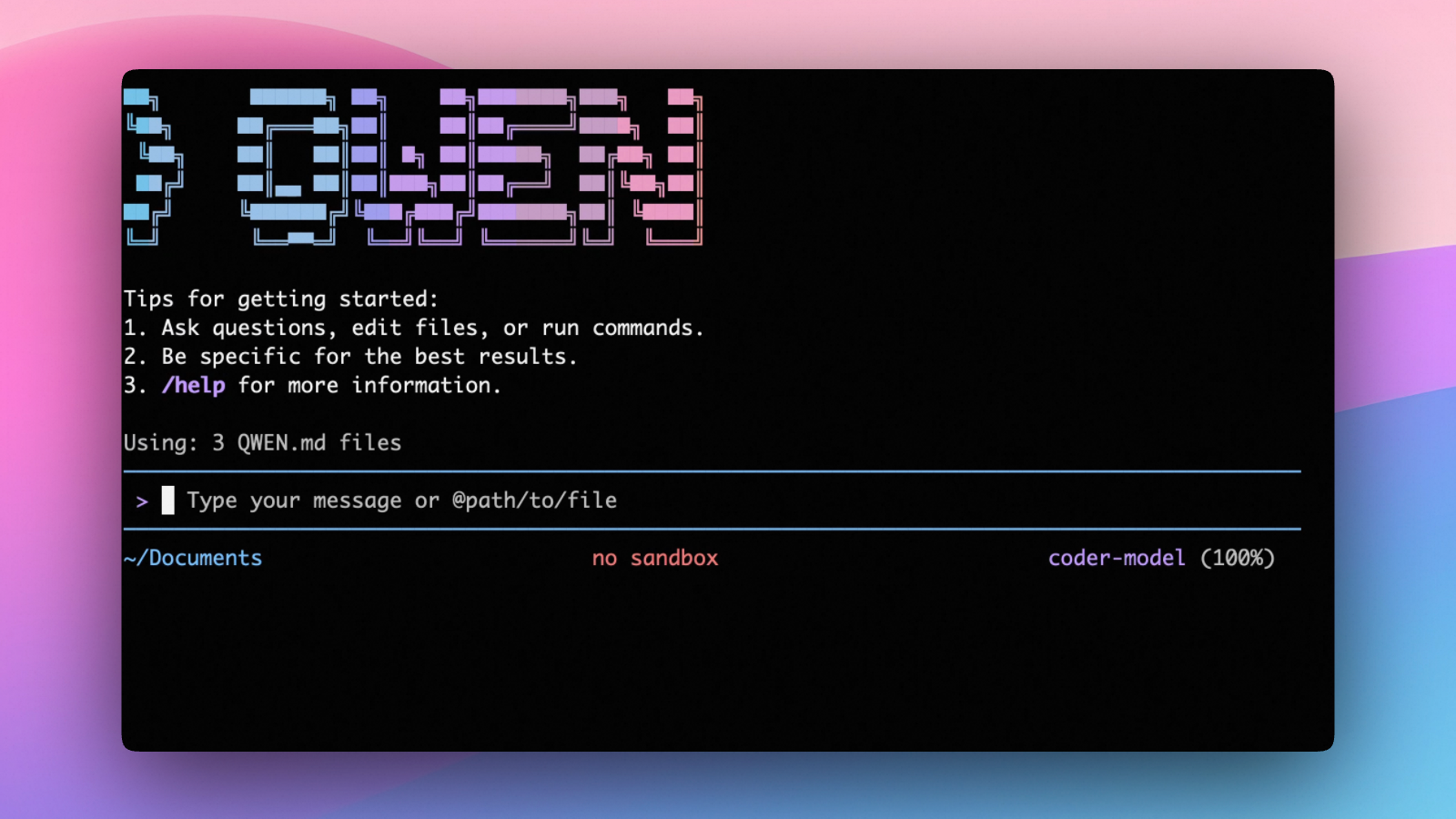
Installation
Quick Install (Recommended)
Linux / macOS
bash -c "$(curl -fsSL https://qwen-code-assets.oss-cn-hangzhou.aliyuncs.com/installation/install-qwen.sh)"
Windows (Run as Administrator)
Works in both Command Prompt and PowerShell:
powershell -Command "Invoke-WebRequest 'https://qwen-code-assets.oss-cn-hangzhou.aliyuncs.com/installation/install-qwen.bat' -OutFile (Join-Path $env:TEMP 'install-qwen.bat'); & (Join-Path $env:TEMP 'install-qwen.bat')"
Note
: It's recommended to restart your terminal after installation to ensure environment variables take effect.
Manual Installation
Prerequisites
Make sure you have Node.js 20 or later installed. Download it from nodejs.org.
NPM
npm install -g @qwen-code/qwen-code@latest
Homebrew (macOS, Linux)
brew install qwen-code
Quick Start
# Start Qwen Code (interactive)
qwen

# Then, in the session:
/help
/auth
On first use, you'll be prompted to sign in. You can run /auth anytime to switch authentication methods.
Example prompts:
What does this project do?
Explain the codebase structure.
Help me refactor this function.
Generate unit tests for this module.
Click to watch a demo video
🦞 Use Qwen Code for Coding Tasks in Claw
Copy the prompt below and paste it into your agent:
Use Qwen Code as a coding agent. First, fetch and read this skill reference:
https://raw.githubusercontent.com/QwenLM/qwen-code/refs/heads/main/.qwen/skills/qwen-code-claw/SKILL.md
Then follow the instructions inside to install, authenticate, and use Qwen Code via acpx for all coding tasks.
Authentication
Qwen Code supports the following authentication methods:
- API Key (recommended): use an API key from Alibaba Cloud Model Studio (Beijing / intl) or any supported provider (OpenAI, Anthropic, Google GenAI, and other compatible endpoints).
- Coding Plan: subscribe to the Alibaba Cloud Coding Plan (Beijing / intl) for a fixed monthly fee with higher quotas.
⚠️ Qwen OAuth was discontinued on April 15, 2026. If you were previously using Qwen OAuth, please switch to one of the methods above. Run
qwenand then/authto reconfigure.
API Key (recommended)
Use an API key to connect to Alibaba Cloud Model Studio or any supported provider. Supports multiple protocols:
- OpenAI-compatible: Alibaba Cloud ModelStudio, ModelScope, OpenAI, OpenRouter, and other OpenAI-compatible providers
- Anthropic: Claude models
- Google GenAI: Gemini models
The recommended way to configure models and providers is by editing ~/.qwen/settings.json (create it if it doesn't exist). This file lets you define all available models, API keys, and default settings in one place.
Quick Setup in 3 Steps
Step 1: Create or edit ~/.qwen/settings.json
Here is a complete example:
{
  "modelProviders": {
    "openai": [
      {
        "id": "qwen3.6-plus",
        "name": "qwen3.6-plus",
        "baseUrl": "https://dashscope.aliyuncs.com/compatible-mode/v1",
        "description": "Qwen3-Coder via Dashscope",
        "envKey": "DASHSCOPE_API_KEY"
      }
    ]
  },
  "env": {
    "DASHSCOPE_API_KEY": "sk-xxxxxxxxxxxxx"
  },
  "security": {
    "auth": {
      "selectedType": "openai"
    }
  },
  "model": {
    "name": "qwen3.6-plus"
  }
}
Step 2: Understand each field
| Field | What it does |
|---|---|
modelProviders |
Declares which models are available and how to connect to them. Keys like openai, anthropic, gemini represent the API protocol. |
modelProviders[].id |
The model ID sent to the API (e.g. qwen3.6-plus, gpt-4o). |
modelProviders[].envKey |
The name of the environment variable that holds your API key. |
modelProviders[].baseUrl |
The API endpoint URL (required for non-default endpoints). |
env |
A fallback place to store API keys (lowest priority; prefer .env files or export for sensitive keys). |
security.auth.selectedType |
The protocol to use on startup (openai, anthropic, gemini, vertex-ai). |
model.name |
The default model to use when Qwen Code starts. |
Step 3: Start Qwen Code — your configuration takes effect automatically:
qwen
Use the /model command at any time to switch between all configured models.
More Examples
Coding Plan (Alibaba Cloud ModelStudio) — fixed monthly fee, higher quotas
{
  "modelProviders": {
    "openai": [
      {
        "id": "qwen3.6-plus",
        "name": "qwen3.6-plus (Coding Plan)",
        "baseUrl": "https://coding.dashscope.aliyuncs.com/v1",
        "description": "qwen3.6-plus from ModelStudio Coding Plan",
        "envKey": "BAILIAN_CODING_PLAN_API_KEY"
      },
      {
        "id": "qwen3.5-plus",
        "name": "qwen3.5-plus (Coding Plan)",
        "baseUrl": "https://coding.dashscope.aliyuncs.com/v1",
        "description": "qwen3.5-plus with thinking enabled from ModelStudio Coding Plan",
        "envKey": "BAILIAN_CODING_PLAN_API_KEY",
        "generationConfig": {
          "extra_body": {
            "enable_thinking": true
          }
        }
      },
      {
        "id": "glm-4.7",
        "name": "glm-4.7 (Coding Plan)",
        "baseUrl": "https://coding.dashscope.aliyuncs.com/v1",
        "description": "glm-4.7 with thinking enabled from ModelStudio Coding Plan",
        "envKey": "BAILIAN_CODING_PLAN_API_KEY",
        "generationConfig": {
          "extra_body": {
            "enable_thinking": true
          }
        }
      },
      {
        "id": "kimi-k2.5",
        "name": "kimi-k2.5 (Coding Plan)",
        "baseUrl": "https://coding.dashscope.aliyuncs.com/v1",
        "description": "kimi-k2.5 with thinking enabled from ModelStudio Coding Plan",
        "envKey": "BAILIAN_CODING_PLAN_API_KEY",
        "generationConfig": {
          "extra_body": {
            "enable_thinking": true
          }
        }
      }
    ]
  },
  "env": {
    "BAILIAN_CODING_PLAN_API_KEY": "sk-xxxxxxxxxxxxx"
  },
  "security": {
    "auth": {
      "selectedType": "openai"
    }
  },
  "model": {
    "name": "qwen3.6-plus"
  }
}
Subscribe to the Coding Plan and get your API key at Alibaba Cloud ModelStudio(Beijing) or Alibaba Cloud ModelStudio(intl).
Multiple providers (OpenAI + Anthropic + Gemini)
{
  "modelProviders": {
    "openai": [
      {
        "id": "gpt-4o",
        "name": "GPT-4o",
        "envKey": "OPENAI_API_KEY",
        "baseUrl": "https://api.openai.com/v1"
      }
    ],
    "anthropic": [
      {
        "id": "claude-sonnet-4-20250514",
        "name": "Claude Sonnet 4",
        "envKey": "ANTHROPIC_API_KEY"
      }
    ],
    "gemini": [
      {
        "id": "gemini-2.5-pro",
        "name": "Gemini 2.5 Pro",
        "envKey": "GEMINI_API_KEY"
      }
    ]
  },
  "env": {
    "OPENAI_API_KEY": "sk-xxxxxxxxxxxxx",
    "ANTHROPIC_API_KEY": "sk-ant-xxxxxxxxxxxxx",
    "GEMINI_API_KEY": "AIzaxxxxxxxxxxxxx"
  },
  "security": {
    "auth": {
      "selectedType": "openai"
    }
  },
  "model": {
    "name": "gpt-4o"
  }
}
Enable thinking mode (for supported models like qwen3.5-plus)
{
  "modelProviders": {
    "openai": [
      {
        "id": "qwen3.5-plus",
        "name": "qwen3.5-plus (thinking)",
        "envKey": "DASHSCOPE_API_KEY",
        "baseUrl": "https://dashscope.aliyuncs.com/compatible-mode/v1",
        "generationConfig": {
          "extra_body": {
            "enable_thinking": true
          }
        }
      }
    ]
  },
  "env": {
    "DASHSCOPE_API_KEY": "sk-xxxxxxxxxxxxx"
  },
  "security": {
    "auth": {
      "selectedType": "openai"
    }
  },
  "model": {
    "name": "qwen3.5-plus"
  }
}
Tip: You can also set API keys via
exportin your shell or.envfiles, which take higher priority thansettings.json→env. See the authentication guide for full details.
Security note: Never commit API keys to version control. The
~/.qwen/settings.jsonfile is in your home directory and should stay private.
Local Model Setup (Ollama / vLLM)
You can also run models locally — no API key or cloud account needed. This is not an authentication method; instead, configure your local model endpoint in ~/.qwen/settings.json using the modelProviders field.
Set generationConfig.contextWindowSize inside the matching provider entry
and adjust it to the context length configured on your local server.
Ollama setup
- Install Ollama from ollama.com
- Pull a model:
ollama pull qwen3:32b - Configure
~/.qwen/settings.json:
{
  "modelProviders": {
    "openai": [
      {
        "id": "qwen3:32b",
        "name": "Qwen3 32B (Ollama)",
        "baseUrl": "http://localhost:11434/v1",
        "description": "Qwen3 32B running locally via Ollama",
        "generationConfig": {
          "contextWindowSize": 131072
        }
      }
    ]
  },
  "security": {
    "auth": {
      "selectedType": "openai"
    }
  },
  "model": {
    "name": "qwen3:32b"
  }
}
vLLM setup
- Install vLLM:
pip install vllm - Start the server:
vllm serve Qwen/Qwen3-32B - Configure
~/.qwen/settings.json:
{
  "modelProviders": {
    "openai": [
      {
        "id": "Qwen/Qwen3-32B",
        "name": "Qwen3 32B (vLLM)",
        "baseUrl": "http://localhost:8000/v1",
        "description": "Qwen3 32B running locally via vLLM",
        "generationConfig": {
          "contextWindowSize": 131072
        }
      }
    ]
  },
  "security": {
    "auth": {
      "selectedType": "openai"
    }
  },
  "model": {
    "name": "Qwen/Qwen3-32B"
  }
}
Usage
As an open-source terminal agent, you can use Qwen Code in four primary ways:
- Interactive mode (terminal UI)
- Headless mode (scripts, CI)
- IDE integration (VS Code, Zed)
- SDKs (TypeScript, Python, Java)
Interactive mode
cd your-project/
qwen
Run qwen in your project folder to launch the interactive terminal UI. Use @ to reference local files (for example @src/main.ts).
Headless mode
cd your-project/
qwen -p "your question"
Use -p to run Qwen Code without the interactive UI—ideal for scripts, automation, and CI/CD. Learn more: Headless mode.
IDE integration
Use Qwen Code inside your editor (VS Code, Zed, and JetBrains IDEs):
SDKs
Build on top of Qwen Code with the available SDKs:
- TypeScript: Use the Qwen Code SDK
- Python: Use the Python SDK
- Java: Use the Java SDK
Python SDK example:
import asyncio

from qwen_code_sdk import is_sdk_result_message, query


async def main() -> None:
    result = query(
        "Summarize the repository layout.",
        {
            "cwd": "/path/to/project",
            "path_to_qwen_executable": "qwen",
        },
    )

    async for message in result:
        if is_sdk_result_message(message):
            print(message["result"])


asyncio.run(main())
Commands & Shortcuts
Session Commands
/help- Display available commands/clear- Clear conversation history/compress- Compress history to save tokens/stats- Show current session information/bug- Submit a bug report/exitor/quit- Exit Qwen Code
Keyboard Shortcuts
Ctrl+C- Cancel current operationCtrl+D- Exit (on empty line)Up/Down- Navigate command history
Learn more about Commands
Tip: In YOLO mode (
--yolo), vision switching happens automatically without prompts when images are detected. Learn more about Approval Mode
Configuration
Qwen Code can be configured via settings.json, environment variables, and CLI flags.
| File | Scope | Description |
|---|---|---|
~/.qwen/settings.json |
User (global) | Applies to all your Qwen Code sessions. Recommended for modelProviders and env. |
.qwen/settings.json |
Project | Applies only when running Qwen Code in this project. Overrides user settings. |
The most commonly used top-level fields in settings.json:
| Field | Description |
|---|---|
modelProviders |
Define available models per protocol (openai, anthropic, gemini, vertex-ai). |
env |
Fallback environment variables (e.g. API keys). Lower priority than shell export and .env files. |
security.auth.selectedType |
The protocol to use on startup (e.g. openai). |
model.name |
The default model to use when Qwen Code starts. |
See the Authentication section above for complete
settings.jsonexamples, and the settings reference for all available options.
Benchmark Results
Terminal-Bench Performance
| Agent | Model | Accuracy |
|---|---|---|
| Qwen Code | Qwen3-Coder-480A35 | 37.5% |
| Qwen Code | Qwen3-Coder-30BA3B | 31.3% |
Ecosystem
Looking for a graphical interface?
- AionUi A modern GUI for command-line AI tools including Qwen Code
- Gemini CLI Desktop A cross-platform desktop/web/mobile UI for Qwen Code
Troubleshooting
If you encounter issues, check the troubleshooting guide.
Common issues:
Qwen OAuth free tier was discontinued on 2026-04-15: Qwen OAuth is no longer available. Runqwen→/authand switch to API Key or Coding Plan. See the Authentication section above for setup instructions.
To report a bug from within the CLI, run /bug and include a short title and repro steps.
Connect with Us
- Discord: https://discord.gg/RN7tqZCeDK
- Dingtalk: https://qr.dingtalk.com/action/joingroup?code=v1,k1,+FX6Gf/ZDlTahTIRi8AEQhIaBlqykA0j+eBKKdhLeAE=&_dt_no_comment=1&origin=1
Acknowledgments
This project is based on Google Gemini CLI. We acknowledge and appreciate the excellent work of the Gemini CLI team. Our main contribution focuses on parser-level adaptations to better support Qwen-Coder models.