 16f024338a
* fix(web-shell): render a plain textarea composer on touch devices Mobile browsers could not type into the Web Shell composer (#5958): CodeMirror's contenteditable interacts poorly with virtual keyboards, and three non-gesture view.focus() calls claim activeElement on iOS without opening the keyboard, after which taps may never refocus the editor. On touch devices ('(hover: none) and (pointer: coarse)' plus maxTouchPoints > 0 — touch laptops keep the desktop editor) useComposerCore now skips creating an EditorView entirely and exposes a mobileComposer backend that ChatEditor renders as a controlled <textarea> at the same mount point. The internal submit pipeline was hoisted out of the editor-creation effect and accepts view: EditorView | null, so history, prompt building, tags, images, and slash/! text interpretation are shared unchanged between both backends. Enter inserts a newline natively; submission goes through the Send button. Programmatic (non-gesture) focus is additionally suppressed on coarse-pointer devices even when CodeMirror is forced, and ?composer=textarea|codemirror serves as a debugging and rollback escape hatch. The choice is frozen at mount so a mid-session flip cannot drop the draft. Known textarea-backend degradations (commands still work as typed text): no slash/@ completion menus, no inline tag chips (fall back to the top placement), no history arrow navigation, no large-paste placeholders, and no followup Tab-accept. Fixes #5958 Co-Authored-By: Claude Fable 5 <noreply@anthropic.com> * fix(web-shell): address review — textarea auto-grow, change notifications, caret restore Address the five inline review suggestions on #7587: - Auto-grow the mobile textarea with its content, capped by the computed CSS max-height (so --chat-editor-input-max-height overrides stay authoritative). Previously rows={1} plus resize:none meant multi-line drafts scrolled inside ~1.5 visible lines and the CSS max-height was dead. Asserted in the mobile e2e spec via bounding-box growth. - Fire onInputTextChange from setMobileText, matching the CodeMirror updateListener contract: programmatic draft changes (setText, history restore, post-submit clear) now notify parent trackers too. handleMobileChange delegates to setMobileText. - Restore the caret after mobile insertText: a controlled textarea resets the caret to the end on value change; setSelectionRange puts it back after React re-renders (rAF with a setTimeout fallback), matching the CodeMirror path's explicit selection anchor. - Cover the mobile submitSearchMatch path: select a history match, submit through the shared pipeline, draft cleared. - Cover the ChatEditor mobile quick-action gating: the history quick action opens the search UI (never dispatches into a missing EditorView) and the keyboard shortcut hints grid is hidden on the mobile composer with a desktop control. Co-Authored-By: Claude Fable 5 <noreply@anthropic.com> * fix(web-shell): decide the touch composer by media query alone Independent macOS verification on #7587 found that Playwright's stock WebKit iPhone profiles match '(hover: none) and (pointer: coarse)' but report navigator.maxTouchPoints === 0, so the automatic detection selected CodeMirror under unmodified WebKit emulation. The maxTouchPoints requirement added nothing the AND media query does not already provide: touch laptops are excluded by the query itself (their primary pointer hovers and is fine), and the only devices that match the query with zero touch points are emulated profiles and TV-style browsers, where the plain textarea is a safe fallback. Dropping it makes stock iPhone/WebKit Playwright runs exercise the automatic detection branch. Real-device behavior is unchanged: phones and tablets match the query and report touch points either way. Co-Authored-By: Claude Fable 5 <noreply@anthropic.com> * fix(web-shell): keep the mobile textarea scrollable past its height cap As .editorArea's last child the textarea inherited `overflow: clip` from the `.editorArea > :last-child` wrapper rule (written for the CodeMirror container, whose inner .cm-scroller does the scrolling). `clip` also forbids programmatic scrolling, so once auto-grow reached the CSS max-height, content beyond the cap was unreachable — scrollTop stayed pinned at 0. Override with `overflow-y: auto` via `.editorArea > textarea.mobileTextarea` (the extra type selector outweighs the wrapper rule's specificity). New mobile e2e regression fills 20 lines, asserts growth stops at the computed 300px cap, and verifies the overflow stays reachable: scrollHeight above clientHeight and scrollTop actually moving to the bottom — the exact probe from the review, which pinned at 0 before this fix. Co-Authored-By: Claude Fable 5 <noreply@anthropic.com> --------- Co-authored-by: ComplexSimply <rudy.arrowsong@gmail.com> Co-authored-by: Claude Fable 5 <noreply@anthropic.com> |
||
|---|---|---|
| .github | ||
| .husky | ||
| .qwen | ||
| .vscode | ||
| docs | ||
| docs-site | ||
| eslint-rules | ||
| integration-tests | ||
| packages | ||
| patches | ||
| scripts | ||
| .dockerignore | ||
| .editorconfig | ||
| .gitattributes | ||
| .gitignore | ||
| .npmrc | ||
| .nvmrc | ||
| .prettierignore | ||
| .prettierrc.json | ||
| .yamllint.yml | ||
| AGENTS.md | ||
| CHANGELOG.md | ||
| CLAUDE.md | ||
| CONTRIBUTING.md | ||
| Dockerfile | ||
| esbuild.config.js | ||
| eslint.config.js | ||
| eslint.legacy-filenames.mjs | ||
| LICENSE | ||
| Makefile | ||
| package-lock.json | ||
| package.json | ||
| README.md | ||
| SECURITY.md | ||
| tsconfig.json | ||
| vitest.config.ts | ||




The open-source AI coding agent that lives in your terminal.
中文 | Deutsch | français | 日本語 | Русский | Português (Brasil)
Why Qwen Code?
- Agentic out of the box — Auto-Memory, Auto-Skills, SubAgents, Agent Teams, and MCP. Dynamic workflows, zero setup.
- Open-source, inside and out — The framework and the Qwen models are open-source. They evolve together. No vendor lock-in.
- Multi-protocol — Supports OpenAI, Anthropic, Gemini, and Qwen APIs. Any third-party provider or local model (Ollama / vLLM). Switch at runtime.
- Beyond the terminal — IDE plugins, Desktop app, daemon mode, SDKs, and IM bots (Telegram / DingTalk / WeChat / Feishu).
Tip
Qwen Code is actively iterating on itself — using its own agent and models to file issues, submit PRs, review code, and run tests. Powered by the community, driven by AI.
Installation
Linux / macOS:
curl -fsSL https://qwen-code-assets.oss-cn-hangzhou.aliyuncs.com/installation/install-qwen-standalone.sh | bash
Windows:
irm https://qwen-code-assets.oss-cn-hangzhou.aliyuncs.com/installation/install-qwen-standalone.ps1 | iex
Restart your terminal after installation to ensure environment variables take effect.
NPM / Homebrew
NPM (requires Node.js 22+):
npm install -g @qwen-code/qwen-code@latest
Homebrew (macOS / Linux):
brew install qwen-code
Quick Start
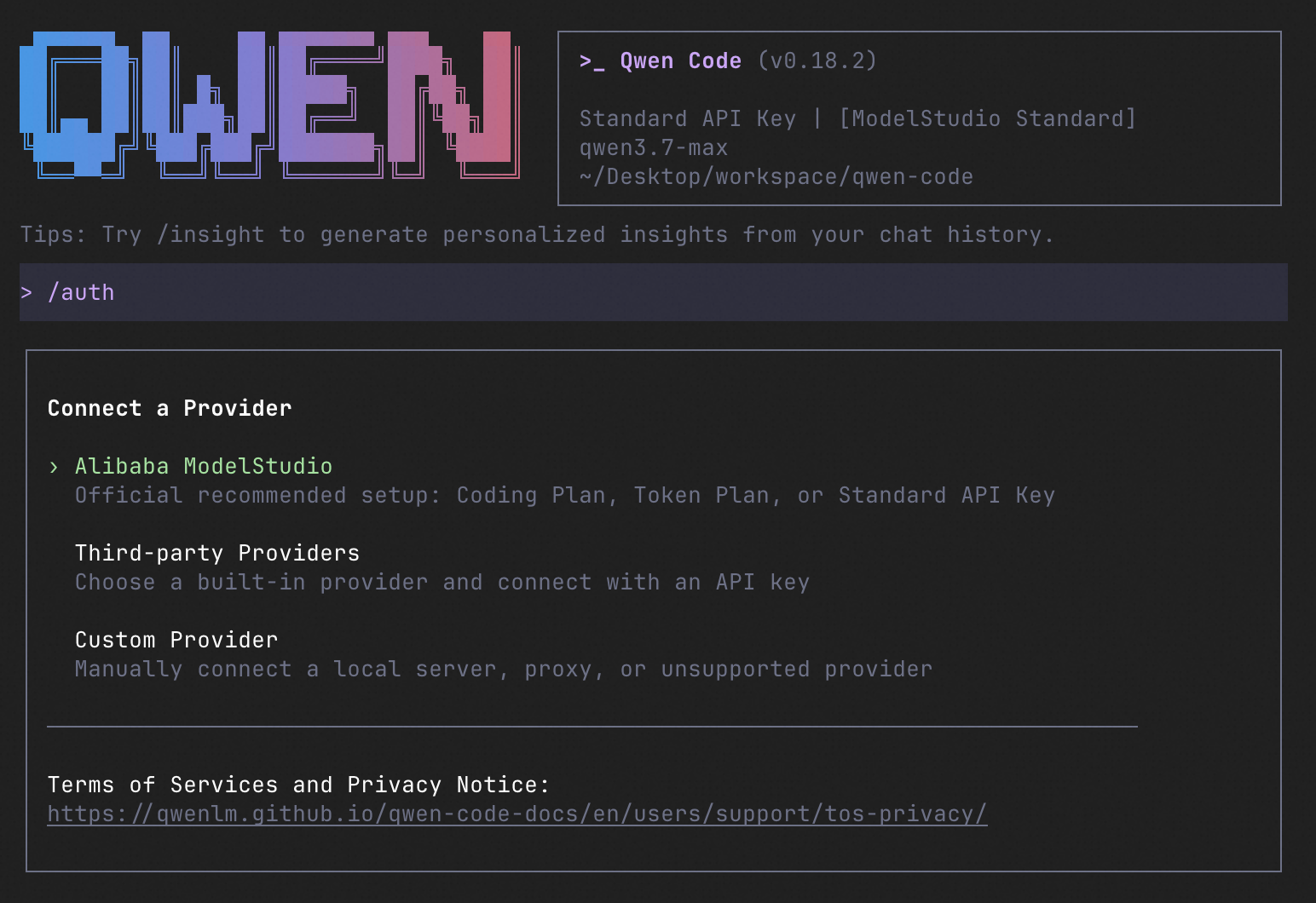
qwen          # Launch interactive terminal UI
# Inside the session:
/auth         # Configure your provider and API key
See the Authentication Guide and Settings Reference for detailed setup.
How to Use Qwen Code
| Mode | Command | Use Case |
|---|---|---|
| Interactive | qwen |
Terminal UI with rich rendering, @file references, slash commands |
| Headless | qwen -p "..." |
Scripts, CI/CD, batch processing — no UI |
| IDE | — | VS Code, Zed, JetBrains |
| Desktop | — | Qwen Code Desktop — GUI for macOS, Windows, Linux |
| Daemon | qwen serve |
Shared agent session over HTTP+SSE (ACP). Multiple clients, one agent. (experimental) Docs |
| SDK | — | TypeScript, Python, Java |
| IM Bot | qwen channel |
Connect to Telegram, DingTalk, WeChat, or Feishu |
SDK example (Python)
import asyncio

from qwen_code_sdk import is_sdk_result_message, query


async def main() -> None:
    result = query(
        "Summarize the repository layout.",
        {
            "cwd": "/path/to/project",
            "path_to_qwen_executable": "qwen",
        },
    )

    async for message in result:
        if is_sdk_result_message(message):
            print(message["result"])


asyncio.run(main())
Capabilities
If you know Claude Code, you already know Qwen Code — and then some. We've put significant effort into bringing Qwen Code to feature parity with Claude Code, improving both breadth and reliability across the board.
| Feature | Qwen Code | Claude Code |
|---|---|---|
| SubAgents, Agent Teams, Dynamic Workflows | ✓ | ✓ |
| Auto-Memory, Auto-Skills, Hooks | ✓ | ✓ |
| Built-in Skills (/review, /batch, /loop, /bugfix…) | ✓ | ✓ |
| MCP, Plan Mode, LSP Integration | ✓ | ✓ |
| Auto Mode, Sandbox, Git Worktrees | ✓ | ✓ |
| Computer Use (desktop automation) | ✓ | ✓ |
| IDE Plugins (VS Code / JetBrains / Zed) | ✓ | ✓ |
| SDK | ✓ | ✓ |
| Headless Mode, Session Management | ✓ | ✓ |
| Open-source — model and framework | ✓ | — |
| Multi-protocol (OpenAI / Anthropic / Gemini / Qwen + any provider) | ✓ | — |
| Agent Arena (multi-model head-to-head on same task) | ✓ | — |
Daemon Mode — qwen serve (multi-client shared agent) |
✓ | — |
| IM Channels (Telegram / DingTalk / WeChat / Feishu) | ✓ | — |
Ecosystem
-
Qwen Code Desktop — Official desktop app for macOS, Windows, and Linux
-
AionUi — A modern GUI for command-line AI tools including Qwen Code
-
Gemini CLI Desktop — A cross-platform desktop/web/mobile UI for Qwen Code
-
🦞 Qwen Code Claw — Let other agents (Claude, Codex, etc.) delegate coding tasks to Qwen Code via ACP. Paste this prompt into your agent:
Use Qwen Code as a coding agent. First, fetch and read this skill reference:
https://raw.githubusercontent.com/QwenLM/qwen-code/refs/heads/main/.qwen/skills/qwen-code-claw/SKILL.md
Then follow the instructions inside to install, authenticate, and use Qwen Code via acpx for all coding tasks.
Contributing
Contributions are welcome! See CONTRIBUTING.md for guidelines.
Acknowledgments
This project was originally based on Google Gemini CLI v0.8.2. We gratefully acknowledge the Gemini CLI team's excellent work. Starting from Qwen Code v0.1, we stopped syncing with upstream and began independent development as a multi-protocol, multi-platform agent framework with deep integrations for Qwen models and beyond.