 10291e16f2
* perf(review): issue independent setup calls in one response Measured on a real small-PR run: the stretch from parse-args to the first agent launch took 7 minutes of wall clock, one round-trip at a time, on calls that never needed an order — pr-context, comment-status and the Step 2 rules load are mutually independent reads. Step 1 now tells the orchestrator to issue all three in a single response (the same rule Step 3 already enforces for the agent fan-out) and to page their outputs in shared responses too. comment-status loses its wait-for-the-context-file guard in worktree mode: learning whether inline comments exist cost a serial round-trip, while running it on a commentless PR just writes an empty index. Step 6's two deterministic gates (script-lint, test-plan) get the same one-response note. The orderings that matter are kept explicit: fetch-pr before everything (it creates the worktree and the plan), the roster after the rules load (it bakes the rules into every brief). * refactor(core): move review skill incident narratives to DESIGN.md SKILL.md is injected wholesale into the review orchestrator's context on every /review run and re-billed on each of its turns, and ~16KB of it was incident narrative — accounts of past dogfood failures and measurements that justify rules but are not themselves instructions. Move 50 such narrative blocks into a new 'Measured incidents (moved from SKILL.md)' section of DESIGN.md (47 anchors, not loaded at runtime), leaving every rule in place with a short '(measured; DESIGN.md — <anchor>)' pointer. Force-bearing figures stay inline where the number is the argument (e.g. the ~161s cold npm ci, the 41% test-code median, the PR #6457 one-of-five checklist measurement). No instruction, gate, format, flag, threshold, or ordering changed; the YAML frontmatter and all 35 fenced code blocks are byte-identical, and the MUST / Do not / never imperative counts are unchanged outside the moved narrative text (verified by script). SKILL.md: 237,847 -> 228,266 bytes; DESIGN.md: 106,708 -> 125,184 bytes. * fix(review): keep DESIGN.md out of the runtime bundle and pin pointers The slim refactor left DESIGN.md shipped beside SKILL.md in dist/bundled/, so one curious read_file of the 125 KB maintainer document would cost more context than the refactor saves. The bundle copy now skips DESIGN.md, and SKILL.md gains a one-line guard telling the orchestrator the pointers are for humans auditing a rule. Also addresses review feedback: a test pins both directions of the SKILL.md incident-pointer mapping, the transcribed-argument narrative keeps its referent after the move, the incidents section title loses its changelog suffix, and Step 2 no longer asks for a base fetch that fetch-pr already performed. * fix(review): gate setup batching by effort and consolidate incident blocks Address round-1 review feedback on the skill-slim PR: - Gate the ONE-response setup batch and the comment-status call to high and medium effort, matching Step 2's low-effort skip. - Scope the Step 6 lint/test-plan batching to same-repo PR reviews. - Merge same-run incident blocks (self-composed Approve into the paraphrased roster prompt; archive verdict into the narrated-away cap), cross-reference the roster-size and relocated-Critical tellings, and state the #8368 path in its block plus the pointer it was missing. - Pointer-ize the last inline QQChannel narrative and fix the scripts-nobody-ran summary to match its block. - Extend the DESIGN.md exclusion to copy_files.js so the transpiled dist/src build and the published core tarball stop shipping it. - Pin the no-read_file guard and the batch ordering constraints in SKILL.test.ts, and fail loudly on pointers the regex cannot parse. --------- Co-authored-by: verify <verify@local> Co-authored-by: qwen-code-ci-bot <qwen-code-ci-bot@users.noreply.github.com> |
||
|---|---|---|
| .github | ||
| .husky | ||
| .qwen | ||
| .vscode | ||
| docs | ||
| docs-site | ||
| eslint-rules | ||
| integration-tests | ||
| integrations/external-context | ||
| packages | ||
| patches | ||
| scripts | ||
| .dockerignore | ||
| .editorconfig | ||
| .gitattributes | ||
| .gitignore | ||
| .npmrc | ||
| .nvmrc | ||
| .prettierignore | ||
| .prettierrc.json | ||
| .yamllint.yml | ||
| AGENTS.md | ||
| CHANGELOG.md | ||
| CLAUDE.md | ||
| CONTRIBUTING.md | ||
| Dockerfile | ||
| esbuild.config.js | ||
| eslint.config.js | ||
| eslint.legacy-filenames.mjs | ||
| LICENSE | ||
| Makefile | ||
| package-lock.json | ||
| package.json | ||
| README.md | ||
| SECURITY.md | ||
| tsconfig.json | ||
| vitest.config.ts | ||




The open-source AI coding agent that lives in your terminal.
中文 | Deutsch | français | 日本語 | Русский | Português (Brasil)
Why Qwen Code?
- Agentic out of the box — Auto-Memory, Auto-Skills, SubAgents, Agent Teams, and MCP. Dynamic workflows, zero setup.
- Open-source, inside and out — The framework and the Qwen models are open-source. They evolve together. No vendor lock-in.
- Multi-protocol — Supports OpenAI, Anthropic, Gemini, and Qwen APIs. Any third-party provider or local model (Ollama / vLLM). Switch at runtime.
- Beyond the terminal — IDE plugins, Desktop app, daemon mode, SDKs, and IM bots (Telegram / DingTalk / WeChat / Feishu).
Tip
Qwen Code is actively iterating on itself — using its own agent and models to file issues, submit PRs, review code, and run tests. Powered by the community, driven by AI.
Installation
Linux / macOS:
curl -fsSL https://qwen-code-assets.oss-cn-hangzhou.aliyuncs.com/installation/install-qwen-standalone.sh | bash
Windows:
irm https://qwen-code-assets.oss-cn-hangzhou.aliyuncs.com/installation/install-qwen-standalone.ps1 | iex
Restart your terminal after installation to ensure environment variables take effect.
NPM / Homebrew
NPM (requires Node.js 22+):
npm install -g @qwen-code/qwen-code@latest
Homebrew (macOS / Linux):
brew install qwen-code
Quick Start
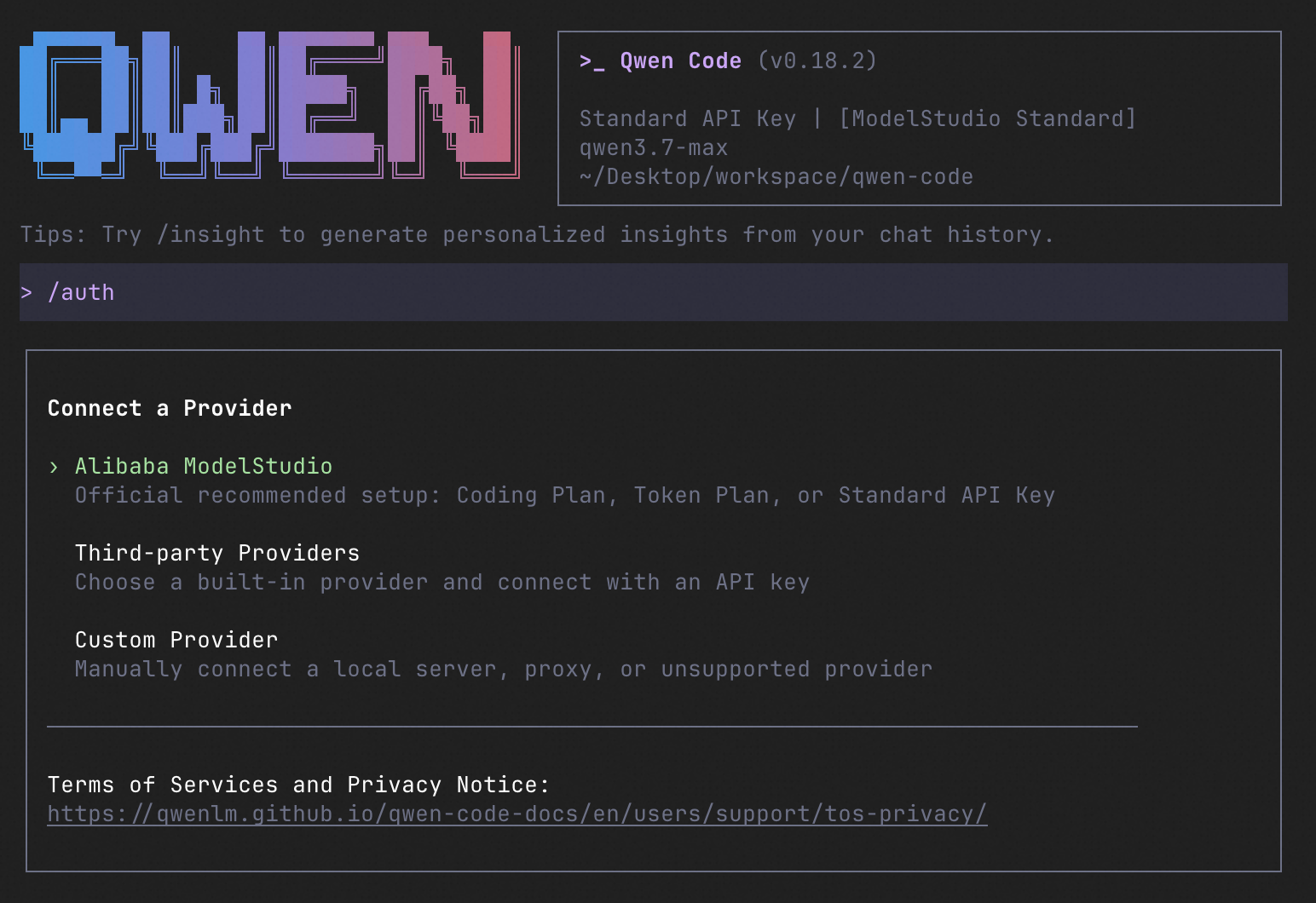
qwen          # Launch interactive terminal UI
# Inside the session:
/auth         # Configure your provider and API key
See the Authentication Guide and Settings Reference for detailed setup.
How to Use Qwen Code
| Mode | Command | Use Case |
|---|---|---|
| Interactive | qwen |
Terminal UI with rich rendering, @file references, slash commands |
| Headless | qwen -p "..." |
Scripts, CI/CD, batch processing — no UI |
| IDE | — | VS Code, Zed, JetBrains |
| Desktop | — | Qwen Code Desktop — GUI for macOS, Windows, Linux |
| Daemon | qwen serve |
Shared agent session over HTTP+SSE (ACP). Multiple clients, one agent. (experimental) Docs |
| SDK | — | TypeScript, Python, Java |
| IM Bot | qwen channel |
Connect to Telegram, DingTalk, WeChat, or Feishu |
SDK example (Python)
import asyncio

from qwen_code_sdk import is_sdk_result_message, query


async def main() -> None:
    result = query(
        "Summarize the repository layout.",
        {
            "cwd": "/path/to/project",
            "path_to_qwen_executable": "qwen",
        },
    )

    async for message in result:
        if is_sdk_result_message(message):
            print(message["result"])


asyncio.run(main())
Capabilities
If you know Claude Code, you already know Qwen Code — and then some. We've put significant effort into bringing Qwen Code to feature parity with Claude Code, improving both breadth and reliability across the board.
| Feature | Qwen Code | Claude Code |
|---|---|---|
| SubAgents, Agent Teams, Dynamic Workflows | ✓ | ✓ |
| Auto-Memory, Auto-Skills, Hooks | ✓ | ✓ |
| Built-in Skills (/review, /batch, /loop, /bugfix…) | ✓ | ✓ |
| MCP, Plan Mode, LSP Integration | ✓ | ✓ |
| Auto Mode, Sandbox, Git Worktrees | ✓ | ✓ |
| Computer Use (desktop automation) | ✓ | ✓ |
| IDE Plugins (VS Code / JetBrains / Zed) | ✓ | ✓ |
| SDK | ✓ | ✓ |
| Headless Mode, Session Management | ✓ | ✓ |
| Open-source — model and framework | ✓ | — |
| Multi-protocol (OpenAI / Anthropic / Gemini / Qwen + any provider) | ✓ | — |
| Agent Arena (multi-model head-to-head on same task) | ✓ | — |
Daemon Mode — qwen serve (multi-client shared agent) |
✓ | — |
| IM Channels (Telegram / DingTalk / WeChat / Feishu) | ✓ | — |
Ecosystem
-
Qwen Code Desktop — Official desktop app for macOS, Windows, and Linux
-
AionUi — A modern GUI for command-line AI tools including Qwen Code
-
Gemini CLI Desktop — A cross-platform desktop/web/mobile UI for Qwen Code
-
🦞 Qwen Code Claw — Let other agents (Claude, Codex, etc.) delegate coding tasks to Qwen Code via ACP. Paste this prompt into your agent:
Use Qwen Code as a coding agent. First, fetch and read this skill reference:
https://raw.githubusercontent.com/QwenLM/qwen-code/refs/heads/main/.qwen/skills/qwen-code-claw/SKILL.md
Then follow the instructions inside to install, authenticate, and use Qwen Code via acpx for all coding tasks.
Contributing
Contributions are welcome! See CONTRIBUTING.md for guidelines.
Acknowledgments
This project was originally based on Google Gemini CLI v0.8.2. We gratefully acknowledge the Gemini CLI team's excellent work. Starting from Qwen Code v0.1, we stopped syncing with upstream and began independent development as a multi-protocol, multi-platform agent framework with deep integrations for Qwen models and beyond.