 0c423deedf
* feat(session): add rename, delete, and auto-title generation for sessions - Add /rename command with LLM auto-title generation when no args provided - Add /delete command to remove sessions from the session picker - Display session name tag embedded in input prompt top border - Restore session name on /resume and --resume <title> CLI flag - Support rename and delete via ACP extMethod for VSCode extension - Add rename/delete UI to WebUI SessionSelector with two-click delete confirmation - Fix parentUuid chain: custom_title records now correctly reference the previous record's UUID, preventing session history from appearing empty after rename - Add SESSION_FILE_PATTERN validation to all SessionService methods that construct file paths from sessionId (defense-in-depth against path traversal) - Fix fd leak in readCustomTitleFromFile with try/finally - Fix --resume <title> exit code (exit 1 when no match found) - Add project ownership checks to VSCode qwenSessionReader delete/rename Co-Authored-By: Qwen-Coder <noreply@qwen.com> * fix(session): fix broken imports and missing mocks from rename/auto-title feature - Fix renameCommand.ts import path to use barrel export instead of deep path - Add setSessionName to mock CommandContext - Add getSessionTitle to SessionService mock in useResumeCommand tests - Update renameCommand tests for auto-generate title behavior - Update InputPrompt snapshots Co-authored-by: Qwen-Coder <qwen-coder@alibabacloud.com> * feat(session): add head+tail dual-read, string-level extraction, and finalize mechanism - Add sessionStorageUtils with extractLastJsonStringField() for fast string-level JSON field extraction without full parse - Add readHeadAndTailSync() to read first and last 64KB of session files - Replace readCustomTitleFromFile() with readSessionTitleFromFile() using head+tail dual-read (tail customTitle > head customTitle) - Add finalize() to ChatRecordingService as single entry point for re-appending session metadata on any session departure - Call finalize() on resume, session switch, and shutdown - Export sessionStorageUtils from core package Co-authored-by: Qwen-Coder <qwen-coder@alibabacloud.com> * fix(session): show filtered picker when /resume <title> matches multiple sessions Previously, multiple title matches opened the full session picker, forcing the user to re-find their session. Now the matched sessions are passed through as initialSessions to the picker, skipping the full listSessions() load and showing only the relevant results. Also clears sessionName on /clear so new sessions don't carry stale title tags from the previous session. Co-authored-by: Qwen-Coder <qwen-coder@alibabacloud.com> * fix(ui): use stringWidth for CJK-safe border alignment in input prompt topRightLabel.length counts UTF-16 code units, not terminal columns. CJK characters take 2 columns but .length returns 1, causing the border line to overflow. Use string-width for correct display width. Co-authored-by: Qwen-Coder <qwen-coder@alibabacloud.com> * fix(session): address remaining PR #3093 review feedback - Add SESSION_TITLE_MAX_LENGTH shared constant in core, replace hardcoded 200 in CLI/ACP/VSCode/WebUI - Add title length validation to ACP renameSession endpoint - Make recordCustomTitle return boolean; renameCommand checks it before updating UI to prevent silent data loss - Add gitBranch to VSCode rename record for consistency with CLI - Remove misleading "enforce kebab-case" comment - Remove duplicate JSDoc on topRightLabel Co-authored-by: Qwen-Coder <qwen-coder@alibabacloud.com> * fix(ui): add animated dots to session name generation loading indicator The static "Generating session name…" text gave no visual feedback that the operation was in progress. Cycle through ".", "..", "..." every 500ms so users can tell the LLM call is still running. Co-Authored-By: Qwen-Coder <noreply@qwen.com> * feat(cli): add /tag as alias for /rename command Co-authored-by: Qwen-Coder <qwen-coder@alibabacloud.com> * feat(vscode): add loading overlay when switching to historical conversations Adds isSwitchingSession state and sessionLoadComplete message to show a loading transition while session history is being rehydrated via ACP. Co-Authored-By: Qwen-Coder <noreply@qwen.com> * fix(vscode): add 15s timeout fallback for session switching loading state Prevents loading overlay from getting stuck indefinitely if sessionLoadComplete message is never received. Co-Authored-By: Qwen-Coder <noreply@qwen.com> * fix(core): fix extractLastJsonStringField offset tracking and add lineContains filter 1. Track global character offset across both pattern variants so the truly last match wins (previously the second pattern scan could overwrite a later match from the first pattern). 2. Add optional lineContains parameter to scope matches to lines containing a marker (e.g. "custom_title"), preventing false matches from user content that happens to include a "customTitle" field. Co-Authored-By: Qwen-Coder <noreply@qwen.com> * chore(cli): add i18n import to DialogManager Co-Authored-By: Qwen-Coder <noreply@qwen.ai> * fix(vscode): align currentConversationId with webview on fallback restore When session/load falls back to creating a fresh ACP session, backend was tracking the new ACP id while the webview still viewed the archived sessionId. That desync caused delete/rename/title-update to target the wrong session during the fallback window, and prevented the post-first- message sync path from firing because the two ids were pre-aligned. Keep currentConversationId pointing at the archived sessionId until the existing stream-end sync flips both sides to the live ACP id on the first user message. Matches the pattern already used by the offline branch. Co-Authored-By: Qwen-Coder <noreply@qwen.com> * fix(core): exhaustive scan in findSessionsByTitle to avoid mtime-boundary misses listSessions() paginates with an mtime-only cursor and strict `<` filter. When several session files share the same mtime across a page boundary, the next page's filter drops them, so --resume <title> could silently miss valid matches. Scan all session files directly for title lookup, with filename as a stable tie-breaker. Also check the (cheap) custom title before the full hydration pass (first-record read, project filter, message count, prompt extraction) so non-matching sessions skip the extra I/O. listSessions() itself is left alone: its cursor crosses ACP/webview package boundaries as a number and this edge case only affects UI display order, not data loss. Co-Authored-By: Qwen-Coder <noreply@qwen.com> * fix(acp): plumb listSessions page size through _meta VSCode companion passes `size` to acpConnection.listSessions, but the ACP spec's ListSessionsRequest schema has no `size` field, so the SDK's zod validator strips it before the agent handler sees it. The agent then only forwarded `cursor` to SessionService.listSessions, silently ignoring the caller's page-size intent. Carry page size through `_meta.size` on both sides, matching the pattern already used for other Qwen Code ACP extensions (e.g. the filesystem service's `_meta.bom` / `_meta.encoding`). `_meta` is typed as an open record in the ACP schema, so extra keys survive validation. Co-Authored-By: Qwen-Coder <noreply@qwen.com> * fix(webui): avoid unintended rename when canceling with Escape The rename input auto-submits on blur, and pressing Escape also triggers blur (via setRenamingSessionId(null) unmounting the input). Because state updates are async, the blur handler's handleRenameSubmit could still read the pre-Escape renameValue from its closure and call onRenameSession, turning a cancel into an accidental rename. Track cancellation via an isCancelingRenameRef flag: set it in the Escape branch, and have onBlur short-circuit when the flag is true, then reset it. Co-Authored-By: Qwen-Coder <noreply@alibabacloud.com> * fix(vscode-ide-companion): clear switch timeout on unmount The 15s session-switch fallback timer was only cleared on the next call to setIsSwitchingSession. If the webview is torn down mid-switch, the timer stays alive and later fires setIsSwitchingSessionRaw(false) on an unmounted hook. Add a useEffect cleanup to clear any pending timer on unmount. Co-Authored-By: Qwen-Coder <noreply@alibabacloud.com> * fix(cli): break handleResume/slashCommandActions circular dep slashCommandActions (useMemo) depends on handleResume, but handleResume was declared after useSlashCommandProcessor so it could call setAwayRecapItem(null). useSlashCommandProcessor itself consumes slashCommandActions, closing a three-way cycle that tsc catches as TS2448 "used before declaration" once #3478's AppContainer changes land in main and get auto-merged into open PRs. Move handleResume above slashCommandActions and route the recap clear through a ref that a later useEffect syncs with setAwayRecapItem. Co-Authored-By: Qwen-Coder <noreply@alibabacloud.com> * fix(core): scan full file when title is not in tail window Replace the head+tail dual-read with readLastJsonStringFieldSync: scan the tail first and return on hit, otherwise stream the whole file and return the last match. Closes the blind spot where a custom_title record landing between the head and tail windows would be missed on large session files. Co-Authored-By: Qwen-Coder <noreply@alibabacloud.com> --------- Co-authored-by: Qwen-Coder <noreply@qwen.com> Co-authored-by: Qwen-Coder <qwen-coder@alibabacloud.com> Co-authored-by: Qwen-Coder <noreply@qwen.ai> Co-authored-by: Qwen-Coder <noreply@alibabacloud.com> |
||
|---|---|---|
| .github | ||
| .husky | ||
| .qwen | ||
| .vscode | ||
| docs | ||
| docs-site | ||
| eslint-rules | ||
| integration-tests | ||
| packages | ||
| scripts | ||
| .dockerignore | ||
| .editorconfig | ||
| .gitattributes | ||
| .gitignore | ||
| .npmrc | ||
| .nvmrc | ||
| .prettierignore | ||
| .prettierrc.json | ||
| .yamllint.yml | ||
| AGENTS.md | ||
| CONTRIBUTING.md | ||
| Dockerfile | ||
| esbuild.config.js | ||
| eslint.config.js | ||
| LICENSE | ||
| Makefile | ||
| package-lock.json | ||
| package.json | ||
| README.md | ||
| SECURITY.md | ||
| tsconfig.json | ||
| vitest.config.ts | ||




An open-source AI agent that lives in your terminal.
中文 | Deutsch | français | 日本語 | Русский | Português (Brasil)
🎉 News
-
2026-04-15: Qwen OAuth free tier has been discontinued. To continue using Qwen Code, switch to Alibaba Cloud Coding Plan, OpenRouter, Fireworks AI, or bring your own API key. Run
qwen authto configure. -
2026-04-13: Qwen OAuth free tier policy update: daily quota adjusted to 100 requests/day (from 1,000).
-
2026-04-02: Qwen3.6-Plus is now live! Get an API key from Alibaba Cloud ModelStudio to access it through the OpenAI-compatible API.
-
2026-02-16: Qwen3.5-Plus is now live!
Why Qwen Code?
Qwen Code is an open-source AI agent for the terminal, optimized for Qwen series models. It helps you understand large codebases, automate tedious work, and ship faster.
- Multi-protocol, flexible providers: use OpenAI / Anthropic / Gemini-compatible APIs, Alibaba Cloud Coding Plan, OpenRouter, Fireworks AI, or bring your own API key.
- Open-source, co-evolving: both the framework and the Qwen3-Coder model are open-source—and they ship and evolve together.
- Agentic workflow, feature-rich: rich built-in tools (Skills, SubAgents) for a full agentic workflow and a Claude Code-like experience.
- Terminal-first, IDE-friendly: built for developers who live in the command line, with optional integration for VS Code, Zed, and JetBrains IDEs.
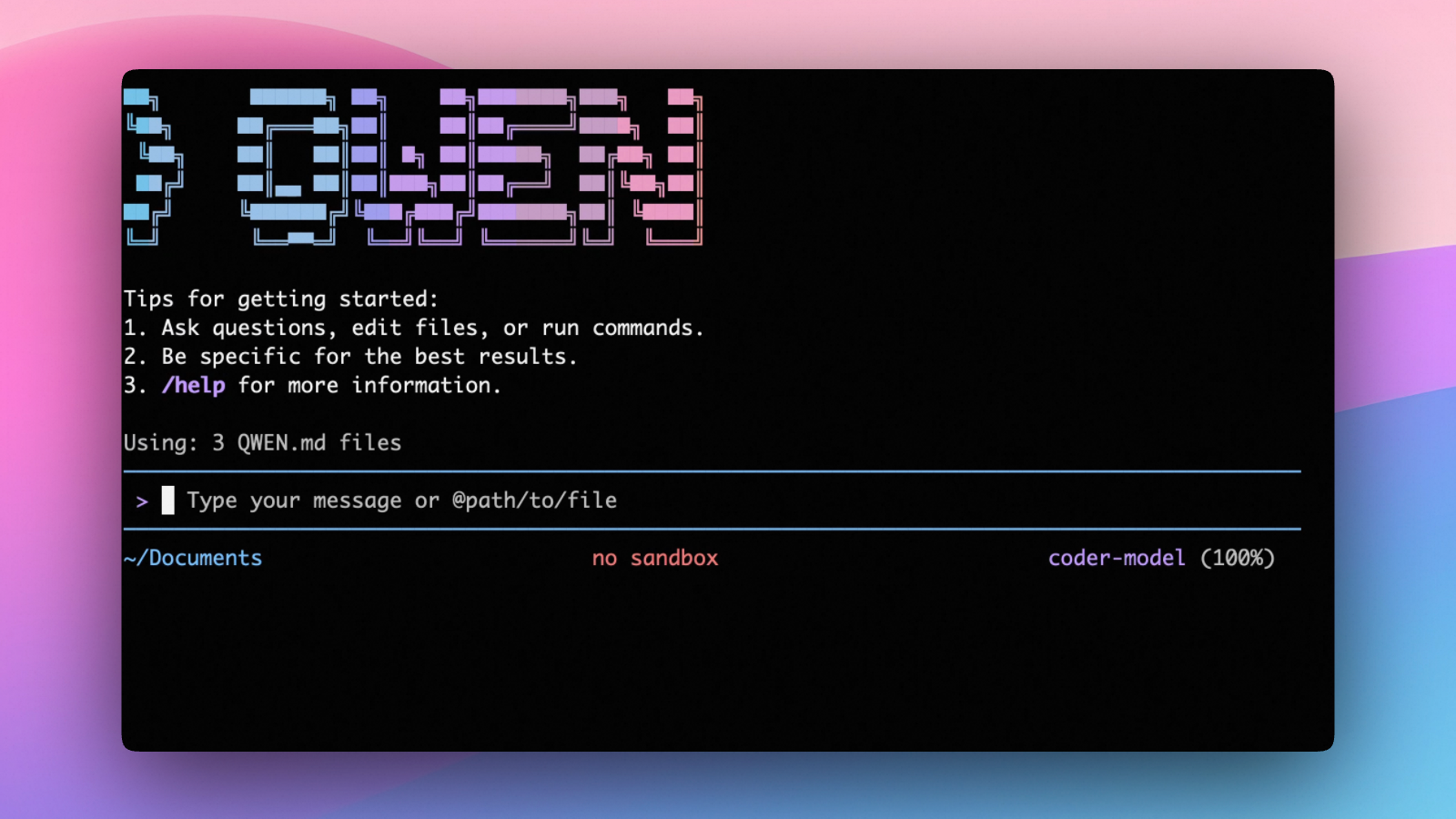
Installation
Quick Install (Recommended)
Linux / macOS
bash -c "$(curl -fsSL https://qwen-code-assets.oss-cn-hangzhou.aliyuncs.com/installation/install-qwen.sh)"
Windows (Run as Administrator)
Works in both Command Prompt and PowerShell:
powershell -Command "Invoke-WebRequest 'https://qwen-code-assets.oss-cn-hangzhou.aliyuncs.com/installation/install-qwen.bat' -OutFile (Join-Path $env:TEMP 'install-qwen.bat'); & (Join-Path $env:TEMP 'install-qwen.bat')"
Note
: It's recommended to restart your terminal after installation to ensure environment variables take effect.
Manual Installation
Prerequisites
Make sure you have Node.js 20 or later installed. Download it from nodejs.org.
NPM
npm install -g @qwen-code/qwen-code@latest
Homebrew (macOS, Linux)
brew install qwen-code
Quick Start
# Start Qwen Code (interactive)
qwen

# Then, in the session:
/help
/auth
On first use, you'll be prompted to sign in. You can run /auth anytime to switch authentication methods.
Example prompts:
What does this project do?
Explain the codebase structure.
Help me refactor this function.
Generate unit tests for this module.
Click to watch a demo video
🦞 Use Qwen Code for Coding Tasks in Claw
Copy the prompt below and paste it into your agent:
Use Qwen Code as a coding agent. First, fetch and read this skill reference:
https://raw.githubusercontent.com/QwenLM/qwen-code/refs/heads/main/.qwen/skills/qwen-code-claw/SKILL.md
Then follow the instructions inside to install, authenticate, and use Qwen Code via acpx for all coding tasks.
Authentication
Qwen Code supports the following authentication methods:
- API Key (recommended): use an API key from Alibaba Cloud Model Studio (Beijing / intl) or any supported provider (OpenAI, Anthropic, Google GenAI, and other compatible endpoints).
- Coding Plan: subscribe to the Alibaba Cloud Coding Plan (Beijing / intl) for a fixed monthly fee with higher quotas.
⚠️ Qwen OAuth was discontinued on April 15, 2026. If you were previously using Qwen OAuth, please switch to one of the methods above. Run
qwenand then/authto reconfigure.
API Key (recommended)
Use an API key to connect to Alibaba Cloud Model Studio or any supported provider. Supports multiple protocols:
- OpenAI-compatible: Alibaba Cloud ModelStudio, ModelScope, OpenAI, OpenRouter, and other OpenAI-compatible providers
- Anthropic: Claude models
- Google GenAI: Gemini models
The recommended way to configure models and providers is by editing ~/.qwen/settings.json (create it if it doesn't exist). This file lets you define all available models, API keys, and default settings in one place.
Quick Setup in 3 Steps
Step 1: Create or edit ~/.qwen/settings.json
Here is a complete example:
{
  "modelProviders": {
    "openai": [
      {
        "id": "qwen3.6-plus",
        "name": "qwen3.6-plus",
        "baseUrl": "https://dashscope.aliyuncs.com/compatible-mode/v1",
        "description": "Qwen3-Coder via Dashscope",
        "envKey": "DASHSCOPE_API_KEY"
      }
    ]
  },
  "env": {
    "DASHSCOPE_API_KEY": "sk-xxxxxxxxxxxxx"
  },
  "security": {
    "auth": {
      "selectedType": "openai"
    }
  },
  "model": {
    "name": "qwen3.6-plus"
  }
}
Step 2: Understand each field
| Field | What it does |
|---|---|
modelProviders |
Declares which models are available and how to connect to them. Keys like openai, anthropic, gemini represent the API protocol. |
modelProviders[].id |
The model ID sent to the API (e.g. qwen3.6-plus, gpt-4o). |
modelProviders[].envKey |
The name of the environment variable that holds your API key. |
modelProviders[].baseUrl |
The API endpoint URL (required for non-default endpoints). |
env |
A fallback place to store API keys (lowest priority; prefer .env files or export for sensitive keys). |
security.auth.selectedType |
The protocol to use on startup (openai, anthropic, gemini, vertex-ai). |
model.name |
The default model to use when Qwen Code starts. |
Step 3: Start Qwen Code — your configuration takes effect automatically:
qwen
Use the /model command at any time to switch between all configured models.
More Examples
Coding Plan (Alibaba Cloud ModelStudio) — fixed monthly fee, higher quotas
{
  "modelProviders": {
    "openai": [
      {
        "id": "qwen3.6-plus",
        "name": "qwen3.6-plus (Coding Plan)",
        "baseUrl": "https://coding.dashscope.aliyuncs.com/v1",
        "description": "qwen3.6-plus from ModelStudio Coding Plan",
        "envKey": "BAILIAN_CODING_PLAN_API_KEY"
      },
      {
        "id": "qwen3.5-plus",
        "name": "qwen3.5-plus (Coding Plan)",
        "baseUrl": "https://coding.dashscope.aliyuncs.com/v1",
        "description": "qwen3.5-plus with thinking enabled from ModelStudio Coding Plan",
        "envKey": "BAILIAN_CODING_PLAN_API_KEY",
        "generationConfig": {
          "extra_body": {
            "enable_thinking": true
          }
        }
      },
      {
        "id": "glm-4.7",
        "name": "glm-4.7 (Coding Plan)",
        "baseUrl": "https://coding.dashscope.aliyuncs.com/v1",
        "description": "glm-4.7 with thinking enabled from ModelStudio Coding Plan",
        "envKey": "BAILIAN_CODING_PLAN_API_KEY",
        "generationConfig": {
          "extra_body": {
            "enable_thinking": true
          }
        }
      },
      {
        "id": "kimi-k2.5",
        "name": "kimi-k2.5 (Coding Plan)",
        "baseUrl": "https://coding.dashscope.aliyuncs.com/v1",
        "description": "kimi-k2.5 with thinking enabled from ModelStudio Coding Plan",
        "envKey": "BAILIAN_CODING_PLAN_API_KEY",
        "generationConfig": {
          "extra_body": {
            "enable_thinking": true
          }
        }
      }
    ]
  },
  "env": {
    "BAILIAN_CODING_PLAN_API_KEY": "sk-xxxxxxxxxxxxx"
  },
  "security": {
    "auth": {
      "selectedType": "openai"
    }
  },
  "model": {
    "name": "qwen3.6-plus"
  }
}
Subscribe to the Coding Plan and get your API key at Alibaba Cloud ModelStudio(Beijing) or Alibaba Cloud ModelStudio(intl).
Multiple providers (OpenAI + Anthropic + Gemini)
{
  "modelProviders": {
    "openai": [
      {
        "id": "gpt-4o",
        "name": "GPT-4o",
        "envKey": "OPENAI_API_KEY",
        "baseUrl": "https://api.openai.com/v1"
      }
    ],
    "anthropic": [
      {
        "id": "claude-sonnet-4-20250514",
        "name": "Claude Sonnet 4",
        "envKey": "ANTHROPIC_API_KEY"
      }
    ],
    "gemini": [
      {
        "id": "gemini-2.5-pro",
        "name": "Gemini 2.5 Pro",
        "envKey": "GEMINI_API_KEY"
      }
    ]
  },
  "env": {
    "OPENAI_API_KEY": "sk-xxxxxxxxxxxxx",
    "ANTHROPIC_API_KEY": "sk-ant-xxxxxxxxxxxxx",
    "GEMINI_API_KEY": "AIzaxxxxxxxxxxxxx"
  },
  "security": {
    "auth": {
      "selectedType": "openai"
    }
  },
  "model": {
    "name": "gpt-4o"
  }
}
Enable thinking mode (for supported models like qwen3.5-plus)
{
  "modelProviders": {
    "openai": [
      {
        "id": "qwen3.5-plus",
        "name": "qwen3.5-plus (thinking)",
        "envKey": "DASHSCOPE_API_KEY",
        "baseUrl": "https://dashscope.aliyuncs.com/compatible-mode/v1",
        "generationConfig": {
          "extra_body": {
            "enable_thinking": true
          }
        }
      }
    ]
  },
  "env": {
    "DASHSCOPE_API_KEY": "sk-xxxxxxxxxxxxx"
  },
  "security": {
    "auth": {
      "selectedType": "openai"
    }
  },
  "model": {
    "name": "qwen3.5-plus"
  }
}
Tip: You can also set API keys via
exportin your shell or.envfiles, which take higher priority thansettings.json→env. See the authentication guide for full details.
Security note: Never commit API keys to version control. The
~/.qwen/settings.jsonfile is in your home directory and should stay private.
Local Model Setup (Ollama / vLLM)
You can also run models locally — no API key or cloud account needed. This is not an authentication method; instead, configure your local model endpoint in ~/.qwen/settings.json using the modelProviders field.
Ollama setup
- Install Ollama from ollama.com
- Pull a model:
ollama pull qwen3:32b - Configure
~/.qwen/settings.json:
{
  "modelProviders": {
    "openai": [
      {
        "id": "qwen3:32b",
        "name": "Qwen3 32B (Ollama)",
        "baseUrl": "http://localhost:11434/v1",
        "description": "Qwen3 32B running locally via Ollama"
      }
    ]
  },
  "security": {
    "auth": {
      "selectedType": "openai"
    }
  },
  "model": {
    "name": "qwen3:32b"
  }
}
vLLM setup
- Install vLLM:
pip install vllm - Start the server:
vllm serve Qwen/Qwen3-32B - Configure
~/.qwen/settings.json:
{
  "modelProviders": {
    "openai": [
      {
        "id": "Qwen/Qwen3-32B",
        "name": "Qwen3 32B (vLLM)",
        "baseUrl": "http://localhost:8000/v1",
        "description": "Qwen3 32B running locally via vLLM"
      }
    ]
  },
  "security": {
    "auth": {
      "selectedType": "openai"
    }
  },
  "model": {
    "name": "Qwen/Qwen3-32B"
  }
}
Usage
As an open-source terminal agent, you can use Qwen Code in four primary ways:
- Interactive mode (terminal UI)
- Headless mode (scripts, CI)
- IDE integration (VS Code, Zed)
- TypeScript SDK
Interactive mode
cd your-project/
qwen
Run qwen in your project folder to launch the interactive terminal UI. Use @ to reference local files (for example @src/main.ts).
Headless mode
cd your-project/
qwen -p "your question"
Use -p to run Qwen Code without the interactive UI—ideal for scripts, automation, and CI/CD. Learn more: Headless mode.
IDE integration
Use Qwen Code inside your editor (VS Code, Zed, and JetBrains IDEs):
TypeScript SDK
Build on top of Qwen Code with the TypeScript SDK:
Commands & Shortcuts
Session Commands
/help- Display available commands/clear- Clear conversation history/compress- Compress history to save tokens/stats- Show current session information/bug- Submit a bug report/exitor/quit- Exit Qwen Code
Keyboard Shortcuts
Ctrl+C- Cancel current operationCtrl+D- Exit (on empty line)Up/Down- Navigate command history
Learn more about Commands
Tip: In YOLO mode (
--yolo), vision switching happens automatically without prompts when images are detected. Learn more about Approval Mode
Configuration
Qwen Code can be configured via settings.json, environment variables, and CLI flags.
| File | Scope | Description |
|---|---|---|
~/.qwen/settings.json |
User (global) | Applies to all your Qwen Code sessions. Recommended for modelProviders and env. |
.qwen/settings.json |
Project | Applies only when running Qwen Code in this project. Overrides user settings. |
The most commonly used top-level fields in settings.json:
| Field | Description |
|---|---|
modelProviders |
Define available models per protocol (openai, anthropic, gemini, vertex-ai). |
env |
Fallback environment variables (e.g. API keys). Lower priority than shell export and .env files. |
security.auth.selectedType |
The protocol to use on startup (e.g. openai). |
model.name |
The default model to use when Qwen Code starts. |
See the Authentication section above for complete
settings.jsonexamples, and the settings reference for all available options.
Benchmark Results
Terminal-Bench Performance
| Agent | Model | Accuracy |
|---|---|---|
| Qwen Code | Qwen3-Coder-480A35 | 37.5% |
| Qwen Code | Qwen3-Coder-30BA3B | 31.3% |
Ecosystem
Looking for a graphical interface?
- AionUi A modern GUI for command-line AI tools including Qwen Code
- Gemini CLI Desktop A cross-platform desktop/web/mobile UI for Qwen Code
Troubleshooting
If you encounter issues, check the troubleshooting guide.
Common issues:
Qwen OAuth free tier was discontinued on 2026-04-15: Qwen OAuth is no longer available. Runqwen→/authand switch to API Key or Coding Plan. See the Authentication section above for setup instructions.
To report a bug from within the CLI, run /bug and include a short title and repro steps.
Connect with Us
- Discord: https://discord.gg/RN7tqZCeDK
- Dingtalk: https://qr.dingtalk.com/action/joingroup?code=v1,k1,+FX6Gf/ZDlTahTIRi8AEQhIaBlqykA0j+eBKKdhLeAE=&_dt_no_comment=1&origin=1
Acknowledgments
This project is based on Google Gemini CLI. We acknowledge and appreciate the excellent work of the Gemini CLI team. Our main contribution focuses on parser-level adaptations to better support Qwen-Coder models.