 07bd5c41cb
* fix(mcp): render OAuth URL as OSC 8 hyperlink so it stays clickable when wrapped Closes #3470. The MCP OAuth flow previously pushed the authorization URL through the generic display-message list, where Ink rendered it as plain text. When the URL exceeded the terminal width it got hard-wrapped into the message buffer, and most terminals could no longer detect it as a single hyperlink (cmd/ctrl+click did nothing, selecting it pulled in extra whitespace). Render the URL as an OSC 8 hyperlink in AuthenticateStep instead, and stop duplicating it through the display-message stream when an event emitter is available. Terminals that support OSC 8 (iTerm2, WezTerm, Kitty, Windows Terminal, VS Code, GNOME Terminal, …) now treat the URL as a single clickable link even when it visually wraps; terminals without OSC 8 support ignore the escapes and fall back to the existing "press c to copy" affordance. * fix(mcp): pre-split OAuth URL so every wrapped line stays clickable Wrapping the whole URL in a single OSC 8 hyperlink and letting Ink / wrap-ansi break the line produced two bugs observed in iTerm2 etc.: only the first visible segment was a hyperlink (wrap-ansi re-emits SGR codes across wraps but does not re-open OSC 8 links), and the remaining URL characters overflowed past the dialog border because wrap-ansi was unable to break the unbroken URL token within the container width. Manually slice the URL into chunks of `columns - 8` characters (MCPManagementDialog's container width) and render each chunk as its own OSC 8 hyperlink with `wrap="truncate"`. Every visible line now carries a complete hyperlink pointing at the same URL, and no line exceeds the container width. * fix(mcp): terminate OSC 8 hyperlinks with BEL so Ink preserves them Ink's renderer tokenizes text through @alcalzone/ansi-tokenize, which only recognizes OSC 8 hyperlink escapes terminated with BEL (\x07). The ST terminator (ESC \\) we were using is valid per the OSC 8 spec but the tokenizer falls through and treats the escape bytes as regular characters. That explains the two symptoms seen after the previous fix: - Only the first URL segment rendered as a clickable hyperlink. The rest of the lines had their opening \\x1b]8;; bytes tokenized as chars, so their hyperlink wrap was lost. - The dialog's right border disappeared because the mangled escape bytes consumed grid cells, pushing the container width past `columns - 8` and shoving the border off-screen. Switch the helper to the BEL-terminated form. Ink now sees each line's OSC 8 wrap as a proper zero-width code, every wrapped line stays clickable, and the border is no longer displaced. * fix(mcp): render OAuth URL via <Static> as a single unwrapped line The per-line OSC 8 approach didn't make lines past the first clickable in real terminals. Root cause: Ink's renderer runs text through @alcalzone/ansi-tokenize, which: - Only accepts OSC 8 sequences with empty params (`\x1b]8;;URL\x07`). Any `id=` form is parsed as a bogus SGR code and the remainder leaks out as visible characters. Without an `id=` grouping parameter, terminals like iTerm2 don't reliably stitch adjacent OSC 8 escapes together as one hyperlink. - Re-emits styles per Ink row via styledCharsToString, so even when each slice carried a self-contained OSC 8 wrap, terminals still treated each visual line as an independent hyperlink that only the first row reliably activated. Emit the URL through Ink's `<Static>` component instead, inside a `<Box width={url.length}>`. Ink sees a single logical line that doesn't need wrapping, so it hands the terminal one OSC 8 open, the whole URL, and one close. The terminal then soft-wraps that line visually, and the OSC 8 hyperlink state is carried across every wrap — every visible line is clickable. `<Static>` writes once above the dynamic dialog (scrollback-safe) and isn't touched by re-renders, which also avoids the flicker we'd get from repeatedly re-emitting the escape sequence inside the live tree. * fix(mcp): render OAuth URL as live row so it clears on dialog dismissal The previous <Static> emission made the URL stay permanently in the scrollback after the OAuth flow finished — e.g. after the dialog was dismissed the URL was still sitting above the prompt. Switch to a normal (live) Ink row: a Box sized to the URL length holding a single OSC 8 wrapped Text. Ink doesn't wrap the row (maxWidth == content width), so it hands log-update one long line; log-update's wrap-ansi pass then wraps it at terminal width and re-emits the OSC 8 escape at every wrap boundary, so every visible wrapped line is clickable. Because this is a regular child of the dialog, log-update tracks its height and erases it cleanly when the AuthenticateStep unmounts (auth succeeds / user backs out / dialog closes). * fix(mcp): pre-split OAuth URL so the live row clears cleanly The wide-Box live approach left dialog fragments in the scrollback: Ink ships its own log-update.js (packages/cli/.../ink/build/log-update.js) which counts erase height with output.split('\n').length and does NOT run wrap-ansi. A single Ink row that exceeds terminal width wraps visually but the erase still covers only one terminal line, so authState transitions (auth success, Esc-to-back, dialog dismiss) leave the top rows of the previous frame behind. Go back to pre-slicing the URL into chunks sized to the dialog content width (columns - 8) and rendering each chunk as its own Ink row with its own OSC 8 wrap. Log-update's row count then matches the visible row count, so erase is clean on every transition. Terminals that group adjacent OSC 8 sequences will still treat the whole URL as clickable; those that don't at least keep the first slice clickable, and the existing "press c to copy" affordance covers the rest. * fix(mcp): commit to Static-rendered URL outside the dialog Stop flip-flopping between in-box and out-of-box URL rendering. Every in-box attempt hit one of two walls: - Per-slice OSC 8 rows: each Ink row is its own self-contained hyperlink, but some terminals (seen with the reporter's) only register the first adjacent OSC 8 without an id= parameter as clickable. Ink's @alcalzone/ansi-tokenize rejects OSC 8 with params, so id= grouping is not deliverable. - Wide-Box overflow rows: the single OSC 8 wrap keeps every wrapped line clickable because the hyperlink state persists across the terminal's soft-wraps, but Ink ships its own log-update.js that counts erase height by output.split('\n').length and never runs wrap-ansi. When the row visually wraps but Ink counts it as 1 row, transitions (auth success / Esc / dismiss) erase too few lines and leave dialog fragments in the scrollback. Render the URL through <Static> above the dialog: it writes once, outside log-update's tracking, so the terminal soft-wraps a single OSC 8 hyperlink and every visible line stays clickable. The trade-off is that the URL stays in the scrollback after the dialog dismisses (Static is append-only); that is acceptable given the URL is no longer sensitive once auth has completed, and it avoids the click-failure and residue problems of the other approaches. * fix(mcp): print OAuth URL via useStdout, erase on unmount Drop <Static> (which persisted the URL in the scrollback forever) and print the authorization URL directly with Ink's `write` (useStdout) instead. Ink's writeToStdout clears the live frame, writes our bytes into the scrollback, and re-renders the frame below, so the URL goes out in a single OSC 8 hyperlink sequence and the terminal's soft-wrap preserves the hyperlink state across every wrapped row — every visible line stays clickable. On unmount (auth success, Esc, dialog dismiss) we use the same `write` path to push a cursor-up + eraseLines sequence that removes the URL rows (plus the leading/trailing blank separators) before log-update redraws the now-smaller live frame. Net effect: URL shows above the dialog while authenticating, disappears cleanly when the dialog goes away, and every wrapped line is clickable throughout. * fix(mcp): period-terminate prompt and restore wrap warning Now that the OAuth URL renders above the dialog (outside the message list), the in-dialog prompt no longer leads into the URL on the next line — rename the i18n key from "…into your browser:" to "…into your browser." and re-add the "Make sure to copy the COMPLETE URL — it may wrap across multiple lines." warning that was dropped when the URL was first moved out of displayMessage. Translations in de/en/fr/ja/pt/ ru/zh are updated to match and to point at the URL "above" rather than "following". * fix(mcp): correct OAuth URL erase count on unmount The previous logic wrote the URL as `\n${URL}\n` (leading + trailing newlines) and erased `urlVisualLines + 2` rows on unmount, but the leading blank and the trailing "\n" don't both occupy their own rows — the trailing newline just moves the cursor to where the dynamic UI is re-rendered. For a typical URL whose length isn't an exact multiple of the terminal width this left the erase off-by-one and wiped a row above the dialog (e.g. a piece of the command prompt). Drop the leading `\n` (no real visual benefit) and compute the erase count as `urlVisualLines + (autoWrapOverflow ? 1 : 0)`. The overflow term handles the aligned edge case where the terminal auto-wraps past the last URL char, leaving a blank row between URL and re-rendered dynamic UI that also needs erasing. Also drop the stale comment about Ink's ansi-tokenize restricting OSC 8 terminator choice — we now bypass Ink's tokenizer via useStdout, so BEL is just the more compatible terminator. * fix(mcp): pass OAuth URL hyperlink through multiplexer wrapper Inside tmux or GNU screen the raw OSC 8 hyperlink escape is intercepted by the multiplexer and never reaches the host terminal — users see the URL as plain text, exactly the bug this PR is trying to fix. The existing `wrapForMultiplexer` helper (already used for OSC 52 clipboard writes) wraps the sequence in a DCS passthrough envelope that tmux / screen forward to the host. Apply the same helper to `osc8Hyperlink` so tmux / screen users get clickable links for every wrapped line as well. Outside a multiplexer the helper is a no-op, so native terminals are unchanged. Also note in a comment that the captured `stdout.columns` goes stale if the terminal is resized during the OAuth flow; this is acceptable for a sub-minute flow on ASCII-only authorization URLs. * docs(mcp): note tmux 3.3+ allow-passthrough requirement * fix(mcp): render OAuth URL inside dialog box Replace the useStdout().write + cursor-up/eraseLines scrollback approach with an in-dialog <Box><Text>{osc8Hyperlink(url)}</Text></Box>. Removes the Ink dynamic-frame interleave and the column-width erase bookkeeping; the URL is owned by the dialog, so it disappears with it. * refactor(mcp): drop redundant Fragment around single Text * revert(mcp): restore original OAuth prompt wording URL now renders inside the dialog box, so the "copy and paste this URL into your browser:" prompt no longer needs the period-terminated / "URL above" rewording. Revert the i18n keys and localized strings; keep the event-driven dispatch so the URL isn't also pushed through displayMessage (which would double-render in the UI). * fix(mcp): sanitize URL/label before embedding in OSC 8 sequence An unescaped \x07 (BEL) or \x1b (ESC) in the URL or label would terminate the OSC 8 envelope early and let the tail bytes through as interpretable terminal escapes. authUrl is normally built via URL.toString() which percent-encodes controls, but the authorization endpoint itself comes from server-controlled OAuth discovery, so treat the input as untrusted and strip C0 + DEL before splicing. |
||
|---|---|---|
| .github | ||
| .husky | ||
| .qwen | ||
| .vscode | ||
| docs | ||
| docs-site | ||
| eslint-rules | ||
| integration-tests | ||
| packages | ||
| scripts | ||
| .dockerignore | ||
| .editorconfig | ||
| .gitattributes | ||
| .gitignore | ||
| .npmrc | ||
| .nvmrc | ||
| .prettierignore | ||
| .prettierrc.json | ||
| .yamllint.yml | ||
| AGENTS.md | ||
| CONTRIBUTING.md | ||
| Dockerfile | ||
| esbuild.config.js | ||
| eslint.config.js | ||
| LICENSE | ||
| Makefile | ||
| package-lock.json | ||
| package.json | ||
| README.md | ||
| SECURITY.md | ||
| tsconfig.json | ||
| vitest.config.ts | ||




An open-source AI agent that lives in your terminal.
中文 | Deutsch | français | 日本語 | Русский | Português (Brasil)
🎉 News
-
2026-04-15: Qwen OAuth free tier has been discontinued. To continue using Qwen Code, switch to Alibaba Cloud Coding Plan, OpenRouter, Fireworks AI, or bring your own API key. Run
qwen authto configure. -
2026-04-13: Qwen OAuth free tier policy update: daily quota adjusted to 100 requests/day (from 1,000).
-
2026-04-02: Qwen3.6-Plus is now live! Get an API key from Alibaba Cloud ModelStudio to access it through the OpenAI-compatible API.
-
2026-02-16: Qwen3.5-Plus is now live!
Why Qwen Code?
Qwen Code is an open-source AI agent for the terminal, optimized for Qwen series models. It helps you understand large codebases, automate tedious work, and ship faster.
- Multi-protocol, flexible providers: use OpenAI / Anthropic / Gemini-compatible APIs, Alibaba Cloud Coding Plan, OpenRouter, Fireworks AI, or bring your own API key.
- Open-source, co-evolving: both the framework and the Qwen3-Coder model are open-source—and they ship and evolve together.
- Agentic workflow, feature-rich: rich built-in tools (Skills, SubAgents) for a full agentic workflow and a Claude Code-like experience.
- Terminal-first, IDE-friendly: built for developers who live in the command line, with optional integration for VS Code, Zed, and JetBrains IDEs.
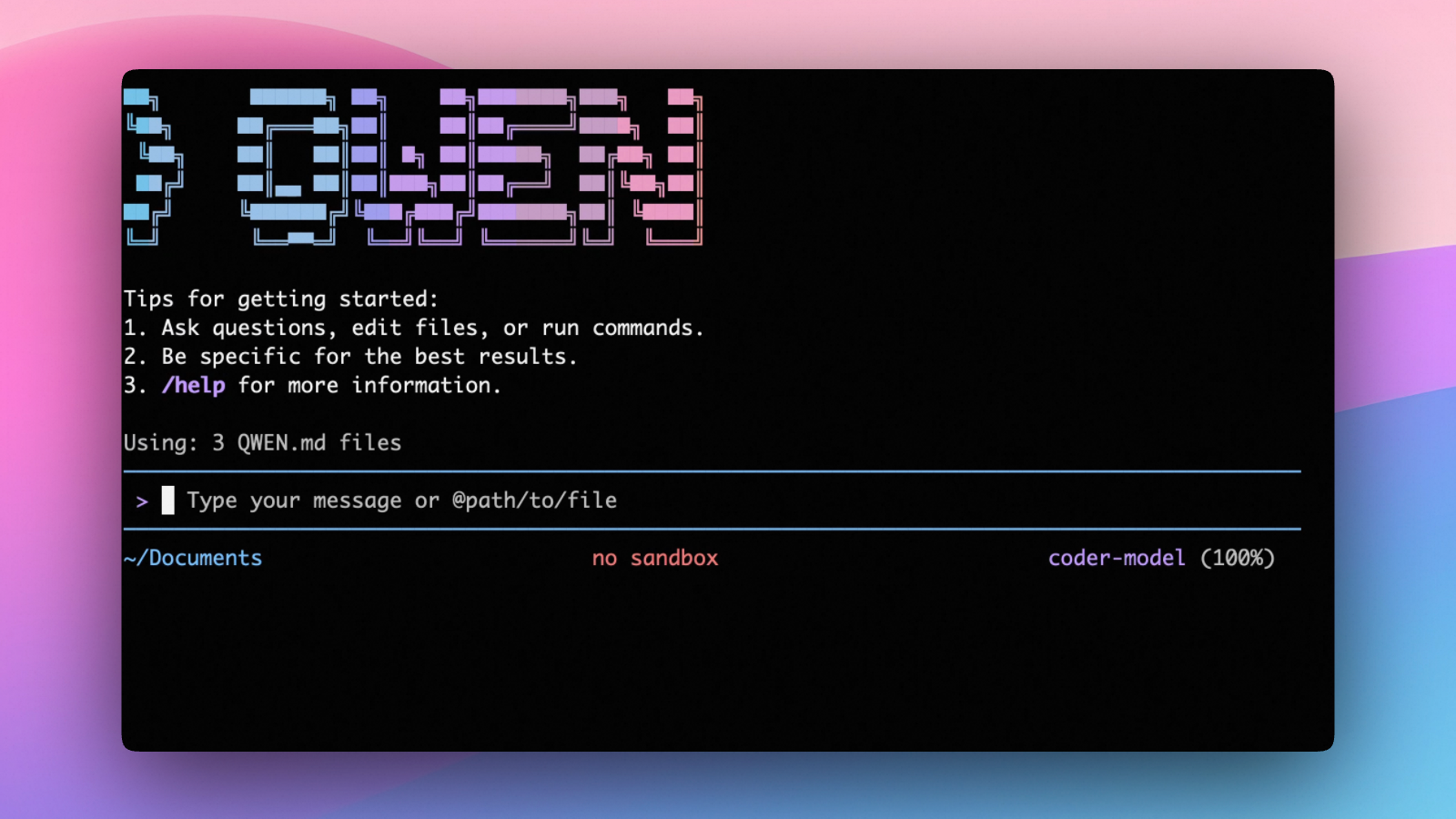
Installation
Quick Install (Recommended)
Linux / macOS
bash -c "$(curl -fsSL https://qwen-code-assets.oss-cn-hangzhou.aliyuncs.com/installation/install-qwen.sh)"
Windows (Run as Administrator)
Works in both Command Prompt and PowerShell:
powershell -Command "Invoke-WebRequest 'https://qwen-code-assets.oss-cn-hangzhou.aliyuncs.com/installation/install-qwen.bat' -OutFile (Join-Path $env:TEMP 'install-qwen.bat'); & (Join-Path $env:TEMP 'install-qwen.bat')"
Note
: It's recommended to restart your terminal after installation to ensure environment variables take effect.
Manual Installation
Prerequisites
Make sure you have Node.js 20 or later installed. Download it from nodejs.org.
NPM
npm install -g @qwen-code/qwen-code@latest
Homebrew (macOS, Linux)
brew install qwen-code
Quick Start
# Start Qwen Code (interactive)
qwen

# Then, in the session:
/help
/auth
On first use, you'll be prompted to sign in. You can run /auth anytime to switch authentication methods.
Example prompts:
What does this project do?
Explain the codebase structure.
Help me refactor this function.
Generate unit tests for this module.
Click to watch a demo video
🦞 Use Qwen Code for Coding Tasks in Claw
Copy the prompt below and paste it into your agent:
Use Qwen Code as a coding agent. First, fetch and read this skill reference:
https://raw.githubusercontent.com/QwenLM/qwen-code/refs/heads/main/.qwen/skills/qwen-code-claw/SKILL.md
Then follow the instructions inside to install, authenticate, and use Qwen Code via acpx for all coding tasks.
Authentication
Qwen Code supports the following authentication methods:
- API Key (recommended): use an API key from Alibaba Cloud Model Studio (Beijing / intl) or any supported provider (OpenAI, Anthropic, Google GenAI, and other compatible endpoints).
- Coding Plan: subscribe to the Alibaba Cloud Coding Plan (Beijing / intl) for a fixed monthly fee with higher quotas.
⚠️ Qwen OAuth was discontinued on April 15, 2026. If you were previously using Qwen OAuth, please switch to one of the methods above. Run
qwenand then/authto reconfigure.
API Key (recommended)
Use an API key to connect to Alibaba Cloud Model Studio or any supported provider. Supports multiple protocols:
- OpenAI-compatible: Alibaba Cloud ModelStudio, ModelScope, OpenAI, OpenRouter, and other OpenAI-compatible providers
- Anthropic: Claude models
- Google GenAI: Gemini models
The recommended way to configure models and providers is by editing ~/.qwen/settings.json (create it if it doesn't exist). This file lets you define all available models, API keys, and default settings in one place.
Quick Setup in 3 Steps
Step 1: Create or edit ~/.qwen/settings.json
Here is a complete example:
{
  "modelProviders": {
    "openai": [
      {
        "id": "qwen3.6-plus",
        "name": "qwen3.6-plus",
        "baseUrl": "https://dashscope.aliyuncs.com/compatible-mode/v1",
        "description": "Qwen3-Coder via Dashscope",
        "envKey": "DASHSCOPE_API_KEY"
      }
    ]
  },
  "env": {
    "DASHSCOPE_API_KEY": "sk-xxxxxxxxxxxxx"
  },
  "security": {
    "auth": {
      "selectedType": "openai"
    }
  },
  "model": {
    "name": "qwen3.6-plus"
  }
}
Step 2: Understand each field
| Field | What it does |
|---|---|
modelProviders |
Declares which models are available and how to connect to them. Keys like openai, anthropic, gemini represent the API protocol. |
modelProviders[].id |
The model ID sent to the API (e.g. qwen3.6-plus, gpt-4o). |
modelProviders[].envKey |
The name of the environment variable that holds your API key. |
modelProviders[].baseUrl |
The API endpoint URL (required for non-default endpoints). |
env |
A fallback place to store API keys (lowest priority; prefer .env files or export for sensitive keys). |
security.auth.selectedType |
The protocol to use on startup (openai, anthropic, gemini, vertex-ai). |
model.name |
The default model to use when Qwen Code starts. |
Step 3: Start Qwen Code — your configuration takes effect automatically:
qwen
Use the /model command at any time to switch between all configured models.
More Examples
Coding Plan (Alibaba Cloud ModelStudio) — fixed monthly fee, higher quotas
{
  "modelProviders": {
    "openai": [
      {
        "id": "qwen3.6-plus",
        "name": "qwen3.6-plus (Coding Plan)",
        "baseUrl": "https://coding.dashscope.aliyuncs.com/v1",
        "description": "qwen3.6-plus from ModelStudio Coding Plan",
        "envKey": "BAILIAN_CODING_PLAN_API_KEY"
      },
      {
        "id": "qwen3.5-plus",
        "name": "qwen3.5-plus (Coding Plan)",
        "baseUrl": "https://coding.dashscope.aliyuncs.com/v1",
        "description": "qwen3.5-plus with thinking enabled from ModelStudio Coding Plan",
        "envKey": "BAILIAN_CODING_PLAN_API_KEY",
        "generationConfig": {
          "extra_body": {
            "enable_thinking": true
          }
        }
      },
      {
        "id": "glm-4.7",
        "name": "glm-4.7 (Coding Plan)",
        "baseUrl": "https://coding.dashscope.aliyuncs.com/v1",
        "description": "glm-4.7 with thinking enabled from ModelStudio Coding Plan",
        "envKey": "BAILIAN_CODING_PLAN_API_KEY",
        "generationConfig": {
          "extra_body": {
            "enable_thinking": true
          }
        }
      },
      {
        "id": "kimi-k2.5",
        "name": "kimi-k2.5 (Coding Plan)",
        "baseUrl": "https://coding.dashscope.aliyuncs.com/v1",
        "description": "kimi-k2.5 with thinking enabled from ModelStudio Coding Plan",
        "envKey": "BAILIAN_CODING_PLAN_API_KEY",
        "generationConfig": {
          "extra_body": {
            "enable_thinking": true
          }
        }
      }
    ]
  },
  "env": {
    "BAILIAN_CODING_PLAN_API_KEY": "sk-xxxxxxxxxxxxx"
  },
  "security": {
    "auth": {
      "selectedType": "openai"
    }
  },
  "model": {
    "name": "qwen3.6-plus"
  }
}
Subscribe to the Coding Plan and get your API key at Alibaba Cloud ModelStudio(Beijing) or Alibaba Cloud ModelStudio(intl).
Multiple providers (OpenAI + Anthropic + Gemini)
{
  "modelProviders": {
    "openai": [
      {
        "id": "gpt-4o",
        "name": "GPT-4o",
        "envKey": "OPENAI_API_KEY",
        "baseUrl": "https://api.openai.com/v1"
      }
    ],
    "anthropic": [
      {
        "id": "claude-sonnet-4-20250514",
        "name": "Claude Sonnet 4",
        "envKey": "ANTHROPIC_API_KEY"
      }
    ],
    "gemini": [
      {
        "id": "gemini-2.5-pro",
        "name": "Gemini 2.5 Pro",
        "envKey": "GEMINI_API_KEY"
      }
    ]
  },
  "env": {
    "OPENAI_API_KEY": "sk-xxxxxxxxxxxxx",
    "ANTHROPIC_API_KEY": "sk-ant-xxxxxxxxxxxxx",
    "GEMINI_API_KEY": "AIzaxxxxxxxxxxxxx"
  },
  "security": {
    "auth": {
      "selectedType": "openai"
    }
  },
  "model": {
    "name": "gpt-4o"
  }
}
Enable thinking mode (for supported models like qwen3.5-plus)
{
  "modelProviders": {
    "openai": [
      {
        "id": "qwen3.5-plus",
        "name": "qwen3.5-plus (thinking)",
        "envKey": "DASHSCOPE_API_KEY",
        "baseUrl": "https://dashscope.aliyuncs.com/compatible-mode/v1",
        "generationConfig": {
          "extra_body": {
            "enable_thinking": true
          }
        }
      }
    ]
  },
  "env": {
    "DASHSCOPE_API_KEY": "sk-xxxxxxxxxxxxx"
  },
  "security": {
    "auth": {
      "selectedType": "openai"
    }
  },
  "model": {
    "name": "qwen3.5-plus"
  }
}
Tip: You can also set API keys via
exportin your shell or.envfiles, which take higher priority thansettings.json→env. See the authentication guide for full details.
Security note: Never commit API keys to version control. The
~/.qwen/settings.jsonfile is in your home directory and should stay private.
Local Model Setup (Ollama / vLLM)
You can also run models locally — no API key or cloud account needed. This is not an authentication method; instead, configure your local model endpoint in ~/.qwen/settings.json using the modelProviders field.
Ollama setup
- Install Ollama from ollama.com
- Pull a model:
ollama pull qwen3:32b - Configure
~/.qwen/settings.json:
{
  "modelProviders": {
    "openai": [
      {
        "id": "qwen3:32b",
        "name": "Qwen3 32B (Ollama)",
        "baseUrl": "http://localhost:11434/v1",
        "description": "Qwen3 32B running locally via Ollama"
      }
    ]
  },
  "security": {
    "auth": {
      "selectedType": "openai"
    }
  },
  "model": {
    "name": "qwen3:32b"
  }
}
vLLM setup
- Install vLLM:
pip install vllm - Start the server:
vllm serve Qwen/Qwen3-32B - Configure
~/.qwen/settings.json:
{
  "modelProviders": {
    "openai": [
      {
        "id": "Qwen/Qwen3-32B",
        "name": "Qwen3 32B (vLLM)",
        "baseUrl": "http://localhost:8000/v1",
        "description": "Qwen3 32B running locally via vLLM"
      }
    ]
  },
  "security": {
    "auth": {
      "selectedType": "openai"
    }
  },
  "model": {
    "name": "Qwen/Qwen3-32B"
  }
}
Usage
As an open-source terminal agent, you can use Qwen Code in four primary ways:
- Interactive mode (terminal UI)
- Headless mode (scripts, CI)
- IDE integration (VS Code, Zed)
- TypeScript SDK
Interactive mode
cd your-project/
qwen
Run qwen in your project folder to launch the interactive terminal UI. Use @ to reference local files (for example @src/main.ts).
Headless mode
cd your-project/
qwen -p "your question"
Use -p to run Qwen Code without the interactive UI—ideal for scripts, automation, and CI/CD. Learn more: Headless mode.
IDE integration
Use Qwen Code inside your editor (VS Code, Zed, and JetBrains IDEs):
TypeScript SDK
Build on top of Qwen Code with the TypeScript SDK:
Commands & Shortcuts
Session Commands
/help- Display available commands/clear- Clear conversation history/compress- Compress history to save tokens/stats- Show current session information/bug- Submit a bug report/exitor/quit- Exit Qwen Code
Keyboard Shortcuts
Ctrl+C- Cancel current operationCtrl+D- Exit (on empty line)Up/Down- Navigate command history
Learn more about Commands
Tip: In YOLO mode (
--yolo), vision switching happens automatically without prompts when images are detected. Learn more about Approval Mode
Configuration
Qwen Code can be configured via settings.json, environment variables, and CLI flags.
| File | Scope | Description |
|---|---|---|
~/.qwen/settings.json |
User (global) | Applies to all your Qwen Code sessions. Recommended for modelProviders and env. |
.qwen/settings.json |
Project | Applies only when running Qwen Code in this project. Overrides user settings. |
The most commonly used top-level fields in settings.json:
| Field | Description |
|---|---|
modelProviders |
Define available models per protocol (openai, anthropic, gemini, vertex-ai). |
env |
Fallback environment variables (e.g. API keys). Lower priority than shell export and .env files. |
security.auth.selectedType |
The protocol to use on startup (e.g. openai). |
model.name |
The default model to use when Qwen Code starts. |
See the Authentication section above for complete
settings.jsonexamples, and the settings reference for all available options.
Benchmark Results
Terminal-Bench Performance
| Agent | Model | Accuracy |
|---|---|---|
| Qwen Code | Qwen3-Coder-480A35 | 37.5% |
| Qwen Code | Qwen3-Coder-30BA3B | 31.3% |
Ecosystem
Looking for a graphical interface?
- AionUi A modern GUI for command-line AI tools including Qwen Code
- Gemini CLI Desktop A cross-platform desktop/web/mobile UI for Qwen Code
Troubleshooting
If you encounter issues, check the troubleshooting guide.
Common issues:
Qwen OAuth free tier was discontinued on 2026-04-15: Qwen OAuth is no longer available. Runqwen→/authand switch to API Key or Coding Plan. See the Authentication section above for setup instructions.
To report a bug from within the CLI, run /bug and include a short title and repro steps.
Connect with Us
- Discord: https://discord.gg/RN7tqZCeDK
- Dingtalk: https://qr.dingtalk.com/action/joingroup?code=v1,k1,+FX6Gf/ZDlTahTIRi8AEQhIaBlqykA0j+eBKKdhLeAE=&_dt_no_comment=1&origin=1
Acknowledgments
This project is based on Google Gemini CLI. We acknowledge and appreciate the excellent work of the Gemini CLI team. Our main contribution focuses on parser-level adaptations to better support Qwen-Coder models.