 076427650d
Some checks are pending
E2E Tests / E2E Test (Linux) - sandbox:docker (push) Waiting to run
E2E Tests / E2E Test (Linux) - sandbox:none (push) Waiting to run
E2E Tests / E2E Test - macOS (push) Waiting to run
E2E Tests / cron-interactive E2E (nightly) (push) Waiting to run
E2E Tests / web-shell Browser Regression (push) Waiting to run
* feat(ci): auto-open a deflake fix issue for confirmed flaky tests

The CI Failure Patrol reruns flaky failures but never fixes them, so
the same tests flake forever on a rerun treadmill. This closes the
loop: when the patrol classifies a rerun as a nondeterministic TEST
(not infra), it now also opens ONE deflake issue that the existing
autofix issue pipeline develops into a reviewable stabilization PR.

- ci-flaky-patrol SKILL: a rerun decision whose cause is a specific
  named flaky test carries an optional flakyTest {file, name}; infra
  reruns (ENOSPC, network, runner death) never do.
- ci-flaky-rerun.mjs: validates flakyTest (malformed → the whole
  decision is rejected, so a bad classification can't open a bogus
  issue); after a rerun, ensureDeflakeIssue upserts a deflake issue
  deduped by a stable (file, name) marker — one open issue per flaky
  test across all PRs — labeled status/ready-for-agent + autofix/
  approved so the scheduled autofix scan picks it up.
- .qwen/skills/deflake/SKILL.md: constrains the fix to four
  assertion-preserving patterns (raise timeout/poll budget, stabilize
  timing/waiting, make randomness/time deterministic, isolate
  interference) and forbids skipping/deleting/loosening the check;
  write failure.md if none applies or the failure looks like a real
  bug. The produced PR is reviewable, never auto-merged.

Tests: deflakeKey stability/collision-freedom, the bilingual issue
body, one-issue-per-test dedup, no issue for infra reruns, and
malformed-flakyTest rejection. 34/34 across both patrol suites.

* fix(ci): deflake review hardening — rerun survives bad metadata, no markup injection

Addresses the two Criticals + suggestions on #7231:

- **Critical: a malformed/over-length flakyTest no longer kills the
  rerun.** flakyTest validation is removed from validDecision (which
  gated the PRIMARY action on secondary metadata — a >200-char nested
  test name or a null silently dropped a valid rerun). Well-formedness
  is now checked in ensureDeflakeIssue, which simply skips the deflake
  issue when the metadata is bad; the rerun always stands.
- **Critical: markup/mention injection via the test path/name.** file
  and name are code-span-stripped of backticks (which cannot be escaped
  inside a span and would break out into live Markdown, turning
   into a mention in a bot-created issue) and both now sit in
  code spans. safeReason alone did not close this (it does not touch
  backticks).
- Best-effort deflake: ensureDeflakeIssue is wrapped in try/catch so a
  transient createIssue failure — after the marker is already posted —
  no longer surfaces as a misleading "skipping PR" and permanently
  suppresses the deflake; it retries on the next flaky occurrence.
- Run link uses the patrol's own repo (client.repo) instead of the dead
  target.repo, so deflake issues on a fork don't 404.
- Body reworded: it no longer claims the rerun already passed (it runs
  right after the rerun is triggered) — it says a real deterministic
  failure is NOT flakiness and must not be stabilized.
- SKILL: bound file/name to 200 chars, and note a malformed one is
  ignored (never drops the rerun).

Tests: malformed flakyTest keeps rerun (no createIssue); long title
truncates ≤240; backtick path/name cannot inject; run link honors the
repo; a throwing createIssue leaves the rerun intact. 38/38.

---------

Co-authored-by: wenshao <wenshao@example.com>
|
||
|---|---|---|
| .github | ||
| .husky | ||
| .qwen | ||
| .vscode | ||
| docs | ||
| docs-site | ||
| eslint-rules | ||
| integration-tests | ||
| packages | ||
| patches | ||
| scripts | ||
| .dockerignore | ||
| .editorconfig | ||
| .gitattributes | ||
| .gitignore | ||
| .npmrc | ||
| .nvmrc | ||
| .prettierignore | ||
| .prettierrc.json | ||
| .yamllint.yml | ||
| AGENTS.md | ||
| CHANGELOG.md | ||
| CLAUDE.md | ||
| CONTRIBUTING.md | ||
| Dockerfile | ||
| esbuild.config.js | ||
| eslint.config.js | ||
| eslint.legacy-filenames.mjs | ||
| LICENSE | ||
| Makefile | ||
| package-lock.json | ||
| package.json | ||
| README.md | ||
| SECURITY.md | ||
| tsconfig.json | ||
| vitest.config.ts | ||




The open-source AI coding agent that lives in your terminal.
中文 | Deutsch | français | 日本語 | Русский | Português (Brasil)
Why Qwen Code?
- Agentic out of the box — Auto-Memory, Auto-Skills, SubAgents, Agent Teams, and MCP. Dynamic workflows, zero setup.
- Open-source, inside and out — The framework and the Qwen models are open-source. They evolve together. No vendor lock-in.
- Multi-protocol — Supports OpenAI, Anthropic, Gemini, and Qwen APIs. Any third-party provider or local model (Ollama / vLLM). Switch at runtime.
- Beyond the terminal — IDE plugins, Desktop app, daemon mode, SDKs, and IM bots (Telegram / DingTalk / WeChat / Feishu).
Tip
Qwen Code is actively iterating on itself — using its own agent and models to file issues, submit PRs, review code, and run tests. Powered by the community, driven by AI.
Installation
Linux / macOS:
curl -fsSL https://qwen-code-assets.oss-cn-hangzhou.aliyuncs.com/installation/install-qwen-standalone.sh | bash
Windows:
irm https://qwen-code-assets.oss-cn-hangzhou.aliyuncs.com/installation/install-qwen-standalone.ps1 | iex
Restart your terminal after installation to ensure environment variables take effect.
NPM / Homebrew
NPM (requires Node.js 22+):
npm install -g @qwen-code/qwen-code@latest
Homebrew (macOS / Linux):
brew install qwen-code
Quick Start
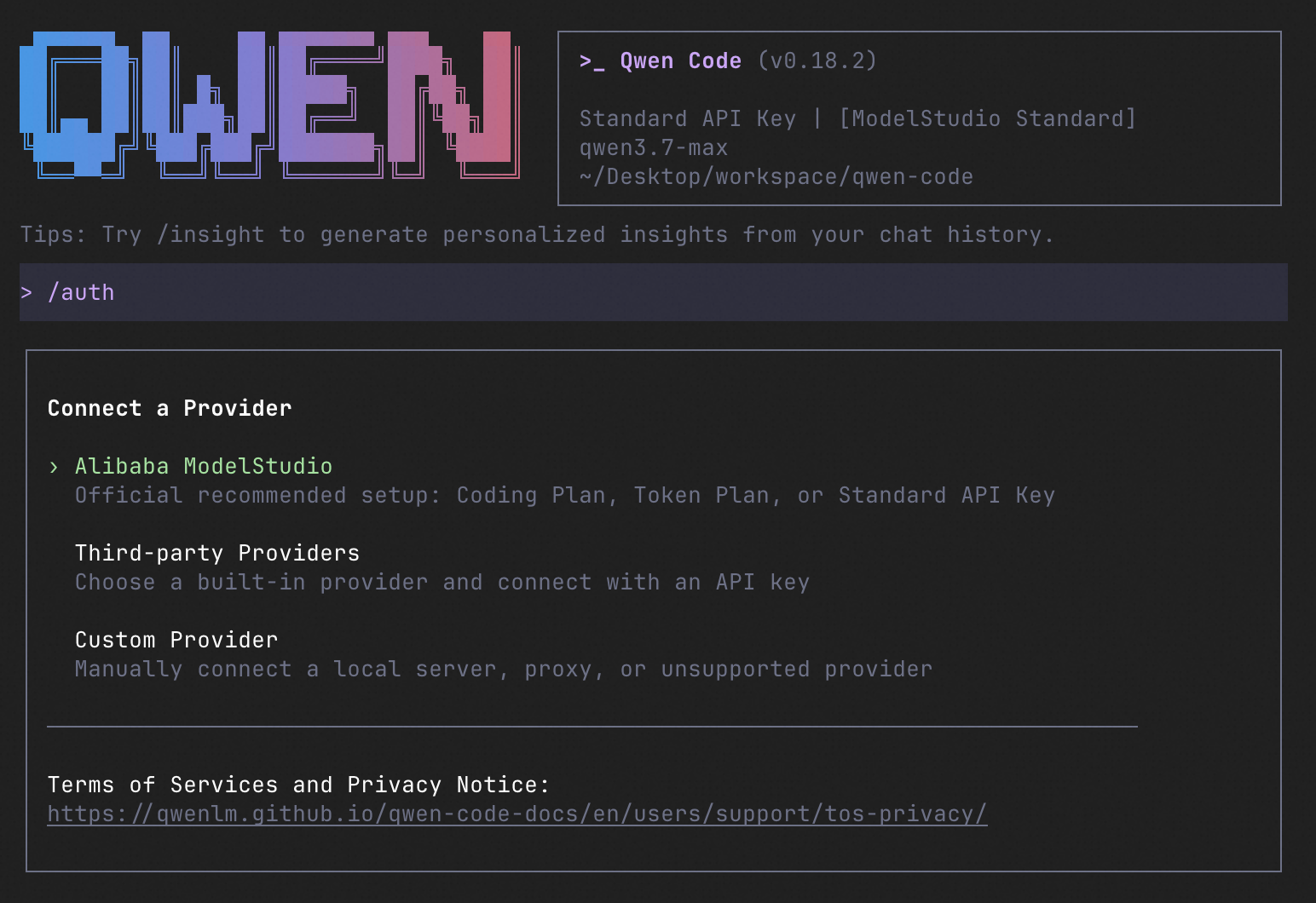
qwen          # Launch interactive terminal UI
# Inside the session:
/auth         # Configure your provider and API key
See the Authentication Guide and Settings Reference for detailed setup.
How to Use Qwen Code
| Mode | Command | Use Case |
|---|---|---|
| Interactive | qwen |
Terminal UI with rich rendering, @file references, slash commands |
| Headless | qwen -p "..." |
Scripts, CI/CD, batch processing — no UI |
| IDE | — | VS Code, Zed, JetBrains |
| Desktop | — | Qwen Code Desktop — GUI for macOS, Windows, Linux |
| Daemon | qwen serve |
Shared agent session over HTTP+SSE (ACP). Multiple clients, one agent. (experimental) Docs |
| SDK | — | TypeScript, Python, Java |
| IM Bot | qwen channel |
Connect to Telegram, DingTalk, WeChat, or Feishu |
SDK example (Python)
import asyncio

from qwen_code_sdk import is_sdk_result_message, query


async def main() -> None:
    result = query(
        "Summarize the repository layout.",
        {
            "cwd": "/path/to/project",
            "path_to_qwen_executable": "qwen",
        },
    )

    async for message in result:
        if is_sdk_result_message(message):
            print(message["result"])


asyncio.run(main())
Capabilities
If you know Claude Code, you already know Qwen Code — and then some. We've put significant effort into bringing Qwen Code to feature parity with Claude Code, improving both breadth and reliability across the board.
| Feature | Qwen Code | Claude Code |
|---|---|---|
| SubAgents, Agent Teams, Dynamic Workflows | ✓ | ✓ |
| Auto-Memory, Auto-Skills, Hooks | ✓ | ✓ |
| Built-in Skills (/review, /batch, /loop, /bugfix…) | ✓ | ✓ |
| MCP, Plan Mode, LSP Integration | ✓ | ✓ |
| Auto Mode, Sandbox, Git Worktrees | ✓ | ✓ |
| Computer Use (desktop automation) | ✓ | ✓ |
| IDE Plugins (VS Code / JetBrains / Zed) | ✓ | ✓ |
| SDK | ✓ | ✓ |
| Headless Mode, Session Management | ✓ | ✓ |
| Open-source — model and framework | ✓ | — |
| Multi-protocol (OpenAI / Anthropic / Gemini / Qwen + any provider) | ✓ | — |
| Agent Arena (multi-model head-to-head on same task) | ✓ | — |
Daemon Mode — qwen serve (multi-client shared agent) |
✓ | — |
| IM Channels (Telegram / DingTalk / WeChat / Feishu) | ✓ | — |
Ecosystem
-
Qwen Code Desktop — Official desktop app for macOS, Windows, and Linux
-
AionUi — A modern GUI for command-line AI tools including Qwen Code
-
Gemini CLI Desktop — A cross-platform desktop/web/mobile UI for Qwen Code
-
🦞 Qwen Code Claw — Let other agents (Claude, Codex, etc.) delegate coding tasks to Qwen Code via ACP. Paste this prompt into your agent:
Use Qwen Code as a coding agent. First, fetch and read this skill reference:
https://raw.githubusercontent.com/QwenLM/qwen-code/refs/heads/main/.qwen/skills/qwen-code-claw/SKILL.md
Then follow the instructions inside to install, authenticate, and use Qwen Code via acpx for all coding tasks.
Contributing
Contributions are welcome! See CONTRIBUTING.md for guidelines.
Acknowledgments
This project was originally based on Google Gemini CLI v0.8.2. We gratefully acknowledge the Gemini CLI team's excellent work. Starting from Qwen Code v0.1, we stopped syncing with upstream and began independent development as a multi-protocol, multi-platform agent framework with deep integrations for Qwen models and beyond.