 0633b8a985
* feat(scheduler): make recurring cron/loop job expiration configurable Recurring cron/loop jobs previously auto-expired after a hardcoded 7 days with no way to extend or disable the limit, forcing long-running daemon deployments to recreate jobs weekly. Add an experimental.cronRecurringMaxAgeDays setting (default 7) and a QWEN_CODE_CRON_MAX_AGE_DAYS environment-variable override (takes precedence, for cloud/container deployments). A value of 0 disables expiry so jobs run until deleted; negative or unparseable values fall back to the 7-day default. The configured limit also applies to durable tasks restored from disk, and the CronCreate tool description now reflects the effective limit instead of a hardcoded '7 days'. Closes #6167 * refactor(scheduler): drop unused DEFAULT_RECURRING_MAX_AGE_MS export Review feedback on #6173 — the ms constant is only used inside the module as the constructor default; keep only the days constant public. * fix(scheduler): align zero max-age semantics and warn on cron expiry misconfiguration Review feedback on #6173: - CronScheduler constructor now maps 0 to Infinity (never expire), matching the config layer instead of silently substituting the 7-day default for direct callers. - Invalid QWEN_CODE_CRON_MAX_AGE_DAYS / cronRecurringMaxAgeDays values now log a warning before falling back to the default, leaving a breadcrumb for misconfigured deployments. - Durable tasks found past the recurring max age at load now log a warning before their final fire + delete, since a lowered max age retroactively expires long-lived tasks and deletion is unrecoverable. - New durable-restore tests: a custom max age applies to tasks reloaded from disk, and a disabled max age (Infinity) restores a 30-day-old task as live instead of aging it out. * fix(scheduler): surface cron expiry warnings on the console Review feedback on #6173: - The invalid-config and retroactive-expiry warnings moved from debugLogger (file-only, off unless QWEN_DEBUG_LOG_FILE is set) to console.warn so they reach container/daemon logs where this knob matters; the config warning is latched to fire once per Config instance. - CronCreateTool's constructor now resolves the max age once instead of three times, so an invalid env var can't emit duplicate warnings during tool registration. * fix(scheduler): reject non-finite timestamps in durable task validation Review feedback on #6173: JSON like -1e999 parses to -Infinity, which passes the typeof-number check and then poisons date math — with a finite lastFiredAt the entry reads as an overdue aged task and the retroactive-expiry warning's toISOString() throws RangeError mid-load, so one malformed persisted entry blocks durable cron startup/takeover. Validation now requires finite createdAt (and lastFiredAt when non-null), routing such entries through the existing fix-or-delete contract for corrupt files. Verified the new end-to-end test reproduces the RangeError without the fix. * refactor(scheduler): single-source the max-age contract and freeze it at Config construction Review follow-ups on #6173: - Extract normalizeRecurringMaxAge as the single owner of the 0/Infinity no-expiry contract, used by both the Config layer and the CronScheduler constructor, so the constructor's 0 handling can no longer be removed as apparent dead code. - Resolve QWEN_CODE_CRON_MAX_AGE_DAYS once at Config construction into a readonly field, honoring the setting's requiresRestart contract; mid-session env changes can no longer make the tool description, tool output, and scheduler report different expiries. The warn once-latch is now unnecessary (construction warns at most once). |
||
|---|---|---|
| .github | ||
| .husky | ||
| .qwen | ||
| .vscode | ||
| docs | ||
| docs-site | ||
| eslint-rules | ||
| integration-tests | ||
| packages | ||
| patches | ||
| scripts | ||
| .dockerignore | ||
| .editorconfig | ||
| .gitattributes | ||
| .gitignore | ||
| .npmrc | ||
| .nvmrc | ||
| .prettierignore | ||
| .prettierrc.json | ||
| .yamllint.yml | ||
| AGENTS.md | ||
| CHANGELOG.md | ||
| CLAUDE.md | ||
| CONTRIBUTING.md | ||
| Dockerfile | ||
| esbuild.config.js | ||
| eslint.config.js | ||
| eslint.legacy-filenames.mjs | ||
| LICENSE | ||
| Makefile | ||
| package-lock.json | ||
| package.json | ||
| README.md | ||
| SECURITY.md | ||
| tsconfig.json | ||
| vitest.config.ts | ||




The open-source AI coding agent that lives in your terminal.
中文 | Deutsch | français | 日本語 | Русский | Português (Brasil)
Why Qwen Code?
- Agentic out of the box — Auto-Memory, Auto-Skills, SubAgents, Agent Teams, and MCP. Dynamic workflows, zero setup.
- Open-source, inside and out — The framework and the Qwen models are open-source. They evolve together. No vendor lock-in.
- Multi-protocol — Supports OpenAI, Anthropic, Gemini, and Qwen APIs. Any third-party provider or local model (Ollama / vLLM). Switch at runtime.
- Beyond the terminal — IDE plugins, Desktop app, daemon mode, SDKs, and IM bots (Telegram / DingTalk / WeChat / Feishu).
Tip
Qwen Code is actively iterating on itself — using its own agent and models to file issues, submit PRs, review code, and run tests. Powered by the community, driven by AI.
Installation
Linux / macOS:
curl -fsSL https://qwen-code-assets.oss-cn-hangzhou.aliyuncs.com/installation/install-qwen-standalone.sh | bash
Windows:
irm https://qwen-code-assets.oss-cn-hangzhou.aliyuncs.com/installation/install-qwen-standalone.ps1 | iex
Restart your terminal after installation to ensure environment variables take effect.
NPM / Homebrew
NPM (requires Node.js 22+):
npm install -g @qwen-code/qwen-code@latest
Homebrew (macOS / Linux):
brew install qwen-code
Quick Start
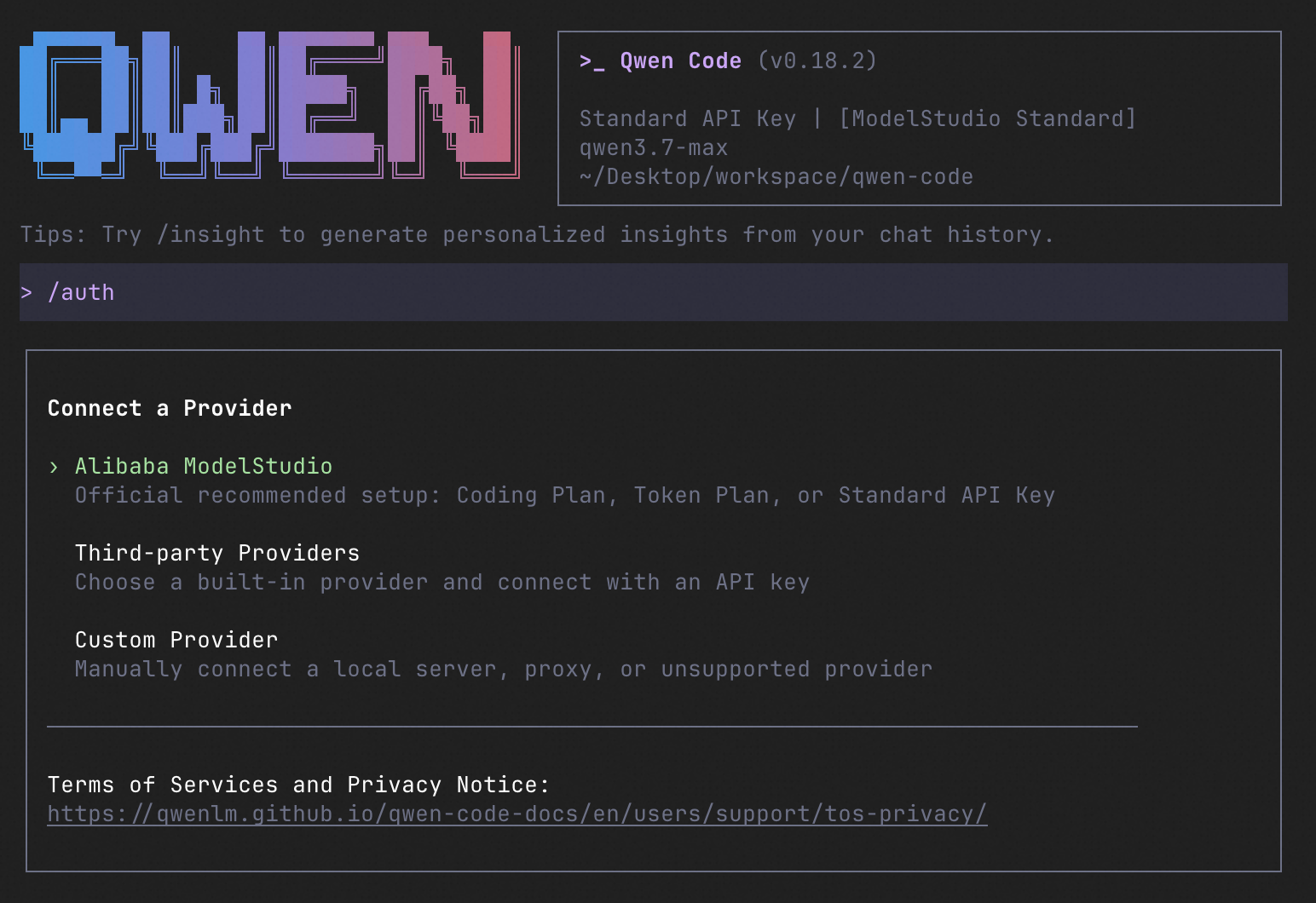
qwen          # Launch interactive terminal UI
# Inside the session:
/auth         # Configure your provider and API key
See the Authentication Guide and Settings Reference for detailed setup.
How to Use Qwen Code
| Mode | Command | Use Case |
|---|---|---|
| Interactive | qwen |
Terminal UI with rich rendering, @file references, slash commands |
| Headless | qwen -p "..." |
Scripts, CI/CD, batch processing — no UI |
| IDE | — | VS Code, Zed, JetBrains |
| Desktop | — | Qwen Code Desktop — GUI for macOS, Windows, Linux |
| Daemon | qwen serve |
Shared agent session over HTTP+SSE (ACP). Multiple clients, one agent. (experimental) Docs |
| SDK | — | TypeScript, Python, Java |
| IM Bot | qwen channel |
Connect to Telegram, DingTalk, WeChat, or Feishu |
SDK example (Python)
import asyncio

from qwen_code_sdk import is_sdk_result_message, query


async def main() -> None:
    result = query(
        "Summarize the repository layout.",
        {
            "cwd": "/path/to/project",
            "path_to_qwen_executable": "qwen",
        },
    )

    async for message in result:
        if is_sdk_result_message(message):
            print(message["result"])


asyncio.run(main())
Capabilities
If you know Claude Code, you already know Qwen Code — and then some. We've put significant effort into bringing Qwen Code to feature parity with Claude Code, improving both breadth and reliability across the board.
| Feature | Qwen Code | Claude Code |
|---|---|---|
| SubAgents, Agent Teams, Dynamic Workflows | ✓ | ✓ |
| Auto-Memory, Auto-Skills, Hooks | ✓ | ✓ |
| Built-in Skills (/review, /batch, /loop, /bugfix…) | ✓ | ✓ |
| MCP, Plan Mode, LSP Integration | ✓ | ✓ |
| Auto Mode, Sandbox, Git Worktrees | ✓ | ✓ |
| Computer Use (desktop automation) | ✓ | ✓ |
| IDE Plugins (VS Code / JetBrains / Zed) | ✓ | ✓ |
| SDK | ✓ | ✓ |
| Headless Mode, Session Management | ✓ | ✓ |
| Open-source — model and framework | ✓ | — |
| Multi-protocol (OpenAI / Anthropic / Gemini / Qwen + any provider) | ✓ | — |
| Agent Arena (multi-model head-to-head on same task) | ✓ | — |
Daemon Mode — qwen serve (multi-client shared agent) |
✓ | — |
| IM Channels (Telegram / DingTalk / WeChat / Feishu) | ✓ | — |
Ecosystem
-
Qwen Code Desktop — Official desktop app for macOS, Windows, and Linux
-
AionUi — A modern GUI for command-line AI tools including Qwen Code
-
Gemini CLI Desktop — A cross-platform desktop/web/mobile UI for Qwen Code
-
🦞 Qwen Code Claw — Let other agents (Claude, Codex, etc.) delegate coding tasks to Qwen Code via ACP. Paste this prompt into your agent:
Use Qwen Code as a coding agent. First, fetch and read this skill reference:
https://raw.githubusercontent.com/QwenLM/qwen-code/refs/heads/main/.qwen/skills/qwen-code-claw/SKILL.md
Then follow the instructions inside to install, authenticate, and use Qwen Code via acpx for all coding tasks.
Contributing
Contributions are welcome! See CONTRIBUTING.md for guidelines.
Acknowledgments
This project was originally based on Google Gemini CLI v0.8.2. We gratefully acknowledge the Gemini CLI team's excellent work. Starting from Qwen Code v0.1, we stopped syncing with upstream and began independent development as a multi-protocol, multi-platform agent framework with deep integrations for Qwen models and beyond.